
A campaign may meet its lead target through content syndication but end up generating only a few sales meetings. This often points to gaps in audience targeting, qualification or sales follow-up. But a low meeting rate can also reflect how the team defines and tracks a meeting.
The content syndication lead-to-meeting conversion rate helps marketers assess whether campaign leads progress towards meaningful sales conversations. Improving it requires a clear measurement method, reliable CRM data and coordinated decisions between marketing and sales.
What Is Content Syndication Lead-to-Meeting Conversion Rate?
The lead-to-meeting conversion rate measures the percentage of eligible leads generated through syndicated content that book a sales meeting within a defined observation period. Teams can also measure how many leads attend a meeting and how many reach a qualified meeting.
Content syndication distributes assets such as reports, white papers and webinars through third-party publishers. While these assets attract potential buyers, a download alone does not establish purchase intent. This is why meeting conversion should be measured separately from lead volume and general campaign engagement.
Why Lead Volume Does Not Guarantee Meetings
High lead volume can hide gaps in campaign performance. Contacts may fall outside the ideal customer profile (ICP), lack buying influence or download content for general research. Even suitable prospects may not book a meeting if they are approached too early or without enough context.
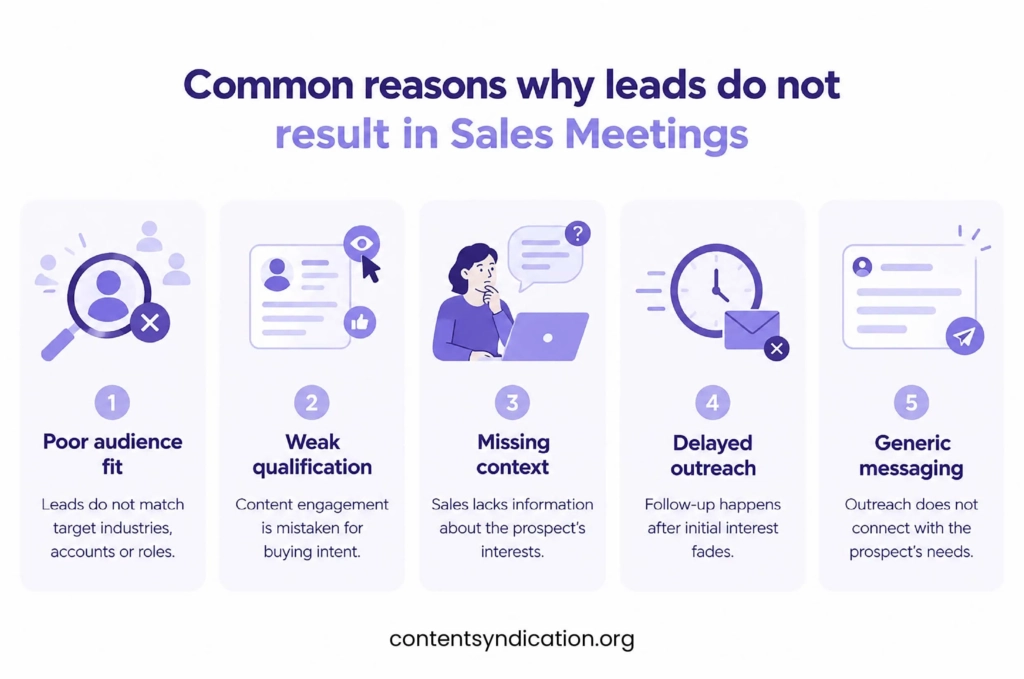
For a broader explanation of targeting and nurture problems, see our guide to why content syndication leads do not convert
How to Calculate Lead-to-Meeting Conversion Rate
Use a consistent denominator and count unique leads rather than treating repeated bookings by the same person as separate lead conversions.
Booked meeting conversion rate = (Unique eligible leads who booked at least one meeting ÷ Total unique eligible leads delivered) × 100
Held meeting conversion rate = (Unique eligible leads who attended at least one meeting ÷ Total unique eligible leads delivered) × 100
Qualified held meeting conversion rate = (Unique eligible leads who attended a meeting meeting agreed qualification criteria ÷ Total unique eligible leads delivered) × 100
A booked meeting measures scheduling activity. A held meeting confirms attendance. A qualified held meeting indicates that the conversation met agreed standards for fit and purpose. These rates should be reported separately, using the same original lead cohort and observation window.
If your team also counts total meeting events, report those separately. One lead may attend multiple meetings, and one meeting may include several leads. Mixing events with unique lead counts can distort the rates.
For the wider campaign scorecard, refer to our overview of content syndication metrics
Lead-to-Meeting Conversion Example: From 500 Leads to Held Meetings
Consider a hypothetical content syndication campaign that delivers 500 eligible, deduplicated leads. Sales accepts 300, 25 unique leads book a meeting, 20 attend and 15 attend a meeting that meets the team’s qualification criteria.
| Funnel stage | Unique leads | Calculation / rate |
|---|---|---|
| Eligible leads delivered | 500 | Starting cohort |
| Accepted by sales | 300 | 300 ÷ 500 = 60% |
| Booked a meeting | 25 | 25 ÷ 500 = 5% |
| Attended a meeting | 20 | 20 ÷ 500 = 4% |
| Held a qualified meeting | 15 | 15 ÷ 500 = 3% |
A second view helps diagnose what happens after acceptance: 25 ÷ 300 = 8.3% of sales-accepted leads booked a meeting. Of the leads who booked, 20 ÷ 25 = 80% attended. Of the leads who attended, 15 ÷ 20 = 75% reached a qualified meeting. These step-to-step rates help locate friction, but they are not substitutes for the overall cohort conversion rates.
These figures are illustrative, not an industry benchmark or a report of actual campaign results.
[OPTIONAL DATA VISUAL: A five-stage funnel showing 500 → 300 → 25 → 20 → 15. Use the same figures and clearly label them as illustrative.]
How Sales Acceptance Affects Meeting Conversion
Before evaluating bookings, establish whether sales considers the leads worth pursuing. Sales acceptance rate measures the share of delivered eligible leads accepted for follow-up under agreed criteria.
Low acceptance may indicate targeting, data quality or qualification problems. High acceptance but few meetings may point to messaging, ownership, outreach timing or a mismatch between the content topic and the proposed meeting.
Record rejection reasons such as poor account fit, irrelevant roles or incomplete information. Keep accepted, rejected and recycled leads visible in the reporting funnel rather than quietly removing them from the denominator after delivery.
For the broader measurement approach, see how to measure B2B content syndication success
How to Measure Meeting Conversion Accurately in Your CRM
The most useful meeting rate is one the team can reproduce next month. Set up the following rules before comparing publishers or campaigns:
• Campaign identity: record the original syndication campaign, publisher or source, asset and delivery date for each lead.
• Deduplication: use a stable CRM lead or contact identifier and define how repeat submissions, merged records and multiple campaign touches will be handled.
• Eligibility: record validity, territory, ICP and other agreed criteria at delivery. Exclude only records covered by a documented, consistent eligibility rule, not leads that later fail to book.
• Lifecycle timestamps: retain delivery, sales acceptance, first outreach, booking, scheduled meeting date, actual attendance and qualification dates.
• Meeting outcome: define booked, held, cancelled, no-show, rescheduled and qualified meeting statuses, with a clear policy for reschedules.
• Attribution: report campaign-sourced meeting outcomes separately from campaign-influenced outcomes. A prospect who engaged with several programs must not be counted as a new unique person in every total.
• Observation window: use a fixed period, such as 60 or 90 days after lead delivery, appropriate to your sales cycle. Treat young cohorts as incomplete until their window closes.
Use cohorts based on lead-delivery month rather than grouping every meeting by booking month alone. That helps prevent late-booking meetings from making newer campaigns look stronger than older ones. CRM reports should be checked against meeting calendars and sales disposition fields so a booked slot is not mistakenly reported as a held meeting.
Factors That Influence Meeting Conversion
Several factors shape whether syndicated leads become sales conversations: audience fit, content relevance, qualification, outreach timing, buyer-stage messaging and clear process ownership. The most useful question is not whether each factor matters, but which one explains the actual drop in your campaign funnel.
Improve Lead Qualification Before Delivery
Qualification should establish whether a lead is relevant, not simply whether someone completed a form. Review account fit, buying-role relevance, content topic and the completeness of the information passed to sales.
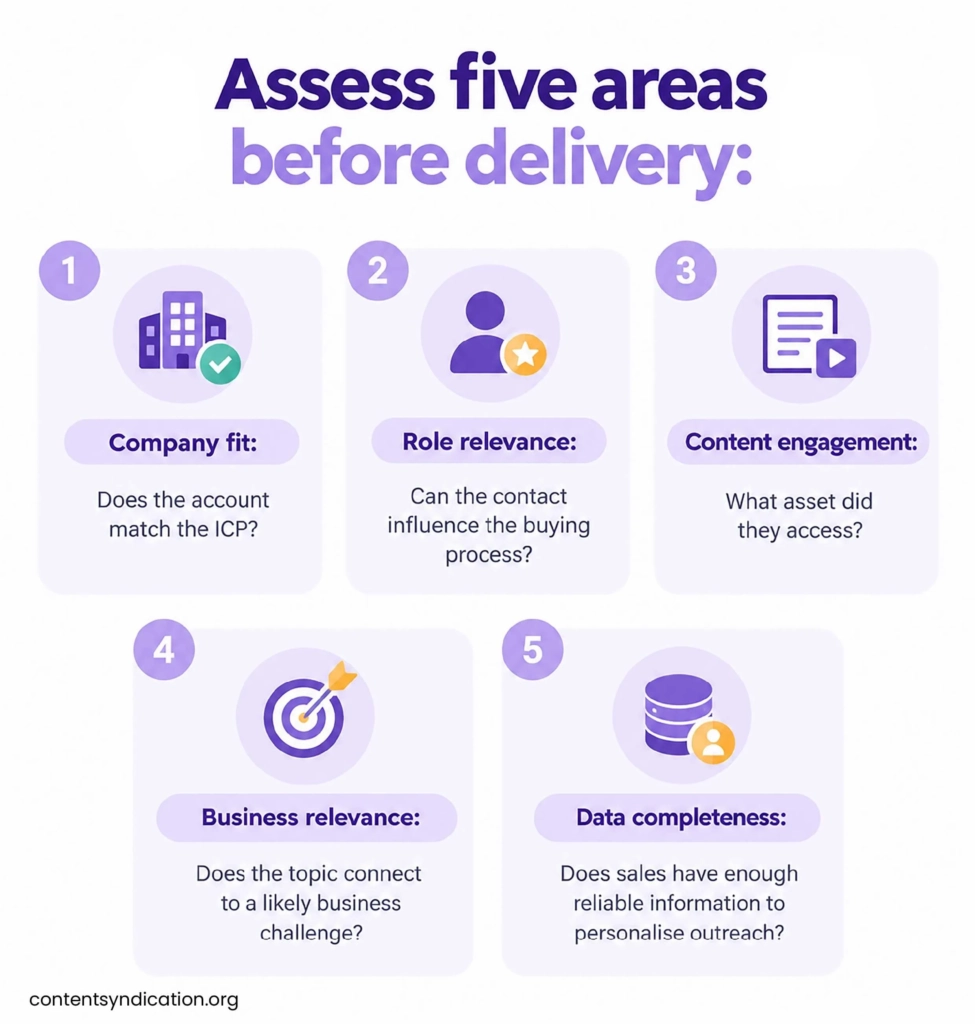
For examples of questions that can strengthen lead data, see our guide to custom qualification questions for content syndication
How Response Time Affects Meeting Bookings
Delays can weaken engagement, particularly when prospects have expressed direct interest. Set response windows according to intent. A demo request may require faster outreach than an educational content download.
Define who owns each lead, when the response clock starts and how overdue leads are escalated. In the CRM, track both time to first outreach attempt and time to first meaningful exchange. Compare those measures with booked and held meeting rates, rather than assuming faster outreach automatically produces better outcomes.
Use Content Context in SDR Follow-Up
Sales development representatives (SDRs) need more than contact details. Provide the asset accessed, campaign source, prospect role and relevant account information. For example, someone downloading a pipeline forecasting report could receive a question about how their team approaches forecasting and which challenges they face.
Effective follow-up uses the content interaction to establish relevance without assuming the prospect is actively evaluating vendors. Keep the outreach matched to buyer stage, and measure the outcome instead of judging success by activity volume.
For the full post-download sequence, use the existing content syndication lead nurture plan
Segment Conversion Rates by Source, Persona and Account Fit
An overall conversion figure can hide meaningful differences. Segment completed lead cohorts by syndication partner, persona, account fit, asset or topic, and outreach approach. A source generating fewer leads may still deliver a higher share of held, qualified meetings.
For example, compare a publisher’s 90-day eligible-lead cohort with another publisher’s cohort over the same period and using the same definitions. Review both rate and sample size. Five qualified meetings from 50 leads is a 10% rate, while 15 from 500 is 3%; the higher rate does not by itself establish which source produced better revenue or represented a repeatable result.
Avoid combining early-stage educational leads and explicit demo requests into one benchmark. They begin at different levels of buyer intent.
Why Syndicated Leads Fail to Convert Into Meetings
Identify where progress slows before changing campaign strategy. The table below links observable symptoms to measurements and first investigations.
| Observed problem | Metric to review | What to investigate |
|---|---|---|
| Many leads rejected by sales | Sales acceptance rate | Check ICP filters, role fit and record quality |
| Accepted leads rarely book | Accepted-to-booked rate | Review ownership, message relevance and outreach |
| Bookings often cancelled or missed | Booked-to-held attendance rate | Review timing, meeting value and confirmation process |
| Held meetings seldom qualify | Held-to-qualified rate | Review buying influence, expectations and qualification criteria |
| One publisher trails others | Qualified held rate by source | Compare matched cohorts, assets and personas |
| Strong rate but very few meetings | Rate and absolute meeting count | Check sample size before reallocating budget |
Use CRM data and sales feedback to validate the cause. Low conversion does not automatically mean the publisher delivered poor leads. It may reflect a mismatch between audience intent and follow-up or an inconsistent reporting rule.
Metrics to Track Beyond Meeting Bookings
Meeting bookings matter, but they do not show the full commercial impact of a campaign. Track sales acceptance, booked meeting rate, held meeting rate, qualified held rate, meeting attendance rate, opportunity creation and cost per meeting alongside the original lead count.
Cost per booked meeting = Attributable campaign spend ÷ Number of booked meetings. Cost per held meeting = Attributable campaign spend ÷ Number of held meetings. Use meeting events for these cost metrics if that is how your reporting model works, and state the counting method explicitly. Never compare one partner’s cost per booked meeting with another’s cost per held meeting.
To evaluate downstream efficiency, monitor cost per qualified held meeting and lead-to-opportunity conversion as well. Connect the results to campaign costs and pipeline outcomes using consistent attribution rules.
If you are reviewing the commercial impact of a campaign, our content syndication ROI calculator
Frequently Asked Questions
1. What is a good content syndication lead-to-meeting conversion rate?
There is no universal benchmark for every B2B syndication campaign. Results depend on the audience, asset, qualification requirements, sales process and measurement window. Build a baseline from comparable campaigns with the same booked and held meeting definitions.
2. Should booked meetings and held meetings be reported separately?
Yes. Booking reflects scheduling, while attendance confirms that a meeting took place. Track qualified held meetings separately to show whether those conversations met agreed criteria.
3. How long should a content syndication lead stay in the reporting cohort?
Use an observation window that fits the sales cycle, then apply it consistently. Reporting a 90-day result for a lead delivered last week would be misleading. Mark cohorts as incomplete until their window has elapsed.
4. Why might a publisher deliver many leads but few qualified meetings?
Possible causes include weak account fit, educational rather than purchase intent, inconsistent qualification, poor sales context or a follow-up process that does not match the content interaction. Compare acceptance, booking, attendance and qualification rates to determine where the gap begins.
Turn Content Syndication Leads Into Meaningful Sales Conversations
The content syndication lead-to-meeting conversion rate connects campaign activity to real sales conversations. Improving it starts with reliable measurement, relevant audiences, clear qualification and follow-up informed by the content a prospect engaged with.
When marketing and sales can see where conversion slows, they can make targeted improvements rather than relying on lead volume alone.
Improve the Quality of Your Content Syndication Pipeline
If your campaigns generate leads but few qualified sales conversations, review the audience definition, acceptance rules and booked-to-held meeting progression before increasing your budget. Explore campaign approaches and vendor-selection criteria that align qualification with measurable outcomes. Compare the options in our B2B content syndication vendor evaluation guide