

Not every person who downloads your report, reads your guide, or clicks through your syndication blog is ready to talk to sales.
A list of hundreds of contacts can look impressive in a campaign report. But volume alone does not tell you whether those contacts match your target accounts or have real buying intent.
The smarter question to ask is: what signals tell us that a contact is worth a conversation?
A strong content syndication lead scoring model helps answer it.
That is where scoring becomes useful. Instead of treating every new contact as equally valuable, you can look at three things together: who the person is, what they seem to need, and how they interact with your content.
A good content syndication lead scoring approach helps your team make better decisions with the information available.
What Is Content Syndication Lead Scoring?
At its simplest, content syndication lead scoring means assigning value to the signals collected from a syndicated lead and using those values to prioritize follow-up.
Think of it as a filter, not a verdict.
A contact might earn points for matching your ideal customer profile, engaging with several assets, coming from a relevant company, or showing behaviors associated with active research. Another contact may download the same asset but have little connection to your target market.
A useful content syndication lead scoring framework combines data rather than relying on one action.
Why Content Syndication Lead Scoring Matters
Without scoring, sales teams often face one of two problems.
- Lead overload: Marketing sends every contact to sales, and reps spend time sorting through people who are unlikely to convert.
- Missed opportunity: A genuinely promising lead gets ignored because it gets buried under hundreds of low-intent contacts.
Scoring creates a shared language between marketing and sales. It can make lead qualification more consistent, improve lead routing, and help teams focus on sales readiness instead of raw lead counts.
More importantly, it shifts the conversation from “How many leads did we generate?” to “Which leads show enough evidence to act on?”
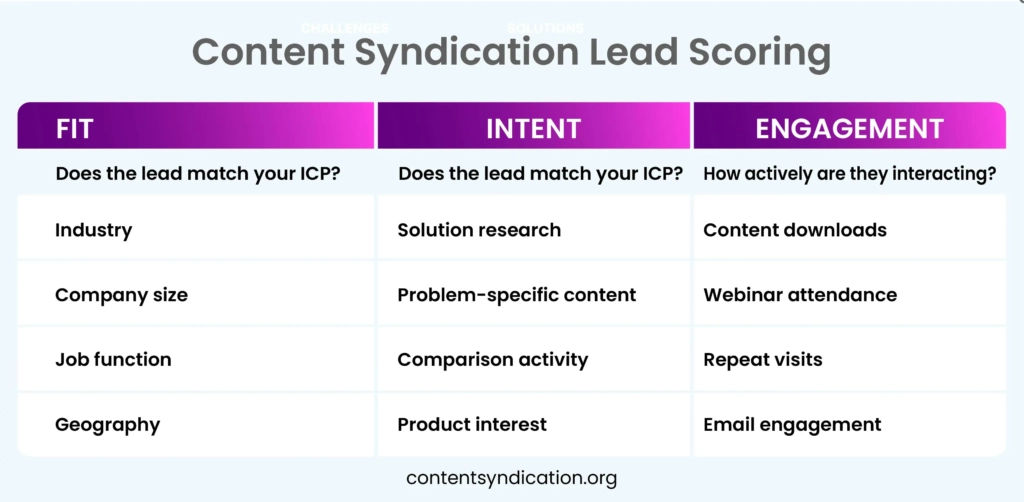
Fit score
Fit answers one basic question: does this person or account look like someone we can realistically help?
Start with firmographic fit. Company size, industry, geography, revenue range, technology environment, and job function can all matter depending on your business model.
Then look at ICP fit. A senior decision-maker at a company that closely resembles your best customers may deserve a higher baseline score than a student, consultant, or unrelated professional, even if both downloaded the same asset.
Fit scoring helps you capture that difference.
Intent score
Intent is about what a prospect’s actions suggest they may be trying to solve.
This is where intent signals become useful. A single content download may show curiosity. Multiple interactions around the same problem can suggest something stronger.
Look for behaviors such as researching a specific solution category, consuming comparison content, returning to product-related pages, or engaging with assets that sit further down the buying journey.
The important thing is not to confuse activity with intent. Ten clicks on unrelated articles may be less meaningful than two interactions that clearly connect to a business problem your product solves.
Engagement score
Engagement scoring measures how actively someone interacts with your brand and content.
Downloads, repeat visits, webinar attendance, email interactions, page views, and time spent with certain resources can all contribute. But the quality of the action matters.
Behavioral signals also need context. Someone can be highly active because they are researching for work, but they could also be a student, competitor, or existing customer. That is why engagement should rarely stand alone.
How to Combine Fit, Intent and Engagement Scores
Think of it as:
Overall score = Fit + Intent + Engagement
You can weight each category differently. If your sales cycle depends heavily on account quality, fit may carry the most weight. If buyers usually conduct extensive research before contacting sales, intent and engagement may deserve more influence.
This is the core idea behind fit intent engagement lead scoring: no single signal tells the full story.
A lead with high engagement but poor fit should not automatically jump to the top. Likewise, a perfect-fit account with almost no meaningful activity may need nurturing rather than immediate outreach.
Content Syndication Lead Scoring Example
Here is a simple starting point:
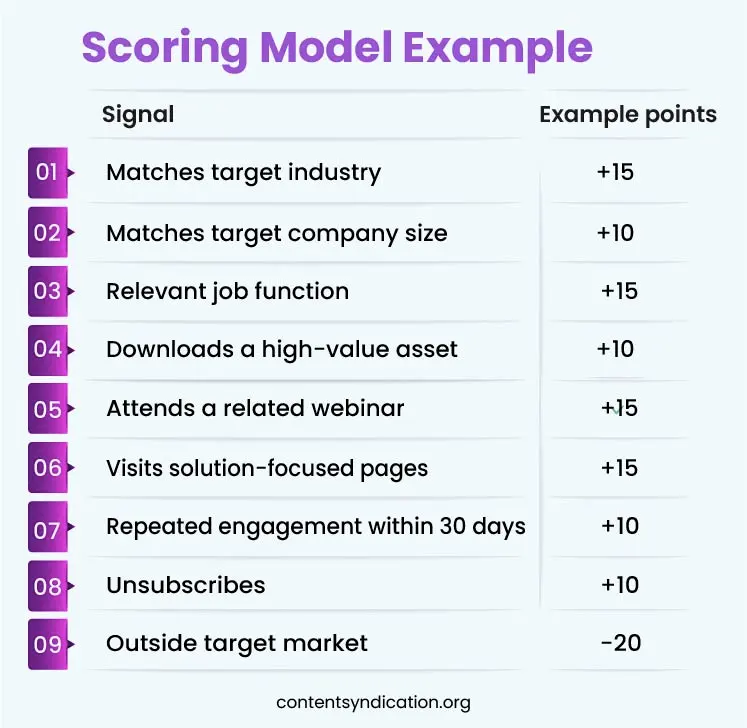
If a lead reaches 60 points, perhaps marketing-qualified follow-up makes sense. At 80, sales may review it. But thresholds should come from your own conversion data, not an arbitrary benchmark.
That is also the practical answer to how to score content syndication leads: define meaningful signals, assign sensible weights, test the model, and keep refining it.
Lead routing and nurture decisions
Scoring only creates value when it changes what happens next.
- High-fit, high-intent leads can move into a faster sales follow-up path.
- Strong-fit leads with lower engagement may enter a nurture sequence built around their likely needs.
- Low-fit leads can be deprioritized or excluded.
This is where lead routing becomes critical.
Your CRM and marketing automation should make the next action clear. Who owns the lead? How quickly should they respond? What information should the rep see? What happens if the lead does not respond?
The goal is to make the move from a useful signal to a useful action as clear as possible.
Common mistakes
The biggest mistake is treating every interaction as equally valuable.
A second mistake is making the model too complicated. If nobody understands why a lead scored highly, sales will not trust the system.
Another problem is ignoring negative signals. Job changes, irrelevant industries, invalid data, unsubscribes, and prolonged inactivity can all reduce confidence.
Do not set the scoring model once and forget it. Buyer behavior changes. Campaign sources behave differently. And your ideal customer profile may evolve.
Metrics to monitor
Start with metrics that connect scoring to business results. Monitor:
- Percentage of scored leads that become qualified opportunities
- Conversion rates by score range
- Sales acceptance rates
- Time to first follow-up
- Pipeline generated from syndicated leads
- Account engagement across target accounts
It is also useful to compare scores against outcomes. Are leads above 70 points actually converting better than leads below 40? Are high-engagement contacts producing revenue, or just activity?
FAQs
1. How often should a scoring model be updated?
Review it regularly, especially after major changes to your audience, product, or sales process. Quarterly reviews are a practical starting point.
2. Should content downloads always increase a score?
Not necessarily. A download is a useful signal, but its value depends on the asset, the person, and the other behaviors around it.
3. How to identify sales-ready syndication leads?
Look for a combination of strong account fit, relevant intent, and recent meaningful engagement. No single action should decide whether someone is ready for sales.
4. Should marketing and sales use the same score?
They should work from the same underlying model, but different teams may use different thresholds or actions based on their responsibilities.
Rethink the signals behind scoring models
Content syndication works best when lead volume is only the beginning.
The real advantage comes from understanding which contacts matter, why they matter, and what your team should do next. A thoughtful content syndication lead scoring model turns scattered activity into a clearer picture of buyer interest.
If your team is generating syndicated leads but struggling to prioritize them, it may be time to rethink the signals behind your scoring model.
Start with fit. Add intent. Measure engagement. Then let real pipeline data tell you what deserves more weight.
Need help improving the quality of your syndicated leads? ContentSyndication.org can help you build campaigns around ICP fit, engagement, and qualification signals so your sales team can focus on the right opportunities. Request a campaign plan.