
Most B2B buyers do not convert after a single interaction. They move through multiple touchpoints, consume content, compare solutions, research vendors, and involve several stakeholders before they are ready to speak with sales.
This is why content syndication and programmatic advertising work so well together.
Content syndication helps brands place relevant assets in front of targeted buyers and capture engagement signals. Programmatic advertising reinforces that engagement by keeping the brand visible across digital environments throughout the buying journey.
When coordinated correctly, the two channels can help B2B marketers build familiarity, strengthen buying intent, reach more members of the buying committee, and prepare target accounts for sales engagement.
A structured account-warming strategy brings these activities together.
This 30-day playbook explains how to use content syndication and programmatic advertising to move target accounts from awareness to trust, evaluation, and ultimately conversion.
Why Content Syndication and Programmatic Advertising Work Better Together
B2B attention is fragmented.
A prospect may download a report today, research your category several days later, visit your website the following week, and only then begin evaluating vendors.
A single interaction rarely creates pipeline.
Content syndication helps solve the discovery problem by distributing relevant gated assets to targeted, in-market audiences.
Programmatic advertising solves a different problem: maintaining visibility.
Once a prospect or account has engaged with your content, display advertising can reinforce your positioning across subsequent digital touchpoints.
Together, these channels create a continuous engagement loop.
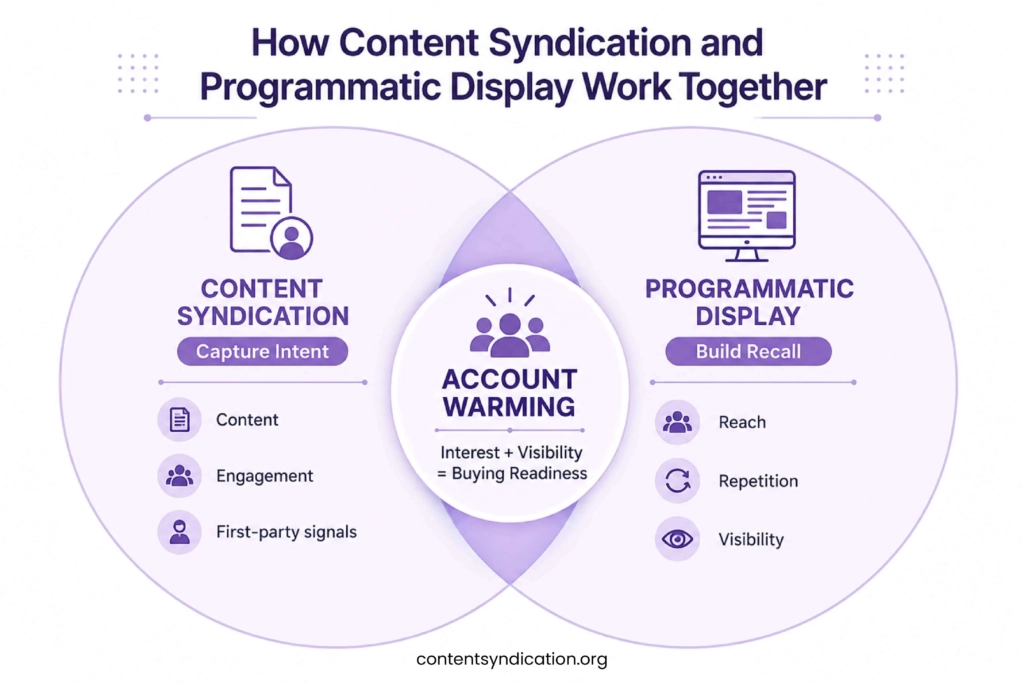
Content syndication captures interest. Programmatic advertising builds recall.
Syndication can generate engagement and first-party signals, while display extends those signals across the broader account and buying committee.
The result is a more structured path from anonymous interest to active evaluation.
What Is an Account-Warming Campaign?
An account-warming campaign is a structured, time-bound engagement strategy designed to increase familiarity and buying intent within target accounts before direct sales outreach.
Instead of immediately pushing prospects toward a demo, the goal is to progressively expose them to relevant information across multiple touchpoints.
Content syndication can introduce educational assets and capture engagement.
Programmatic advertising can then reinforce those messages through repeated, targeted exposure.
By the time sales reaches out, the target account should ideally:
- Recognize the brand
- Understand the problem the company solves
- Have engaged with relevant content
- Be familiar with the value proposition
- Show stronger behavioral intent
This approach can be particularly useful in account-based marketing environments, where B2B buying decisions involve multiple stakeholders.
Rather than focusing only on individual lead volume, account warming focuses on building readiness across the account.
How to Build the Target Account Audience
Audience definition is one of the most important components of an account-warming strategy.
Without precise targeting, even a well-designed campaign can generate activity without generating meaningful pipeline.
Start by defining three targeting layers.
ICP Criteria
Identify the firmographic characteristics of your ideal accounts, including:
- Industry
- Company revenue
- Employee size
- Geography
- Business model
- Growth stage
Technographic Signals
Consider the technologies, platforms, and infrastructure already used by the target company.
Technographic data can help indicate whether an account is technically suitable for your solution and whether it is likely to have the infrastructure required to adopt it.
Intent Signals
Look for signals that indicate active research or growing interest.
These may include:
- Content engagement
- Category research
- Website visits
- Search behavior
- Topic consumption
- Repeat interactions
Once the target account universe is defined, divide those accounts into activation segments.
Programmatic display for B2B can then help reach relevant stakeholders across different digital environments.
Segmentation should also consider buying committee roles.
A CFO may care about financial impact and ROI.
A technical evaluator may care about integrations, implementation, and performance.
A business user may care about usability and operational outcomes.
The combination of content syndication and programmatic advertising allows marketers to create different messages for each stakeholder while maintaining a consistent account-level narrative.
The 30-Day Account-Warming Framework
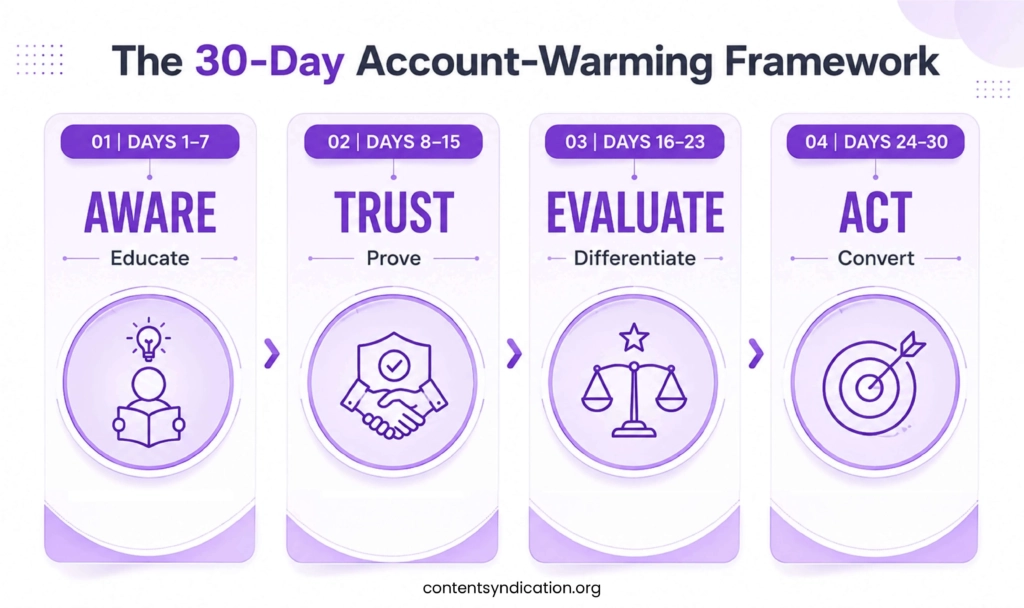
The campaign can be divided into four stages:
Days 1–7: Awareness
Educate the account.
Days 8–15: Trust
Prove credibility.
Days 16–23: Evaluation
Differentiate your solution.
Days 24–30: Action
Convert engagement into a sales conversation.
Each phase should build on the engagement created during the previous stage.
Days 1–7: Educational Awareness
The first week should focus on education and problem framing.
The objective is not immediate conversion.
The objective is recognition.
During this stage, content syndication and programmatic advertising can work together to introduce important category-level ideas.
Content syndication may distribute assets such as:
- Industry reports
- Research studies
- Educational guides
- Benchmark reports
- Whitepapers
- Best-practice content
Programmatic advertising can reinforce the major themes from those assets through consistent exposure.
This is also where B2B ad sequencing begins.
Early ads should focus on the buyer’s challenges, industry changes, emerging trends, and educational insights rather than aggressive product promotion.
The goal is to establish relevance without creating pressure.
By the end of the first phase, target accounts should begin associating your brand with a particular business problem or category.
Prioritize ICP reach and meaningful engagement rather than aggressive conversion.
Days 8–15: Proof, Case Studies, and Credibility
Once awareness has been established, the next stage should focus on trust.
Prospects now need evidence that your company can actually deliver the outcomes it promises.
Shift the content mix toward proof-based assets such as:
- Customer case studies
- Benchmark reports
- Client success stories
- Industry research
- Performance data
- Testimonials
This stage can also incorporate content syndication retargeting.
Prospects who engaged with an initial educational asset can be exposed to deeper proof points through additional content and programmatic display.
The buyer’s question begins to change.
During the awareness phase, the question is:
“What is this?”
During the credibility phase, it becomes:
“Does this work for a company like mine?”
Consistent exposure to credible evidence can reduce perceived risk and build trust across multiple members of the buying committee.
Days 16–23: Comparison and ROI Messaging
The next phase is evaluation.
At this stage, prospects may already understand the problem and recognize your brand. Now they are more likely to compare approaches, solutions, and vendors.
Content syndication and programmatic advertising should therefore shift toward differentiation.
Useful content may include:
- ROI frameworks
- Comparison guides
- Buyer’s guides
- Analyst research
- Cost calculators
- Implementation guides
- Business-case templates
Messaging should explain why your approach is different and how it creates measurable business value.
Display retargeting can also become more focused during this phase.
Accounts that have demonstrated stronger engagement can receive ads aligned with their previous content interactions.
The objective is not simply to explain your category.
It is to help buyers build confidence in their evaluation.
Good evaluation-stage content also helps internal champions justify the investment to other members of the buying committee.
Days 24–30: Demo or Consultation CTA
The final stage focuses on conversion.
By this point, the target account should have experienced several relevant touchpoints across content and advertising.
Now the messaging can become more action-oriented.
Potential CTAs include:
- Request a demo
- Book a consultation
- Get a campaign estimate
- Request a custom plan
- Speak with an expert
- Calculate potential ROI
This is where display retargeting of engaged syndication leads can become particularly valuable.
Prospects who interacted with previous content can be re-engaged with conversion-focused advertising designed to encourage a sales conversation.
The CTA should remain simple and relevant to the prospect’s previous engagement.
Content syndication and programmatic advertising should also be coordinated closely with sales outreach during this phase.
Timing matters.
Sales should engage when behavioral signals indicate increased interest rather than simply contacting every lead immediately after a download.
Frequency Caps, Creative Variation, and Sales Timing
The quality of execution determines whether an account-warming campaign generates meaningful pipeline.
Three areas deserve particular attention.
Frequency Management
Repeated visibility can improve recall, but excessive repetition can create ad fatigue.
Too little exposure can make the campaign forgettable.
Use frequency controls to maintain consistent visibility without overwhelming the audience.
Creative Variation
The message should evolve throughout the 30-day campaign.
Do not show the same advertisement for an entire month.
Instead, align creative with the buyer’s progression:
Awareness → Credibility → Evaluation → Action
Account-based advertising can support this progression by keeping messages consistent across channels while adapting them to account behavior.
Sales Timing
Sales outreach should align with engagement.
Contacting an account too early may reduce effectiveness because the buyer has not yet developed enough familiarity or intent.
Waiting too long may allow the opportunity to lose momentum.
When content syndication and programmatic advertising are synchronized with sales activity, sales teams can engage accounts that are better informed and more familiar with the brand.
KPIs to Measure Pipeline Influence
Account-warming campaigns should not be evaluated only on lead volume.
The more important question is whether target accounts are progressing toward meaningful sales engagement.
Useful KPIs include:
- Account engagement rate
- Content downloads and completion
- Repeat website visits
- Buying committee engagement
- Meeting conversion rate
- Sales acceptance rate
- Pipeline influenced
- Time from first engagement to sales interaction
- Opportunity creation rate
- Branded search growth
- Direct website traffic
A well-structured 30-day B2B account-warming strategy should measure how engagement develops across the entire campaign.
The objective is not simply to generate activity.
It is to move accounts efficiently from awareness to opportunity.
Plan an Integrated Content Syndication Campaign
Modern B2B demand generation cannot rely on isolated channels.
It requires orchestration.
Content syndication can help identify and engage relevant buyers.
Programmatic advertising can reinforce those interactions and maintain visibility across the account.
Sales can then engage when those signals indicate increasing readiness.
When these activities operate as one coordinated system, every interaction can build on the previous one.
That is the real advantage of combining content syndication and programmatic advertising: instead of generating isolated leads, marketers can create a structured journey that warms target accounts and moves them closer to a buying decision.
If your goal is to increase account penetration, strengthen buying intent, and generate more sales-ready opportunities, build your campaign around account behavior and let each touchpoint move the buyer closer to action.
Frequently Asked Questions
What is content syndication and programmatic advertising?
Content syndication distributes gated B2B content to targeted audiences to generate engagement and intent signals. Programmatic advertising uses automated ad buying to keep those audiences and accounts exposed to relevant brand messages across digital channels. Used together, they can support awareness, account warming, and pipeline generation.
How do content syndication and programmatic advertising work together?
Content syndication helps identify and engage prospects through assets such as reports, guides, and whitepapers. Programmatic advertising can then reinforce those interactions through targeted display ads, helping maintain visibility as buyers continue researching and evaluating solutions.
What is an account-warming campaign?
An account-warming campaign is a structured strategy designed to increase familiarity and buying intent within target accounts before direct sales outreach. It uses multiple touchpoints over time so prospects recognize the brand, understand its value proposition, and demonstrate engagement before sales contacts them.
How long should a B2B account-warming campaign run?
A 30-day account-warming campaign can be divided into four stages: awareness during Days 1–7, credibility during Days 8–15, evaluation during Days 16–23, and conversion during Days 24–30. The exact duration can vary depending on the sales cycle, audience, and level of account engagement.
What content should be used in an account-warming campaign?
Early-stage campaigns can use educational reports, guides, industry research, and benchmark content. As accounts become more engaged, marketers can introduce case studies, customer success stories, ROI calculators, comparison guides, analyst insights, and eventually demo or consultation offers.
Can programmatic advertising retarget content syndication leads?
Yes. Prospects who engage with syndicated content can be included in relevant retargeting audiences where appropriate and permitted. Programmatic display can then reinforce educational, proof-based, ROI, or conversion messages based on the prospect’s stage in the buying journey.
What are the main benefits of combining content syndication with programmatic advertising?
The combination can improve brand recall, expand visibility across buying committees, reinforce content engagement, and help move target accounts from initial awareness toward evaluation. It also gives marketing and sales teams additional engagement signals that can help determine when an account may be ready for outreach.
What KPIs should be tracked for content syndication and programmatic advertising?
Important KPIs include account engagement rate, content engagement, repeat website visits, meeting conversion rate, time from first engagement to sales interaction, opportunity creation, and pipeline influenced by multiple touchpoints. Measurement should focus on account progression rather than lead volume alone.
How does content syndication support account-based marketing?
Content syndication can help ABM teams distribute relevant content to prospects within priority accounts and capture engagement signals. These signals can then inform programmatic advertising, retargeting, content sequencing, and sales outreach across different members of the buying committee.
When should sales contact an account after content syndication engagement?
Sales outreach should generally be aligned with meaningful engagement rather than triggered automatically after a single content download. Multiple interactions, repeat visits, deeper content consumption, or stronger intent signals may indicate that an account is becoming more sales-ready.
Ready to Build an Integrated Content Syndication Campaign?
ContentSyndication.org helps B2B marketers reach targeted audiences, engage priority accounts, and generate qualified opportunities through strategic content syndication campaigns.
If you are planning your next demand-generation campaign, request a campaign plan and see how content syndication can support your pipeline goals.