

Why One Syndication Lead Is an Incomplete Account Signal
A content download confirms that one person showed interest. It does not confirm that the wider account understands the problem, agrees on the need, has validated the solution, or is ready to approve a purchase.
This distinction matters because B2B decisions usually involve several roles. The exact number varies by deal size and complexity, but the decision commonly extends beyond the first person who fills out a form. When a campaign reaches only one role, marketers see contact activity rather than account readiness.
Buying-group coverage closes that visibility gap. It shows which decision roles have been identified, which have engaged, and which are still missing from the conversation.
What Is Buying Group Coverage in Content Syndication?
Buying-group coverage is the proportion of priority decision roles within a target account that have been identified or engaged through a content-syndication program.
The most useful programs do not treat all coverage as the same. They separate three levels:
| Coverage Level | What It Measures | Question It Answers |
|---|---|---|
| Coverage Level Identification coverage | What It Measures Priority roles with a known, reachable contact | Question It Answers Do we know who should be involved? |
| Coverage Level Engagement coverage | What It Measures Priority roles that consumed or interacted with content | Question It Answers Which parts of the committee are active? |
| Coverage Level High-intent coverage | What It Measures Priority roles showing stronger buying signals | Question It Answers Is interest broad and meaningful enough for action? |
This separation prevents a common reporting mistake: describing an account as “covered” simply because several names exist in the database. A contact is not the same as an engaged stakeholder, and an engagement is not automatically a buying signal.
Which Buying-Group Roles Should You Track?
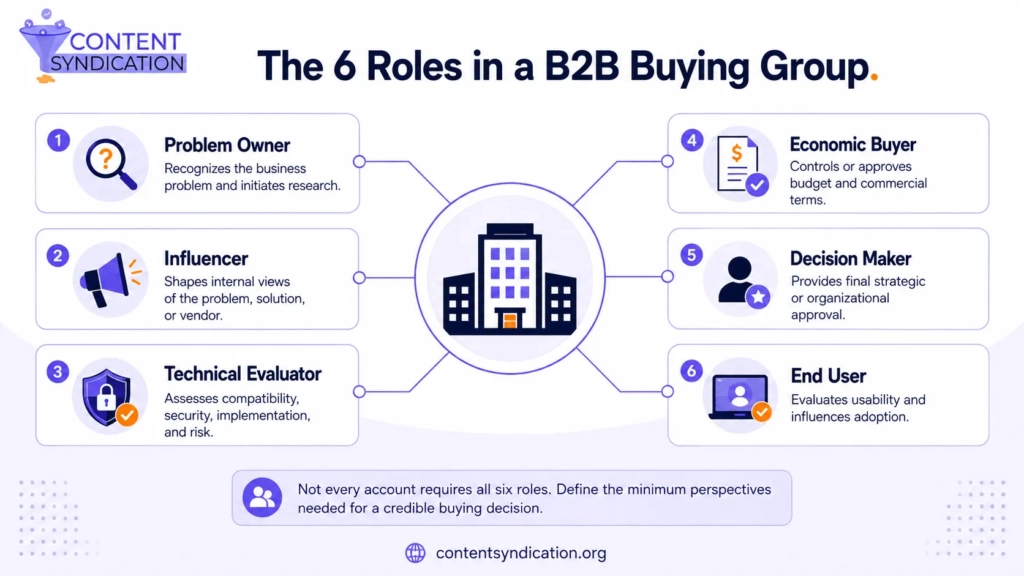
The required roles depend on the solution, market, and account. A practical starting model includes:
Problem owner: Recognizes the business problem and initiates research.
Influencer: Shapes the internal view of the problem, solution, or vendor.
Technical evaluator: Assesses compatibility, security, implementation, and risk.
Economic buyer: Controls or approves budget and commercial terms.
Decision maker: Provides final strategic or organizational approval.
End user: Evaluates usability and influences adoption after purchase.
Not every account needs all six roles, and one person may perform more than one role. The goal is not to force every opportunity into a rigid template. It is to define the minimum set of perspectives required for a credible buying decision.
How Content Syndication Expands Stakeholder Coverage
1. Define the role map before launch
For each ideal-customer-profile segment, define the priority roles, seniority bands, functions, and exclusion criteria. This becomes the coverage blueprint for campaign targeting and reporting.
2. Map assets to role and decision stage
- Problem owners: trend reports, diagnostic guides, and problem-framing content.
- Technical evaluators: implementation guides, architecture details, security content, and comparison assets.
- Economic buyers: business cases, ROI models, total-cost analysis, and risk-reduction evidence.
- Decision makers: strategic briefs, customer outcomes, and executive-level value narratives.
- End users: workflows, demonstrations, adoption guides, and practical use cases.
3. Match contacts at the account level
Normalize company names and domains, deduplicate contacts, and group engagement under the correct account. Without reliable account matching, coverage calculations can overstate or understate the true picture.
4. Track role-level engagement
Report not only how many contacts engaged, but which required roles they represent, what assets they consumed, and whether engagement occurred across complementary roles.
5. Use coverage gaps to guide the next action
If technical interest is strong but the economic buyer is absent, distribute ROI and commercial content to finance or executive audiences. If only senior leaders are engaged, add practitioner-oriented assets that help validate implementation and adoption.
How to Calculate Buying-Group Coverage
Start with the roles required for the account or segment. Then count how many of those roles meet the coverage threshold you are measuring.
| Buying-Group Coverage = (Covered Priority Roles ÷ Total Priority Roles) × 100 |
Calculate identification, engagement, and high-intent coverage separately. Combining them into one percentage can hide the difference between a well-mapped account and an account that is genuinely moving toward a purchase.
Worked Example: From Contact Activity to Account Readiness
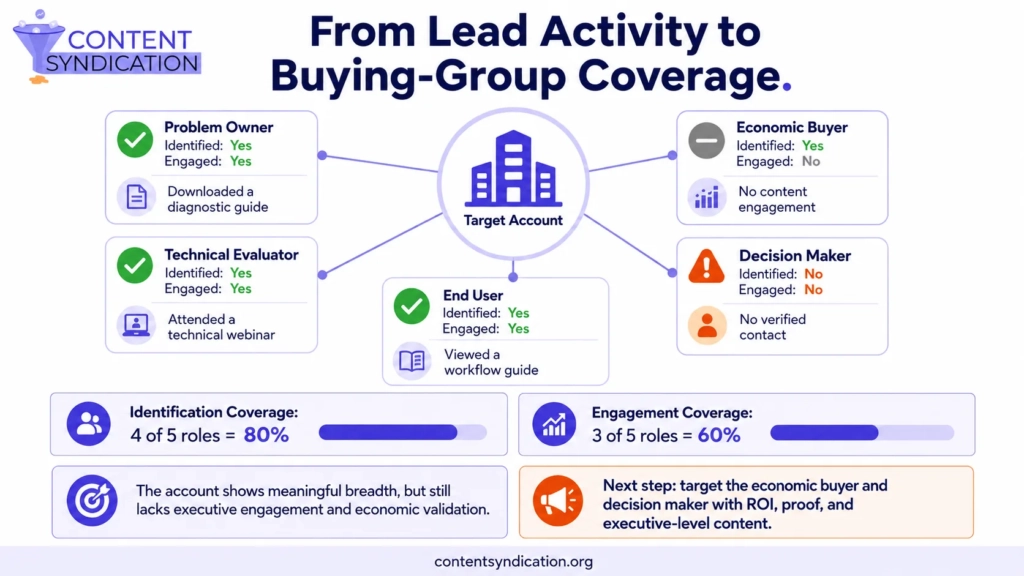
Assume a target account requires five roles: problem owner, technical evaluator, economic buyer, decision maker, and end user.
| Priority Role | Identified? | Engaged? | Observed Signal |
|---|---|---|---|
| Priority Role Problem owner | Identified? Yes | Engaged? Yes | Observed Signal Downloaded a diagnostic guide |
| Priority Role Technical evaluator | Identified? Yes | Engaged? Yes | Observed Signal Attended a technical webinar |
| Priority Role Economic buyer | Identified? Yes | Engaged? No | Observed Signal No content engagement |
| Priority Role Decision maker | Identified? No | Engaged? No | Observed Signal No verified contact |
| Priority Role End user | Identified? Yes | Engaged? Yes | Observed Signal Viewed a workflow guide |
In this example, identification coverage is 80% because four of five roles are known. Engagement coverage is 60% because three of five roles engaged. The account shows meaningful breadth, but it still lacks executive engagement and economic validation.
Recommended next action: continue targeted syndication to the economic buyer and decision-maker profiles while sales uses the existing technical and user engagement as context for coordinated outreach. The account should not yet be described as fully covered.
Buying-Group Coverage Matrix
| Coverage State | Interpretation | Recommended Action |
|---|---|---|
| Coverage State Single-threaded | Interpretation One role is active; account interest is unconfirmed. | Recommended Action Continue nurture and target complementary roles. |
| Coverage State Emerging | Interpretation Two or more roles are active, but a key perspective is missing. | Recommended Action Use role-specific assets to close the gap. |
| Coverage State Evaluation-ready | Interpretation Business and technical perspectives are both engaged. | Recommended Action Coordinate marketing and sales follow-up. |
| Coverage State Commercially aligned | Interpretation Technical, business, and economic roles show engagement. | Recommended Action Prioritize the account and introduce proof, ROI, and next-step content. |
| Coverage State Broad coverage | Interpretation Most required roles are identified and meaningfully engaged. | Recommended Action Use a coordinated multi-threaded opportunity plan. |
How Sales Should Use Coverage Data
Coverage data becomes valuable when it changes the follow-up plan. Sales should review all engaged contacts within the account rather than routing the first responder into an isolated sequence.
- Map each contact to a likely role and confirm that role during discovery.
- Tailor the message: technical depth for evaluators, operational value for managers, ROI and risk for economic buyers, and strategic impact for executives.
- Sequence outreach rather than contacting every stakeholder with the same message at the same time.
- Keep the value narrative consistent across threads while adapting evidence to each role.
- Use missing-role data to decide whether the next step belongs to sales, marketing, or the syndication partner.
Metrics That Make Coverage Actionable
A buying-group dashboard should remain focused on role coverage and account action. Broader campaign, funnel, and revenue reporting can remain in the organization’s main content-syndication dashboard.
- Identification coverage rate: percentage of required roles with a verified contact.
- Engagement coverage rate: percentage of required roles that engaged with content.
- High-intent coverage rate: percentage of required roles showing defined intent signals.
- Role distribution: whether engagement is balanced or concentrated in one function or seniority level.
- Multi-stakeholder account rate: percentage of target accounts with engagement from multiple required roles.
- Time to required coverage: time taken to reach the organization’s minimum role threshold.
- Coverage-to-opportunity conversion: opportunity creation by coverage state or coverage band.
Set thresholds from your own historical data rather than presenting a universal percentage as an industry standard. The right threshold will vary by deal complexity, sales motion, market, and the roles required for a decision.
Common Measurement Mistakes
- Counting multiple contacts from the same role as broader buying-group coverage.
- Treating identified contacts as engaged stakeholders.
- Giving every content interaction the same weight.
- Using a generic role map for every product, segment, or deal type.
- Ignoring account-matching and deduplication problems.
- Passing one lead to sales without the surrounding account context.
- Reporting a coverage percentage without showing which critical roles are missing.
Frequently Asked Questions
1. How many stakeholders should a content-syndication campaign reach?
There is no universal number. Define the roles required for the specific product, segment, and sales motion, then measure coverage against that role map. Larger or more complex purchases generally require broader stakeholder participation.
2. Is buying-group coverage the same as account engagement?
No. Account engagement aggregates activity across an account. Buying-group coverage adds role context, showing whether engagement is distributed across the people needed for a decision or concentrated in one part of the organization.
3. Should every engaged role receive the same score?
Not necessarily. Engagement can be weighted by role relevance, content type, recency, and signal strength. The model should remain understandable enough for marketing and sales teams to act on it consistently.
4. When should sales begin multi-threaded follow-up?
Use a defined trigger based on complementary role engagement, signal strength, account fit, and sales capacity. A single download may justify continued nurture; engagement from multiple required roles may justify coordinated outreach.
Build for Account Depth, Not Just Lead Volume
A content-syndication program becomes more valuable when it reveals how interest is developing across the decision-making unit. Lead volume shows activity. Buying-group coverage shows whether that activity is broad enough, relevant enough, and strong enough to support the next account action.
Define the required roles, distinguish identification from engagement, measure gaps at the account level, and use those gaps to coordinate content and sales follow-up. That is how content syndication moves from isolated contact generation to a clearer view of buying readiness.