
Content syndication can fill the top of the funnel quickly, but volume alone does not create pipeline. Many B2B teams celebrate form fills, only to find that the conversation goes quiet after handoff. That is why content syndication lead conversion depends on what happens after the download, not just the lead capture itself.
In most cases, the issue is not necessarily poor leads or a weak channel. The issue is that the buyer is still early in the journey and needs more context, stronger relevance, and a clearer reason to engage. A structured content syndication lead nurture plan helps determine what should happen after the initial download. This article explains why content syndication lead conversion breaks down and how to improve it with better targeting, nurture, and sales alignment.
Quick Answer: Content syndication leads often fail to convert because they are treated as sales-ready immediately after downloading an asset. Conversion improves when teams target the right ICP, identify the buyer’s stage, segment by intent, nurture with relevant content, and route only qualified leads to sales.
Why Content Syndication Leads Still Fail to Convert
Content syndication leads usually enter the funnel as researchers, not ready buyers. They have shown interest in a topic, but not always in a vendor. When content syndication leads don’t convert, the problem is often a mismatch between the buyer’s stage and the follow-up-not a failure of the channel itself.
If the offer is too broad, the audience is too loose, or the message is too generic, the lead may be real but not relevant. Content syndication lead conversion improves when the campaign matches the buyer’s level of intent and gives them a clear next step.
For many teams, the gap is even wider because the buyer needs proof of fit, not just education. They want to know whether the solution applies to their environment, supports their goals, and justifies the effort of moving forward. In other words, the lead is not the problem. The journey after the lead is.
Where Is Your Content Syndication Conversion Breaking?
| Warning Sign | Likely Problem | Recommended Fix |
|---|---|---|
| High lead volume but few MQLs | Broad ICP or weak targeting | Tighten industry, company-size, role and account filters |
| MQLs are rejected by sales | Marketing and sales use different definitions | Agree on qualification and acceptance criteria |
| Leads download but do not engage again | Generic nurture journey | Segment follow-up by asset, topic and buyer stage |
| SDR replies remain low | Outreach lacks context | Reference the downloaded asset and business challenge |
| MQLs become SQLs but no opportunities emerge | Weak intent or premature handoff | Add stronger intent and sales-readiness checks |
| CPL looks good but pipeline remains flat | Measuring volume instead of progression | Track SQLs, opportunities and pipeline contribution |
The Most Common Reasons Content Syndication Leads Don’t Become Customers
Even well-run campaigns can underperform when the audience definition is loose or the offer is too early-stage for the buyer. The result is a list of contacts that looks healthy on paper but does not support real pipeline growth.
The most common reasons content syndication lead conversion breaks down include:
Weak lead qualification
Not every form fill deserves the same sales motion. If every contact is treated the same, sales spends time on leads that were never close to buying. Teams should define clear BANT, MQL, and SQL qualification criteria before deciding which leads should be routed to sales.
Poor lead quality improvement
Teams often optimize for volume first and quality later. That usually creates more activity, not more opportunity.
Generic content offers
Broad educational assets attract attention, but they do not always create urgency or buying intent.
Campaign content and targeting should be aligned before distribution begins, not corrected only after lead quality declines.
No buying-stage context
A prospect who downloads a top-of-funnel guide should not receive the same follow-up as someone comparing vendors.
A structured content syndication lead funnel ensures awareness-stage, consideration-stage, and decision-stage buyers receive different next steps.
Weak internal routing
If the lead reaches sales without context, the handoff loses momentum before the conversation even starts. Each of these issues slows content syndication lead conversion because the buyer never gets a reason to move from interest to evaluation.
Leads should enter the pipeline with the downloaded asset, topic, engagement history, qualification data, and known account signals attached.
Marketing Mistakes That Reduce Lead Conversion Rates
Marketing often creates the conversion problem before sales ever sees the lead. The issue is not that the campaign failed to attract attention. It is that the campaign did not prepare the buyer for the next step.
Review the broader list of B2B content syndication mistakes to identify campaign, partner, targeting, SEO, and follow-up problems.
Without lead nurturing, even a strong asset goes cold after the first touch. A single download rarely moves a buyer from curiosity to commitment. They need a sequence that builds confidence over time.
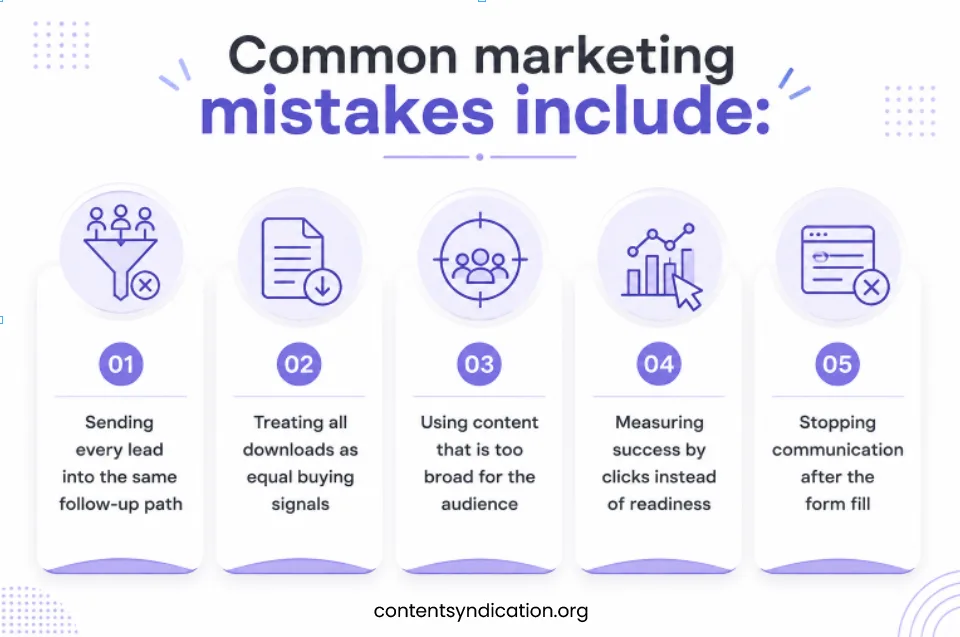
Lead conversion optimization starts with matching the message to the buyer’s stage. If the content is educational, the next step should continue the education. If the buyer is comparing options, the next step should help them evaluate fit.
Sales Follow-Up Mistakes That Kill Opportunities
In the B2B sales process, timing and relevance matter as much as the offer itself.
Sales teams often hurt content syndication lead conversion by:
- Waiting too long to respond
- Using template outreach with no context
- Asking for a meeting before trust is built
- Failing to reference the content the buyer engaged with
- Not multi-threading across the buying committee
The best content syndication sales follow-up does not treat syndicated leads like cold leads. It treats them like warm signals that need a smarter conversation. That means using buyer behavior, not just contact details, to shape the next step.
A Proven Framework for Lead Conversion Optimization
A stronger framework can turn content syndication lead conversion into a repeatable process instead of a one-off result. The goal is not just to generate leads. The goal is to move the right leads into the right next step.
1. Tighten the ICP and the offer
Start with the ideal customer profile. If the audience is too broad, the campaign will attract low-intent contacts. If the offer is too generic, the buyer will not see enough relevance to continue. Well-designed custom qualification questions can reveal project timelines, buying roles, existing solutions, and evaluation status.
2. Segment by source and intent
Not every lead should enter the same path. Segment by topic, engagement level, and source so the follow-up matches the buyer’s likely stage.
3. Build a stage-based nurture path
Use content that answers the next logical question. Early-stage buyers need education. Mid-stage buyers need proof. Late-stage buyers need confidence.
4. Route to sales with context
Give sales the asset consumed, the topic of interest, and any known account signals. That context improves the first conversation and shortens the path to value.
5. Review conversion weekly
Track what happens after the lead is captured. If the same source keeps producing low engagement, adjust the audience, the offer, or the handoff.
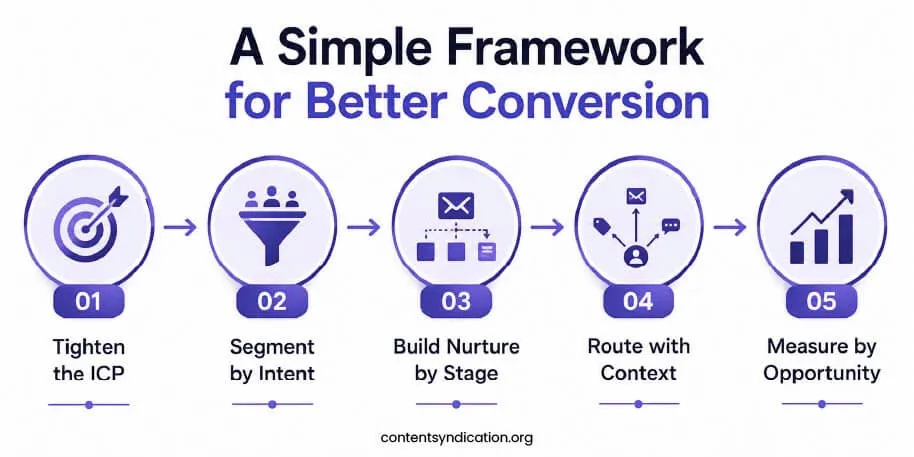
For teams trying to understand how to convert content syndication leads faster, this framework separates research-stage interest from genuine buying intent.
It also gives marketing and sales a practical way to improve content syndication lead conversion without relying on guesswork.
Metrics That Measure Lead Conversion Success
The right metrics show whether content syndication lead conversion is improving or just creating activity. A high lead count can look impressive, but it does not tell you whether the campaign is producing pipeline.
Use a simple scorecard like this:
| Metric | What it tells you |
|---|---|
| MQL to SQL conversion | Whether marketing is sending sales-ready leads |
| Opportunity rate | Whether leads are becoming real deals |
| pipeline conversion | Whether syndication is influencing revenue |
| CPL | Whether acquisition cost is sustainable |
| Sales velocity | How quickly leads move through the funnel |
If the MQL to SQL conversion rate is weak, the issue is usually fit, message, or follow-up. If opportunity rate is low, the problem may be the offer or the audience. If pipeline conversion is flat, the campaign may be generating interest without enough buying intent. Use a content syndication ROI calculator to connect lead volume, CPL, qualification rates, customers, revenue, and campaign return.
Best Practices for Aligning Marketing and Sales Teams
Content syndication lead conversion improves fastest when marketing and sales work from the same definition of quality.
Best practices include:
- Agree on what a qualified lead looks like
- Share feedback on lead quality every week
- Use account-level scoring, not just individual form fills
- Map content to funnel stages and buyer questions
- Review lost opportunities to refine targeting
When both teams operate from the same playbook, the buying journey becomes easier to manage and easier to scale. That alignment is essential for content syndication lead conversion because the first touch is only the beginning.
Frequently Asked Questions About Content Syndication Lead Conversion
1. How long should a lead stay in nurture before sales outreach?
Long enough to show buying readiness. The right timing depends on deal complexity, audience type, and engagement level.
2. Why do some leads never move forward?
They often lack fit, urgency, or a clear next step. In many cases, the campaign created interest but not enough confidence.
3. Can syndication work for technical audiences?
Yes. It can be effective when the content is educational, the audience is well defined, and the follow-up is tailored to the buyer’s stage.
Close the Conversion Gap
If you want to improve content syndication lead conversion, start by auditing your targeting, nurture path, and handoff rules. Better systems do more than create leads. They create better conversations, stronger pipeline, and more predictable revenue.
If you are ready to close the gap between lead volume and revenue, now is the time to fix the process.