
A content syndication lead nurture plan helps B2B marketers decide what should happen after a prospect downloads an eBook, whitepaper, report, or webinar asset. While a content download may look like a successful conversion, it does not always mean the buyer is ready for a sales conversation.
The real opportunity begins after the download. By tracking buyer intent signals, segmenting leads, delivering relevant follow-up content, and defining clear SDR handoff criteria, marketers can turn content syndication leads into qualified pipeline instead of letting them sit in a generic email sequence.
The reality is that a content download is an engagement signal, not a buying signal on its own. It is simply the start of a conversation. An effective lead nurture plan focuses on understanding why the content was downloaded, what interests the buyer, and how their engagement evolves over time.
Why a Content Download Is Not a Buying Signal
In content syndication, intent-aware nurturing is especially important because many leads enter the funnel through educational assets rather than direct product inquiries.
A content download shows interest, but it does not confirm purchase intent. Many B2B buyers download content during early-stage research, competitive evaluation, internal education, or problem discovery.
Treating every content syndication lead as sales-ready can create poor buyer experiences and waste SDR time. Instead, marketers should use the download as the first signal in a broader nurture journey. The goal is to understand what the buyer cares about, how they engage after the download, and whether their behavior shows stronger commercial intent over time.
What Is an Intent-Aware Content Syndication Lead Nurture Plan?
Many organizations invest heavily in content distribution but overlook the importance of the post-download experience. An effective content syndication follow-up uses engagement data and buyer intent signals to determine the next best action for each lead.
Instead of assuming every lead is ready for a sales call, intent-aware follow-up evaluates indicators such as:
- Which content asset was downloaded
- Pages visited after the download
- Email engagement activity
- Repeat website visits
- Consumption of additional resources
- Requests for product-related information
These actions help marketers understand where a prospect may be in the buying journey.
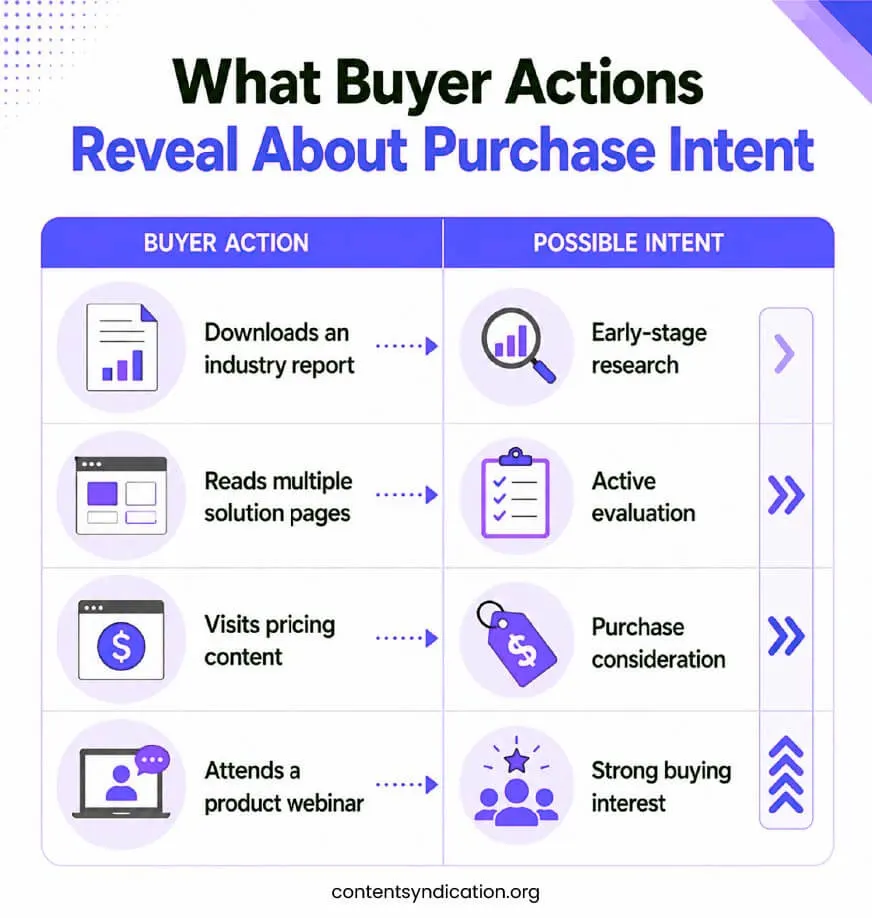
An intent-driven lead nurture plan ensures prospects receive relevant content, educational guidance, and sales engagement at the appropriate stage of their decision-making process.
Post-Download Marketing Automation Workflow for Content Syndication Leads
Modern nurturing depends on technology that can capture, interpret, and respond to buyer behavior in real time.
A well-designed marketing automation workflow connects content engagement, behavioral tracking, segmentation, and communication into a unified process. A typical workflow includes the following stages:
Step 1: Capture Lead Information
The process begins when a prospect submits a form to access gated content.
Basic information may include:
- Name
- Company
- Job title
- Industry
- Business email
This data helps establish an initial audience profile.
Step 2: Segment the Lead
Not every lead should enter the same nurture path.
Segmentation may be based on:
- Industry
- Company size
- Geographic region
- Job function
- Content topic downloaded
This enables more relevant messaging and content recommendations.
While segmentation improves relevance, adding too many strict filters too early can reduce reach and slow lead delivery. To avoid this, marketers should understand how to avoid over-targeting in B2B content syndication campaigns before building their nurture segments.
Step 3: Monitor Behavioral Signals
After the download, marketers should track engagement patterns across channels.
Examples include:
- Website visits
- Resource consumption
- Webinar attendance
- Email interactions
- Return visits
These activities provide valuable insight into buyer intent.
Step 4: Prioritize Engagement
This is where lead scoring becomes valuable.
By assigning values to specific actions, organizations can identify which prospects are showing stronger interest.
For example:
| Activity | Score |
|---|---|
| Content download | 10 |
| Email click | 15 |
| Webinar registration | 25 |
| Product page visit | 30 |
| Demo request | 50 |
Scoring helps prioritize outreach efforts while ensuring less-engaged prospects remain in nurturing programs.
Example Lead Score Thresholds
| Lead Score | Status | Recommended Action |
|---|---|---|
| 0–30 | Early nurture | Send educational content and monitor engagement |
| 31–60 | Engaged lead | Add to topic-specific nurture sequence |
| 61–80 | MQL review | Check ICP fit and recent behavior |
| 81+ | Sales-ready | Trigger SDR handoff or direct sales follow-up |
Step 5: Deliver Relevant Content
The most effective nurture programs align content to buyer needs.
Potential content assets include:
- Educational guides
- Industry research
- Use cases
- Product comparisons
- Customer success stories
This creates a more personalized experience and strengthens buyer confidence.
A successful lead nurture plan continuously adapts based on engagement rather than relying on a fixed communication schedule.
This post-download workflow helps marketing teams avoid one-size-fits-all nurturing. Instead of sending the same follow-up sequence to every lead, the workflow adjusts based on fit, behavior, and engagement quality.
14-Day Post-Download Nurture Workflow for B2B Marketers
| Timeline | Action | Goal |
|---|---|---|
| Day 0 | Send thank-you email with asset link | Confirm access and start engagement |
| Day 2 | Share related educational content | Continue problem awareness |
| Day 4 | Segment based on topic and role | Improve content relevance |
| Day 6 | Send use case or industry-specific resource | Connect content to business pain |
| Day 8 | Track website visits and email clicks | Identify active buyers |
| Day 10 | Share case study or comparison guide | Support evaluation-stage leads |
| Day 12 | Review lead score and ICP fit | Decide if lead is ready for SDR review |
| Day 14 | Trigger SDR handoff or continue nurture | Match outreach to buyer readiness |
This workflow is not meant to be a fixed drip campaign for every lead. B2B marketers should adjust the timing and content based on buyer behavior, lead score, and fit. A lead who visits product pages or attends a webinar may move to SDR review faster, while a lead with low engagement should remain in educational nurture.
Why Buyer Context Matters More Than Email Sequences
Today buyers expect more relevance. Hence, nurturing style becomes important. The difference between contextual nurturing and generic nurturing can significantly impact engagement and conversion rates.
| Generic Drip Campaigns | Contextual Nurturing |
|---|---|
| Time-based | Behavior-based |
| Same content for everyone | Personalized experiences |
| Limited buyer insight | Intent-driven engagement |
| Static journey | Dynamic journey |
| Lower engagement rates | Higher relevance |
Consider two prospects who download the same content syndication asset.
Prospect A downloads an industry report but does not open follow-up emails or return to the website. This lead may still be researching and should remain in an educational nurture path.
Prospect B downloads the same report, visits solution pages, attends a product webinar, and reads customer success stories. This lead shows stronger buying intent and may be ready for SDR review.
A strong content syndication lead nurture plan treats these two buyers differently instead of forcing both into the same email sequence.
Why Relevance Matters More Than Fast Sales Follow-Up
Many organizations continue to prioritize immediate sales outreach after every content download.
While speed matters, relevance matters more.
Instant cold calling assumes every lead is ready to engage with sales. In reality, most buyers are still researching solutions and evaluating options.
Behavior-triggered outreach takes a different approach.
Instead of initiating conversations immediately, it waits for stronger buying indicators such as:
- Multiple website visits
- Product-focused engagement
- Webinar participation
- Repeated content consumption
- Commercial-intent actions
This creates more meaningful conversations because outreach occurs when prospects demonstrate genuine interest.
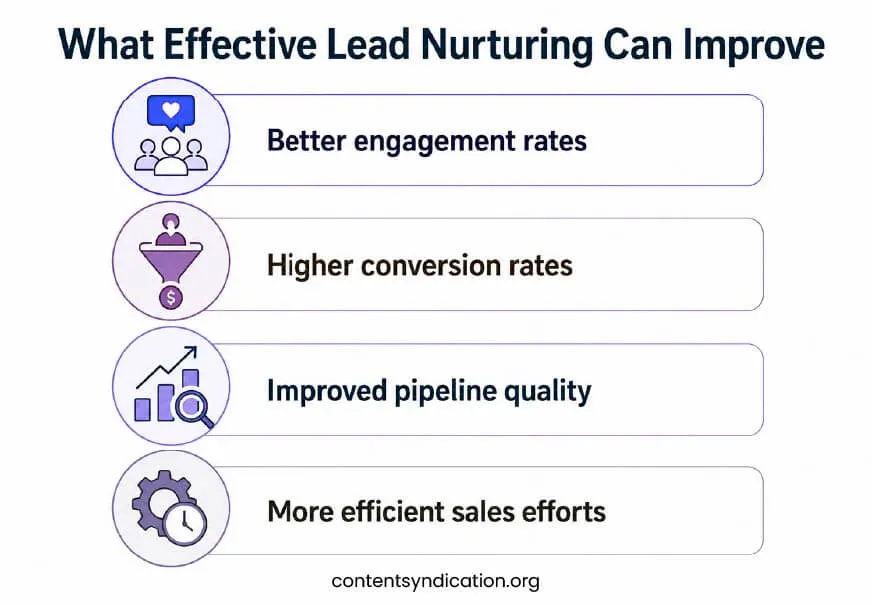
From an ROI perspective, behavior-triggered engagement often delivers stronger outcomes because:
- Sales teams spend time on higher-intent prospects
- Conversion rates improve
- Customer acquisition costs decrease
- Pipeline quality increases
Organizations seeking the best post-download nurture strategy for B2B environments should focus on balancing responsiveness with relevance rather than prioritizing speed alone.
The objective is not to contact every lead immediately. The objective is to engage buyers when they are most likely to benefit from the conversation.
When Should Marketing Hand Off a Lead to Sales?
One of the most important decisions in any nurture program is determining when a prospect should move from marketing to sales.
Premature handoffs can frustrate buyers and waste sales resources. Delayed handoffs can result in missed opportunities.
The solution is establishing a clearly defined SDR handoff process based on engagement thresholds.
Common trigger signals include:
High-Intent Website Activity
Prospects who repeatedly visit solution, pricing, or product pages may be actively evaluating vendors.
Multiple Engagement Events
A combination of actions often provides stronger intent signals than a single activity.
Examples include:
- Downloading multiple assets
- Attending webinars
- Clicking product-focused emails
Buyer Profile Match
Behavior should be evaluated alongside fit. Ideal prospects often match criteria such as:
- Target industry
- Company size
- Budget potential
- Decision-making authority
Sales-Ready Requests
Direct actions such as demo requests or consultation inquiries typically indicate immediate readiness for outreach.
The most effective lead nurture plan defines these criteria clearly and ensures marketing and sales teams share a common understanding of qualification standards.
SDR Handoff Checklist
Before sending a content syndication lead to sales, confirm:
- The lead matches the target industry, company size, or account profile.
- The downloaded content topic aligns with a real business pain point.
- The lead has shown repeat engagement after the first download.
- The lead has visited solution, pricing, product, or case study pages.
- The lead score has crossed the agreed MQL or sales-ready threshold.
- Marketing has shared the asset downloaded, engagement history, and recommended talking points with the SDR.
A clear SDR handoff process prevents sales teams from receiving leads without context. It also helps SDRs personalize outreach based on what the buyer has actually consumed and how their intent has developed over time.
How to Measure ROI Beyond CPL
To evaluate the effectiveness of a lead nurture plan, organizations should track metrics across the entire funnel.
| Metric Category | What to Track | Why It Matters |
|---|---|---|
| Engagement | Email clicks, content views, website visits | Shows whether leads are still interested |
| Qualification | MQLs, SQLs, ICP match rate | Measures lead quality |
| Pipeline | Opportunities created, pipeline value | Connects nurture to sales impact |
| Revenue | Closed-won deals, CAC, deal velocity | Shows business outcome |
| Progression | Movement from lead to MQL to SQL | Reveals whether nurture is moving buyers forward |
Engagement Metrics
Measure how leads interact with content and campaigns.
Examples include:
- Email engagement rates
- Content consumption
- Website activity
- Webinar participation
Pipeline Metrics
Understand how nurturing influences opportunity creation.
Track:
- Marketing-qualified leads
- Sales-qualified leads
- Opportunity conversion rates
- Pipeline contribution
Revenue Metrics
Ultimately, nurturing should support revenue growth.
Monitor:
- Customer acquisition cost
- Revenue influenced by marketing
- Deal velocity
- Closed-won opportunities
Lead Progression Metrics
Evaluate how effectively leads move through the buying journey.
Questions to ask include:
- Are leads engaging with additional content?
- Are qualification rates improving?
- Are prospects reaching sales conversations faster?
A mature lead nurture plan focuses on pipeline and revenue impact rather than lead volume alone.
The organizations achieving the strongest ROI are often those that optimize for buyer progression, not simply lead generation.
Frequently Asked Questions (FAQs)
What is a content syndication lead nurture plan?
A content syndication lead nurture plan is a structured follow-up process that helps marketers engage leads after they download a syndicated content asset. It uses segmentation, intent signals, lead scoring, and relevant content to move prospects toward qualification.
What should happen after a lead downloads content?
After a lead downloads content, marketers should confirm asset delivery, segment the lead, track engagement, send relevant follow-up content, score buyer behavior, and determine whether the lead should remain in nurture or move to sales.
Is a content download a buying signal?
A content download is an engagement signal, but it is not always a buying signal. Stronger buying intent usually appears through repeat engagement, solution-page visits, webinar attendance, pricing-page visits, or demo requests.
How soon should sales follow up with content syndication leads?
Sales should follow up when the lead shows enough fit and intent. Some high-intent leads may need fast SDR outreach, while early-stage leads should continue receiving educational nurture until stronger buying signals appear.
How do you measure content syndication nurture success?
Measure success using engagement rates, MQL-to-SQL conversion, opportunity creation, pipeline contribution, revenue influenced, customer acquisition cost, and lead progression through the funnel.
Creating a More Effective Path to Revenue
A content download is not the finish line. It is the beginning of a buyer relationship.
The difference between average and high-performing demand generation programs often comes down to what happens after that first interaction. Organizations that rely on generic nurturing risk losing engagement, while those that build behavior-driven experiences create stronger buyer journeys and better business outcomes.
A successful lead nurture plan combines relevance, timing, buyer intent, and cross-functional alignment. By focusing on engagement signals, personalized experiences, and measurable progression through the funnel, marketers can transform content downloads into qualified opportunities and long-term revenue growth.