
If you are still setting up your campaign from scratch, start with our B2B content syndication campaign launch guide before refining your targeting filters.
Over-targeting in B2B content syndication campaigns happens when ICP filters become so narrow that they reduce reach, increase CPL, and slow lead delivery.
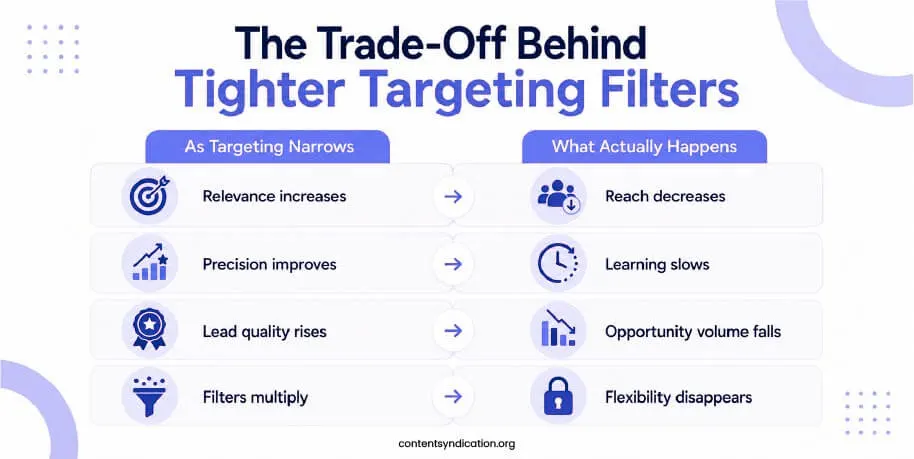
In B2B content syndication campaigns, narrow targeting can improve lead relevance. But when filters become too strict, the campaign may lose reach, increase CPL, delay delivery, and reduce total pipeline opportunities.
This article does not explain how to launch a content syndication campaign. Instead, it focuses on one specific campaign mistake: over-targeting, and how to balance ICP accuracy with campaign scalability.
What Is Campaign Over-Targeting in B2B?
Campaign over-targeting happens when the audience becomes so narrow that it starts hurting performance.
It usually begins with a good goal: improve lead quality. But then one filter leads to another. You start with a broad ICP, then add exact job titles, then a tight company size range, then a small list of industries, then a limited geography.
Each choice may seem fine on its own. Together, they can make the audience too small.
For example, imagine a SaaS company selling enterprise workflow software. Instead of targeting operations professionals broadly, the campaign only goes after Directors of Operations at companies with 1,000 to 5,000 employees, in two industries, and in one region.
That audience might be a good fit. But it may also be too small to deliver enough volume.
Strong B2B content syndication campaigns focus on the full buying group, not just one narrow profile. In B2B, buying decisions are rarely made by one person. There are usually users, managers, decision-makers, and sometimes procurement involved. If your targeting is too narrow, you may miss the people who influence the deal even if they are not the final signer.
Over-targeting is not the same as poor targeting. Poor targeting is too broad. Over-targeting is when the ICP is technically correct but commercially too restrictive to generate enough qualified lead volume.
The Hidden Threat of CPL Inflation
To understand how CPL, CPM, CPC, and campaign pricing models affect budget planning, see our content syndication pricing guide.
When the audience is too narrow, there are fewer people available to reach. That means publishers and syndication partners have less inventory to work with, and the cost of reaching those leads goes up.
You usually see this in a few ways:
- Delivery slows down because the audience pool is limited.
- Costs rise because more campaigns are competing for the same contacts.
- Budget efficiency drops because each lead costs more to acquire.
- Volume becomes harder to hit, even when demand is there.
So while the campaign may feel more precise, it is often becoming less efficient.
Smart Segmenting vs. Restrictive Filtering
If you are comparing distribution options, our B2B content syndication platforms guide explains where each channel fits in the funnel.
Smart segmentation helps you organize your audience in a way that makes your messaging more relevant without making the campaign too small. Restrictive filtering keeps removing people until the campaign becomes hard to scale.
| Smart Segmentation | Restrictive Filtering |
|---|---|
| Defines the best-fit ICP but keeps enough audience volume | Adds too many filters and reduces reachable accounts |
| Uses must-have and nice-to-have filters separately | Treats every filter as mandatory |
| Balances lead quality, CPL, and delivery speed | Improves fit on paper but slows campaign performance |
| Allows testing across segments | Blocks learning by narrowing the campaign too early |
Smart segmentation usually looks like this:
- Grouping audiences by industry clusters instead of one very narrow vertical.
- Segmenting by buying stage so the message fits the level of interest.
- Prioritizing account tiers while still leaving room to expand.
- Creating role-based messaging for different people in the buying committee.
Restrictive filtering usually looks like this:
- Requiring exact job titles instead of broader functional roles.
- Excluding companies that are only slightly outside a revenue range.
- Limiting the campaign to a very small account list too early.
- Adding multiple qualification rules before any engagement data exists.
The best B2B content syndication campaigns use segmentation to improve relevance, not to shut down reach.
How It Impacts ROI
You can also use our content syndication ROI calculator to estimate how CPL, MQL rate, and conversion rate affect campaign outcomes.
Rigid parameters put precision first. That can look good in reporting, but it often limits how many opportunities actually enter the pipeline.
Controlled scale takes a more balanced approach. It starts with a clear ICP, but it leaves room for adjacent audiences, broader buying committees, and new opportunities that still fit the business.
| Rigid Parameters | Controlled Scale |
|---|---|
| Smaller audience pool | Broader qualified reach |
| Higher acquisition costs | More efficient spending |
| Slower campaign delivery | Faster lead generation |
| Limited testing opportunities | Greater optimization potential |
| Reduced market visibility | Stronger pipeline coverage |
ROI depends on both lead quality and opportunity volume.
For most teams, controlled scale gives a better mix of efficiency, reach, and long-term pipeline value. That is why successful B2B content syndication campaigns usually expand carefully before they start cutting too much.
How to Use Phased Filtering Without Killing Campaign Scale
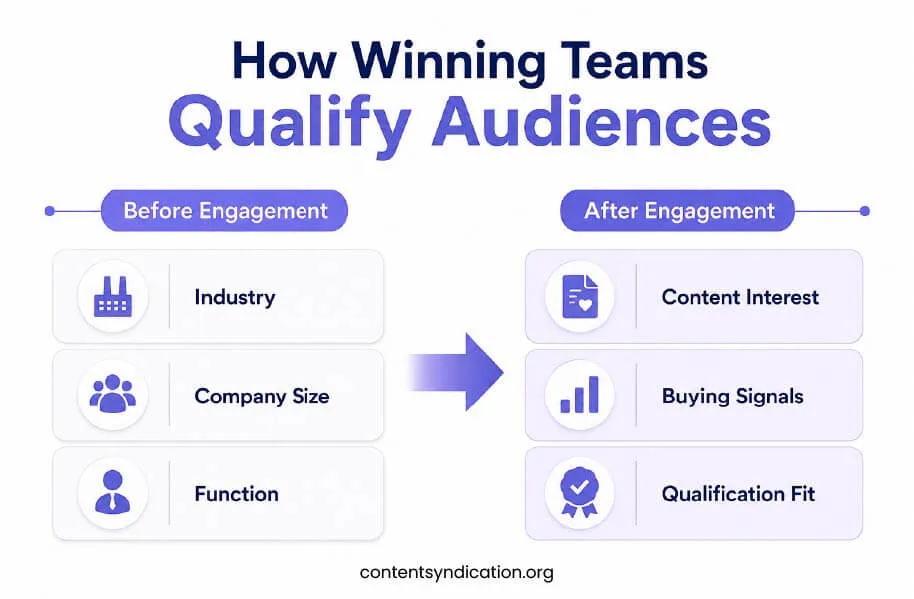
Instead of trying to qualify everything before launch, it usually works better to use a phased approach.
This lets the campaign collect engagement data first and qualify more deeply later. In most cases, that leads to a better balance between scale and quality.
Phase 1: Broad ICP Alignment
Start with the basics. Industry, company size, geography, and department are usually enough to keep the audience relevant without making it too small.
These filters give the campaign a strong starting point while still leaving enough room to perform.
Start with the filters that directly affect sales fit: industry, company size, geography, seniority, and job function. These should define whether a lead belongs in the campaign at all.
Phase 2: Engagement Analysis
Once the campaign is live, pay attention to how people actually interact with the content.
Look at things like:
- Content consumption
- Asset downloads
- Form completion quality
- Repeat engagement
This kind of behavior often tells you more than static filters ever could. At this stage, real interest starts to show you which leads are worth moving forward.
Do not add extra restrictions before you have enough performance data. First review which segments show stronger content engagement, MQL movement, and sales acceptance.
Phase 3: Secondary Disqualification
After you have engagement data, remove the leads that clearly do not fit.
That may include:
- Students
- Consultants
- Duplicate contacts
- Inactive records
- Companies outside key business requirements
This keeps the quality high without blocking good prospects before they have a chance to engage.
For B2B content syndication campaigns, this phased method usually gives you better reach, better efficiency, and better conversion potential.
Secondary filters should be used after campaign learning begins, not before launch. This prevents the campaign from becoming too narrow before you know which segments actually convert.
When Over-Targeting Hurts B2B Lead Generation Quality
Over-targeting can look like a quality improvement, but it can quietly damage lead generation performance. When the audience pool becomes too small, the campaign may deliver fewer leads, take longer to complete, and create inconsistent pipeline coverage.
This becomes a problem when sales teams need both quality and volume. A campaign with a perfect ICP definition but very limited reach may not support revenue goals. The better approach is to separate non-negotiable filters from flexible filters.
Once leads start coming in, use a content syndication lead validation checklist to separate high-fit leads from poor-quality submissions before sales handoff.
How to Measure ROI
To measure whether over-targeting is affecting ROI, do not look at CPL alone. A narrow campaign may appear high-quality, but the real test is whether it produces enough accepted leads, opportunities, and pipeline.
Track these metrics:
- Reachable audience size before campaign launch
- CPL movement after adding new filters
- Lead delivery speed
- MQL rate by segment
- Sales acceptance rate
- Cost per opportunity
- Pipeline created from syndicated leads
If CPL rises while lead volume and opportunity creation fall, the campaign may be over-targeted.
Frequently Asked Questions (FAQs)
What is over-targeting in B2B content syndication?
Over-targeting happens when a campaign uses too many strict filters, reducing the available audience pool and making lead delivery slower or more expensive.
Does narrow targeting always improve lead quality?
Not always. Narrow targeting can improve relevance, but if it becomes too restrictive, the campaign may lose scale and increase CPL.
How do I know if my campaign is over-targeted?
Signs include low lead volume, slow delivery, rising CPL, limited account coverage, and fewer opportunities despite strict ICP filters.
How can I avoid over-targeting?
Separate must-have filters from flexible filters, start with core ICP criteria, and add secondary filters only after reviewing campaign performance data.
What are the biggest hyper-targeting risks in B2B marketing?
The biggest risks are lower scale, higher acquisition costs, slower delivery, and missed members of the buying committee. Hyper-targeting can also make testing harder, which limits optimization over time.
Why is audience reach important in content syndication?
Reach matters because B2B buying decisions usually involve several people. If you only reach one role or one small segment, you may miss the people who help move the deal forward later.
How Balance Beats Over-Precision
The strongest campaigns are not always the most restrictive ones.
Precision matters, but when targeting gets too narrow, it can quietly work against the results you are trying to improve. A better approach is to balance relevance with scale, use phased filtering instead of over-filtering upfront, and measure success by pipeline impact instead of CPL alone.
That is how B2B content syndication campaigns create real value instead of expensive noise.
Looking for higher-quality B2B leads? Explore our guide to B2B content syndication vendors and compare the best providers for lead generation.