

Every marketing team wants the same outcome: qualified leads that turn into revenue without exhausting the whole budget. In B2B, however, the cost of generating a lead is rarely straightforward.
A software buyer, a manufacturing manager, and a healthcare decision-maker do not respond to the same channels, content, or sales cycle. That is why B2B lead generation cost by industry matters. It helps teams set realistic expectations, compare performance fairly, and invest where returns are strongest.
For B2B teams using content syndication, paid media, outbound, webinars, SEO, or account-based campaigns, CPL benchmarks help compare whether a channel is producing qualified leads at a sustainable cost.
Why Lead Generation Costs Vary Across Industries
The main reason B2B lead generation cost by industry differs is simple: no two markets buy in the same way. Some industries have long evaluation cycles, multiple stakeholders, and intense competition for attention. Others have broader audiences and shorter buying journeys.
Industry context, channel mix, and lead quality all shape CPL. That means comparing your results with a company in a completely different sector can lead to poor decisions.
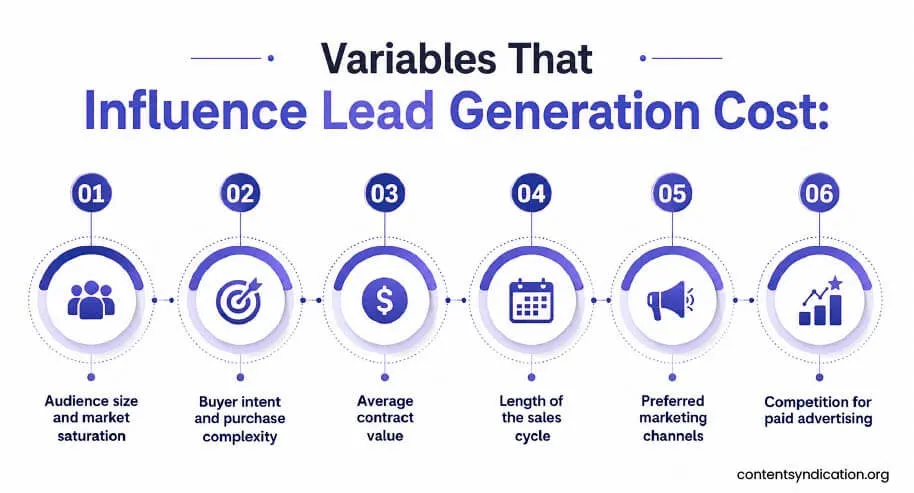
By contrast, industries with shorter buying cycles and broader audiences often see lower acquisition costs because prospects move through the funnel faster.
What Is Cost Per Lead (CPL) in B2B Marketing?
Cost Per Lead, or CPL, measures how much a business spends to generate one qualified lead through marketing. It is one of the most common ways to evaluate campaign efficiency.
The formula is simple:
Cost Per Lead = Total Campaign Spend ÷ Number of Qualified Leads Generated
If a campaign spends $10,000 and produces 100 qualified leads, the CPL is $100.
That said, CPL should never be judged in isolation. A low number may look attractive, but if those leads do not convert into opportunities, the campaign is not efficient in practice. This is why cost per lead benchmarks should be used as directional guides, not fixed rules.
Average B2B Lead Generation Cost by Industry (2026 Benchmarks)
The average B2B lead generation cost by industry varies widely, but benchmark ranges can help teams plan budgets and set realistic expectations. The figures below are directional 2026 planning ranges based on common B2B demand patterns.
These ranges should be treated as directional planning benchmarks, not fixed pricing rules. Actual CPL depends on the channel, region, lead qualification standard, ICP complexity, and sales cycle length.
| Industry | Estimated CPL Range (USD) |
|---|---|
| Software & IT Services | $1,680–$2,800 |
| Cloud Integrators | $1,820–$3,080 |
| Cybersecurity | $1,750–$2,800 |
| AI Solutions | $700–$1,120 |
| Medical Technology | $840–$1,190 |
| Banking & Financial Services | $840–$1,680 |
| Insurance | $1,120–$1,750 |
| Manufacturing | $700–$1,260 |
| Transportation & Logistics | $840–$1,400 |
| Telecommunications | $1,050–$1,680 |
| Marketing & Advertising Services | $1,050–$1,540 |
| Market Research | $1,680–$2,800 |
| Education Technology (EdTech) | $700–$1,120 |
| Analytics & Business Intelligence SaaS | $1,680–$2,800 |
The B2B lead generation cost by industry varies considerably, with 2026 benchmarks ranging from approximately $700 to $3,080 per qualified lead.
Industries such as software, cloud services, cybersecurity, and analytics consistently report the highest CPL because they sell complex, high-value solutions that involve multiple decision-makers and longer evaluation cycles.
In comparison, sectors such as AI, EdTech, and manufacturing typically experience lower acquisition costs due to broader demand, clearer use cases, or shorter buying journeys.
B2B Lead Generation Cost by Channel
| Channel | Typical CPL Behavior |
|---|---|
| SEO | Lower long-term CPL, slower ramp-up |
| LinkedIn Ads | Higher CPL, strong targeting |
| PPC | Competitive and keyword-dependent |
| Content Syndication | Predictable CPL model for qualified lead volume |
| Webinars | Strong intent but needs follow-up |
| Referrals | Low CPL but limited scale |
| Trade Shows | High cost but strong relationship value |
What Factors Increase B2B Lead Generation Costs?
Several conditions can push lead costs higher across industries. Understanding them helps teams identify where to optimize.
Highly Competitive Markets
When many vendors target the same audience, paid media costs rise quickly. More competition means higher bids, more expensive clicks, and greater pressure on conversion rates.
Longer Sales Cycles
Complex buying journeys require more nurturing, more content, and more follow-up before a prospect becomes sales-ready. That increases overall demand generation cost.
Narrow Target Audiences
Reaching senior executives, technical specialists, or niche buyers usually requires more precise targeting and more personalized messaging.
Low Brand Visibility
If prospects do not recognize your brand, they need more education before they engage. That increases the effort required to generate trust and interest.
Poor Campaign Targeting
Broad targeting wastes spend on people who are unlikely to buy. Better segmentation improves efficiency and reduces unnecessary lead generation cost.
In lead generation pricing, the better question is whether the channel produces qualified opportunities at a sustainable rate.
How to Reduce CPL Without Sacrificing Lead Quality
Reducing CPL should never mean lowering standards. The goal is to improve efficiency while keeping lead quality strong.
Refine Your Ideal Customer Profile
Start with a clear ICP. Define company size, industry, geography, buying role, and technology stack before launching campaigns.
Invest in High-Value Content
Buyers respond to content that helps them solve real business problems. Strong offers attract stronger intent.
Useful formats include:
- Industry reports
- Research studies
- Webinars
- Buyer guides
- Case studies
- Interactive tools
Improve Landing Page Performance
Small changes in page speed, form length, messaging, and calls to action can improve conversion rates significantly.
Higher conversion rates reduce B2B CPL without increasing spend.
Align Sales and Marketing on Qualification
Marketing should not optimize for lead volume alone. Sales and marketing teams need shared qualification criteria so the funnel focuses on leads with real revenue potential.
Test and Optimize Continuously
Campaign performance improves through iteration. Test audience segments, creative, offers, and landing pages regularly.
A disciplined optimization process is one of the most reliable ways to improve B2B lead generation cost by industry performance over time.
Industry-Specific Strategies to Improve Lead Generation ROI
Different industries need different tactics to improve efficiency. A one-size-fits-all approach rarely works.
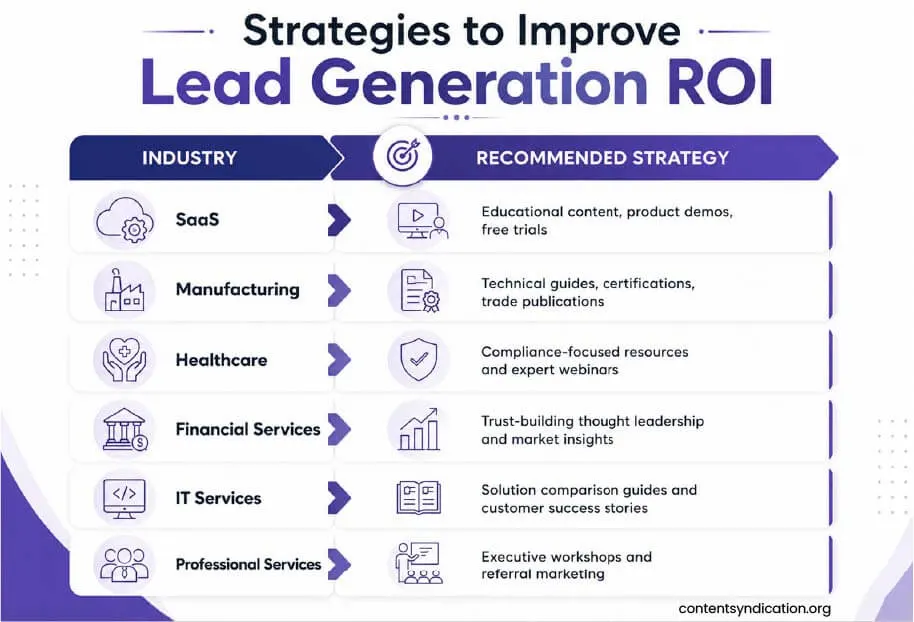
The best campaigns match the buying process of the industry they serve. That is why a strong B2B lead generation pricing guide should always connect offer type, audience intent, and channel selection.
It is also important to align each tactic with the available marketing budget and the expected pipeline value.
Key Metrics Every Marketing Team Should Track
CPL is useful, but it does not tell the full story. To understand performance properly, teams should track multiple metrics together.
| Metric | Why It Matters |
|---|---|
| Marketing Qualified Leads (MQLs) | Measures lead quality entering the funnel |
| Sales Qualified Leads (SQLs) | Indicates sales readiness |
| Opportunity Conversion Rate | Tracks progression through the pipeline |
| Revenue per Lead | Measures financial impact |
| Pipeline Contribution | Connects marketing to revenue generation |
| Return on Marketing Investment | Evaluates campaign profitability |
| Win Rate | Shows overall sales effectiveness |
| Customer Lifetime Value | Measures long-term business value |
When teams compare B2B lead generation cost by industry with these metrics, they get a much clearer view of efficiency.
It is also smart to track customer acquisition cost, lead acquisition cost, and demand generation cost alongside CPL. Together, these metrics show whether your funnel is producing profitable growth or just more activity.
Frequently Asked Questions
What is a good CPL for B2B lead generation in 2026?
A good CPL depends on industry, channel, lead quality, and deal value. In complex B2B markets, a higher CPL may still be profitable if leads convert into qualified opportunities and pipeline.
How can content syndication reduce B2B lead generation cost?
Content syndication can help reduce wasted spend by promoting gated assets to targeted audiences and generating qualified leads through controlled CPL-based campaigns.
What is the average B2B lead generation cost by industry?
The average B2B lead generation cost by industry depends on competition, audience size, buying complexity, and channel mix.
Why is cost per lead different across industries?
Each industry has different buying behavior, sales cycles, and audience expectations. Those differences directly affect campaign costs and conversion rates.
How often should businesses review CPL benchmarks?
Teams should review performance quarterly and compare results against annual benchmarks to spot trends early and adjust strategy.
Should companies always aim for the lowest CPL?
No. A lower CPL is only valuable if the leads are qualified and contribute to pipeline. Revenue impact matters more than raw volume.
What is the cost per lead by industry 2026 useful for?
It helps teams benchmark performance, forecast budgets, improve planning, and identify where optimization can improve ROI.
Ready to Improve Your Lead Generation Strategy?
Benchmarking is only the starting point. The real value comes from using those insights to improve performance.
Review your current CPL, compare it against relevant industry ranges, and identify where your funnel can become more efficient. If your team wants to reduce B2B lead generation cost by industry while protecting lead quality, the next step is to align strategy, targeting, and measurement around revenue, not just lead volume.
Want to compare your CPL with content syndication campaign benchmarks? ContentSyndication.org helps B2B teams plan targeted campaigns, improve lead quality, and measure CPL, MQL, SQL, and pipeline impact.