
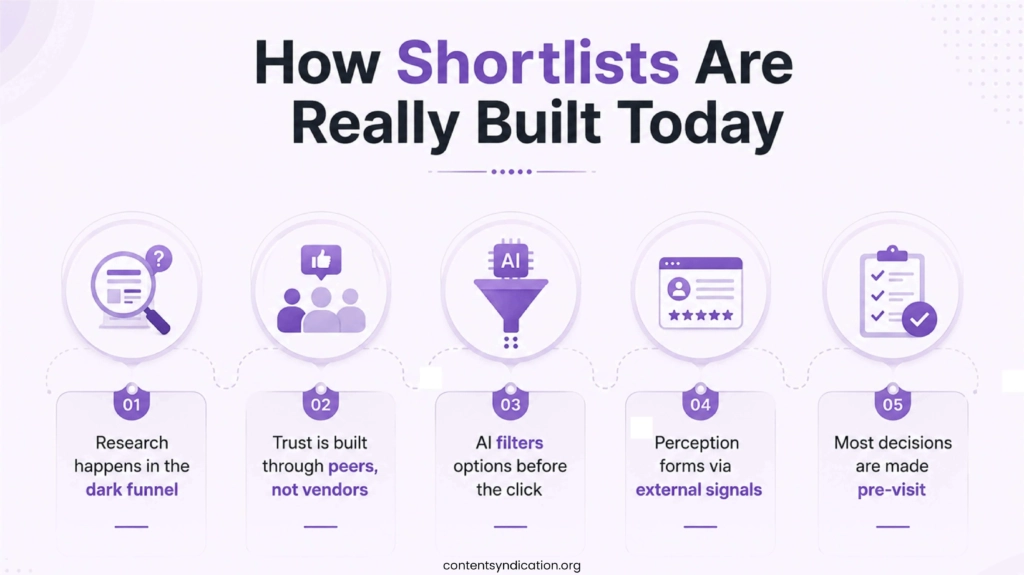
B2B buyers no longer wait until they visit a vendor website or fill out a form to begin evaluating solutions.
Today, buyers form opinions through search summaries, AI-generated answers, analyst content, peer discussions, industry publications, and other third-party sources long before a company knows they are actively researching.
That means B2B visibility is happening earlier, faster, and increasingly without a direct click.
For marketers, this creates a new challenge: how do you influence buyers who may never visit your website during the early stages of research?
This is where content syndication becomes valuable.
By distributing relevant content across third-party environments where buyers already consume information, brands can build awareness, establish credibility, and remain visible during the research process.
For zero-click B2B buyers, being present before the website visit can make the difference between being considered and being overlooked.
What Is Zero-Click B2B Research?
Zero-click B2B research happens when buyers gather information, compare solutions, and form vendor preferences without directly visiting a company’s website or engaging with its owned digital channels.
Instead, buyers may rely on:
- AI-generated answers
- Search result summaries
- Analyst reports
- Industry publications
- Peer discussions
- Comparison content
- Syndicated articles and assets
- Partner and media platforms
The research process still happens.
What changes is where it happens.
Instead of beginning on a vendor’s website, a buyer may build most of their understanding within external environments.
By the time that buyer eventually visits a vendor website, they may not be starting their research.
They may already be validating a shortlist.
This makes early brand visibility increasingly important for B2B marketers.
How AI and Search Summaries Are Changing the B2B Buyer Journey
AI-powered search experiences are changing the way buyers consume information.
Instead of opening multiple websites and reviewing each source individually, buyers can increasingly receive consolidated answers directly within search results or AI interfaces.
This can make research faster, but it can also reduce the number of direct website visits during the early stages of the buying journey.
For marketers, this changes the visibility equation.
Ranking in search remains important, but visibility can also depend on whether your brand, expertise, ideas, and content appear across the broader information ecosystem buyers use to make decisions.
That makes third-party content distribution increasingly valuable.
When your content appears across relevant external platforms, your brand has more opportunities to influence perception even when the buyer does not click through to your website.
In a zero-click environment, the objective is not only to generate traffic.
It is also to shape buyer perception before direct engagement begins.
Why B2B Buyers Build Shortlists Before Visiting Vendor Websites
Complex B2B purchases involve multiple stakeholders, long evaluation cycles, competing priorities, and numerous potential vendors.
Buyers need a way to simplify that complexity.
One common approach is to narrow the market before speaking with sales.
Buyers may use analyst reports, peer recommendations, comparison content, industry publications, AI-generated summaries, and third-party research to determine which vendors appear relevant.
This allows them to eliminate unsuitable options before entering formal conversations.
It also helps buyers avoid relying entirely on vendor-controlled messaging.
Instead, they can compare multiple sources, understand differences between solutions, and develop internal evaluation criteria.
As a result, buyers may approach a vendor only after they already have:
- A clearer understanding of the category
- A list of potential solutions
- Defined business requirements
- Initial vendor preferences
- Internal stakeholder alignment
The shortlist becomes a filter.
And if your brand is invisible while that shortlist is being formed, you may never receive the opportunity to compete.
How Third-Party Content Builds Early Brand Visibility
Third-party platforms can play an important role in early buyer research.
Industry publications, syndication networks, media platforms, partner ecosystems, and other relevant channels often expose buyers to ideas and brands before they visit vendor-owned websites.
This is where third-party content distribution becomes strategically useful.
Instead of waiting for buyers to discover your website, you can distribute valuable content into environments where your audience is already consuming information.
That content might include:
- Industry research
- Benchmark reports
- Educational guides
- Whitepapers
- Thought leadership
- Market analysis
- Best-practice content
- Decision-making frameworks
The objective is not simply to maximize reach.
The objective is to create relevant visibility in trusted environments.
In zero-click B2B marketing, buyers may encounter your insights several times without visiting your website immediately.
Those interactions can still contribute to awareness, recognition, and consideration.
How Content Syndication Supports B2B Shortlist Formation
Content syndication helps brands distribute educational and thought-leadership content beyond their owned channels.
Instead of relying entirely on organic website traffic, marketers can place relevant assets in front of audiences across external platforms.
This can be particularly useful during the early stages of the buyer journey.
A buyer may not be ready to request a demo or speak with sales.
But they may be actively researching a problem, category, or potential solution.
Content syndication allows your brand to participate in that research process.
For example, imagine a decision-maker researching solutions for a complex business problem.
They encounter:
- An industry benchmark featuring your point of view.
- A syndicated guide explaining the problem.
- A third-party article discussing the category.
- Additional research aligned with their evaluation criteria.
The buyer may never click directly to your website during those first interactions.
But your brand becomes more familiar.
When the buyer eventually begins building a shortlist, that familiarity can matter.
This is the value of zero-click content syndication.
It helps your brand appear during the research phase instead of waiting until the buyer reaches your website.
Are Your Target Accounts Seeing Your Brand Before They Visit Your Website?
B2B buyers may be evaluating solutions long before they become visible in your analytics.
ContentSyndication.org helps B2B marketers distribute relevant content to targeted audiences and extend their visibility beyond owned channels.
If your goal is to reach more decision-makers and create demand earlier in the buying journey, request a content syndication campaign plan.
What Traditional Attribution Reports Miss
Traditional digital attribution is heavily based on measurable actions.
Marketers typically track:
- Clicks
- Website sessions
- Form submissions
- Content downloads
- Conversions
- Demo requests
These metrics remain useful.
But they do not capture every interaction that influences a B2B purchase.
In a zero-click environment, buyers may consume information, discuss vendors internally, evaluate options, or develop preferences without creating a trackable website event.
This creates an attribution blind spot.
A buyer could encounter your brand through several external channels before eventually arriving on your website through direct traffic, branded search, a referral, or another unconnected touchpoint.
Traditional attribution may assign credit only to the final measurable interaction.
But the buyer’s decision may have been influenced much earlier.
This is closely connected to the dark funnel: the collection of buyer interactions that influence purchasing decisions but remain difficult to track directly.
These may include:
- Peer recommendations
- Private communities
- AI-generated summaries
- Third-party content consumption
- Internal discussions
- Analyst research
- Syndicated content exposure
That means zero-click influence should not be measured only through last-click attribution.
Marketers need a broader view of how visibility contributes to pipeline.
Metrics for Measuring Zero-Click B2B Influence
If clicks cannot tell the whole story, measurement needs to expand beyond click-based metrics.
Several indicators can help marketers evaluate the influence of distributed content.
Brand Visibility Lift
Track whether your brand is becoming more visible across relevant industry platforms and content ecosystems.
Increasing visibility can indicate that your distribution strategy is expanding your presence during early-stage research.
Share of Voice
Measure how frequently your brand appears in relevant conversations and distributed content compared with competitors.
Share of voice can help show whether your brand is becoming more visible within a category.
Assisted Pipeline Influence
Look at whether prospects and accounts exposed to syndicated content later become opportunities.
The objective is to understand whether distributed content contributes to pipeline, even when it is not the final conversion touchpoint.
Shortlist Inclusion
Where possible, ask prospects how they discovered your company and whether your brand was already under consideration before they visited your website.
This can provide useful insight into how early visibility contributes to vendor selection.
Third-Party Engagement
Measure available engagement indicators from syndication and distribution platforms, such as:
- Content views
- Downloads
- Time spent
- Repeat engagement
- Topic interest
- Account engagement
Together, these metrics provide a broader view of how zero-click visibility contributes to demand generation.
How to Create Content That Travels Beyond Owned Channels
Content designed only for your website may not perform equally well across third-party environments.
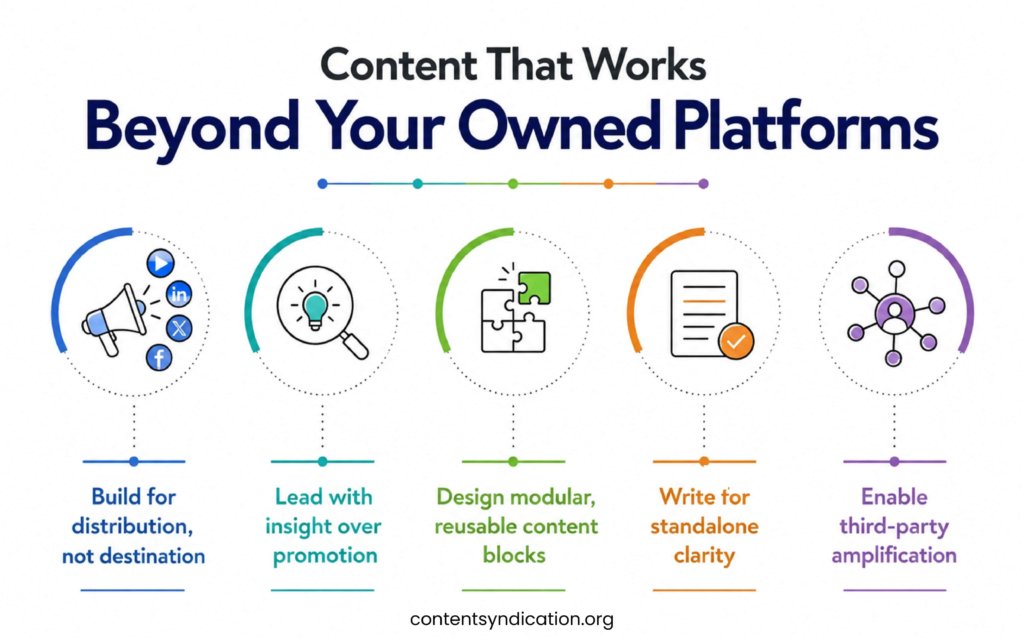
For a zero-click content strategy, marketers should create assets that remain useful even when they are consumed outside their original context.
Lead With Education
Content should help buyers understand a problem, opportunity, framework, or decision.
Educational depth gives audiences a reason to pay attention even when they are not familiar with your brand.
Build Standalone Value
A syndicated section should make sense without requiring the reader to visit another page first.
Avoid making every useful insight dependent on a click.
Give buyers enough value to understand your expertise wherever they encounter the content.
Make Content Modular
Structure content into sections that can be distributed or repurposed independently.
For example:
- Key statistics
- Frameworks
- Charts
- Checklists
- Short explanations
- Comparison tables
- Expert insights
Modular content is easier to adapt across different distribution channels.
Match Content to Buyer Intent
Not every prospect needs the same information.
Early-stage content should emphasize education and category understanding.
Mid-stage content can focus on:
- Evaluation
- Comparisons
- Proof
- Business impact
- Decision criteria
The stronger the alignment between content and buyer intent, the more useful distributed content becomes.
Content Syndication Is About More Than Generating a Click
The value of content syndication should not be judged only by whether every exposure immediately produces website traffic.
For B2B marketers, the larger opportunity is to influence buyers earlier.
A well-planned syndication strategy can help brands:
- Reach relevant B2B audiences
- Build awareness outside owned channels
- Reinforce category expertise
- Increase brand familiarity
- Support shortlist formation
- Generate engagement signals
- Influence future pipeline
That makes content syndication part of a broader demand-generation strategy.
The objective is not to replace your website, SEO, paid media, or sales outreach.
It is to extend your brand beyond the channels you directly control.
Frequently Asked Questions About Zero-Click B2B Marketing
1. What is zero-click B2B marketing?
Zero-click B2B marketing refers to buyer research and decision-making that happens without a direct visit to a vendor’s website. Buyers may rely on AI-generated answers, search summaries, third-party publications, analyst content, peer discussions, and syndicated information.
2. How does content syndication support zero-click B2B buyers?
Content syndication distributes relevant content across external platforms where B2B buyers already research topics and solutions. This helps brands build visibility and familiarity before buyers directly engage with the company.
3. Why is zero-click behavior important for B2B marketers?
Zero-click behavior matters because buyers can form vendor preferences before appearing in website analytics or submitting a form. Brands that are visible during early research have a better opportunity to become part of the buyer’s consideration set.
4. How do B2B buyers shortlist vendors without visiting their websites?
Buyers can use analyst research, peer recommendations, comparison content, AI-generated summaries, third-party publications, and syndicated content to evaluate potential vendors before direct engagement.
5. How can marketers measure zero-click influence?
Marketers can look beyond clicks and track indicators such as brand visibility, share of voice, third-party engagement, assisted pipeline, branded search, direct traffic, and whether prospects were already familiar with the brand before contacting sales.
6. What type of content works best for zero-click B2B marketing?
Educational, standalone content works well because buyers can understand its value without visiting another page. Research, benchmarks, frameworks, guides, comparisons, thought leadership, and decision-support content are useful formats for third-party distribution.
Expand Your Reach Beyond Owned Channels
B2B buyers are forming opinions long before they click.
If your brand is absent during those early research moments, it may be excluded from consideration before your sales team ever gets an opportunity to engage.
That is why modern demand generation cannot depend entirely on driving every buyer directly to an owned website.
Brands need to be visible wherever buyers research, compare, and evaluate solutions.
Content syndication helps extend that visibility by putting relevant content in front of targeted audiences across third-party environments.
The goal is not simply to chase clicks.
It is to build recognition, influence consideration, and create demand before the buyer raises their hand.
Get Your Brand in Front of B2B Buyers Earlier
ContentSyndication.org helps B2B marketers distribute high-value content to relevant audiences and create opportunities beyond their owned channels.
If you want to increase visibility across your target market and generate more qualified B2B demand, request a content syndication campaign plan today.