
B2B marketers are under increasing pressure to generate pipeline while keeping acquisition costs under control.
That makes content syndication vs LinkedIn ads an important budget decision.
Both channels are widely used for B2B lead generation, but they work differently. Content syndication focuses on distributing gated assets through third-party publisher networks, while LinkedIn Ads provides direct professional targeting within LinkedIn’s ecosystem.
The right choice depends on your goals, audience, funnel stage, budget, and the type of pipeline you want to create.
This guide compares content syndication and LinkedIn Ads across cost, targeting, lead quality, nurturing requirements, attribution, and ROI to help you determine where your B2B budget should go.
Quick Comparison: Content Syndication vs LinkedIn Ads
At a high level, the difference comes down to scale, targeting control, and funnel role.
Content Syndication
Content syndication distributes assets such as whitepapers, reports, guides, and webinars across relevant third-party publisher networks.
It can help marketers:
- Reach broader ICP audiences
- Capture early- and mid-funnel interest
- Generate leads at scale
- Extend reach beyond owned channels
- Build awareness among in-market audiences
LinkedIn Ads
LinkedIn Ads allows marketers to target audiences using professional attributes such as:
- Job title
- Industry
- Company size
- Seniority
- Job function
- Account
- Geography
It is especially useful when marketers need more direct control over who sees a campaign.
The key question is not simply which channel generates more leads.
It is which channel best supports your pipeline objective.
How Content Syndication Works
Content syndication distributes gated B2B content across publisher networks and third-party platforms.
The content may include:
- Whitepapers
- Research reports
- Benchmark studies
- Guides
- Webinars
- Industry insights
Interested users access the content and provide their contact details, which can then be delivered to the advertiser as leads.
Content syndication is often effective for early- to mid-funnel campaigns because it helps brands reach buyers who are already consuming relevant industry content.
Compared with LinkedIn Ads, content syndication can provide broader reach across publisher ecosystems.
However, campaign quality depends heavily on:
- Publisher quality
- Audience targeting
- ICP alignment
- Lead validation
- Content relevance
- Qualification criteria
For marketers focused on scalable demand capture, these factors determine whether syndication produces meaningful pipeline or simply lead volume.
How LinkedIn Lead Gen Ads Work
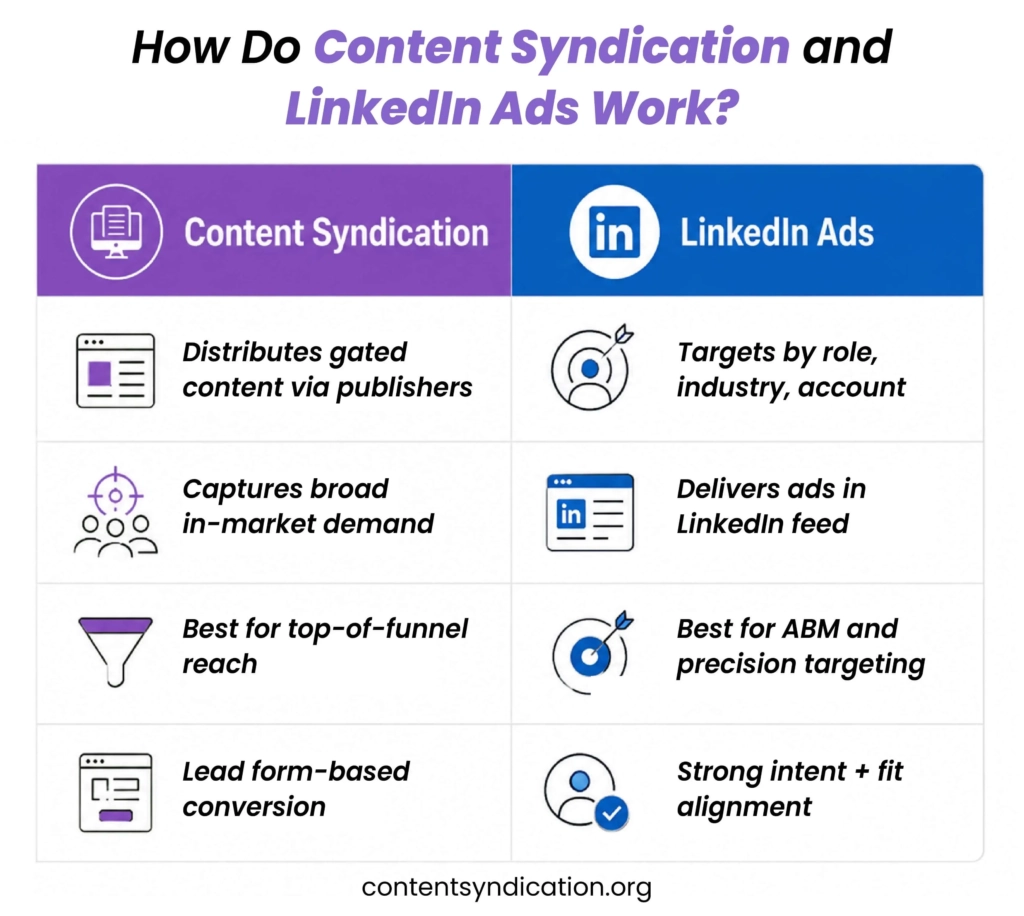
LinkedIn Lead Gen Ads operate within LinkedIn’s professional ecosystem.
Marketers can build audiences based on professional and firmographic characteristics and deliver ads directly in the LinkedIn feed.
Lead Gen Forms can reduce friction because user information is often prefilled.
LinkedIn can be particularly effective for:
- Account-based marketing campaigns
- Named-account targeting
- Seniority-based campaigns
- Role-specific targeting
- Narrow ICP audiences
Compared with syndication, LinkedIn usually gives marketers greater direct control over audience definition.
Content syndication, however, can provide broader reach across external publisher networks.
The right choice depends on whether your priority is precision, scale, or a combination of both.
Cost, Budget Structure, and CPL
Cost is one of the biggest differences in the content syndication vs LinkedIn ads comparison.
Content Syndication Costs
Content syndication commonly operates on a CPL model.
Marketers agree on a cost for each qualified lead that meets defined targeting or validation requirements.
This can provide more predictable lead-acquisition costs.
However, CPL alone does not determine campaign performance.
A lower-cost lead that never progresses through the funnel may ultimately be more expensive than a higher-cost lead that becomes an opportunity.
LinkedIn Ads Costs
LinkedIn generally operates through auction-based advertising.
Costs can vary based on factors such as:
- Audience size
- Competition
- Industry
- Job seniority
- Target geography
- Ad format
- Campaign objective
Marketers may pay based on impressions, clicks, or other campaign actions.
LinkedIn can sometimes have a higher visible acquisition cost, particularly for highly competitive professional audiences.
But the more important metric is downstream efficiency.
Instead of comparing only CPL, marketers should look at:
Lead → MQL → SQL → Opportunity → Revenue
That provides a more accurate picture of channel performance.
Targeting, Audience Reach, and Control
Targeting is one of the clearest differences between content syndication and LinkedIn Ads.
Content syndication depends on publisher networks and audience segmentation.
Campaigns can typically be defined using criteria such as:
- Industry
- Geography
- Company size
- Job function
- Seniority
- Account lists
- Topic interest
The advertiser relies partly on the publisher or syndication partner to identify matching audiences.
LinkedIn gives marketers more direct control over audience creation inside the platform.
This makes it particularly useful when the campaign needs to reach specific job roles, companies, or decision-makers.
In simple terms:
Content syndication can support broader ICP coverage.
LinkedIn Ads can support highly controlled audience targeting.
The right choice depends on how much scale and targeting precision your campaign requires.
Lead Quality and Buying Intent
Lead quality should be evaluated based on fit and buying stage, not simply the channel that generated the lead.
Content syndication leads are often generated when prospects consume educational content.
That means many leads may still be relatively early in the buyer journey.
They may have a relevant problem or interest but may not yet be ready for a sales conversation.
LinkedIn leads can have strong professional relevance because targeting is based on user and company information.
However, targeting accuracy does not automatically equal buying intent.
A person can perfectly match your ICP and still have no immediate need for your solution.
That means both channels should be evaluated using:
- ICP fit
- Engagement
- Qualification
- Intent
- Funnel progression
- Opportunity creation
The question is not:
“Which platform generates better leads?”
A better question is:
“Which channel generates the right type of lead for this stage of our funnel?”
Nurturing and Sales Follow-Up Requirements
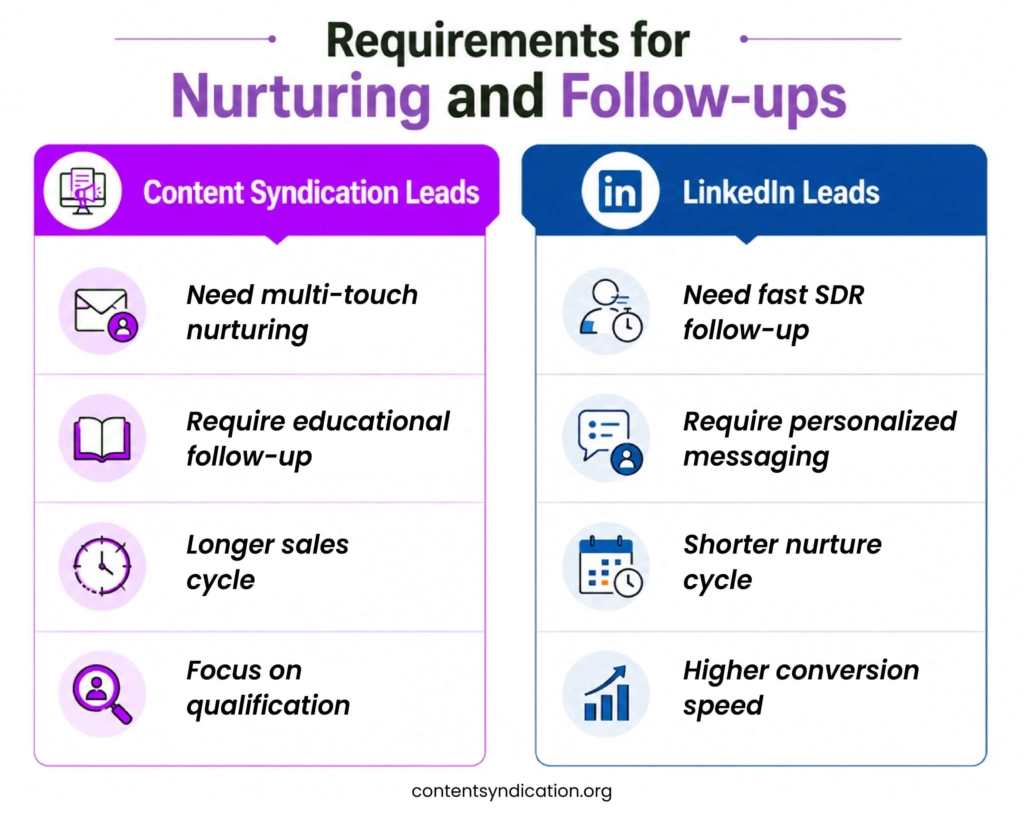
Both content syndication and LinkedIn Ads require structured follow-up.
The difference is often the buyer’s level of readiness.
Content Syndication Leads
Syndication leads frequently require additional nurturing because the initial interaction is content-driven.
Useful follow-up may include:
- Educational email sequences
- Related content
- Retargeting
- Case studies
- Research
- Intent monitoring
- Qualification
Sales teams should avoid treating every content download as an immediate buying signal.
LinkedIn Leads
Some LinkedIn campaigns may generate leads closer to a specific account or campaign objective.
Those leads may benefit from faster follow-up, particularly when the campaign is aligned with known accounts or higher-intent offers.
However, they still require relevant and personalized outreach.
Regardless of the channel, poor follow-up can reduce campaign ROI.
Lead generation is only the first stage.
The real value comes from converting engagement into qualified pipeline.
Attribution, ROI, and Pipeline Measurement
Attribution can be difficult when comparing content syndication vs LinkedIn Ads.
Content syndication often contributes to early-stage awareness and engagement, which may make direct revenue attribution harder without strong CRM tracking.
LinkedIn provides native campaign reporting and conversion tracking, but platform metrics still do not show the entire B2B buyer journey.
For both channels, marketers should track downstream metrics such as:
- MQL-to-SQL conversion rate
- Sales acceptance rate
- Opportunity creation rate
- Pipeline generated
- Pipeline velocity
- Revenue contribution
- Cost per opportunity
- Cost per acquired customer
A lead should not be considered successful simply because it was inexpensive.
The real question is:
Did the channel contribute to qualified pipeline and revenue?
When to Choose Content Syndication
Content syndication can be a strong choice when:
- You need scalable top-of-funnel demand
- You want to reach audiences beyond owned channels
- You are entering new markets
- You want to distribute high-value B2B content
- You need predictable CPL-based lead acquisition
- You want to build awareness across a wider ICP
It is particularly useful when your strategy includes educational content and structured nurturing.
When to Choose LinkedIn Ads
LinkedIn Ads can be a strong choice when:
- You need precise professional targeting
- You are running ABM campaigns
- You want to target named accounts
- You need job-title or seniority targeting
- You want direct control over campaign audiences
- You are promoting offers to narrowly defined segments
LinkedIn can be especially valuable when audience precision matters more than broad scale.
Should You Use Content Syndication and LinkedIn Ads Together?
In many cases, the strongest strategy is not choosing one channel over the other.
It is using both for different roles.
For example:
Content Syndication
→ Generate broader awareness and early engagement.
LinkedIn Ads
→ Reinforce messaging within selected accounts and buying committees.
Nurturing
→ Educate and qualify engaged prospects.
Sales Outreach
→ Engage accounts when intent and readiness increase.
This creates a more connected demand-generation system.
Instead of expecting one channel to perform every role, marketers can assign each channel to the part of the funnel where it performs best.
Content Syndication vs LinkedIn Ads: Which Is Better?
Neither channel is universally better.
The right choice depends on your campaign objective.
Choose content syndication when your priority is scalable content-driven demand generation and broader ICP coverage.
Choose LinkedIn Ads when your priority is highly controlled professional or account-level targeting.
Use both when you want to combine broader demand capture with precise account engagement.
The most important consideration is not lead volume.
It is whether the channel helps generate qualified opportunities and pipeline.
Frequently Asked Questions
1. Is content syndication cheaper than LinkedIn Ads?
Content syndication often uses a fixed CPL model, which can make lead costs more predictable. LinkedIn uses auction-based pricing, so costs vary based on competition and targeting. Actual cost efficiency should be evaluated based on downstream conversions, not CPL alone.
2. Which generates better B2B leads: content syndication or LinkedIn Ads?
Neither channel automatically produces better leads. Content syndication often captures earlier-stage content engagement, while LinkedIn can provide precise professional targeting. Lead quality depends on ICP fit, intent, qualification, and funnel progression.
3. Is content syndication good for B2B lead generation?
Yes. Content syndication can help B2B marketers distribute valuable content to relevant audiences, capture early-stage demand, generate leads, and expand reach beyond owned channels.
4. Is LinkedIn better for ABM campaigns?
LinkedIn can be particularly useful for ABM because marketers can target specific companies, job functions, seniority levels, and professional audiences.
5. Can content syndication and LinkedIn Ads be used together?
Yes. Content syndication can create broader awareness and engagement, while LinkedIn Ads can reinforce messaging within priority accounts. Using both can help cover multiple stages of the B2B buyer journey.
6. What should marketers measure when comparing these channels?
Marketers should look beyond CPL and measure MQL-to-SQL conversion, sales acceptance, opportunity creation, pipeline generated, cost per opportunity, and revenue contribution.
Compare Your B2B Campaign Options
Choosing between content syndication and LinkedIn Ads is more than a media-buying decision.
It is a pipeline strategy decision.
If your goal is predictable B2B growth, start by identifying:
- Your target audience
- Funnel stage
- Campaign objective
- Lead-volume requirement
- Targeting precision
- Sales capacity
- Pipeline goal
Then assign each channel a clear role.
In many mature B2B programs, the strongest results come from using channels together rather than forcing one channel to solve the entire demand-generation problem.
Not Sure Which Channel Fits Your B2B Funnel?
ContentSyndication.org helps B2B marketers reach relevant audiences, distribute high-value content, and generate qualified demand through targeted content syndication campaigns.
If you are deciding how to allocate your demand-generation budget, request a content syndication campaign plan and compare the right approach for your ICP, funnel stage, and pipeline goals.