
While syndication campaigns can consistently deliver opt-in prospects from trusted third-party publishers, not every lead enters the buying journey at the same stage. Some are actively evaluating solutions, while others are simply exploring industry insights.
Without a structured qualification process, marketing teams risk passing unqualified contacts to sales, resulting in wasted outreach, longer sales cycles, and declining confidence in campaign performance.
This is where BANT vs MQL vs SQL becomes an important discussion. Each framework serves a different purpose, and understanding when to use each can significantly improve lead quality, sales alignment, and pipeline contribution.
This guide explains how these qualification models work, where they differ, and how to apply them effectively within modern demand generation programs.
Why BANT Alone Isn’t Enough for Content Syndication
The BANT framework is one of the oldest and most widely recognized methods for qualifying prospects. Originally developed by IBM, it helps sales teams determine whether a prospect is likely to become a viable opportunity.
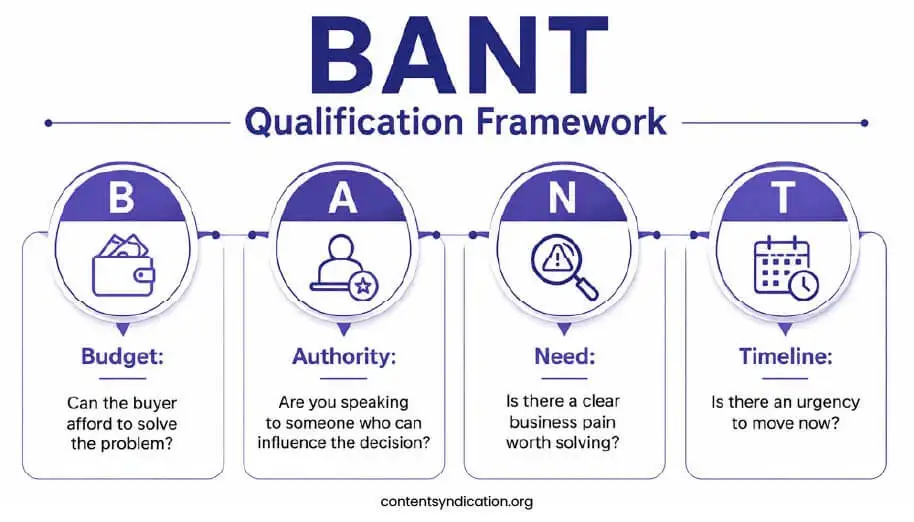
BANT evaluates four primary qualification criteria:
- Budget measures if the prospect has financial capacity.
- Authority measures if they can influence or make purchasing decisions.
- Need highlights if the organization has a clear business channel we can solve.
- Timeline shows if there is an expected timeframe for the purchase.
Rather than measuring marketing engagement, BANT focuses on sales readiness. It is most valuable during direct conversations where sales representatives can ask discovery questions and gather detailed information.
Its greatest strength is simplicity. By providing a structured conversation framework, sales teams can quickly determine whether an opportunity deserves additional attention.
However, BANT has limitations when applied too early. Many prospects downloading educational content have not yet established budgets or purchasing timelines, making complete qualification difficult during the initial interaction.
Signs a Content Syndication Lead Is Ready for Sales
- Requested a product demo
- Visited pricing or solution pages multiple times
- Downloaded multiple high-intent assets
- Replied to follow-up emails
- Matches your Ideal Customer Profile (ICP)
- Achieved the lead score defined by marketing and sales
From MQL to SQL: When a Syndicated Lead Is Ready for Sales
Modern buying journeys rarely move in a straight line. Buyers consume educational resources, compare vendors independently, and conduct extensive research before speaking with sales. As a result, marketing and sales rely on different qualification stages.
Marketing qualified leads represent prospects who have demonstrated sufficient interest through marketing engagement. This may include downloading premium content, attending webinars, requesting industry reports, or repeatedly interacting with relevant campaigns.
These leads indicate buying interest but are not necessarily ready for direct sales engagement.
By comparison, sales qualified leads have demonstrated stronger purchase intent or have been reviewed by sales and determined to be suitable for active conversations. These prospects often show behaviors such as requesting demonstrations, discussing business requirements, or expressing immediate project needs.
Understanding MQL vs SQL in B2B marketing allows organizations to align marketing activity with sales priorities while ensuring prospects receive the appropriate follow-up at each stage of their journey.
BANT vs MQL vs SQL: Key Differences Explained
Although these models are often discussed together, they solve different qualification challenges.
| Framework | Primary Purpose | Best Used By | Typical Stage |
|---|---|---|---|
| BANT | Evaluates buying readiness | Sales | Discovery conversations |
| MQL | Measures marketing engagement | Marketing | Early to mid-funnel |
| SQL | Confirms sales readiness | Marketing and Sales | Late funnel |
When evaluating BANT vs MQL vs SQL, the biggest difference lies in what each framework measures.
- MQLs focus on engagement signals.
- SQLs focus on purchase readiness.
- BANT validates whether a genuine business opportunity exists through direct qualification.
Rather than replacing one another, these frameworks often complement each other within a structured qualification strategy.
Which Framework Works Best for Content Syndication Campaigns?
There is no universal answer to BANT vs MQL vs SQL because different campaigns generate different types of prospects.
Content syndication often attracts buyers who are researching solutions rather than requesting immediate conversations. That means applying strict BANT criteria immediately after content consumption can eliminate valuable future opportunities.
Instead, organizations should first evaluate engagement and intent before introducing sales qualification.
An effective lead qualification framework typically follows a progressive approach:
- Capture verified opt-in prospects.
- Evaluate engagement and relevance.
- Apply behavioral and demographic qualification.
- Transition qualified prospects to sales.
- Validate opportunity through BANT during discovery.
This layered process helps organizations balance lead volume with lead quality while reducing unnecessary handoffs between marketing and sales.
For organizations comparing qualification frameworks, the strongest approach is not selecting one framework over another. Instead, successful demand generation programs integrate all three based on buyer readiness.
Building a Modern Lead Qualification Process
Today’s buying journeys involve multiple stakeholders, longer research cycles, and increasing digital engagement. Qualification strategies must evolve accordingly.
A modern lead qualification process begins with defining an ideal customer profile before campaigns launch. Marketing and sales should agree on company size, industry, job roles, buying triggers, and engagement thresholds.
Technology also plays an important role.
Using lead scoring, organizations can assign values to behavioral actions such as whitepaper downloads, repeat website visits, webinar attendance, and email engagement. These signals help prioritize prospects based on demonstrated interest instead of relying solely on individual interactions.
Marketing automation platforms can then route qualified prospects to sales while continuing to nurture contacts who require additional education.
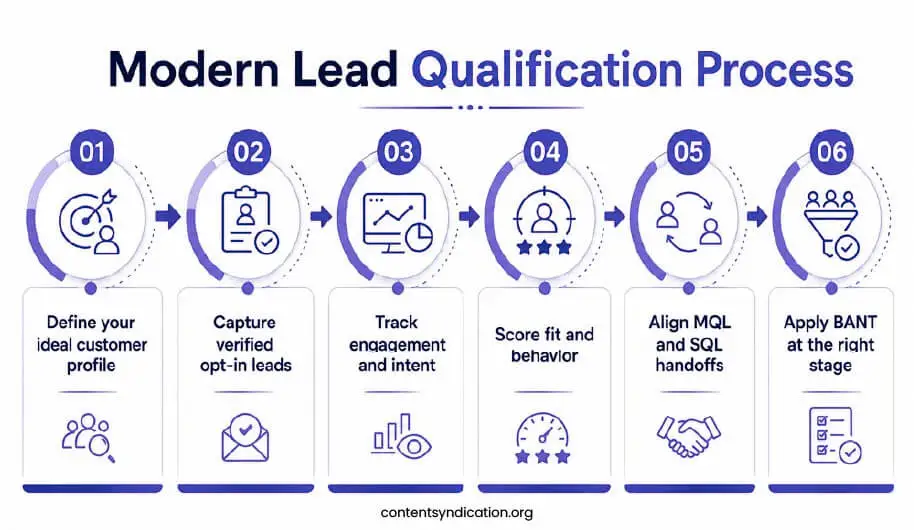
This approach supports more consistent demand generation qualification, ensuring every prospect receives follow-up appropriate to their stage in the buying journey.
Common Qualification Mistakes That Hurt Pipeline Growth
Even well-designed campaigns can underperform when qualification processes are inconsistent.
Some of the most common mistakes include:
Treating every download as a sales opportunity
Not every content consumer intends to purchase immediately. Premature outreach often results in lower response rates and reduced sales productivity.
Relying on only one qualification model
Organizations that debate BANT vs MQL vs SQL as mutually exclusive options often overlook the strengths of combining them throughout the customer journey.
Ignoring sales feedback
Marketing and sales should regularly review conversion data to refine qualification criteria and improve campaign performance.
Prioritizing quantity over quality
Generating larger lead volumes means little if opportunities fail to convert into revenue. Qualification should focus on pipeline contribution rather than lead counts alone.
Failing to revisit qualification criteria
Markets evolve, buyer behavior changes, and qualification standards should adapt accordingly through continuous optimization.
Frequently Asked Questions
What is the difference between BANT, MQL, and SQL?
The primary difference is the stage of qualification. Marketing evaluates engagement, sales evaluates readiness, and BANT validates whether a qualified opportunity exists through structured discovery.
Which model is better for content syndication?
Organizations evaluating qualification framework for content syndication typically achieve better outcomes by using engagement-based qualification first and applying BANT later during sales conversations.
What is the best lead qualification framework?
The best lead qualification framework depends on campaign goals, sales cycles, and buying behavior. Most successful B2B organizations combine multiple qualification methods instead of relying on one.
How should teams qualify syndication campaigns?
Teams looking at how to qualify content syndication leads should align qualification criteria with buyer intent, engagement signals, and sales readiness before initiating direct outreach.
Should marketing and sales use different qualification criteria?
Marketing measures engagement while sales validates purchase potential. Alignment between both teams creates smoother handoffs and stronger conversion rates.
Can an MQL skip directly to SQL?
An MQL can become an SQL if the prospect demonstrates strong buying intent through actions such as requesting a demo, asking for pricing, scheduling a consultation, or meeting your organization’s qualification criteria. Lead scoring, behavioral signals, and sales validation help determine when an MQL is ready to move directly into the sales pipeline.
Should every syndicated lead become an SQL?
No. Not every syndicated lead is ready for immediate sales engagement. Many prospects download content to research a topic rather than make a purchase decision. Marketing should nurture these leads until they demonstrate stronger intent, while sales should focus on prospects who meet qualification criteria and are ready for meaningful conversations.
Qualification Framework That Works Best
Choosing between BANT vs MQL vs SQL should not be about selecting a single methodology. Each framework contributes valuable insight at different stages of the buyer journey.
For organizations running content syndication campaigns, combining engagement signals with progressive sales qualification creates a more reliable path from lead generation to revenue. Marketing can focus on identifying high-potential prospects, while sales spends more time engaging buyers who are genuinely prepared for meaningful conversations.
By building a structured qualification strategy, businesses can improve conversion rates, strengthen marketing and sales alignment, and generate a healthier pipeline that supports long-term growth.
Looking to improve the quality of your content syndication leads? Explore our guide to B2B Content Syndication Vendors to understand how the right partner can help you generate better-qualified opportunities.