

Many B2B marketers invest significant budget into a content syndication campaign only to discover that lead quality, engagement, and conversion rates fall short of expectations. While targeting, audience selection, and distribution channels matter, one factor often determines campaign success before launch: the asset itself.
The content asset acts as the value exchange between your brand and your audience. It influences who responds, how much information they are willing to share, and whether they are genuinely interested in solving a business problem.
This makes asset selection a strategic decision rather than a creative one.
The challenge is that there is no universal “best” asset. A whitepaper that performs exceptionally well for a cybersecurity audience may struggle in a SaaS productivity campaign. Similarly, an ebook that generates high lead volume may not necessarily produce the strongest pipeline outcomes.
What Is a High-Performing Asset in Content Syndication?
A high-performing asset is not simply the one that generates the most downloads. It is the asset that attracts the right audience and moves them closer to a buying decision.
Effective assets typically share several characteristics:
- They address a specific business challenge.
- They provide practical insights rather than promotional messaging.
- They align with the buyer’s stage in the journey.
- They deliver clear value in exchange for contact information.
- They support meaningful sales conversations.
The strongest B2B lead generation assets help prospects understand a problem, evaluate potential solutions, or justify a future purchase.
Examples include:
- Industry research reports
- Whitepapers
- Ebooks
- Analyst guides
- Benchmark studies
- Solution comparison guides
- Case studies
Rather than asking, “Which asset is most popular?” marketers should ask, “Which asset best matches the audience we want to reach?”
Whitepapers vs Ebooks: Which Is Better?
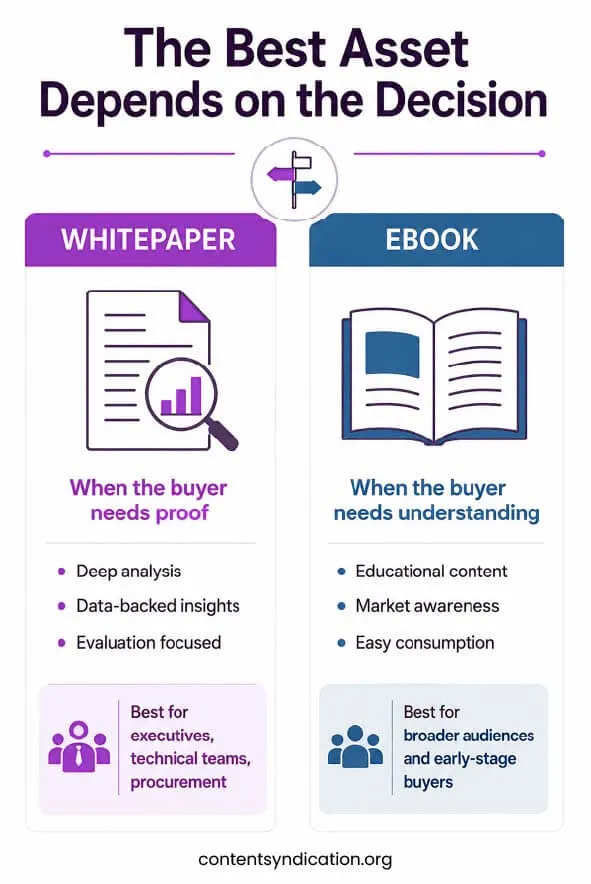
One of the most common decisions marketers have to make is to choose between whitepapers and ebooks. Although both formats are widely used in content syndication, they serve different purposes.
When evaluating whitepapers vs ebooks, the decision should depend on campaign objectives.
A whitepaper is often more effective when targeting technical buyers, procurement teams, or executives evaluating a significant purchase. These audiences expect data, analysis, and evidence.
An ebook may perform better when introducing a topic, educating a broader market, or building awareness around an emerging challenge.
Neither format is inherently superior. The right choice depends on the audience, buying stage, and desired outcome.
Mapping Assets to Funnel Depth
Asset selection becomes easier when viewed through the lens of funnel depth. Different buyers require different information depending on where they are in their journey.
Top of Funnel (TOFU)
At this stage, prospects are identifying challenges and exploring opportunities.
Recommended assets:
- Educational ebooks
- Industry trend reports
- Market overviews
- Beginner guides
The goal is visibility and engagement.
Middle of Funnel (MOFU)
Prospects have defined their problem and are actively researching solutions. This is where mid-funnel assets become valuable.
Recommended assets:
- Research reports
- Expert guides
- Benchmark studies
- Strategic frameworks
The objective is to help buyers evaluate options and understand potential approaches.
Bottom of Funnel (BOFU)
Prospects are closer to making a decision.
Recommended assets:
- Case studies
- Product comparison guides
- ROI calculators
- Implementation frameworks
At this stage, buyers need confidence, proof, and business justification.
The biggest mistake marketers make is using awareness-stage content for decision-stage audiences. Misalignment between funnel stage and content asset often leads to lower conversion rates and wasted budget.
Gated Volume or Asset Depth Which Impacts ROI More?
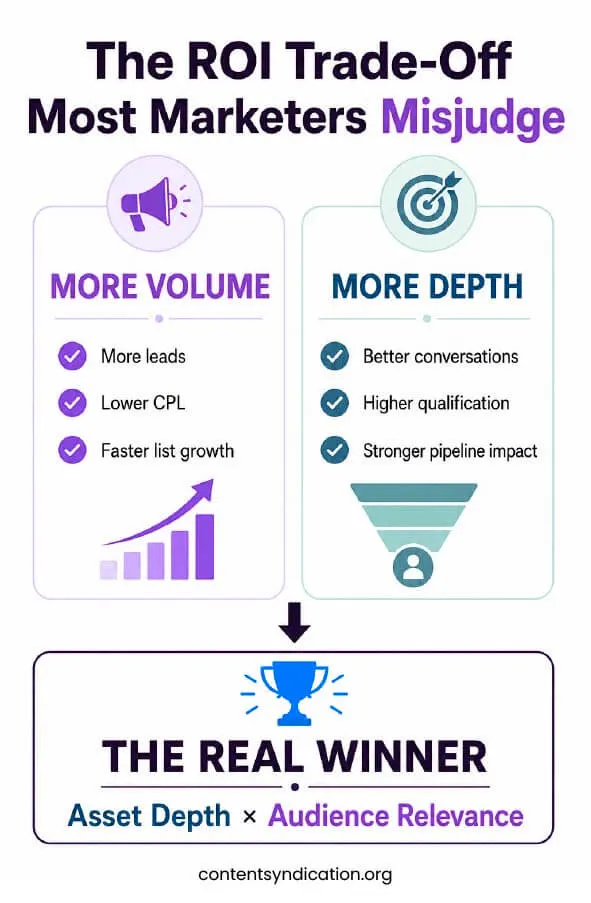
Many marketers wonder if they prioritize assets that generate more leads or assets that generate better leads? The answer depends on business objectives.
High-volume assets typically produce:
- Lower CPL
- Larger lead pools
- Greater audience reach
However, these leads may require additional nurturing before becoming sales-ready.
Deeper assets often generate:
- Lower lead volume
- Higher engagement
- Better qualification rates
- Stronger sales conversations
This is particularly true when the asset contains high-intent content that addresses specific business challenges, implementation concerns, or solution evaluation criteria.
Instead of focusing exclusively on lead quantity or lead quality, leading organizations evaluate both.
A campaign that produces fewer but highly qualified opportunities may deliver significantly better pipeline results than one generating thousands of lightly engaged contacts.
The most successful teams balance reach and depth based on revenue objectives.
Best Approach for Selecting Asset for Syndication
Different stakeholders consume information differently.
The same asset rarely resonates equally with executives, managers, technical teams, and procurement leaders.
Consider the following framework:
| Job Title | Preferred Content Type | Primary Goal |
|---|---|---|
| C-Suite Executives | Research reports, executive briefs | Strategic decision-making |
| VP and Directors | Industry benchmarks, frameworks | Planning and optimization |
| Managers | Practical guides, implementation resources | Execution |
| Technical Teams | Detailed documentation, whitepapers | Evaluation and validation |
| Procurement | ROI-focused content | Risk reduction |
Asset selection should reflect the responsibilities and priorities of the target audience.
For example, a CIO evaluating a cybersecurity platform may respond positively to a research-backed whitepaper. A marketing manager exploring campaign optimization may prefer a practical guide with actionable recommendations.
The closer the asset aligns with a stakeholder’s role, the greater the likelihood of meaningful engagement.
How to Measure ROI Beyond CPL
Cost per lead remains one of the most commonly tracked metrics in syndication programs.
However, CPL alone provides an incomplete picture. To evaluate the true impact of a content syndication campaign, marketers should monitor additional metrics such as:
Lead-to-MQL Conversion Rate
Measures how many syndicated leads meet qualification criteria.
Opportunity Creation Rate
Tracks the percentage of leads that progress into pipeline opportunities.
Pipeline Contribution
Evaluates total pipeline value generated by the campaign.
Revenue Attribution
Connects campaign activity directly to closed-won business.
Engagement Metrics
Analyze content consumption, email engagement, and follow-up interactions.
Sales Acceptance Rate
Measures how many leads are accepted and worked by the sales team.
These metrics provide a more accurate understanding of campaign effectiveness and business impact.
The ultimate objective is not simply generating leads. It is generating revenue opportunities.
FAQs
What is the best asset for content syndication?
There is no single best asset. The ideal choice depends on audience, funnel stage, campaign objectives, and buying intent.
Should I use a whitepaper or an ebook?
Choose based on audience needs. Whitepapers generally support deeper evaluation, while ebooks are often better for broader education and awareness.
How often should assets be refreshed?
Review performance quarterly and update assets whenever industry trends, product capabilities, or buyer priorities change.
Are gated assets always necessary?
Not always. Gated content works best when the value provided justifies the information requested from prospects.
How do I improve lead quality?
Focus on audience targeting, asset relevance, funnel alignment, and post-campaign lead qualification processes.
Conclusion
The most effective marketers align asset selection with buyer intent, funnel stage, and stakeholder priorities. Instead of chasing downloads alone, they focus on creating meaningful value exchanges that attract qualified prospects and support the buying journey.
When the right content reaches the right audience at the right moment, content syndication becomes more than a lead generation tactic. It becomes a predictable pipeline growth strategy.