
Generating qualified leads that actually move through the pipeline is the real challenge.
Many B2B marketers run content syndication campaigns to increase reach and capture opt-in leads at scale. But high form-fill numbers do not always translate into meaningful sales conversations. Most standard forms collect only basic contact details, offering little insight into intent, urgency, or buying readiness.
This is where custom questions become important.
By adding strategic qualification fields to syndication forms, marketers can identify stronger-fit prospects earlier, improve sales follow-up, and increase conversion efficiency. Instead of focusing only on lead volume, businesses can focus on lead quality and pipeline impact.
In this blog, we will explore how content syndication custom questions improve qualification, which questions work best, what to avoid, and how response data can support better sales and marketing outcomes.
How Custom Questions Help Improve Lead Quality
Content syndication can generate a large number of leads, but not every lead is ready for sales. Some prospects may only be researching, while others may already be comparing vendors or planning a purchase.
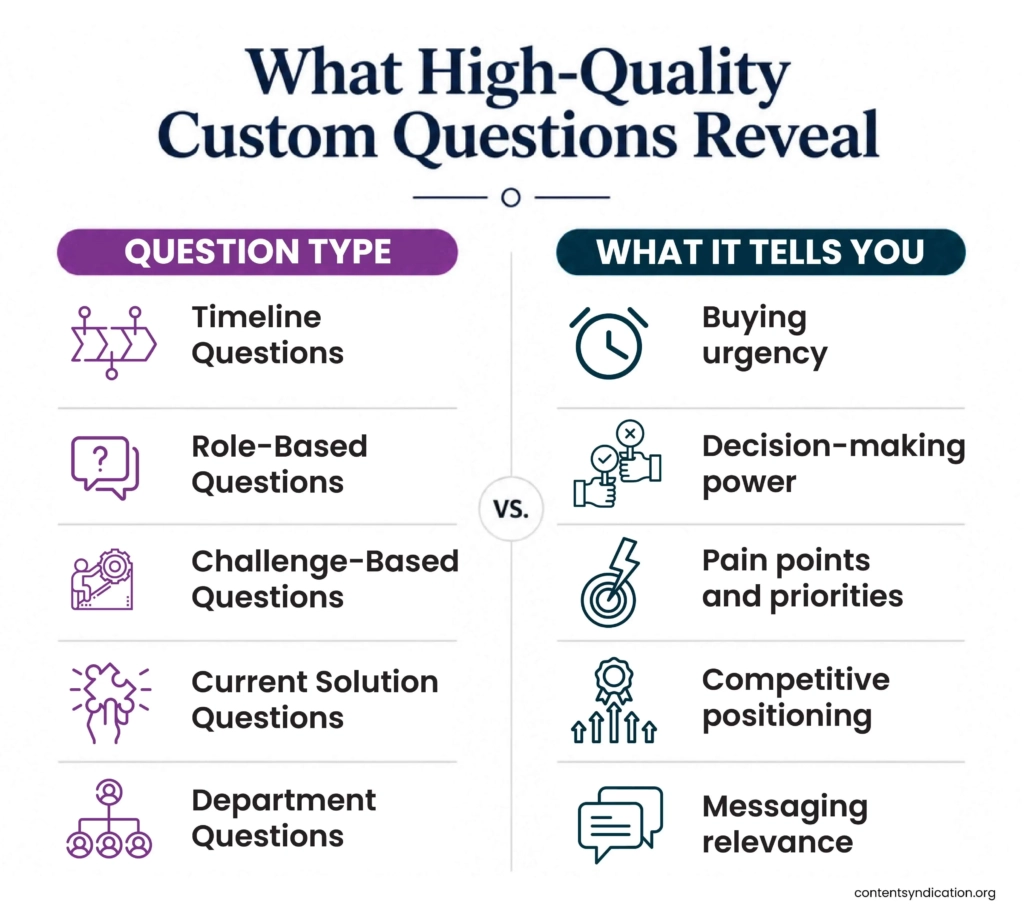
Custom questions help marketers understand the difference. By asking about challenges, timelines, current solutions, and decision-making roles, businesses can identify which leads are more likely to become real pipeline opportunities.
For example, two people may download the same whitepaper. One may be learning about the topic for future planning, while another may be evaluating solutions within the next three months. Without custom questions, both leads look the same. With the right qualification questions, sales and marketing teams can prioritize the stronger opportunity.
Why Custom Questions Matter in Content Syndication
Most syndication forms collect:
- Name
- Email address
- Job title
- Company name
While this helps identify a contact, it does not indicate whether the lead is a strong opportunity.
Custom qualification fields provide deeper insights into:
- Business priorities
- Purchase timelines
- Current challenges
- Decision-making authority
- Solution evaluation stage
This directly improves content syndication lead quality because marketers can better identify prospects likely to convert. For example, two people may download the same whitepaper. One may simply be researching trends, while another may be actively evaluating vendors.
Without qualification data, both leads appear identical.
This is why custom questions matter.
They help teams identify stronger intent signals earlier and improve alignment between marketing and sales.
These custom responses also help marketers:
- Refine audience segmentation
- Improve nurture workflows
- Optimize messaging
- Improve campaign performance
Most importantly, content syndication custom questions help businesses optimize for revenue impact instead of only lead volume.
What Makes a Good Custom Question?
Not every form field improves qualification. Poorly written questions create friction without adding meaningful value. A good custom question should:
- Gather actionable information
- Support qualification or segmentation
- Be easy to answer
- Improve sales context
- Align with campaign goals
The best content syndication custom questions are:
- Specific
- Relevant
- Easy to analyze
- Simple to answer
For example, instead of asking:
“What are your business challenges?”
Use a structured question like:
What is your biggest challenge related to cybersecurity visibility?
- Managing endpoints
- Compliance concerns
- Limited visibility
- Tool integration issues
- Resource limitations
Structured answers improve reporting consistency and make qualification easier.
The custom questions should also support qualification criteria and help marketers evaluate:
- Buying readiness
- Company fit
- Industry alignment
- Business needs
At the same time, forms should stay concise.
How to Align Custom Questions With Your Ideal Customer Profile
Before adding custom questions to a content syndication form, marketers should connect each question to their Ideal Customer Profile. This ensures the answers help identify whether a lead is a good fit for the business.
For example, if your ideal buyers are mid-market cybersecurity companies, your questions should help confirm company size, industry, role, current challenges, and buying stage.
Useful ICP-based questions may include:
- What is your company size?
- Which industry does your company operate in?
- What best describes your role in the buying process?
- What is your biggest challenge related to this topic?
- Are you currently evaluating a solution?
When custom questions are aligned with ICP criteria, marketing teams can separate high-fit leads from low-fit contacts more effectively.
Best Custom Questions to Ask
The most effective custom questions focus on intent, urgency, fit, and buyer readiness. These questions should be simple for the prospect to answer and useful for sales and marketing teams.
1. What Is Your Biggest Challenge Related to This Topic?
This question helps uncover the prospect’s main pain point. It also allows sales teams to personalize follow-up based on the specific challenge the lead is facing.
Example options:
- Reducing operational costs
- Improving security visibility
- Automating workflows
- Improving reporting accuracy
- Solving integration issues
2. What Is Your Expected Implementation Timeline?
Timeline questions help identify urgency and buying readiness. A prospect planning implementation soon may need faster sales follow-up, while a future researcher may be better suited for a nurture campaign.
Example options:
- Immediately
- Within 3 months
- Within 6 months
- Researching for future projects
3. Are You Currently Evaluating Solutions?
This question helps separate active buyers from early-stage researchers. Leads who are already comparing vendors or evaluating solutions usually show stronger buying intent.
Example options:
- Yes, actively evaluating
- Planning to evaluate soon
- Not currently evaluating
- Just researching
4. Which Solutions Are You Currently Using?
This question gives sales teams useful competitive and positioning context. It helps them understand the prospect’s current setup and personalize outreach around gaps, integrations, or replacement opportunities.
Example options:
- Existing vendor solution
- In-house/manual process
- Multiple tools
- Not using any solution currently
- Prefer not to say
5. What Best Describes Your Role in the Purchasing Process?
This question helps identify whether the lead is a decision-maker, influencer, researcher, or technical evaluator. It also helps sales teams adjust their messaging based on the person’s level of authority.
Example options:
- Final decision-maker
- Influencer or recommender
- Technical evaluator
- Researcher
- Not involved in purchasing decisions
6. What Is Your Company Size?
Company size helps determine whether the lead matches your ideal customer profile. It can also indicate budget potential, sales complexity, and product fit.
Example options:
- 1–50 employees
- 51–200 employees
- 201–500 employees
- 501–1,000 employees
- 1,000+ employees
7. Which Department Are You Part Of?
Department-level insights help improve segmentation and follow-up messaging. For example, a technical lead may need product details, while a business leader may respond better to ROI-focused messaging.
Example options:
- Marketing
- Sales
- IT
- Operations
- Finance
- Human Resources
- Other
These questions are considered some of the best custom questions for content syndication campaigns because they improve qualification without creating unnecessary friction. Strong custom questions should support both marketing optimization and sales execution.
Questions to Avoid
Not every question improves campaign performance. Some create friction without improving qualification. Avoid questions that are:
- Too personal
- Too broad
- Difficult to answer
- Irrelevant to campaign goals
Overly Personal Questions
Avoid asking for sensitive details too early in the journey.
Examples include:
- Detailed budget disclosures
- Internal operational data
- Personal contact details
Large Open-Ended Questions
Long text responses are difficult to analyze and often inconsistent.
Structured multiple-choice fields usually perform better.
Questions You Can Enrich Later
If information already exists in your CRM or enrichment tools, do not ask prospects to enter it manually.
Reducing friction improves conversion rates.
Many marketers trying to understand how to improve lead quality with custom questions assume more questions automatically create better qualification. In reality, relevance matters more than form length.
How to Validate Custom Question Responses
Custom question responses are useful, but they should also be validated before being passed to sales. Incorrect or inconsistent data can reduce lead quality and waste sales effort.
Marketing teams can validate responses by checking:
- Business email and company domain
- Job title and seniority
- Company size
- Industry fit
- Duplicate records in the CRM
- Match between the selected answers and the target audience criteria
For example, if a lead selects “decision-maker” but the job title shows an entry-level role, the lead may need further review before being routed to sales.
Validation helps ensure that only accurate and relevant leads move forward in the pipeline.
How to Use Answers for Lead Scoring
Collecting qualification data only matters if teams use it effectively.
The insights gathered through content syndication custom questions can significantly improve lead scoring models.
Instead of scoring leads only by downloads, marketers can score based on:
- Purchase timeline
- Job seniority
- Company size
- Industry fit
- Evaluation stage
For example:
| Lead Type | Recommended Follow-Up |
|---|---|
| Decision-maker with 3-month timeline | SDR call within 24 hours |
| Influencer with active project | Personalized email with relevant case study |
| Research-stage lead | Add to nurture campaign |
| Technical evaluator | Share product documentation or integration resources |
| Low-fit lead | Recycle, suppress, or continue light nurturing |
This helps improve the transition from MQL to SQL by ensuring sales teams receive better-qualified opportunities.
Response data also helps improve:
- Audience segmentation
- Messaging alignment
- Content positioning
- Future campaign targeting
Most importantly, content syndication custom questions help businesses prioritize pipeline quality over raw lead volume.
How Sales Should Follow Up Based on Responses
Qualification data improves sales conversations.
Generic outreach often fails because it lacks context.
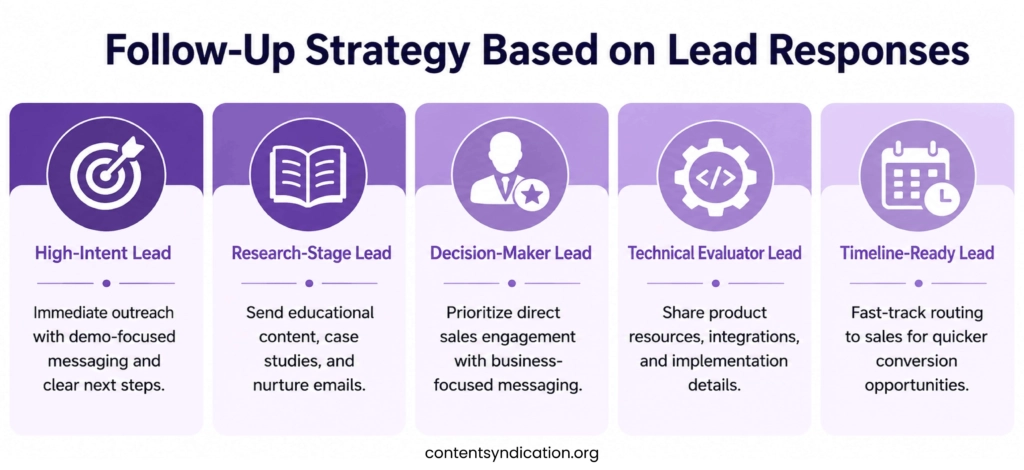
When sales teams receive detailed qualification insights, they can personalize follow-up based on:
- Pain points
- Business priorities
- Evaluation stage
- Purchase urgency
For example, a prospect planning implementation within three months may require immediate outreach and demo-focused messaging.
Meanwhile, early-stage researchers may respond better to educational content and nurture campaigns.
This approach helps teams prioritize sales-ready leads faster and improves overall pipeline efficiency.
It also creates better alignment between marketing and sales.
Additionally, using structured B2B lead qualification questions improves consistency across syndication campaigns and lead evaluation processes.
For scalable demand generation programs, strategic content syndication custom questions provide the visibility needed to improve qualification and conversion outcomes.
Additionally, using structured content syndication form questions for B2B marketers helps standardize lead evaluation across campaigns and syndication partners.
| Lead Type | Recommended Follow-Up |
|---|---|
| Decision-maker with 3-month timeline | SDR call within 24 hours |
| Influencer with active project | Personalized email with relevant case study |
| Research-stage lead | Add to nurture campaign |
| Technical evaluator | Share product documentation or integration resources |
| Low-fit lead | Recycle, suppress, or continue light nurturing |
Why Syndication Partner Quality Still Matters
Custom questions can improve qualification, but they cannot fix poor targeting. If the syndication partner is reaching the wrong audience, even the best form questions will not produce strong leads.
This is why marketers should also review partner quality, audience targeting, publisher relevance, lead validation process, and delivery standards.
A strong content syndication campaign depends on both smart qualification questions and the right audience source.
FAQ
1. What are custom questions in content syndication?
Custom questions in content syndication are extra form fields used to collect lead qualification details beyond basic contact information. They help marketers understand a lead’s challenges, timeline, buying role, and level of interest.
2. How many custom questions should a content syndication form include?
Most content syndication forms should include 2 to 5 custom questions. This is usually enough to qualify leads without making the form too long or reducing conversions.
3. Do custom questions reduce conversion rates?
Custom questions can reduce conversion rates if the form is too long or asks irrelevant questions. However, well-written questions often improve lead quality by helping marketers identify serious buyers and better-fit prospects.
4. Which custom questions show buyer intent?
The best custom questions for buyer intent focus on implementation timeline, active solution evaluation, current challenges, budget readiness, and purchasing role. These answers help sales teams identify leads that may be closer to a buying decision.
5. Should every content syndication campaign use the same questions?
No. Each content syndication campaign should use questions based on the topic, target audience, asset type, and campaign goal. A cybersecurity campaign, for example, may need different qualification questions than a marketing automation campaign.
6. Are multiple-choice questions better than open-text fields?
Yes, multiple-choice questions are usually better for content syndication campaigns because they are easier to answer, analyze, segment, and score. Open-text answers can be useful, but they are harder to standardize at scale.
7. How do custom questions improve MQL to SQL conversion?
Custom questions improve MQL to SQL conversion by giving marketing and sales teams better insight into lead fit, intent, urgency, and buying authority. This helps sales prioritize stronger leads and follow up with more relevant messaging.
8. How often should qualification questions be optimized?
Qualification questions should be reviewed after every campaign or at least once a quarter. Marketers should update questions based on lead quality, conversion rates, sales feedback, and pipeline performance.
Generate Better-Qualified Content Syndication Leads
Content syndication can help B2B marketers reach more prospects, but lead volume alone is not enough. To generate real pipeline value, teams need to understand who the lead is, what they care about, how urgent their need is, and whether they match the company’s ideal customer profile.
Custom questions make this possible. By asking about challenges, timelines, current solutions, company fit, and purchasing roles, marketers can improve lead scoring, sales routing, campaign segmentation, and follow-up quality.
The key is to keep questions relevant, simple, and connected to clear business actions. When used correctly, custom questions help businesses move beyond basic form fills and generate better-qualified content syndication leads.
Want to improve the quality of your content syndication campaigns? Only-B2B can help you design targeted campaigns that focus on qualified leads, better segmentation, and stronger pipeline outcomes.