

Two companies may operate in the same industry, have similar revenue and employ roughly the same number of people. Yet their technology environments can be completely different.
One may use Salesforce with AWS, while another relies on HubSpot and Microsoft Azure. For a software vendor selling a specific integration or migration solution, those differences can determine whether the company is a suitable prospect.
Traditional audience filters may identify both companies as potential buyers. They cannot, on their own, establish whether either company uses the systems needed for the proposed solution.
Technographic targeting in B2B content syndication addresses this gap by using information about an organization’s technology environment to refine audience selection, identify relevant use cases and distribute content that speaks to specific technical requirements.
However, technology data is not always complete or accurate. A useful campaign needs more than a list of software installations. Marketers must define the right technology criteria, validate the available signals and measure whether the resulting leads meet sales expectations.
This guide explains how to apply those principles to a practical content syndication campaign.
Why Firmographics Alone Miss Technology Fit
Firmographic data helps marketers identify companies based on characteristics such as industry, revenue, employee count and location. These attributes provide a useful starting point for defining an ideal customer profile (ICP).
But companies with similar firmographic profiles may have very different software requirements.
Consider a SaaS provider offering an application designed to integrate with Salesforce. Two companies may meet its industry and company-size requirements, but only one currently uses Salesforce.
Without technology information, a campaign may reach both companies even though their immediate integration requirements differ.
Relying only on firmographics can lead to:
- Poor product alignment: A company meets the general ICP but lacks the technology environment required for the solution.
- Irrelevant content distribution: Prospects receive guides that do not address their existing systems.
- Unnecessary sales qualification: Sales teams spend time establishing basic technical compatibility after leads have already been delivered.
- Missed use cases: Campaigns overlook companies with clear integration, migration or upgrade requirements.
Technographic segmentation adds another layer to audience selection.
It does not replace firmographics or prove that a company is ready to purchase. Instead, it helps marketers determine whether a relevant technical use case may exist.
For a broader explanation of reaching technology decision-makers, see our guide to B2B technology buyers through content syndication.
What Is Technographic Targeting in Content Syndication?
Technographic targeting is the practice of identifying and segmenting organizations based on the technologies they use or are reasonably believed to use.
The information may cover business applications, cloud platforms, databases, security systems, marketing tools and other elements of an organization’s technology environment.
In content syndication, marketers use these signals to identify relevant audiences and distribute gated resources through appropriate third-party publishers.
For example, a cybersecurity vendor offering integration with a particular cloud platform might target companies using that platform with a guide explaining the relevant security controls.
A typical process involves:
- Defining the technologies relevant to the solution.
- Identifying accounts with matching technology signals.
- Validating the available technology information.
- Segmenting accounts according to their potential requirements.
- Selecting assets that address those requirements.
- Distributing content and evaluating the resulting leads.
The goal is to improve audience relevance before the campaign begins, rather than discovering technical incompatibility after leads enter the CRM.
Technographics vs. Firmographics vs. Intent Data
These three data categories answer different questions about potential buyers.
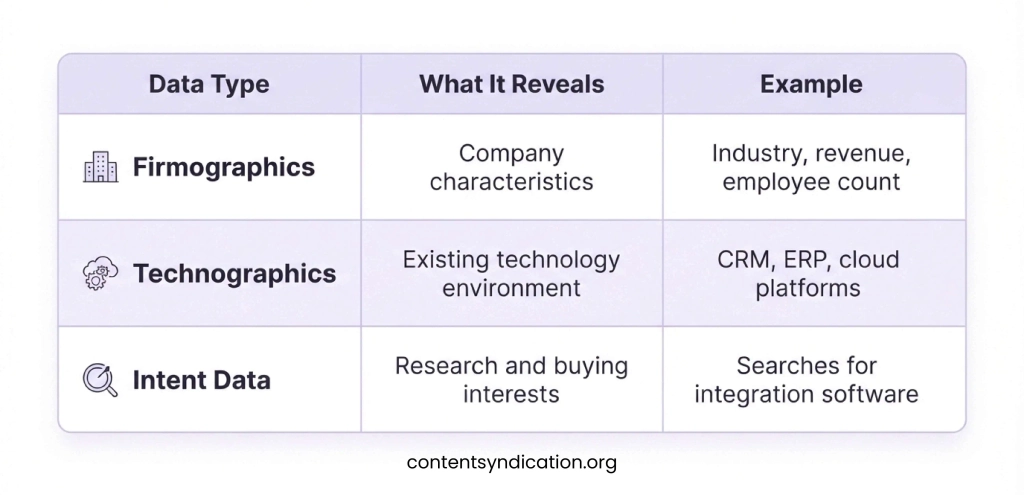
Firmographics establish organizational fit. Technographics help assess technical compatibility. Intent signals provide additional context about research activity.
Consider a company that meets your ICP and uses a compatible CRM.
That combination may make it a relevant target for an integration guide. If the company also shows meaningful interest in integration-related topics, it may warrant additional attention.
However, none of these signals independently proves purchasing authority, budget approval or readiness for a sales conversation.
Combining them is useful when each has a defined role in campaign qualification.
Technology Stack and Install-Base Signals to Evaluate
Effective technology stack targeting begins with identifying the systems that directly influence product compatibility or the proposed use case.
Not every detected application needs to become a targeting requirement.
Business Applications
CRM, ERP, marketing automation and customer support platforms can indicate whether a company operates in a relevant software environment.
For example, a provider offering CRM-to-ERP integration may prioritize accounts using compatible systems.
Cloud and Infrastructure Platforms
Cloud providers, hosting environments and infrastructure technologies may be relevant for cybersecurity, DevOps, migration and infrastructure-management solutions.
The specific platforms matter only when they have a meaningful relationship with the offering.
Software Versions and Legacy Systems
Older versions or systems approaching a planned transition may present potential upgrade or migration requirements.
However, a detected version should not automatically be treated as confirmation that the organization is planning a replacement.
Competing or Complementary Solutions
Install-base targeting can help identify companies using competing software or products that work alongside the advertised solution.
For example, an integration provider may want to reach companies already using a complementary platform.
Technology Adoption Signals
Recent deployments, publicly announced technology partnerships or verified infrastructure changes can provide useful context.
These signals should be interpreted carefully. A recent implementation may create an integration opportunity, but it may also mean the company is unlikely to consider another major system change immediately.
Record the Evidence Behind Each Signal
Before using a technology attribute as a strict targeting filter, record:
| Validation field | Why it matters |
|---|---|
| Technology name | Identifies the relevant product or platform |
| Evidence source | Shows where the information originated |
| Last verified date | Helps assess potential staleness |
| Confidence level | Distinguishes confirmed and inferred use |
| Relevant use case | Connects the technology to the campaign objective |
| Validation status | Shows whether the signal requires additional checks |
A publicly detectable website technology may provide useful evidence, but it does not necessarily reveal the company’s full internal software environment.
This distinction becomes particularly important when campaign success depends on a specific platform or software version.
Segment Audiences by Compatibility, Migration and Use Case
Companies using the same technology do not necessarily have the same business requirements.
A practical technographic segmentation strategy groups accounts according to why the technology matters to the promoted solution.
1. Compatibility-Based Segmentation
Identify organizations using platforms that directly integrate with the advertised product.
For example, a data integration provider could prioritize companies using Salesforce and NetSuite, provided those platforms are supported by the integration being promoted.
The relevant content might explain supported integrations, implementation considerations or common data synchronization challenges.
2. Migration-Based Segmentation
Identify accounts using legacy or competing systems that may be candidates for migration.
A cloud services provider might distribute a migration-planning guide to companies with relevant on-premise infrastructure.
The presence of a legacy platform creates a possible use case, not proof of an active migration project.
3. Use-Case-Based Segmentation
Group accounts around operational problems associated with particular technology combinations.
For example, a company using separate CRM and email marketing systems may be relevant to a guide about data synchronization, provided that integration challenge is applicable.
| Segment | Technology-fit requirement | Content approach |
|---|---|---|
| Compatibility | Uses a supported platform | Integration guide |
| Migration | Uses a relevant legacy or competing system | Migration assessment |
| Use case | Has a technology combination linked to a specific challenge | Practical implementation resource |
Avoid making every available technology attribute mandatory.
Overly restrictive criteria may reduce reachable account volume without improving downstream lead quality. Our guide on avoiding over-targeting in content syndication campaigns explores this trade-off.
Step-by-Step Technographic Content Syndication Campaign Setup
A technology-focused campaign should connect audience selection, publisher requirements, asset relevance and lead acceptance before distribution begins.
The following example illustrates how the process can work.
Suppose a SaaS provider offers a data integration product for Salesforce users. The company wants to reach relevant mid-market accounts in the United States.
Step 1: Define Campaign Objectives
Start by identifying the desired outcome.
The campaign may aim to educate technically relevant buyers, generate qualified leads for an integration solution or support an existing account-based marketing program.
For this example, the objective is to generate leads from companies with a relevant Salesforce integration use case.
Step 2: Establish Technology Criteria
Define both mandatory and preferred targeting requirements.
| Targeting attribute | Illustrative requirement |
|---|---|
| Geography | United States |
| Company size | 200 – 2,000 employees |
| Technology | Salesforce usage |
| Relevant departments | IT, sales operations, revenue operations |
| Preferred signal | A relevant integration or data-management requirement |
| Exclusions | Existing customers, suppressed accounts, unsuitable company types |
These criteria are illustrative rather than universal best practices.
A technology should be a mandatory filter only when it is genuinely necessary for the product or campaign objective.
Step 3: Identify Target Accounts
Use technographic intelligence and publisher audience data to identify accounts that appear to meet your requirements. Check whether the technology match comes from direct evidence, verified company information, or an inferred model.
Before approving a technographic audience segment, ask your data provider or syndication partner:
- What evidence supports each technology match?
- When was the information last verified?
- Is the attribute confirmed or inferred?
- How are unknown technology matches handled?
- Can technology verification status be included in lead reporting?
- How are incorrect matches treated under the campaign’s acceptance rules?
These questions help establish whether the available technology data is reliable enough for the campaign’s targeting requirements.
Step 4: Build Audience Segments
Separate the account list by relevant requirements.
For this example, the campaign might distinguish:
- Companies seeking CRM-to-ERP integration.
- Organizations managing disconnected customer data.
- Accounts considering data integration improvements.
These segments should be based on supported evidence or relevant campaign responses, rather than assigning an assumed business problem to every company using Salesforce.
Step 5: Select Relevant Assets
Match each segment to an asset that addresses its likely information needs.
An integration checklist may suit teams exploring platform compatibility, while a technical implementation guide may help audiences evaluating deployment requirements.
Avoid using one generic asset simply because all accounts share the same software platform.
Step 6: Launch Distribution with Clear Acceptance Rules
Before distributing content, agree with the syndication partner on the fields and checks required for delivery.
These may include:
- Company and contact identifiers.
- Job role and relevant company attributes.
- Campaign and content asset source.
- Required technology attribute and its verification status.
- Applicable consent or other lawful communication basis.
- Deduplication and account-suppression rules.
- Rejection reasons and replacement conditions.
Confirm that the publisher can actually support the required technology targeting and reporting. If a mandatory attribute cannot be verified, define how the lead will be handled rather than silently treating the match as confirmed.
Step 7: Review Lead Acceptance and Segment Performance
Once leads enter the CRM, compare delivery records against the agreed acceptance requirements.
Review inaccurate technology matches, missing fields, rejected leads and the performance of individual audience segments.
Where relevant, feed sales feedback back into the targeting rules.
For more on preserving campaign fields and ownership during lead delivery, see our content syndication CRM integration guide.
Match Syndicated Assets to Technology-Stack Needs
Content relevance depends on the technical problem a prospect may be trying to solve.
A company using a particular platform should not automatically receive every asset related to that platform.
Instead, connect the technology signal to an appropriate business question.
| Audience segment | Recommended content asset |
|---|---|
| Legacy ERP users | ERP modernization guide |
| Companies using multiple CRM platforms | Integration checklist |
| Cloud migration prospects | Cloud migration whitepaper |
| Users of competing software | Solution comparison guide |
The buyer’s stage of evaluation also affects which content is useful.
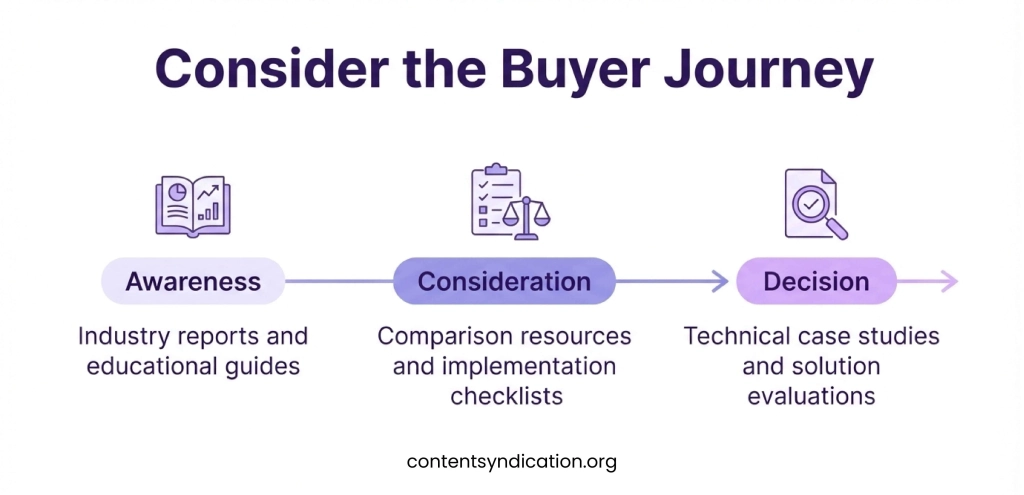
Awareness
Use industry reports and educational guides to explain relevant challenges and approaches.
Consideration
Offer comparison resources, implementation checklists and materials addressing technical requirements.
Decision
Provide technical case studies, evaluation guides and implementation details that support deeper assessment.
A technology match can improve content relevance, but it should not be used as a substitute for understanding the prospect’s actual needs.
Data Accuracy, Coverage Gaps and Privacy Considerations
Technographic data can become outdated as companies introduce new platforms, replace vendors, migrate infrastructure or change software configurations.
A campaign that depends on an inaccurate technology match may deliver leads that appear qualified but are unsuitable for the advertised solution.
Check Data Freshness
Ask when the technology information was collected or last verified.
A technology detected several months ago may still be in use, but the detection date alone cannot establish its current status.
Recognize Coverage Gaps
Some technologies are visible through public websites or documented integrations. Others are internal systems that cannot be reliably detected from outside the organization.
Absence of a detected technology should not automatically be treated as proof that the company does not use it.
Separate Confirmed and Inferred Information
Use clear classifications where possible:
- Confirmed: Supported by sufficiently reliable and current evidence.
- Inferred: Suggested by indirect signals but not independently verified.
- Unknown: Insufficient evidence to determine usage.
For campaigns with strict technology requirements, decide in advance which classifications qualify for delivery.
Validate Data at the Right Stage
Some information can be checked before distribution. Other requirements may need confirmation during lead qualification or through a relevant, appropriately designed question.
Do not assume that a company-level technology signal validates the individual contact’s responsibilities or purchasing authority.
Respect Privacy and Communication Requirements
Company technology information and personal contact data are not interchangeable.
When technographic intelligence is combined with identifiable lead records, review the applicable privacy, data-use and electronic marketing requirements.
Campaign teams should document the relevant communication permissions or lawful basis, maintain suppression records and honor applicable opt-out rights.
For a closer look at publisher and consent considerations, see our B2B content syndication consent requirements guide.
Measure Segment-Level Lead Acceptance and Opportunity Impact
Lead volume alone does not show whether technology-based targeting has improved a campaign.
The more useful question is whether leads from each segment meet the agreed technical requirements and progress toward meaningful sales outcomes.
Metrics to Track
| Metric | What it measures |
|---|---|
| Lead acceptance rate | Share of delivered leads accepted under the agreed criteria |
| Technology-fit rate | Share of accepted leads with a verified match to the preferred technology criteria. |
| Cost per qualified lead | Campaign spend divided by qualified leads |
| Meeting conversion rate | Share of the defined lead cohort progressing to meetings |
| Opportunity creation rate | Share of the defined lead cohort becoming opportunities |
| Pipeline contribution | Opportunity value attributed to or influenced by the campaign under the agreed model |
Example: Technology-Fit Campaign Performance
Suppose a content syndication campaign delivers 200 leads.
After validation and sales review:
- 150 leads pass the campaign’s general acceptance checks.
- Of those 150 accepted leads, 120 have a verified match to the preferred technology criteria.
- 30 accepted leads progress to held meetings.
- 8 accepted leads become opportunities.
For this example, verified technology usage is a preferred attribute, not a mandatory acceptance condition.
| Metric | Calculation | Result |
|---|---|---|
| Lead acceptance rate | 150 ÷ 200 × 100 | 75% |
| Verified technology-fit rate among accepted leads | 120 ÷ 150 × 100 | 80% |
| Meeting conversion rate | 30 ÷ 150 × 100 | 20% |
| Opportunity creation rate | 8 ÷ 150 × 100 | 5.3% |
These figures are illustrative calculations, not actual campaign results or industry benchmarks. Meeting and opportunity conversion rates use accepted leads as the denominator.
The technology-fit rate should be compared with the campaign’s agreed acceptance rules. If technology fit is mandatory, any discrepancy between accepted leads and verified matches requires investigation.
Compare Performance Across Segments
Evaluate compatibility, migration and use-case segments separately.
For example, a migration-focused segment may generate fewer leads but produce more qualified sales meetings.
That does not necessarily make it the strongest segment overall. Compare the cost, acceptance quality, opportunity value and observation period before reallocating budget.
For additional downstream measurement considerations, see our lead-to-meeting conversion rate guide.
Frequently Asked Questions
1. What is technographic targeting in B2B content syndication?
Technographic targeting uses information about companies’ technology environments to identify relevant audiences for syndicated content. It helps marketers select accounts whose software or infrastructure may be compatible with the promoted solution.
2. How can marketers identify companies based on their technology stack?
Marketers can use technology intelligence providers, relevant public information, company-level records and publisher targeting capabilities. The available signals should be evaluated for source reliability, freshness and coverage before use.
3. What are some technographic targeting examples for B2B marketers?
Examples include reaching companies using a supported CRM with integration guides, targeting legacy ERP users with migration resources and sharing technical comparison materials with organizations using competing software.
Each example depends on a valid relationship between the detected technology and the advertised offering.
4. How can marketers improve B2B lead quality using technographic data?
Combine technology-fit requirements with relevant ICP criteria, define acceptable evidence standards and validate delivered leads against the agreed campaign rules.
Review rejected leads and downstream sales outcomes to determine whether the technology filters are helping.
5. Can technology data be combined with intent data?
Yes. Technology information helps establish potential product compatibility, while intent signals provide context about relevant research activity.
Using both may help prioritize accounts, but neither guarantees that an organization has an approved project or an immediate purchasing requirement.
Plan a Technology-Fit Content Syndication Campaign
Reaching relevant B2B buyers requires more than matching industry, revenue or job-title filters.
For products with specific integration, migration or infrastructure requirements, the technology environment can be an important part of audience qualification.
Technographic targeting helps marketers apply that information before content is distributed. The approach works best when teams define relevant technology criteria, understand data limitations and validate results against sales acceptance requirements.
The objective is not to target the largest possible number of companies using a particular platform. It is to identify organizations where the promoted content addresses a credible technical need.
Planning a Technology-Focused Content Syndication Campaign?
If your product depends on specific software platforms, integrations, or infrastructure requirements, define those technology-fit criteria before choosing your audience.
Contact the ContentSyndication.org team to discuss your target accounts, technographic segmentation requirements, and lead qualification criteria for an upcoming B2B content syndication campaign.