
A syndicated lead can look promising on paper. The company fits your target market, the job title matches your ideal customer profile, and the contact has downloaded a relevant white paper.
But there’s an important question that doesn’t always get asked before the lead enters your CRM:
Does your organization have an appropriate legal basis to use that person’s information for the intended follow-up?
This is where content syndication can become complicated.
Unlike a lead captured through your own website, a syndicated lead may pass through a publisher, a distribution partner, and a syndication vendor before reaching your marketing team. Each handoff introduces questions about how the information was collected, what the prospect was told, and whether its intended use is permitted.
A completed form alone doesn’t answer those questions.
For B2B marketers, understanding content syndication consent requirements is not simply about avoiding regulatory problems. It is also about receiving leads with a clear source, usable documentation, and realistic expectations about future communication.
This guide explains what marketers and vendors need to consider, what evidence to request, and how to manage consent-related information throughout the lead lifecycle.
What Does Consent Mean in B2B Content Syndication?
In B2B content syndication, consent refers to an individual’s permission for particular uses of their personal information, where consent is the applicable legal basis.
It might be requested when someone downloads an ebook, registers for a webinar, or completes a form hosted by a third-party publisher.
However, there’s an important distinction between agreeing to access content and agreeing to receive future marketing communications.
Consider a typical example.
A technology professional downloads a cybersecurity report from an industry publication. The report is sponsored by a software provider.
The professional may understand that they are receiving the report from the publication. But did the form also make it clear that their details could be passed to the software provider? Were they told what type of follow-up to expect?
Those details matter.
Under the GDPR, when an organization relies on consent as its lawful basis, that consent must be freely given, specific, informed, and unambiguous. Individuals must also be able to withdraw it.
However, consent is not the only possible lawful basis under the GDPR. Depending on the circumstances, another basis, such as legitimate interests, may be applicable. The relevant rules for the communication channel must also be considered.
The European Data Protection Board’s guidance on lawful processing explains these distinctions.
The practical lesson is that a content download should never be treated as unrestricted permission for every subsequent use of a person’s information.
Why Consent and Lead Source Transparency Matter
Marketers naturally spend considerable time evaluating lead quality.
They check whether a contact belongs to the right industry, holds the right position, works at a suitable company, and has engaged with relevant content.
These are important checks, but they don’t tell the whole story.
A lead may meet every targeting requirement and still be unsuitable for a planned marketing activity if the original collection process cannot support that use.
For marketers
Poor consent documentation can create several operational problems:
- Prospects receive messages they weren’t expecting.
- Sales representatives cannot explain where a contact came from.
- Marketing teams struggle to process objections or opt-out requests.
- CRM records contain incomplete information about collection and permitted use.
- Lead disputes become difficult to investigate.
There is also a customer experience issue.
When someone asks, “How did you get my details?” your team should be able to provide a clear and accurate explanation.
For content syndication vendors
The same transparency is important for publishers and vendors.
A vendor that maintains reliable collection records can answer buyer questions, investigate complaints, and demonstrate how a lead originated.
This is particularly valuable in campaigns involving several publishing partners.
Instead of treating every lead as an interchangeable record, marketers can evaluate the quality and traceability of individual sources.
For a broader view of how source quality affects campaigns, read our guide to first-party data in B2B content syndication.
What Information Should Be Captured When a Lead Is Generated?
A checkbox alone is rarely enough to explain the circumstances in which personal information was collected.
Marketers need enough information to understand what happened at the original collection point and whether their planned use is supported.
The exact information required depends on the campaign, jurisdiction, and applicable lawful basis. However, a useful collection record generally includes the following.
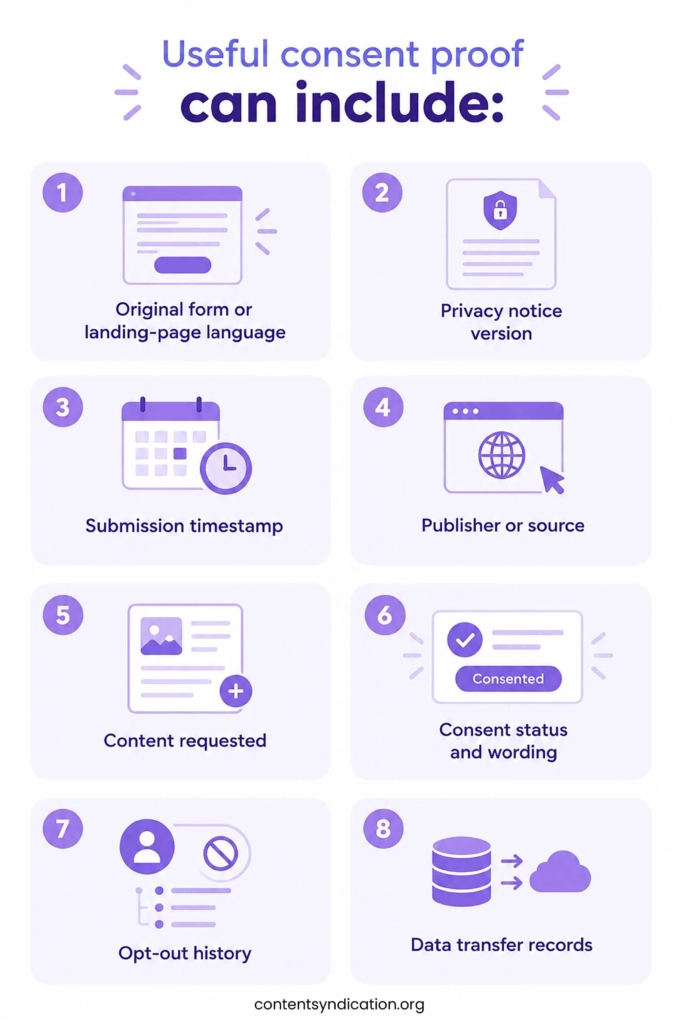
| Information | Why it matters |
|---|---|
| Name and business contact details | Identifies the individual and the information collected |
| Company and job details | Supports campaign qualification and targeting |
| Content asset requested | Establishes the context of the interaction |
| Submission date and time | Documents when the information was collected |
| Publisher and campaign source | Identifies the original collection channel |
| Form or landing-page reference | Helps reconstruct what the individual saw |
| Consent wording, where applicable | Shows what permission was requested |
| Privacy notice version | Helps establish what information was disclosed |
| Lawful basis and intended use | Supports decisions about processing and follow-up |
| Opt-out and preference status | Helps prevent unwanted communication |
| Transfer details | Documents how the lead reached the receiving organization |
Not every campaign will require all these fields in exactly this format.
The important point is to collect and preserve the information necessary to justify and manage the intended activity.
A lead record containing only a name, email address, and campaign ID may be sufficient for basic routing. It is unlikely to provide the same level of transparency when someone questions how their information was obtained.
B2B Content Syndication Consent Requirements by Region
One of the most common mistakes in international content syndication is applying the same consent process to every market.
Privacy and electronic marketing requirements can differ significantly depending on where the individual is located, how the information is obtained, and how the marketer intends to contact them.
GDPR: European Union and European Economic Area
The GDPR requires organizations processing personal data to identify an appropriate lawful basis and meet relevant transparency, accountability, and individual rights obligations.
Consent is one potential lawful basis, but it isn’t automatically required for every B2B processing activity.
Where consent is relied upon, it must satisfy the GDPR’s validity requirements, and the organization must be able to demonstrate that valid consent was obtained.
Marketers should also distinguish between the lawful basis for processing personal information and separate rules governing direct marketing communications.
Before launching a European campaign, establish:
- What personal information will be collected?
- Who will collect it?
- Which organizations will receive it?
- What lawful basis supports each relevant processing activity?
- What information must be provided to the individual?
- Which electronic marketing rules apply to the intended outreach?
- How will objections, withdrawal, or other rights requests be handled?
These questions should be resolved before campaign activation, not after a lead dispute.
United Kingdom: UK GDPR and PECR
UK B2B marketing requires particular attention to the recipient type and communication method.
Under the UK’s Privacy and Electronic Communications Regulations (PECR), the rules for marketing to corporate subscribers differ from those for sole traders and certain partnerships.
For example, prior consent under PECR is generally not required for unsolicited marketing emails sent to corporate subscribers. However, UK GDPR obligations still apply when personal data is processed, including requirements relating to lawful basis, transparency, and the right to object.
The UK Information Commissioner’s Office provides detailed guidance on business-to-business marketing.
California: CCPA and CPRA
The California Consumer Privacy Act, as amended by the California Privacy Rights Act, takes a different approach from the GDPR.
For businesses covered by the law, relevant obligations may include providing privacy notices, responding to applicable consumer rights requests, and honoring certain opt-out rights relating to the sale or sharing of personal information.
The meaning of “sharing” under the CCPA has a specific legal definition and should not be confused with every ordinary transfer of lead data between business partners.
B2B contact information should not automatically be treated as outside California privacy requirements.
Marketers should understand the roles of the organizations involved, the purposes of disclosure, and whether relevant rights or contractual obligations apply.
See the California Privacy Protection Agency’s CCPA information for additional context.
United States: CAN-SPAM
For US commercial email marketing, the CAN-SPAM Act is an important consideration.
The law applies to commercial B2B email as well as consumer-facing commercial email.
CAN-SPAM does not impose a general prior opt-in requirement for commercial email. However, senders must meet requirements relating to truthful message information, appropriate disclosures, physical postal addresses, unsubscribe mechanisms, and honoring opt-out requests.
The Federal Trade Commission’s CAN-SPAM compliance guide explains these obligations.
Other federal and state laws may also affect a particular campaign, especially where telephone outreach, text messages, or additional data practices are involved.
Quick regional comparison
| Regulation | Main consideration for syndicated leads |
|---|---|
| EU GDPR | Lawful basis, transparency, accountability, individual rights, and applicable marketing rules |
| UK GDPR and PECR | Personal data obligations and recipient-specific electronic marketing rules |
| California CCPA/CPRA | Privacy notices, applicable consumer rights, and sale/sharing obligations |
| US CAN-SPAM | Requirements for commercial email, including identification and opt-outs |
This comparison is a starting point, not a substitute for reviewing the laws applicable to a particular campaign.
How Can Marketers Verify Consent for Syndicated Leads?
A vendor’s statement that its leads are “GDPR compliant” or “fully opted in” should be the beginning of a conversation, not the end of the verification process.
The buyer needs to understand how those claims are supported.
That doesn’t necessarily mean requesting a screenshot for every individual submission.
It does mean agreeing on what evidence the vendor must maintain and how that evidence can be reviewed when necessary.
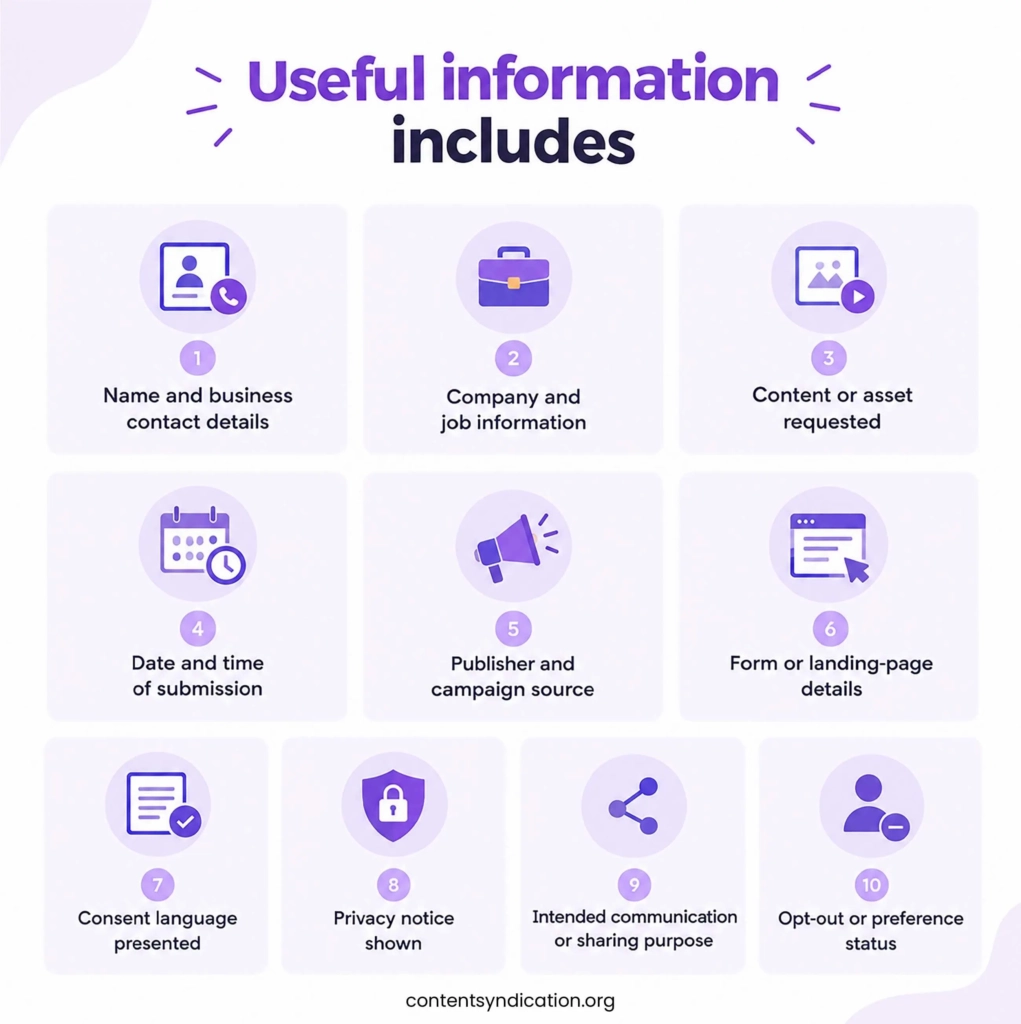
Useful documentation may include:
- The original form or landing-page wording
- The privacy notice applicable at the time
- Submission timestamps
- Publisher and campaign identifiers
- Details of the content requested
- Consent choices and wording, where consent applies
- Relevant lawful basis information
- Opt-out and preference history
- Records of lead transfer between parties
What should a buyer look for?
Start with the collection experience.
If the lead came from a third-party website, ask what the prospect saw before submitting their information.
Was the sponsoring company identified where necessary? Was the intended use explained? Could the individual make an informed decision? Were any optional choices presented appropriately?
Then look at traceability.
Can the vendor connect the delivered record to a specific source and collection event?
Finally, assess whether the documentation actually supports the activity your marketing team intends to carry out.
An audit trail is useful evidence, but a detailed audit trail cannot make an otherwise unlawful collection process compliant.
Example: A Syndicated Lead Consent Record
To understand how this works, consider a fictional B2B cybersecurity campaign.
A software company sponsors a downloadable report distributed through an industry publisher. A prospect completes a registration form and the publisher transfers the record through an authorized syndication partner.
The buyer might maintain a record similar to the following.
| Field | Illustrative record |
|---|---|
| Campaign | Enterprise Security Report |
| Publisher | Example Industry Media |
| Content requested | 2026 Enterprise Security Research |
| Submission date | October 5, 2026 |
| Collection source | Publisher-hosted registration page |
| Privacy notice | Version 3.2 |
| Sponsor disclosure | Recorded from the form shown to the prospect |
| Consent choice, if applicable | Stored with exact wording and status |
| Intended follow-up | Defined in the approved campaign documentation |
| Transfer record | Publisher to authorized syndication vendor to buyer |
| Preference status | No opt-out recorded at the time of transfer |
This is a fictional documentation example. It does not establish that any particular outreach is lawful or that the hypothetical collection process meets regulatory requirements.
A record like this helps the receiving marketer investigate the origin of a lead.
It also highlights information that may be missing.
For example, if the buyer cannot retrieve the original disclosure or establish the relevant lawful basis, the team may need to pause the intended use until those questions are resolved.
Publisher, Vendor, and Buyer Responsibilities
Consent and privacy obligations do not automatically end when a lead is transferred.
Each organization involved in a content syndication campaign needs to understand its role and obligations.
Publisher responsibilities
The publisher should understand the collection process it operates and be able to document relevant notices, choices, and source information.
If the publisher collects personal information on behalf of another organization, the applicable legal roles and contractual arrangements should be clearly established.
Syndication vendor responsibilities
The vendor should understand how participating publishers collect and transfer lead information.
Depending on its role, this may involve maintaining source documentation, applying agreed collection standards, managing data transfers, and supporting requests for collection evidence.
Marketer or lead buyer responsibilities
The receiving marketer needs to evaluate whether the information may be used for its intended purpose.
It should not assume that every lead delivered by a vendor can automatically be used for unrestricted marketing outreach.
Contracts should clearly define permitted uses, privacy notices, applicable data protection roles, transfer arrangements, retention expectations, security responsibilities, opt-out handling, and procedures for responding to rights requests.
These considerations also belong in the initial campaign planning process. Our B2B content syndication campaign brief template explains how buyers can document operational requirements before launching a campaign.
Lead Source Transparency and Data Provenance
When a contact enters your CRM, the source field may simply say “Content Syndication.”
That label explains the channel, but it doesn’t explain the record’s origin.
Which publisher collected it? Which asset generated the registration? When was it submitted? Which partner transferred the information?
Without these details, investigating a problem becomes much harder.
Data provenance means maintaining information about where data originated and how it moved between systems or organizations.
For a B2B content syndication program, stronger provenance can support several practical activities:
- Investigating disputed leads
- Reviewing publisher performance
- Identifying recurring opt-out complaints
- Tracing unexpected data transfers
- Evaluating source-specific quality problems
- Supporting appropriate privacy and data protection reviews
It can also help marketing teams distinguish between two publishers that deliver similar lead volumes but provide very different levels of transparency.
This is why source documentation should be part of vendor evaluation rather than an afterthought.
Managing Opt-Outs, Suppression Lists, and Communication Preferences
Consent and privacy management do not stop when the lead is delivered.
A prospect’s preferences may change after the original registration.
They may unsubscribe from email, object to direct marketing, withdraw previously given consent, or exercise an applicable privacy right.
The correct response depends on the request and governing law, but relevant systems should be capable of acting on it.
Keep suppression information connected
Suppose a prospect unsubscribes from your marketing emails.
A month later, another publisher includes the same person in a new content syndication campaign.
If your suppression process doesn’t recognize the existing preference, the contact may enter your marketing automation platform again and receive unwanted communication.
To reduce that risk, teams should:
- Maintain appropriate suppression information.
- Apply suppression checks to new lead deliveries.
- Define how opt-out information moves between relevant systems and partners.
- Establish a process for conflicting or outdated preferences.
- Avoid treating a new data delivery as automatically overriding an earlier objection or opt-out.
- Respect applicable legal requirements for responding to requests.
A clearly defined process is more dependable than relying on individual team members to remember which records should not be contacted.
How to Store Consent Information in Your CRM
Your CRM is often where syndicated lead information becomes actionable.
Sales teams use it to prioritize contacts. Marketing teams use it for segmentation, nurturing, reporting, and campaign attribution.
If consent-related information is lost during the transfer from publisher to vendor to marketing automation platform, teams may not have enough context to make appropriate decisions later.
Relevant CRM fields may include:
| CRM field | Purpose |
|---|---|
| Lead source | Identifies the acquisition channel |
| Original publisher | Records where the lead originated |
| Campaign and asset | Identifies the content interaction |
| Collection timestamp | Records when the information was submitted |
| Applicable lawful basis | Documents the basis identified for relevant processing |
| Consent status and purpose | Records permission where consent is relied upon |
| Consent wording reference | Connects the record to the relevant statement |
| Privacy notice version | Identifies the applicable notice |
| Opt-out date | Records when an objection or unsubscribe occurred |
| Suppression status | Helps prevent inappropriate re-entry |
| Communication preferences | Supports appropriate channel and preference handling |
Not all fields need to be visible to every sales representative.
However, the organization should have a reliable way to preserve, retrieve, and use the information needed for compliance and campaign operations.
Access controls and appropriate retention periods are important as well. Retaining more personal information than necessary does not automatically make a program safer.
10 Questions to Ask a Content Syndication Vendor Before Launch
Before approving a new vendor or publisher network, have a direct conversation about data collection and documentation.
These ten questions provide a useful starting point:
- Where are leads originally collected? Identify the actual publishers, platforms, or collection environments.
- What lawful basis supports the intended processing? Understand how this is assessed for each relevant campaign and jurisdiction.
- What does the prospect see before submitting a form? Request representative landing pages, notices, and collection language.
- Is the sponsoring company identified where required? Confirm whether the intended recipients and purposes of data use are appropriately disclosed.
- Can the original consent wording be retrieved? Where consent applies, the vendor should explain how it records the wording and relevant choices.
- How are opt-outs and objections managed? Review procedures for recording, applying, and communicating applicable preferences.
- Can every delivered lead be traced to its source? Ask which identifiers and collection records will be provided or retained.
- How long is lead information retained? Understand the purpose, retention arrangements, and deletion procedures.
- What happens when a lead is disputed? Establish investigation steps, response expectations, and any agreed replacement policy.
- What documentation can be provided during a compliance review? Agree on the evidence available and the process for requesting it.
These questions help buyers move beyond general assurances about lead quality.
For additional guidance on evaluating providers, see our B2B content syndication vendor comparison and selection guide.
Common Content Syndication Consent and Compliance Mistakes
Even well-planned campaigns can encounter problems when privacy considerations are addressed too late.
1. Assuming every download creates marketing permission
Someone downloading a report has shown interest in the content. That action does not automatically authorize every possible form of follow-up or data processing.
2. Using vague collection language
People should be given the information required to understand how their personal data will be used.
Generic statements about unspecified partners may not provide sufficient transparency in every situation.
3. Treating the vendor’s compliance claim as proof
A vendor may have established processes, but buyers still need to understand what evidence is available and whether the intended use is supported.
4. Losing collection details during CRM import
Mapping only basic contact fields can leave the receiving team without source, notice, purpose, or consent-related information.
5. Failing to coordinate suppression
A preference recorded in one platform is less effective if another part of the marketing operation continues using outdated information.
6. Assuming all B2B contacts follow the same rules
A business email address does not eliminate privacy obligations. Geographic location, recipient type, processing activity, and communication method can change the applicable requirements.
7. Keeping documentation without reviewing it
Storing timestamps and form references is useful, but documentation must also be relevant, accurate, and connected to a lawful collection and processing process.
Pre-Launch B2B Content Syndication Consent Checklist
Before activating a campaign, use this checklist with your marketing, operations, legal, and vendor teams.
- The original collection sources are identified.
- Applicable jurisdictions and communication rules have been assessed.
- Relevant lawful bases have been established.
- Privacy notices and collection language have been reviewed.
- Consent choices are properly documented where applicable.
- Publisher, vendor, and buyer responsibilities are defined.
- Required source and collection records can be retrieved.
- Opt-out and suppression procedures are documented.
- CRM fields preserve necessary consent and provenance details.
- Retention, access, and deletion requirements are addressed.
- Lead disputes and evidence requests have a defined process.
- Campaign stakeholders understand the approved uses of lead information.
A short review before launch can be more effective than trying to reconstruct incomplete records after a campaign has delivered thousands of leads.
Frequently Asked Questions
Do B2B content syndication leads always require explicit consent?
No. The requirements depend on the applicable laws, lawful basis for processing, recipient location, and intended communication method. Under the GDPR, consent is one possible lawful basis, not the only one. Separate electronic marketing rules may also apply.
Is downloading a white paper the same as opting into marketing?
Not automatically. A download establishes that the individual requested content. Whether it also supports subsequent marketing depends on the collection disclosures, relevant choices, applicable lawful basis, and governing marketing rules.
What proof of consent should a content syndication vendor provide?
Where consent is the relevant basis, supporting evidence may include the original consent wording, submission timestamp, collection source, privacy notice version, and recorded choice. Other lawful bases may require different documentation.
Can marketers use syndicated leads under GDPR legitimate interests?
Legitimate interests may be available for certain processing activities, but organizations must complete the relevant assessment and satisfy GDPR requirements. Separate electronic marketing rules may still require consent for particular communications.
Does CAN-SPAM require prior consent for B2B marketing emails?
CAN-SPAM does not generally require prior opt-in permission. However, it regulates commercial email and includes requirements such as truthful sender information, appropriate disclosures, and effective opt-out mechanisms. Other applicable laws may impose additional obligations.
Should consent information be stored in a CRM?
Relevant information should be preserved in a reliable, accessible system. A CRM or connected data management platform may store the source, timestamp, lawful basis, consent details where applicable, and communication preferences.
What if a vendor cannot provide consent or collection evidence?
Pause the affected use while clarifying the source, applicable lawful basis, and documentation. If sufficient evidence cannot be established, the buyer should not assume the information is suitable for the planned activity.
Who is responsible when a content syndication lead creates a privacy complaint?
Responsibility depends on each organization’s legal role, actions, and applicable law. Publishers, vendors, and lead buyers should define their respective obligations through appropriate processes and contractual arrangements.
Conclusion: A Qualified Lead Should Also Be Traceable
A content syndication campaign can deliver contacts that match your target accounts, job functions, and industry criteria.
But lead qualification should not end with demographic accuracy.
Marketers also need to understand where the information came from, what was disclosed during collection, which processing and communication activities are permitted, and how relevant preferences will be handled.
For vendors, maintaining clear records makes it easier to answer questions and resolve disputes. For buyers, that transparency supports more informed decisions about how syndicated leads enter marketing and sales workflows.
Before scaling your next campaign, ask one simple question:
Can we explain where this lead came from and why we can use the information for our intended purpose?
If the answer is unclear, review the process before moving forward.
Planning a B2B Content Syndication Campaign?
Choosing a syndication partner involves more than comparing lead volumes and cost per lead.
Review your requirements for audience targeting, lead validation, source transparency, consent documentation, reporting, and campaign delivery before committing your budget.
Explore our B2B Content Syndication Vendor Selection Guide to compare providers and identify the questions worth asking before launch.