
Manufacturing has always been built on relationships, technical expertise, and long sales cycles. However, today’s buying environment has changed significantly. Buyers conduct extensive research before speaking with suppliers, compare multiple vendors online, and involve several stakeholders throughout the purchasing process. As a result, relying solely on trade shows, referrals, and outbound sales is no longer enough to maintain a healthy pipeline.
Modern manufacturers need a predictable way to connect with decision-makers before they begin evaluating vendors. This shift has made manufacturing content syndication an important component of a scalable growth strategy.
By distributing valuable content through trusted third-party publishers and industry platforms, manufacturers can engage qualified prospects who are actively researching solutions. Rather than waiting for buyers to discover your business, content syndication places your expertise directly in front of the right audience.
Quick Answer: Manufacturing content syndication helps industrial and manufacturing companies distribute technical and educational content through trusted third-party channels. It allows them to reach operations leaders, engineers, plant managers, procurement teams, and other stakeholders before they contact sales.
Which Manufacturing Industries Can Use Content Syndication?
Manufacturing content syndication can support demand generation across several specialized sectors, including:
- Industrial automation
- Robotics and machinery
- Manufacturing software
- Industrial IoT
- Electronics and electrical equipment
- Automotive manufacturing
- Aerospace and defence manufacturing
- Supply chain and logistics technology
- Engineering and production solutions
Each sector may require different targeting criteria, technical content, and qualification questions. However, the core objective remains the same: reaching relevant stakeholders while they are researching a business or operational challenge.
Understanding Content Syndication for Manufacturing
At its core, manufacturing content syndication is the process of promoting your content across relevant industry publications, media networks, and professional communities to reach targeted business audiences.
Instead of depending entirely on your website traffic, manufacturers distribute resources such as guides, technical papers, product comparisons, and industry reports through external platforms where potential buyers are already consuming information.
Content syndication prioritizes engagement. Prospects voluntarily access your content by completing a registration form, providing your sales and marketing teams with permission-based leads that have already demonstrated interest.
Manufacturers can use different content syndication platforms to distribute technical and educational assets beyond their existing website audience.
This makes content syndication particularly valuable for manufacturers selling complex products or services where education plays a significant role in purchase decisions.
As part of a broader manufacturing lead generation approach, syndication helps companies consistently attract qualified prospects while supporting long-term relationship building.
Why It Works
Content syndication helps manufacturers:
- Reach decision-makers earlier in their buying journey.
- Expand visibility beyond their existing audience.
- Generate qualified leads at scale.
- Build credibility through educational content.
- Support sales teams with better-informed prospects.
Instead of interrupting buyers with promotional messages, manufacturers become trusted sources of information during the research phase.
Manufacturing Buyer Journey and Decision-Making Process
Manufacturing purchases rarely happen overnight.
Whether purchasing industrial equipment, automation software, engineering solutions, or production technologies, buying decisions often involve multiple departments and lengthy evaluation periods.
Typical stakeholders include:
- Operations managers
- Plant managers
- Procurement teams
- Engineering leaders
- Technical specialists
- Finance executives
Each stakeholder evaluates vendors from a different perspective. Some focus on technical performance, while others prioritize cost, implementation, compliance, or long-term reliability.
This complexity makes education a critical part of the buying experience.
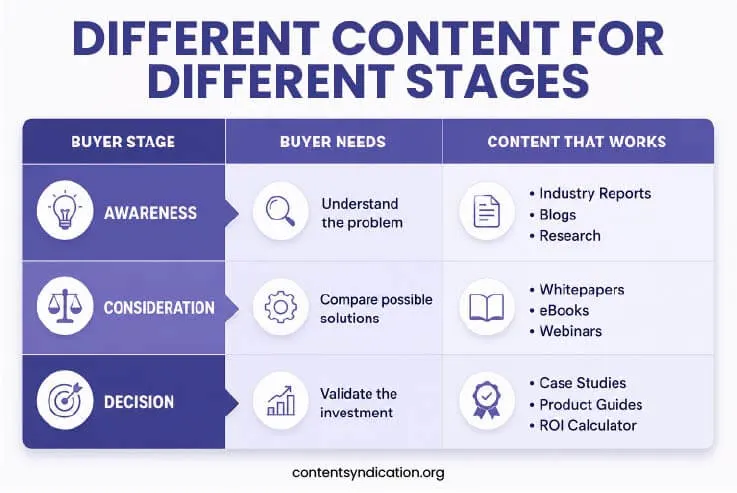
Successful manufacturing content syndication campaigns align content with every stage of the buyer journey.
Awareness Stage
Buyers identify operational challenges or opportunities for improvement.
Helpful content includes:
- Industry reports
- Educational blogs
- Trend analysis
- Research studies
Consideration Stage
Buyers begin comparing possible approaches.
Content typically includes:
- Whitepapers
- Product comparison guides
- Technical webinars
- Solution briefs
Decision Stage
Prospects narrow vendor options and validate investment decisions.
Effective resources include:
- Case studies
- Customer success stories
- Product demonstrations
- ROI calculators
Supporting buyers with relevant information at every stage builds confidence while improving conversion opportunities.
Best Content Formats for Manufacturing Lead Generation
Different content formats address different buyer needs. A diverse content strategy allows manufacturers to engage prospects across multiple decision stages.
Here are several formats that consistently perform well for manufacturing content syndication campaigns.
Whitepapers
Technical whitepapers provide detailed insights into industry challenges, technologies, compliance requirements, and engineering solutions. They help establish subject matter expertise while generating high-quality leads. A structured white paper syndication campaign can help manufacturers distribute technical research to relevant engineering, operations, and procurement audiences.
Case Studies
Real-world customer success stories demonstrate measurable business outcomes and reduce buyer uncertainty.
eBooks
Comprehensive guides help educate buyers on emerging technologies, implementation strategies, and industry trends.
Webinars
Live and on-demand webinars allow manufacturers to explain complex topics while encouraging direct engagement. Webinar content syndication can extend the lifespan of technical presentations and generate leads after the live session has ended.
Research Reports
Original research builds authority while providing valuable market intelligence that buyers actively seek.
Product Guides
Detailed product documentation helps technical evaluators compare specifications, capabilities, and implementation considerations.
Combining these formats creates a balanced manufacturing content marketing strategy that supports both awareness and purchase readiness.
How to Build a High-Performing Manufacturing Content Syndication Campaign
An effective content syndication campaign requires more than publishing great content. Success depends on aligning audience targeting, content quality, distribution, and lead management.
Step 1: Define Your Ideal Customer Profile
Identify the industries, company sizes, job functions, and geographic regions that best match your solution.
Clear audience targeting improves lead quality while reducing unnecessary acquisition costs. Before finalizing these filters, follow a structured B2B content syndication campaign launch process to align targeting, content, budget, and lead criteria.
Step 2: Create High-Value Educational Content
Manufacturing buyers value practical expertise over promotional messaging.
Focus on solving problems rather than selling products.
The strongest content answers important questions, explains industry challenges, and provides actionable insights.
Step 3: Choose the Right Distribution Partners
Work with reputable publishers and content syndication vendors that have verified access to your target manufacturing audience.
Quality distribution directly influences campaign performance and lead relevance.
Organizations evaluating industrial content syndication services should prioritize audience quality, transparency, and data accuracy over volume alone.
Step 4: Establish Lead Qualification Criteria
Not every download represents a sales-ready opportunity.
Custom qualification questions can help identify a prospect’s role, operational challenges, project timeline, and current solution-evaluation stage.
Develop qualification frameworks based on firmographic information, engagement level, and buying intent before routing leads to sales.
This helps strengthen your manufacturing sales pipeline while improving sales productivity.
Teams can also use BANT, MQL, and SQL criteria to decide which manufacturing leads should remain in nurture and which are ready for sales.
Step 5: Build Timely Follow-Up Processes
Lead generation is only the beginning.
Fast, relevant follow-up improves engagement and increases the likelihood of meaningful sales conversations.
Marketing and sales alignment is essential for maximizing campaign performance.
As part of a broader manufacturing demand generation program, content syndication works best when supported by consistent nurturing and personalized outreach. A structured content syndication lead nurture plan helps teams follow up according to buyer role, engagement, ICP fit, and purchase intent.
What KPIs to Measure?
Measuring the right metrics helps manufacturers optimize future campaigns while demonstrating marketing impact.
Important KPIs include:
Lead Volume
The total number of qualified leads generated during the campaign.
Cost Per Lead (CPL)
Measures acquisition efficiency and budget performance.
Lead Quality
Evaluates how closely generated prospects match your ideal customer profile.
Conversion Rate
Tracks how effectively leads progress through each sales stage.
Sales Acceptance Rate
Measures how many marketing-generated leads are accepted by the sales team.
Pipeline Contribution
Connects marketing activity directly to revenue opportunities.
Rather than focusing exclusively on lead quantity, successful manufacturers prioritize lead quality and long-term pipeline value. This balanced approach strengthens both marketing performance and industrial lead generation outcomes.
Common Mistakes Manufacturing Marketers Should Avoid
Even well-designed campaigns can underperform when common mistakes go unnoticed. Reviewing the most common B2B content syndication mistakes can help teams avoid weak targeting, premature sales handoffs, and poor campaign measurement.
- Targeting everyone instead of your ideal buyers.
Build a clearly defined ICP and target decision-makers who are most likely to convert.
- Leading with product features instead of buyer challenges.
Create educational content that helps buyers solve problems before promoting your solution.
- Marketing and sales working with different qualification criteria.
Align both teams on lead definitions, follow-up timelines, and campaign goals.
- Measuring success by lead volume alone.
Track lead quality, pipeline contribution, and revenue impact alongside lead volume.
- Delaying follow-up after content engagement.
Respond quickly with relevant outreach while buyer intent is still high.
Frequently Asked Questions
What is manufacturing content syndication?
Manufacturing content syndication is the practice of distributing educational content through third-party publishers and industry platforms to generate qualified business leads for the manufacturing industry.
Why is content syndication effective for manufacturers?
Manufacturing buyers spend considerable time researching vendors before contacting sales. Syndication helps companies engage prospects during this research phase with valuable educational resources.
Which content performs best?
Whitepapers, technical guides, case studies, webinars, research reports, and product comparison resources consistently generate strong engagement.
How do manufacturers measure campaign success?
Organizations typically evaluate lead quality, conversion rates, cost per lead, sales acceptance, pipeline contribution, and overall return on investment.
Can content syndication support long sales cycles?
Yes, by providing relevant educational content throughout the buyer journey, manufacturers remain visible while buyers evaluate multiple solutions over extended decision timelines.
How does content syndication support modern buyer behavior?
As part of a comprehensive manufacturing lead generation strategy, content syndication helps businesses educate buyers early, build credibility, and maintain engagement until prospects are ready to speak with sales.
Is content syndication suitable for industrial manufacturing companies?
Yes. It is particularly useful for companies selling industrial equipment, automation platforms, manufacturing software, engineering services, and other complex solutions that require buyer education before a sales conversation.
How should manufacturers follow up with syndicated leads?
Manufacturers should follow up with content related to the asset downloaded, the prospect’s role, industry challenges, and likely buying stage. Leads showing strong ICP fit and intent can be prioritized for sales, while others should enter a structured nurture program.
Turn Manufacturing Content Into Qualified Pipeline
Modern manufacturing buyers expect valuable information before they engage with suppliers. Organizations that consistently educate, inform, and nurture prospects are better positioned to generate qualified opportunities and accelerate revenue growth.
If you’re looking to improve manufacturing content syndication performance, generate higher-quality leads, and strengthen your pipeline through B2B manufacturing demand generation, partnering with an experienced content syndication provider can help you reach the right buyers with the right message at the right time.