
B2B buyers rarely make complex purchasing decisions after consuming a single piece of content. They research solutions, compare approaches, evaluate business risks and consult colleagues before deciding which vendors deserve consideration. Marketing teams must therefore support a decision process that extends beyond the first content download.
Content syndication can support these decisions by making relevant resources available through publishers buyers already use. The goal is not simply to capture a download. It is to help the right people answer the questions that stand between initial research and an informed vendor decision.
What Buyer Enablement Means in B2B
Buyer enablement helps potential customers understand their challenges, evaluate available solutions and make informed purchasing decisions. It includes the information, tools and resources buyers need to assess options and build agreement within their organisation.
A structured B2B buyer enablement strategy accounts for different needs of multiple stakeholders. Instead of measuring success only through content engagement, teams consider whether their resources help buyers answer important questions, resolve uncertainty and move towards a decision.
Buyer enablement differs from lead nurturing. Nurturing determines how a company follows up with a contact after engagement; buyer enablement starts with what the buyer needs to understand, compare or explain to colleagues. The two activities can work together, but they should not be measured as the same thing.
How Content Syndication Supports Buyer Enablement
Content syndication distributes relevant assets through third-party publishers and platforms, helping businesses reach audiences beyond their owned channels. These assets can include research reports, industry guides, expert articles, webinars and practical frameworks.
The value lies in connecting the right audience with content that addresses a real business question.
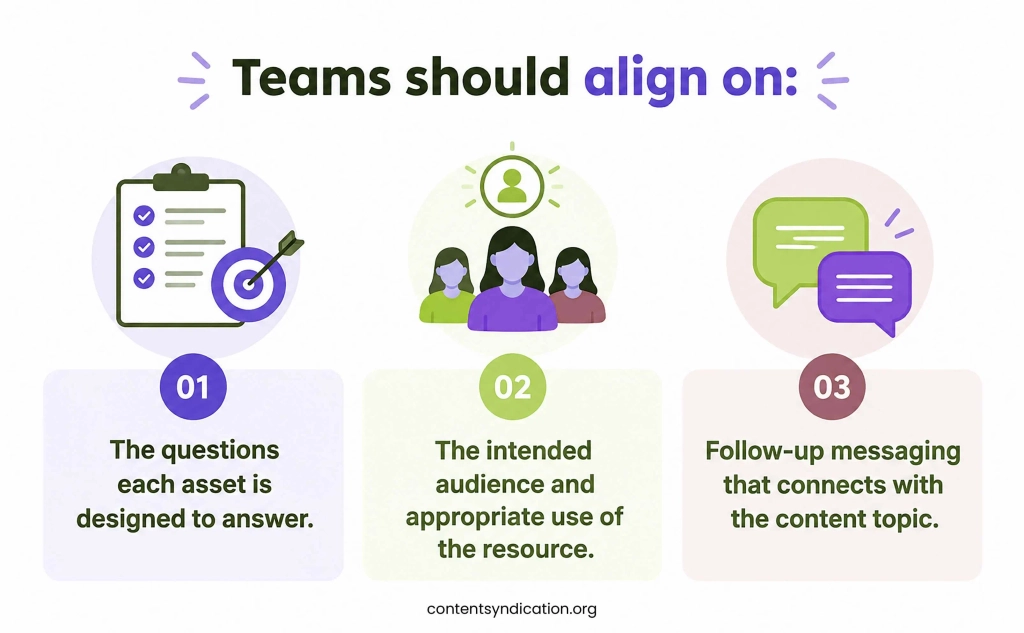
A useful content syndication buyer enablement program starts with a buyer question, not a content format. Teams identify the account and role they need to reach, select an asset that answers a specific question, choose a relevant distribution partner, and offer a sensible next resource. Marketing can then see whether the engagement led to further evaluation rather than assuming every download signals intent.
Before launch, align three decisions:
• Audience: Reach relevant accounts, industries and professional roles.
• Content: Address questions buyers need to resolve.
• Next step: Provide a relevant resource that builds on the initial interaction.
This alignment makes content distribution part of a broader buying experience rather than an isolated lead-generation activity.
Understand the Buying Committee and Its Information Needs
Most complex B2B purchases involve several people who influence, evaluate or approve the decision. This group, often called the buying committee, may include business leaders, technical evaluators, end users, procurement teams and finance stakeholders.
Each participant approaches the decision from a different perspective.
For guidance on which roles to identify and how to measure coverage, see our buying-group coverage framework.
Forrester also describes how marketing and sales can identify and support multiple members of an active buying group in its six steps to buying group success.
Match Content to the Buyer Decision, Not Just the Funnel Stage
Buyers need different information as they move from recognising a problem to evaluating potential solutions. Content should reflect both the stakeholder’s role and the questions they are trying to answer.
Rather than assuming that everyone at the same stage needs the same asset, start with the question each role must resolve. The examples below can be adapted to a specific industry or account segment.
| Stakeholder | Decision question | Useful syndicated resource |
|---|---|---|
| Business leader | Is solving this problem worth the investment? | Business-impact report and executive brief |
| Technical evaluator | Will the solution meet implementation, security and integration requirements? | Technical checklist and architecture guide |
| End user | Will this work in our daily process? | Workflow guide and practical use case |
| Finance | What will it cost, and how can the business case be tested? | Cost comparison and ROI worksheet |
| Procurement | Which options meet the agreed selection criteria? | Vendor evaluation matrix and risk checklist |
For example, a technical checklist should help an evaluator assess compatibility, not just list product features. A finance worksheet should show the assumptions behind a business case, not promise returns. Materials that answer real questions are easier for buyers to share and use in internal discussions.
For the separate task of choosing asset depth and format for a campaign, see how to choose the right content syndication asset.
Use Syndication to Create Early-Stage Access to Useful Content
Buyers may begin researching a problem long before they visit a vendor’s website or speak with a sales representative. Syndication can help businesses reach these audiences through publications and platforms they already use to explore industry topics.
Buyer education plays an important role here. The content should offer meaningful information on its own, rather than functioning only as a route to a product pitch.
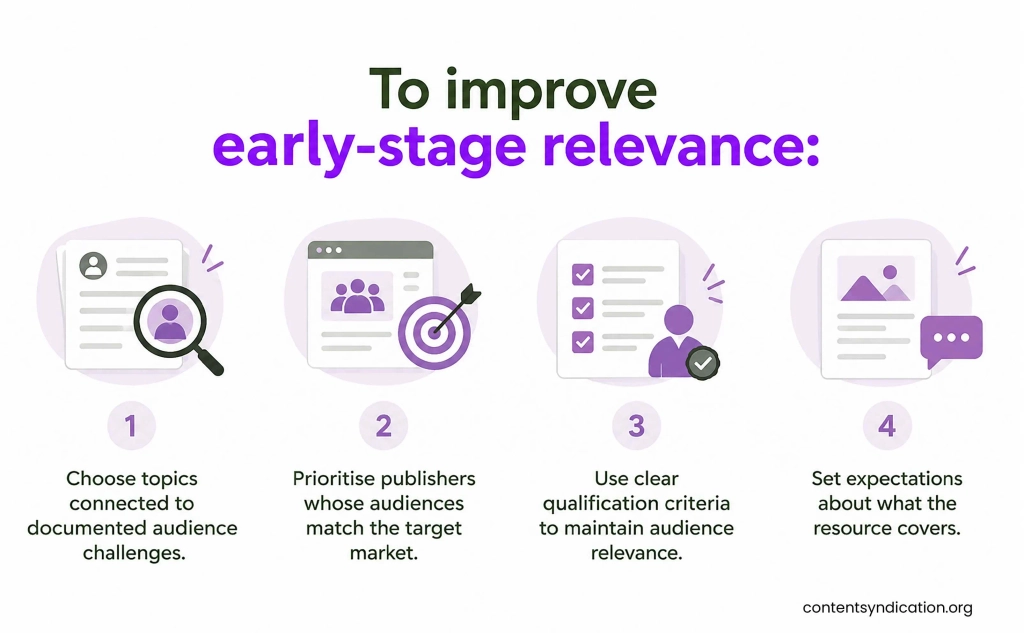
Early engagement provides an entry point for further learning. It does not, by itself, confirm that a prospect is ready to purchase.
Build Content Progression Around the Next Buyer Question
The first download should inform what happens next. If a prospect engages with an introductory guide, the next resource should help answer a related question rather than repeat the same information.
The next resource should address a gap in understanding, not merely push the reader to a later funnel stage. For example, a buyer researching workflow automation may need a process assessment checklist before an implementation guide. Another buyer may be ready to compare integration requirements immediately.
Use a simple three-step process:
• Identify the initial topic: Record the asset and subject that generated engagement.
• Determine the likely next question: Use buyer research and sales insights to identify what readers may need to understand next.
• Recommend a relevant resource: Offer content that adds useful detail without assuming purchase intent.
The sequence should remain flexible. Buyers may revisit earlier questions, involve new colleagues or move directly to technical evaluation. The goal is to make relevant information available as needs evolve.
If you need the separate post-download email and SDR workflow, refer to the content syndication lead nurture plan.
Practical Example: Supporting a Buying Decision Across Roles
Consider a hypothetical US enterprise software company distributing a report on reducing workflow bottlenecks. An operations manager downloads the report through an industry publisher. The initial interaction tells marketing what topic attracted attention, but not whether the company is actively buying.
The operations manager receives a process assessment checklist. A technical evaluator later reviews an integration and security guide, while a finance colleague uses a cost-and-benefit worksheet to test assumptions. Marketing records each relevant interaction against the account, without treating every content view as an opportunity.
If a buyer requests a vendor comparison or an implementation discussion, sales can use the resource history to understand the questions already addressed and those still unresolved. If no further engagement occurs, the appropriate next step may simply be to keep useful research available. This example illustrates a possible workflow, not an actual customer result.
| Observed buyer need | Useful resource | Appropriate next step |
|---|---|---|
| Clarify operational problem | Industry report and assessment checklist | Offer detailed process criteria |
| Validate technical feasibility | Integration and security guide | Answer requirements questions |
| Evaluate cost and risk | ROI worksheet with assumptions | Share a business-case template |
| Compare vendors | Evaluation matrix | Offer a focused consultation when requested |
Enable Internal Sharing Across the Buying Group
A person who downloads content may not be the final decision-maker. They may be researching on behalf of a team, gathering evidence for a business case or preparing to compare vendors with colleagues.
Resources should therefore be useful beyond the original reader. Clear summaries, accessible explanations, practical checklists and shareable research findings can help buyers communicate what they have learned.
Marketing teams can support this by creating complementary assets for technical, commercial and operational audiences, while keeping the central message consistent.
Help the initial reader share the material by including a one-page summary, clearly stated assumptions, a short list of open questions and links to supporting evidence. A useful internal brief can travel across functions without requiring every colleague to sit through a sales presentation.
Connect Marketing Content With Sales Enablement
Marketing and sales should work from a shared understanding of the buyer’s questions. Marketing can identify which resources address common concerns, while sales can explain where prospects need additional clarity during conversations.
This coordination helps turn useful research into practical sales enablement content. For example, a guide about implementation challenges can support a discovery conversation, while a comparison framework can help a sales representative explore evaluation criteria with an account.
A practical sales handoff should include the asset and topic, relevant account and stakeholder context, known evaluation questions, and the source of the engagement. Sales can then decide whether to offer a relevant resource, answer a specific question or invite a conversation. Record uncertainty rather than assuming that a content download proves purchase readiness.
The aim is to make content useful throughout the buying process. Sales follow-up should build on the prospect’s interests without treating a download as proof of active purchase intent.
Use Engagement Signals to Guide the Next Experience
Engagement data can help teams understand which topics attract attention and which resources merit further exploration. Useful signals may include repeat visits, engagement with related assets, webinar participation and interactions from multiple contacts at the same account.
However, these signals require context. One download may reflect general research, while repeated engagement across several relevant topics could indicate a broader evaluation process. Neither pattern should be interpreted in isolation.
A buyer enablement strategy using content syndication combines engagement data with account fit, stakeholder roles and sales feedback to determine the most appropriate next step.
This approach encourages relevant stakeholder engagement without relying on activity scores alone.
For detailed thresholds and routing considerations, see the content syndication lead scoring guide.
Measure Buyer Enablement Beyond Downloads
Downloads remain useful for understanding initial content response, but they do not show whether the information helped buyers make progress. Measurement should connect engagement with the quality of the audience and the outcomes that follow.
Start by tracking whether the people and accounts reached match the intended audience. Then assess whether engagement advances toward the next decision-support resource or an appropriate sales conversation. Report these metrics by campaign, asset, audience segment and a consistent observation period.
| Measurement | How to track it | Why it matters |
|---|---|---|
| ICP-fit engagement | Engaged contacts meeting documented target criteria / eligible engaged contacts | Separates relevant audiences from overall volume |
| Next-resource progression | Known contacts engaging with a relevant second asset / first-asset engaged contacts | Shows whether resources support continued learning |
| Multi-stakeholder participation | Target accounts with two or more relevant roles engaged / engaged target accounts | Adds account context without claiming buying readiness |
| Sales acceptance | Accepted eligible leads / eligible leads delivered | Checks whether sales finds the audience suitable |
| Opportunity progression | Engaged target accounts reaching an agreed opportunity stage / eligible engaged target accounts | Connects content support to commercial outcomes |
These are reporting definitions teams can adopt, not universal industry benchmarks. Define the observation window and counting method before comparing campaigns. Account-level outcomes and contact-level engagement should remain separate to avoid misleading conversion rates.
For instance, if 40 of 200 eligible first-asset contacts engage with a relevant second resource within a defined window, the next-resource progression rate is 20%. That alone does not show that 40 people are sales-ready. Review what they consumed, who they are and whether other decision-makers were involved. Figures are illustrative.
For broader campaign KPIs, see our content syndication metrics guide.
Turning Buyer Support Into Qualified B2B Enquiries
Buyers who are comparing approaches or building a case often need a more specific discussion about audience coverage, content relevance or qualification requirements. A natural next step is to offer campaign planning support, not a generic product pitch.
Are you reaching the right members of the buying committee? Review your target accounts, roles and existing content before committing more syndication budget. A short planning discussion can help identify which buyer questions your next campaign should address.
Explore ContentSyndication.org and its campaign enquiry options at ContentSyndication.org.
Frequently Asked Questions
1. What is B2B buyer enablement through content syndication?
It is the use of relevant syndicated resources to help B2B stakeholders understand a problem, evaluate alternatives and answer questions needed for a purchasing decision. It should support buyer learning, not just lead acquisition.
2. How does buyer enablement differ from content syndication lead nurturing?
Buyer enablement focuses on the information buyers need to make decisions. Lead nurturing focuses on how marketing follows up with engaged contacts. A useful resource may support both, but the goals and measurements are different.
3. How can content syndication support a buying committee?
Map the questions different stakeholders need to answer, then distribute resources that address those questions. Make the information shareable and use account context to decide what should happen next.
4. How do you measure buyer enablement effectiveness?
Track ICP fit, progression to relevant next resources, engagement across stakeholder roles, sales acceptance and opportunity outcomes. Use consistent cohorts and avoid treating downloads as proof of purchase intent.
Build Content Syndication Around Buyer Needs
Content syndication becomes more valuable when it helps buyers understand their options and progress through complex decisions. That requires relevant content, a clear understanding of stakeholder needs and a thoughtful connection between initial engagement and subsequent resources.
For teams planning B2B buyer enablement through content syndication, the priority is to identify what stakeholders need to learn, make resources useful across the buying group and measure whether those resources help people evaluate options. When these elements work together, content distribution can contribute to better-informed buying groups and more meaningful sales conversations.
Want to plan a program around relevant buyer questions and better-qualified enquiries? Discuss your target audience, content assets and campaign objectives with the ContentSyndication.org team.
Start with the ContentSyndication.org campaign enquiry page.