

Even in the age of AI, creating high-quality content isn’t easy. It takes time, effort, and strategy to build something that actually earns attention and trust. Yet most of that content gets used once—and then forgotten.
That’s where the real inefficiency begins. Instead of constantly producing new assets, it makes more sense to repurpose content for syndication. When you focus on repurposing for syndication, you’re not just extending reach; you’re giving one idea multiple chances to drive pipeline impact.
Done right, content repurposing in B2B marketing turns one strong piece into several touchpoints across the buyer journey.
One high-performing asset can generate 5–7 demand touchpoints when repurposed strategically.
A strong B2B content syndication strategy depends heavily on how effectively you repurpose and distribute existing assets.
Content repurposing strategy in B2B marketing helps maximize ROI from every content asset.
Why is Repurposing Important in Content Syndication?
Content syndication only works when content feels native to the platform where it is distributed. That is exactly why a content repurposing strategy matters so much.
Most teams make the mistake of pushing the same asset across every channel and expecting different results. But buyers don’t behave that way. A decision-maker scrolling through LinkedIn is not in the same mindset as someone downloading a research report.
So instead of repeating content, effective syndication strategies reshape it. Teams that invest in a content repurposing strategy adjust tone, format, and depth based on where the buyer is in their journey.
A long-form webinar can become a quick insights post. A whitepaper can turn into a checklist or a short guide. The idea stays the same, but the delivery changes to match attention and intent.
When content feels native to the platform, engagement improves—and more importantly, the leads generated are far more relevant to pipeline growth.
Companies that repurpose content see up to 60% higher engagement across channels.
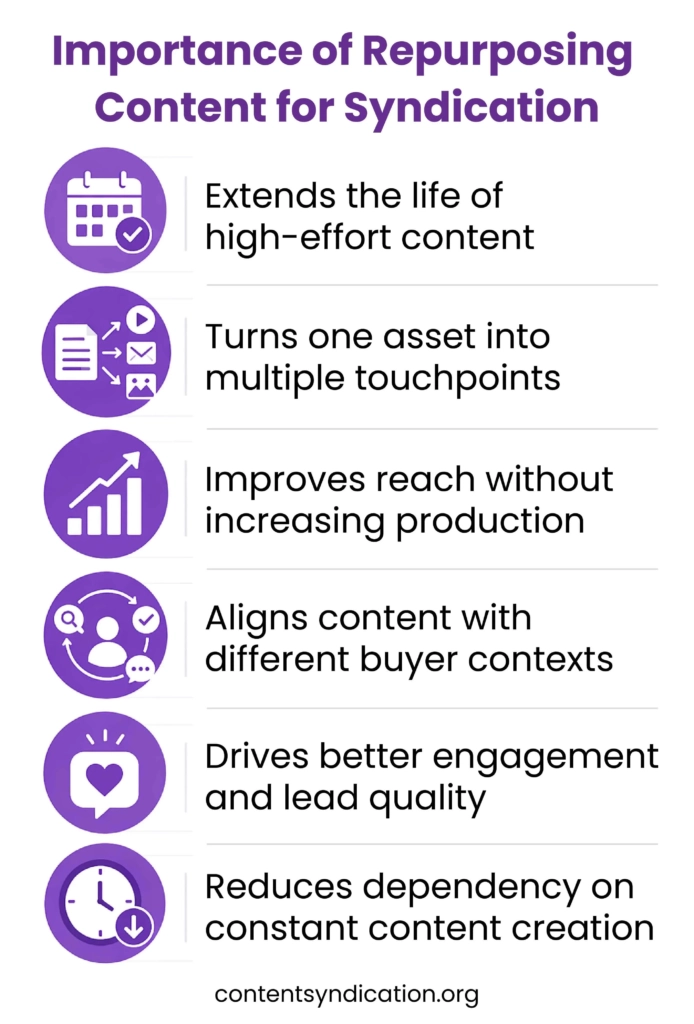
Here’s how repurposing strengthens content syndication outcomes in practice:
Best Content Types to Repurpose
Not every content asset deserves equal investment. Some pieces naturally have more mileage than others, especially in syndication.
The strongest candidates are assets that have already proven their performance:
Blogs with consistent organic traction
- Why they work: They already prove topic relevance and search intent alignment.
- How to repurpose: Turn them into short-form posts, email snippets, or gated guides.
- Who it targets: Top-of-funnel audiences exploring problems and early solutions.
Webinars and virtual events
- Why they work: They contain rich, conversational insights and expert positioning.
- How to repurpose: Break into highlight clips, quote posts, or multi-part articles.
- Who it targets: Mid-funnel buyers evaluating approaches and vendors.
Case studies with measurable outcomes
- Why they work: They build trust through proof, not just messaging.
- How to repurpose: Convert into one-pagers, carousel posts, or ROI-focused snippets.
- Who it targets: Bottom-of-funnel decision-makers validating purchase decisions.
Research reports and industry insights
- Why they work: They establish authority and an original data advantage.
- How to repurpose: Slice into stat-driven posts, infographics, or executive summaries.
- Who it targets: Senior stakeholders and strategy-led buyers.
Comparison and evaluation guides
- Why they work: They directly support decision-making moments.
- How to repurpose: Turn into simplified checklists, email sequences, or landing page assets
- Who it targets: High-intent buyers actively shortlisting solutions.
The goal of reusing content here is not to recycle everything. It is to identify what already resonates and give it a structured second, third, or even fourth life in different formats.
How to Turn One Asset into Multiple Formats
Once you have a high-performing asset, the real opportunity lies in extending its lifecycle.
When you create syndication-ready content, one asset can evolve into multiple demand touchpoints:
- A detailed eBook for gated lead capture
- A blog series for SEO visibility
- A LinkedIn content sequence for engagement
- A visual infographic for quick consumption
- A nurture email flow for conversions
For example, a B2B SaaS company can turn a single webinar into a blog series, LinkedIn posts, a gated guide, and an email sequence. Instead of one campaign, this creates multiple touchpoints across the buyer journey—often resulting in higher engagement and stronger pipeline conversion.
This is where content repurposing becomes a system rather than a one-time activity.
Mapping Content to Funnel Stages
Effective syndication doesn’t just create reach—it moves buyers through the funnel.
That is why mapping content is critical in a B2B content syndication strategy.
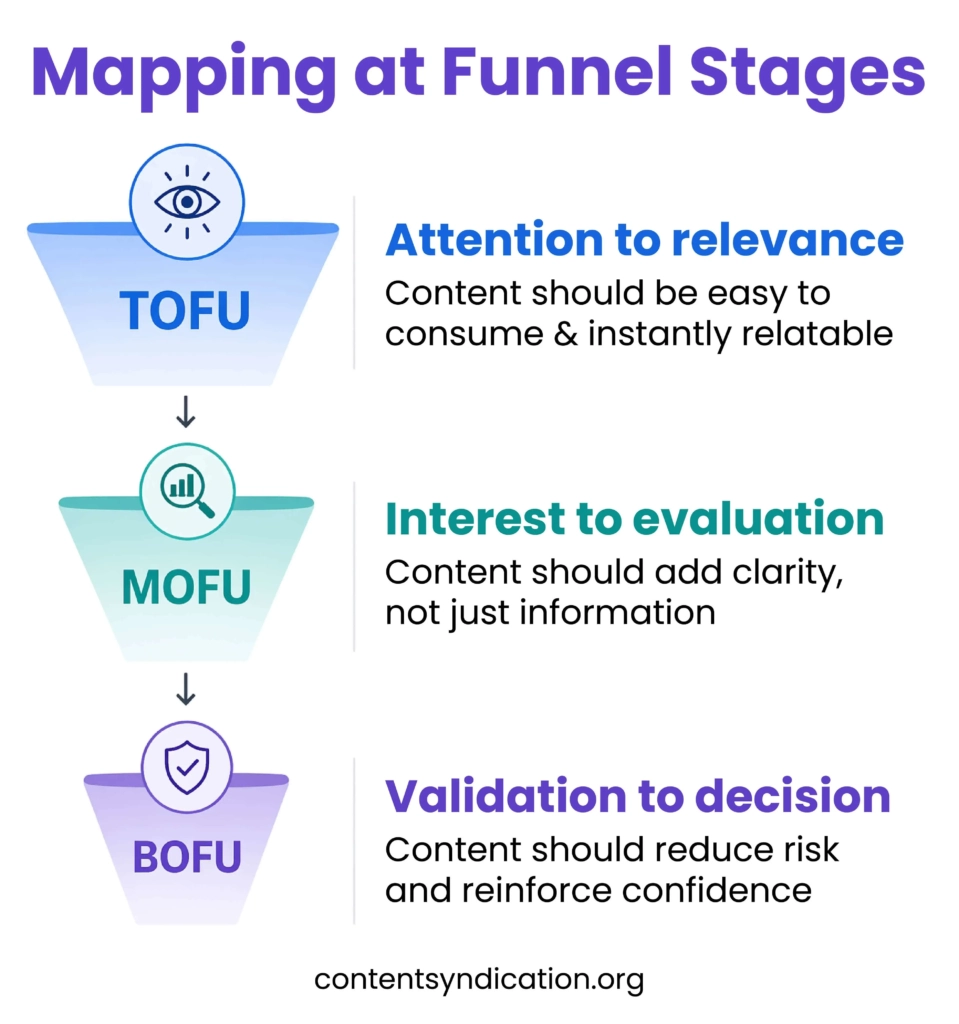
- TOFU: Blogs, trends, educational insights
- MOFU: Webinars, case studies, comparison guides
- BOFU: Product demos, ROI breakdowns, implementation stories
A single asset can support multiple stages when broken down strategically. The same idea can attract attention, build trust, and drive decisions.
Here’s how content should align across funnel stages:
Distribution Strategy for Repurposed Content
Even the best content underperforms without the right distribution.
A strong content distribution strategy includes:
- Third-party syndication platforms
- Industry publications
- Paid intent-based channels
- Email nurturing workflows
- Co-marketing partnerships
When content is repurposed properly, distribution becomes more efficient because each channel gets a format designed for it.
The goal isn’t just to distribute content—it’s to deliver the right format to the right audience at the right stage of intent.
Common Mistakes People Make While Repurposing
One of the biggest mistakes is misunderstanding repurposing.
Many teams simply copy and paste the same asset across platforms. This leads to low engagement and poor lead quality.
Real performance comes from adapting content—not duplicating it.
Copy-paste spreads content. Optimization drives performance.
Best Practices
If you want consistent results, your approach needs to be structured-not experimental.
- Start with content that already performs well
- Align each format with a specific funnel stage
- Adjust tone and depth based on platform behavior
- Track performance and refine based on engagement signals
- Keep messaging consistent, even when formats change
At its core, syndication should always enhance clarity, not dilute it.
Consistency in execution is what turns content repurposing into a scalable growth strategy.
Frequently Asked Questions
1. Why is repurposing important in syndication?
Repurposing in syndication ensures content aligns with how buyers consume information across platforms, improving engagement and lead quality.
2. What is the fastest way to scale content syndication?
You should start with strong existing assets and systematically break them into multiple usable formats.
3. How to repurpose content for B2B syndication?
It refers to transforming a single content asset into multiple formats optimized for different distribution channels.
4. Can every asset be reused for syndication?
No. Focus on evergreen, insight-driven, and high-performing content for repurposing.
Conclusion
B2B growth today is less about creating more content and more about making existing content work harder.
When you repurpose content for syndication, you extend the life and impact of a single idea—turning it into multiple opportunities for engagement and conversion.
The real shift happens when teams move from isolated assets to structured content systems. That’s where content repurposing becomes a predictable driver of pipeline growth—not just a distribution tactic.
If you want to build a scalable content engine, start by turning your best-performing assets into multi-format campaigns that consistently drive pipeline impact.