
A content syndication campaign generates 500 leads. After the first round of sales follow-up, some contacts are interested but have no approved budget. Others are still researching solutions, while a few have postponed their projects until the next quarter.
What happens to these leads?
In many B2B teams, they are marked as rejected or closed and receive little attention afterward. Yet some of these contacts may match the ideal customer profile (ICP) perfectly. The problem is not necessarily lead quality. It may simply be that sales approached them before they were ready to buy.
B2B content syndication lead recycling helps marketing and sales distinguish between leads that should be disqualified and those worth revisiting later. With clear rejection reasons, CRM ownership and requalification criteria, teams can continue nurturing relevant contacts without repeatedly sending them back to sales.
This guide explains which leads are suitable for recycling, when to re-engage them, how to manage the process in your CRM and what to measure to understand whether recycling is contributing to pipeline.
Why Unready Leads Are Not Always Bad Leads
A prospect who downloads a white paper may be interested in solving a business problem without having an active purchasing project.
Consider an IT director researching cloud security solutions. The company fits your target audience, and the director has a relevant role. However, the organisation may still be assessing its current systems or waiting for budget approval.
If an SDR immediately requests a product demonstration, the prospect may decline. That response does not necessarily mean the original lead was poor.
There is an important difference between three situations:
- Poor fit: The contact or company does not meet your targeting requirements.
- Poor data quality: The contact information is inaccurate, incomplete or unusable.
- Not sales-ready: The contact is relevant but does not currently have sufficient need, timing or buying intent.
The first two situations may require exclusion, correction or further validation. The third may justify continued nurturing.
This distinction matters particularly in content syndication, where prospects often engage with educational material before they are ready to speak with vendors.
A useful lead recycling process therefore begins with understanding why a lead did not progress, rather than treating every rejected lead as the same outcome.
What Is B2B Content Syndication Lead Recycling?
B2B content syndication lead recycling is the process of returning eligible, sales-rejected or unready leads to marketing for continued nurturing, with the possibility of requalification when their circumstances change.
Instead of closing every rejected record permanently, marketing maintains appropriate engagement with contacts who still meet the target audience requirements.
For example, a prospect may download an industry report in March but indicate that their organisation will not review vendors until September. Sales can record that timing, and marketing can schedule a relevant follow-up rather than restarting outreach immediately.
A practical B2B lead recycling strategy connects three activities:
- Sales feedback: Identify the reason the lead is not progressing.
- Marketing nurture: Continue relevant engagement when permitted and appropriate.
- Requalification: Return the lead to sales only when agreed readiness criteria are met.
Recycling is not the same as repeatedly contacting an unresponsive prospect. Each return to sales should have a documented reason.
Which Leads Are Eligible and Which Must Not Be Recycled?
Not every sales-rejected lead belongs in a nurture programme.
Eligibility depends on the original rejection reason, account fit, data quality and whether future contact is appropriate.
A simple decision framework can help marketing and sales apply consistent rules.
| Lead situation | Recommended action | Reason |
|---|---|---|
| No approved budget | Recycle | The purchasing situation may change |
| Project postponed | Recycle | A future review date may be appropriate |
| Early-stage research | Recycle | The contact may benefit from educational content |
| Internal approval pending | Recycle | The buying process is incomplete |
| Valid contact with outdated job information | Verify before recycling | The current role and relevance need confirmation |
| Invalid or fabricated contact details | Reject or correct | The record is not reliable for outreach |
| Company outside ICP | Do not recycle | No realistic account fit |
| Student, job seeker or unrelated vendor | Exclude from sales recycling | The contact does not match the campaign’s buyer criteria |
| Existing customer | Route to the appropriate customer programme | A separate relationship already exists |
| Unsubscribed or opted-out contact | Suppress from affected marketing communications | Communication preferences and applicable rights must be respected |
The distinction between an unready lead and an invalid lead is especially important.
For example, a contact with a verified business email and a relevant job title may still be unsuitable if the organisation falls outside the agreed target industry.
On the other hand, a well-matched contact whose project was postponed may remain a useful prospect.
Before recycling, check the original campaign’s acceptance criteria. A lead that should never have been accepted as a valid campaign delivery should not automatically be reported as a successful recycled lead.
For additional checks covering contact accuracy and usability, see our guide to contact validation for content syndication.
When to Recycle: Timing, Intent and Requalification Triggers
The right time to recycle a lead depends on why sales rejected it and what has changed since that decision.
A fixed follow-up interval may be convenient for automation, but it should not replace buyer context.
If a prospect explicitly asks to reconnect next quarter, the CRM should retain that information. If a project has been cancelled indefinitely, sending another meeting request after 30 days is unlikely to be useful.
Match Re-engagement to the Rejection Reason
| Original rejection reason | Possible re-engagement trigger | Recommended next step |
|---|---|---|
| Budget unavailable | New budget cycle or funding confirmation | Review current project priority |
| Project postponed | Agreed project review date or confirmed restart | Reassess timing |
| Early-stage research | Meaningful engagement with related content | Offer relevant educational material |
| No current requirement | New stated need or relevant initiative | Confirm whether priorities have changed |
| Internal alignment pending | Additional stakeholders become involved | Review buying-group readiness |
| Wrong timing | Prospect’s requested follow-up date | Resume contact in line with preferences |
These triggers should guide the lead requalification process, not act as automatic proof of purchase intent.
A prospect downloading another report does not necessarily mean they are ready for a sales meeting. Engagement becomes more useful when interpreted alongside account fit, expressed needs and previous conversations.
Avoid Recycling Too Early
Before returning a lead to sales, ask:
- Has the original reason for rejection changed?
- Is there a meaningful new buying or engagement signal?
- Does the contact still meet our qualification criteria?
- Is the planned follow-up permitted and appropriate?
- Can sales offer a relevant next step?
If the answers remain unclear, the lead may need more nurturing rather than another sales handoff.
How to Build a B2B Lead Recycling Strategy and Workflow
A lead recycling workflow should be simple enough for sales representatives to use consistently and detailed enough for marketing operations to manage reliably.
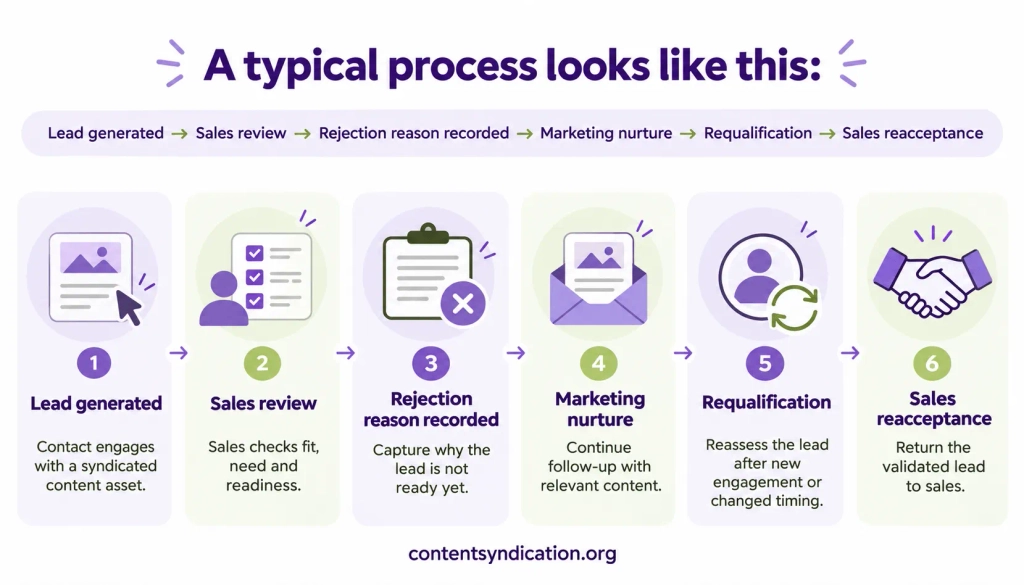
The process begins when sales decides that a lead cannot progress under the current qualification criteria.
Step 1: Review the Lead
Sales checks the contact against the agreed qualification criteria, including account fit, role relevance, identified need and buying readiness.
The outcome should distinguish a genuinely unsuitable lead from a relevant prospect who is simply not ready.
Step 2: Record a Specific Rejection Reason
Avoid relying on a generic status such as “Not Qualified.”
Instead, use defined reasons such as:
- Budget pending
- Project delayed
- Early-stage research
- No current business requirement
- Incorrect contact information
- Outside target audience
- Do not contact
These reasons should determine what happens next.
Step 3: Assign Eligible Leads to Marketing
Once sales identifies an eligible recycling reason, the CRM can route the contact to the appropriate marketing owner or nurture segment.
The handoff should preserve the original campaign, content asset, rejection reason and relevant sales notes.
Step 4: Re-Engage with Relevant Content
Marketing selects follow-up material based on the contact’s previous interests and buying stage.
A prospect researching market trends may benefit from updated industry research. Someone evaluating implementation challenges may find a technical guide more useful.
Step 5: Requalify Before Returning to Sales
When the contact shows meaningful new interest, marketing reviews their fit and readiness against agreed criteria.
Sales should receive an explanation of what changed, not merely a notification that the lead clicked another email.
This makes the marketing-to-sales handoff more useful and reduces unnecessary repeat outreach.
The quality of the initial CRM setup also affects how reliably these stages work. Our guide to content syndication CRM integration explains how lead data, attribution and ownership can be preserved during delivery and processing.
How to Track Recycled Leads in CRM
A recycling process becomes difficult to manage when teams cannot see who owns a record, why it was rejected or when it should be reviewed again.
CRM lead statuses should therefore distinguish between rejection, nurturing and renewed qualification.
Suggested Lead Recycling Statuses
- Sales rejected: Not ready
- Sales rejected: Budget pending
- Recycled: Marketing nurture
- Re-engaged: Review required
- Requalified: Ready for sales
- Sales reaccepted
- Disqualified: Do not recycle
The status labels can vary by CRM. What matters is that each label has a clear definition and an agreed owner.
Essential CRM Fields for Lead Recycling
| CRM field | What it records | Example |
|---|---|---|
| Original campaign | Where the lead originated | Q3 Security Report Campaign |
| Content asset | What the prospect engaged with | Cloud Security Guide |
| Rejection reason | Why sales did not progress the lead | Budget pending |
| Recycle status | Current lifecycle stage | Marketing nurture |
| Recycle owner | Team responsible for the next action | Marketing operations |
| Last sales review date | When sales last evaluated readiness | 12 August 2026 |
| Next review date | When another assessment is appropriate | 15 November 2026 |
| Requalification trigger | What would justify another review | Budget approval |
| Contact permission status | Applicable communication permissions and preferences | Review before outreach |
| Sales reacceptance date | When sales accepted the lead again | Recorded when applicable |
Not every organisation needs separate custom fields for every item. Some information may already exist in activity history, campaign records or connected marketing automation tools.
The important requirement is that the information remains accessible and reportable.
Define Ownership Before Automating
Sales should document rejection reasons and clarify whether a lead is eligible for recycling.
Marketing should manage nurturing, monitor engagement and identify potential requalification triggers.
Revenue operations or marketing operations can maintain CRM definitions, routing rules, suppression checks and reporting.
A scheduled review of overdue records is also useful. Leads should not remain in nurture indefinitely without an agreed review or retention policy.
Re-Engage with Relevant Content Without Duplicate Outreach
A recycled lead already has some history with your organisation.
That history should influence the next communication.
Sending the same white paper repeatedly or introducing the prospect to an unrelated campaign can make the follow-up feel disconnected from their original interest.
Instead, consider what the prospect previously engaged with and what information might help them move forward.
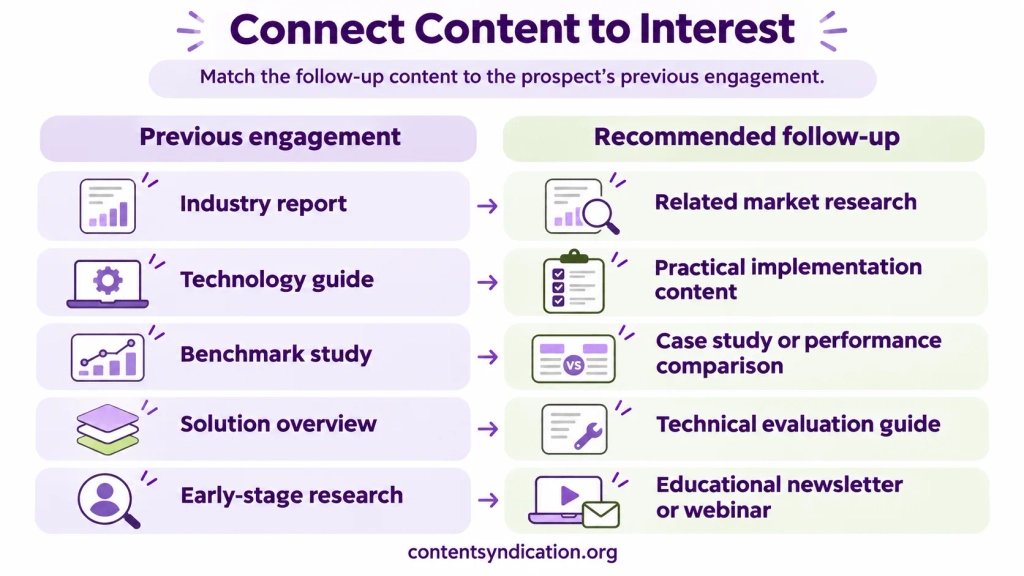
Match Content to Previous Engagement
| Previous engagement | Recommended follow-up content |
|---|---|
| Industry report | Updated market research or trends |
| Technology guide | Practical implementation guide |
| Benchmark study | Case study or performance comparison |
| Solution overview | Technical evaluation checklist |
| Early-stage educational content | Related webinar or educational resource |
| Implementation-focused material | Deployment considerations or project planning guide |
These recommendations are starting points. Actual engagement should determine whether a particular topic remains relevant.
Prevent Duplicate and Conflicting Outreach
Before enrolling a recycled lead in another campaign, check:
- Whether the contact is already receiving sales follow-up.
- Whether another active campaign targets the same person or account.
- Whether the content has already been delivered.
- Whether the contact has requested a specific communication frequency.
- Whether suppression or opt-out restrictions apply.
Marketing and sales should work from shared contact history wherever possible.
For example, if an account executive has arranged a discussion for the following month, an automated nurture email asking the same contact to book an introductory meeting may be unnecessary.
Account-level coordination matters too. Multiple stakeholders from one company may be engaging with different assets. A useful account view helps teams understand that activity without assuming every contact is ready for direct sales outreach.
Keep Communication Permissions Visible
A recycled status does not create new permission to contact someone.
Before launching another nurture sequence, confirm that the proposed activity is supported by the applicable legal basis, relevant electronic marketing rules and the individual’s preferences.
Our guide to B2B content syndication consent requirements covers the information marketers should retain when leads originate from third-party publishers.
For UK B2B campaigns, the Information Commissioner’s Office guidance on business-to-business marketing explains how requirements can differ based on the recipient type and communication channel.
Regardless of the applicable framework, teams should honour valid objections and opt-out requests and avoid restoring suppressed contacts to outreach simply because their CRM lifecycle status has changed.
How to Measure Lead Recycling Performance
The number of leads placed back into marketing nurture is not enough to determine whether recycling works.
A stronger measurement approach follows leads from initial rejection through requalification, sales reacceptance and eventual commercial outcomes.
Key Lead Recycling Metrics
| Metric | What it measures |
|---|---|
| Eligible recycle rate | Share of sales-rejected leads that qualify for recycling |
| Re-engagement rate | Share of recycled leads that show a defined subsequent engagement |
| Requalification rate | Share of recycled leads that meet sales-readiness criteria again |
| Sales reacceptance rate | Share of requalified leads accepted by sales |
| Opportunity creation rate | Share of recycled leads that become opportunities |
| Time to reactivation | Time between initial rejection and renewed qualification |
Define each metric carefully before comparing campaigns. For example, an email open, a content click and a direct request for a meeting should not automatically receive the same weight.
Example: Measuring a Recycled Lead Cohort
Suppose a B2B campaign produces 200 eligible recycled leads.
After an agreed observation period:
- 80 leads have meaningful new engagement.
- 40 leads meet the requalification criteria.
- Sales reaccepts 30 of those leads.
- 6 recycled leads progress to opportunities.
The resulting calculations would be:
| Metric | Calculation | Result |
|---|---|---|
| Re-engagement rate | 80 ÷ 200 × 100 | 40% |
| Requalification rate | 40 ÷ 200 × 100 | 20% |
| Sales reacceptance rate | 30 ÷ 40 × 100 | 75% |
| Opportunity creation rate | 6 ÷ 200 × 100 | 3% |
These figures are illustrative calculations, not industry benchmarks or actual campaign results.
The distinction between requalification and sales reacceptance is useful.
A lead may meet marketing’s updated qualification criteria but still be rejected by sales if the supporting information is incomplete or the buying opportunity is not sufficiently developed.
If requalification is high but sales reacceptance remains low, examine the readiness rules and handoff information before increasing nurture activity.
Compare Results by Campaign and Rejection Reason
An overall conversion rate can hide important differences.
Compare recycling outcomes by:
- Original content syndication campaign
- Publisher or lead source
- Content asset
- Industry and buyer persona
- Rejection reason
- Nurture segment
- Time between rejection and requalification
A campaign that initially produces fewer sales-ready contacts may still contribute to later opportunities. However, that contribution should be measured using consistent attribution rules.
Avoid counting the same contact as a newly generated lead each time they return to sales.
For a related view of downstream performance, see our guide to content syndication lead-to-meeting conversion rates.
Frequently Asked Questions
1. When should sales-rejected leads be recycled?
Recycle leads when the rejection relates to timing, budget, readiness or another potentially temporary issue, provided the contact remains relevant and future engagement is appropriate.
The decision should be based on a documented rejection reason rather than an automatic waiting period.
2. How often should recycled leads be contacted?
There is no universal follow-up frequency.
A contact who requests a conversation next quarter should not receive the same sequence as someone who has actively engaged with several recent resources.
Use buying context, engagement history, communication preferences and agreed follow-up timing to determine the appropriate approach.
3. How do you requalify content syndication leads?
Review the original qualification details, current account fit, relevant new engagement and any changes in the prospect’s requirements.
Before returning the lead to sales, confirm that it meets the agreed readiness criteria and provide the context supporting that decision.
4. Who owns recycled leads?
Marketing generally owns nurturing and monitors potential requalification triggers. Sales owns its qualification decisions and accepts leads that meet the agreed requirements.
Revenue operations or marketing operations can support the process by managing CRM statuses, routing rules and reporting.
Ownership should be explicitly documented so records do not move between teams without accountability.
5. Does lead recycling require new consent?
Not automatically. Whether new consent is required depends on the applicable laws, the original collection circumstances, the proposed communication channel and the lawful basis for the intended activity.
Existing permissions should not be assumed to cover every future campaign.
Teams should verify relevant communication requirements, maintain appropriate records and respect opt-outs or objections before re-engaging contacts.
Build a Controlled Lead Recycling Process
Not every content syndication lead will be ready for a sales conversation when it first enters the CRM.
Some contacts will be unsuitable and should be excluded. Others may be a strong fit but need more time, information or internal approval before they can consider a purchase.
A useful lead recycling process keeps those situations separate.
Sales records why a lead cannot progress. Marketing follows up with content that reflects the prospect’s interests. Both teams work from clear CRM ownership and agreed criteria for returning a contact to sales.
The goal is not to keep every lead active indefinitely. It is to recognise when a previously unready prospect has a legitimate reason to re-enter the sales process.
Improve Your Content Syndication Lead Quality and Follow-Up
If your content syndication campaigns are generating leads but too few qualified sales conversations, review the full process-from audience targeting and lead validation to sales acceptance and subsequent nurturing.
Contact the ContentSyndication.org team to discuss your campaign goals and how a more coordinated lead generation and qualification process could support your pipeline.