
Content syndication helps B2B marketers expand reach and generate demand, but many campaigns fail to deliver strong ROI because they target the wrong audience. High lead volumes and low CPL might look promising, yet poor-fit leads rarely convert.
This is where firmographic filters become essential. By targeting companies based on attributes such as industry, revenue, employee count, and location, marketers can focus on organizations that match their ideal customer profile.
The result is better lead quality, stronger sales alignment, and improved B2B content syndication success through more relevant audience engagement and higher conversion potential.
Why Do Marketers Miss ROI?
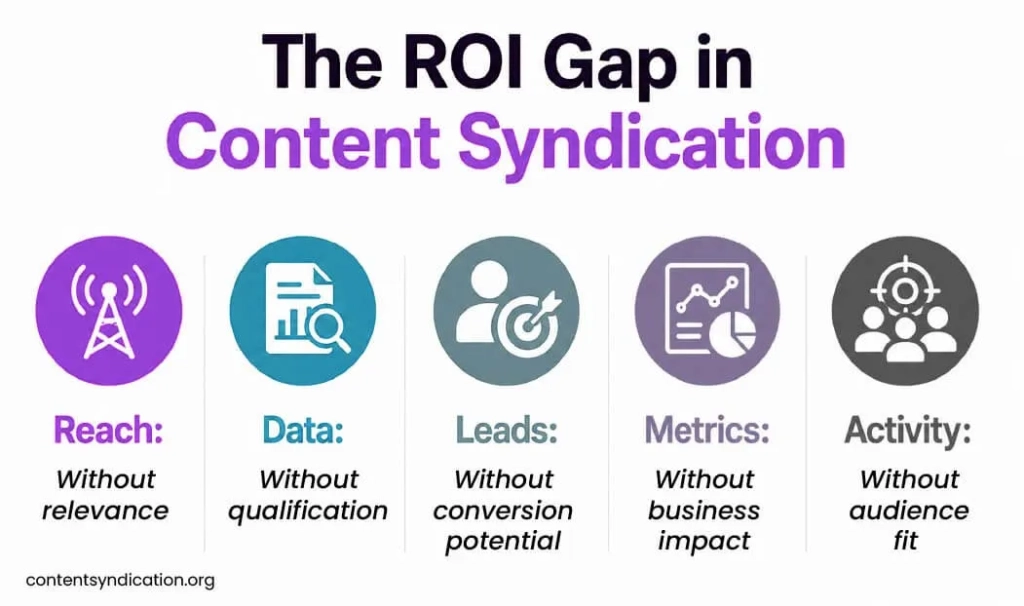
Many B2B marketers evaluate campaign success based on lead volume or cost per lead (CPL). While these metrics provide useful visibility into campaign efficiency, they do not always reflect business impact.
A campaign may generate hundreds of leads at an attractive CPL, yet produce little pipeline or revenue if those leads do not match the ideal customer profile (ICP).
Common reasons marketers miss ROI include:
- Prioritizing volume over relevance
- Using overly broad targeting criteria
- Focusing only on top-of-funnel metrics
- Lack of alignment between marketing and sales teams
- Poor audience segmentation
This challenge becomes especially evident in content syndication campaigns where reach can be scaled quickly. Without effective audience filters, marketers often pay to engage companies that have little potential to become customers.
What Is Firmographic Segmentation in Content Syndication?
Firmographic segmentation is the process of categorizing and targeting businesses based on specific organizational attributes.
Similar to demographic segmentation for consumers, firmographics help marketers identify companies that are most likely to benefit from their solutions.
Common firmographic attributes include:
| Category | Firmographics | Technographics |
|---|---|---|
| Focus | Business attributes | Technology environment |
| Examples | Industry, revenue, employees | CRM, cloud platforms, software stack |
| Primary Goal | Identify ideal companies | Identify technology fit |
| Funnel Impact | Audience qualification | Buying readiness and compatibility |
Within content syndication campaigns, these filters help ensure content reaches organizations that closely match your ICP rather than a broad, unqualified audience.
For example, a cybersecurity provider targeting enterprise financial institutions will likely achieve stronger results by focusing on organizations that match specific business characteristics instead of distributing content across all industries.
This level of precision is a major contributor to a successful content syndication campaign because it improves lead relevance from the beginning of the buyer journey.
The Hidden Cost of Bad Filters
Poor audience filtering creates costs that often remain invisible until later stages of the funnel.
When targeting criteria are too broad, marketers may see:
- Increased lead review time
- Lower sales acceptance rates
- Reduced conversion rates
- Longer sales cycles
- Higher customer acquisition costs
Consider a campaign generating 500 leads. On paper, performance may appear strong. However, if only a small percentage fit the ICP, the majority of those leads create operational overhead without contributing meaningful pipeline value.
The more closely audience criteria align with the actual buying market, the greater the likelihood of generating qualified opportunities.
Organizations that focus on precision often discover that fewer, better-qualified leads outperform larger volumes of low-fit prospects.
Ultimately, campaign success depends on maximizing the quality of engagement rather than simply increasing exposure.
What Are the Key Differences Between Firmographics and Technographics
Both firmographic and technographic data help improve targeting, but they serve different purposes.
| Category | Firmographics | Technographics |
|---|---|---|
| Focus | Business attributes | Technology environment |
| Examples | Industry, revenue, employees | CRM, cloud platforms, software stack |
| Primary Goal | Identify ideal companies | Identify technology fit |
| Funnel Impact | Audience qualification | Buying readiness and compatibility |
Firmographics answer the question:
“Is this the type of company we want to target?”
Technographics answer:
“Is this company using technologies relevant to our solution?”
For example:
- A marketing automation platform may target mid-market SaaS organizations using firmographic criteria.
- Technographic data may reveal whether those companies already use complementary tools that support adoption.
Both data types provide value, but they solve different targeting challenges.
Organizations that achieve consistent Maximizing content syndication performance often begin with firmographic qualification before introducing additional data layers.
Which One Impacts ROI More: Broad Reach vs. Firmographic Precision?
A common misconception is that broader reach naturally generates better results.
In reality, reach and ROI are not the same thing.
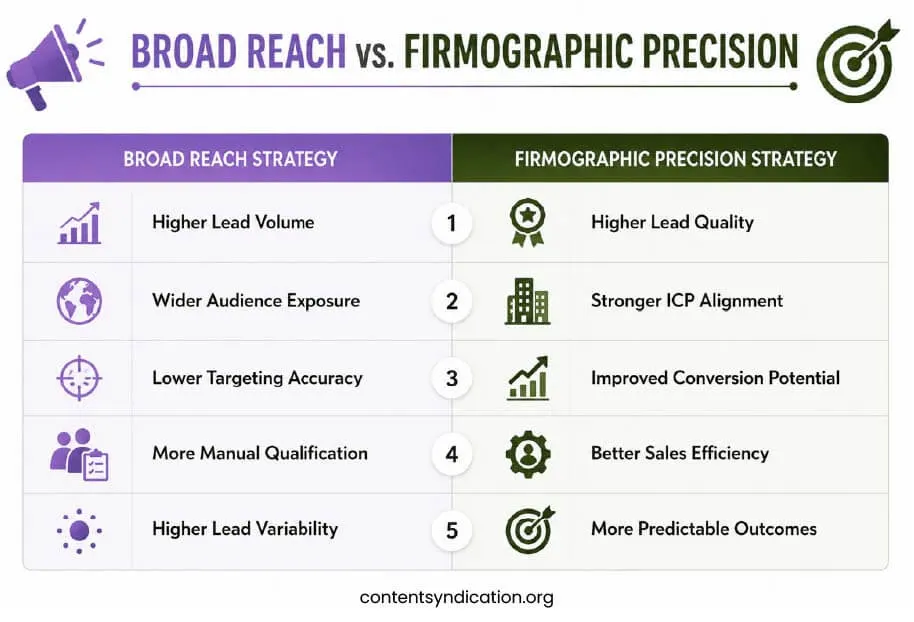
Broad campaigns may support awareness objectives, but performance-driven syndication campaigns require greater precision.
Using a carefully defined target account list allows marketers to focus resources on organizations that have a higher likelihood of progressing through the funnel.
Similarly, applying appropriate company size filters helps eliminate businesses that lack the budget, complexity, or operational requirements for your solution.
When evaluating campaign performance, precision consistently produces stronger long-term business outcomes than reach alone.
This is one reason why leading demand generation teams prioritize audience fit as a key driver of Successful demand generation campaigns.
Layering Firmographics with Intent Signals
While firmographics improve audience quality, they do not necessarily indicate buying readiness.
This is where intent data becomes valuable.
Intent signals help identify organizations actively researching relevant topics, products, or challenges. Combining both approaches creates a stronger targeting framework:
Step 1: Define Firmographic Criteria
Identify the characteristics of your ideal customer profile:
- Industry
- Revenue range
- Employee count
- Geographic markets
- Business maturity
Step 2: Add Intent Signals
Look for indicators such as:
- Content consumption behavior
- Topic research activity
- Engagement with industry publications
- Solution-related searches
Step 3: Prioritize High-Fit Accounts
Focus campaigns on organizations that meet both qualification criteria and demonstrated interest.
This layered approach improves:
- Lead quality
- Engagement rates
- Pipeline contribution
- Conversion efficiency
For organizations seeking the best firmographic filters for tech lead generation, combining firmographic qualification with intent signals often delivers the strongest results because it aligns fit with timing.
As buying journeys become increasingly complex, this integrated strategy is becoming a major driver of B2B content syndication success.
How to Measure ROI Beyond CPL
Cost per lead remains an important metric, but it should not be the primary indicator of campaign effectiveness. A more comprehensive measurement framework includes:
Lead-to-MQL Conversion Rate
Measures how many leads meet qualification criteria.
Sales Acceptance Rate
Indicates whether generated leads align with sales expectations.
Opportunity Creation Rate
Tracks the percentage of leads progressing into active opportunities.
Pipeline Contribution
Measures total pipeline value influenced by the campaign.
Revenue Influence
Evaluates how campaigns contribute to closed business.
Customer Acquisition Cost
Provides visibility into overall efficiency beyond initial lead generation.
When these metrics improve, organizations typically experience stronger B2B content syndication success regardless of whether CPL increases slightly.
Lower CPL does not always mean better performance. Better business outcomes do.
FAQs
1. What are firmographic filters in content syndication?
Firmographic filters are audience-targeting criteria based on business characteristics such as industry, revenue, employee count, location, and company type. They help marketers reach organizations that closely align with their ideal customer profile.
2. Why are firmographic filters important for syndication campaigns?
They improve lead quality by ensuring content reaches relevant organizations rather than broad audiences, resulting in stronger conversion potential and better campaign efficiency.
3. Are firmographics better than technographics?
They serve different purposes. Firmographics identify the right companies, while technographics identify technology fit. The most effective campaigns often use both.
4. How do intent signals improve targeting?
Intent signals help identify organizations actively researching relevant solutions, allowing marketers to prioritize accounts that are more likely to engage and convert.
5. What metrics should marketers track besides CPL?
Lead quality, sales acceptance rates, opportunity creation, pipeline contribution, and revenue influence provide a more accurate view of campaign performance.
Drive Better Results with Smarter Audience Targeting
The effectiveness of a content syndication campaign depends not only on the quality of the content but also on the quality of the audience.
By applying firmographic filters strategically and combining them with intent-driven insights, marketers can improve lead quality, increase conversion efficiency, and achieve sustainable Driving high-quality B2B leads.