

A content syndication campaign can have the right content, the right audience, and the right vendor, yet still underperform when the campaign brief leaves too much open to interpretation.
Before a vendor activates a campaign, both sides need a shared understanding of who should be reached, what qualifies as a lead, how leads should be delivered, and what happens when a lead does not meet the agreed requirements.
That is where a B2B content syndication brief template becomes useful.
Instead of relying on scattered emails, assumptions, or verbal agreements, the brief turns campaign expectations into specific instructions that can be executed, measured, and reviewed consistently.
A strong brief should define:
- Campaign objectives
- Ideal customer profile
- Target accounts
- Buyer roles and seniority
- Content assets
- Lead qualification criteria
- Suppression and duplicate rules
- Replacement conditions
- Geography and pacing
- Lead delivery
- CRM requirements
- Reporting
- Service-level expectations
The goal is simple: make sure marketing, sales, operations, and the syndication vendor are working from the same definition of campaign success.
What Is a B2B Content Syndication Campaign Brief?
A content syndication campaign brief is a document that defines the requirements for a campaign before a vendor begins execution.
It translates strategy into practical campaign instructions.
A complete brief typically covers:
- Campaign objective and expected outcomes
- Ideal customer profile and account criteria
- Target job functions and seniority
- Content assets and messaging
- Lead qualification requirements
- Geographic and volume requirements
- Lead delivery and reporting
- Duplicate, suppression, and replacement rules
- Service-level expectations
The B2B content syndication brief template should answer one important question:
What exactly should the vendor deliver, to whom, under what conditions, and how will the campaign be measured?
Without that clarity, different teams can interpret the same campaign differently.
For teams preparing their first program, our B2B content syndication campaign launch guide provides additional guidance on campaign setup and execution.
Why the Brief Matters Before Vendor Activation
The campaign brief establishes the working definition of campaign success before execution begins.
If expectations are not documented before launch, disagreements often appear after lead delivery starts.
Marketing may expect director-level contacts.
Sales may expect buying authority.
The vendor may be working from a broader job-function filter.
Operations may reject records because required CRM fields were never discussed.
None of these problems necessarily mean the campaign itself was poorly executed. They can simply mean the requirements were unclear.
A well-developed B2B content syndication brief helps prevent that by creating a shared reference for both the vendor and internal teams.
It also makes vendor comparison easier. When requirements are clearly defined, marketers can evaluate delivery against agreed criteria instead of trying to redefine campaign quality after leads have already arrived.
Define Campaign Objective and Success Criteria
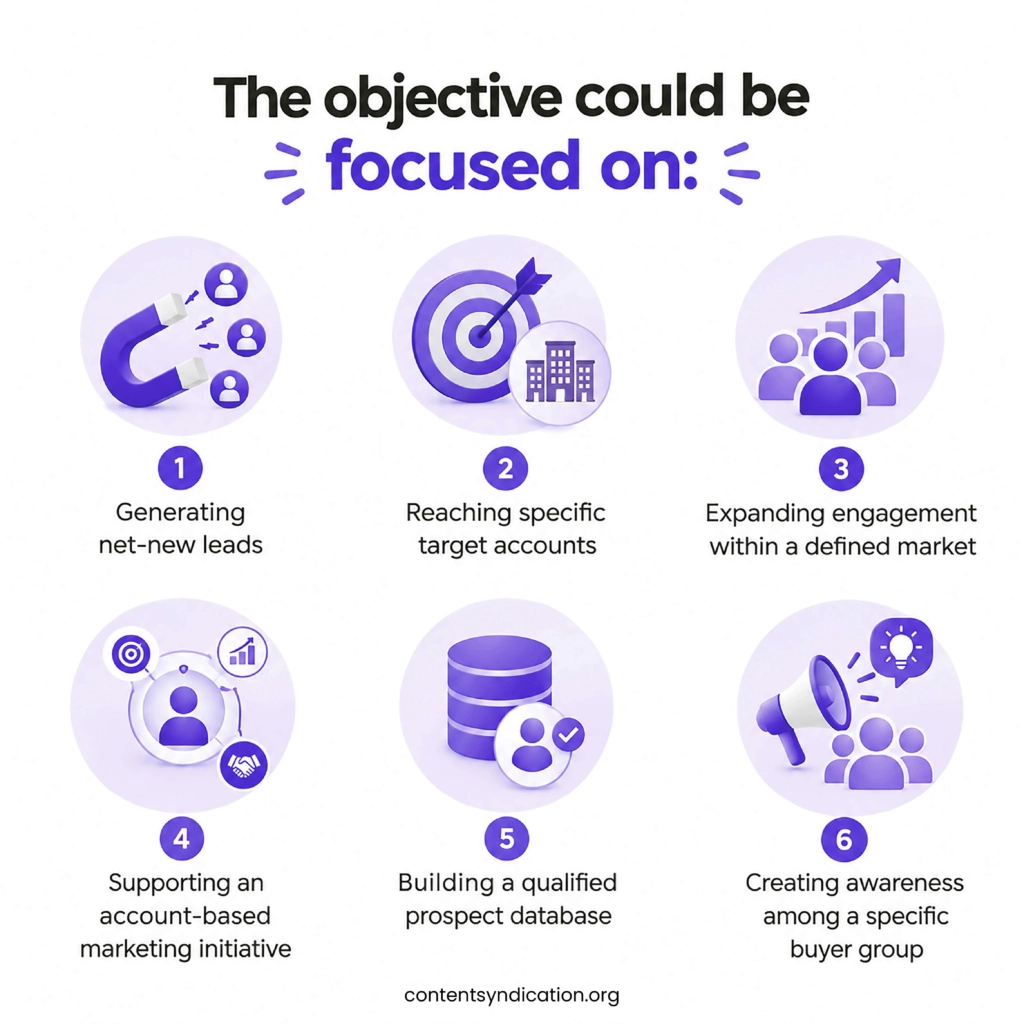
Start the content syndication campaign brief with a clear statement of what the campaign is expected to achieve.
Possible objectives include:
- Generating net-new B2B leads
- Reaching named target accounts
- Expanding engagement within a defined market
- Supporting an account-based marketing initiative
- Building a qualified prospect database
- Creating awareness among a specific buying group
The objective should then be connected to measurable success criteria.
For example:
Campaign goal:
Generate qualified leads from target accounts in North America.
Success criteria:
Deliver leads that meet agreed company, role, geography, content engagement, and qualification requirements.
This gives the vendor a clear execution target and gives internal teams a consistent basis for evaluating delivery.
Document the ICP and Target Account Criteria
The next section should define exactly which companies belong in the campaign.
A clear ICP targeting section can include:
- Industry
- Sub-industry
- Company size
- Revenue range
- Geography
- Technology environment
- Business model
- Relevant operational characteristics
- Named target accounts
- Excluded industries
- Excluded account types
Avoid relying on broad descriptions such as:
“Enterprise technology companies.”
That description may still allow thousands of companies that sales would never pursue.
The more specific the criteria, the easier it becomes for a vendor to identify suitable records and for marketing teams to determine whether delivered leads actually fit the campaign.
Define Buying Roles, Job Functions and Seniority
Company fit alone does not make a lead relevant.
The brief should also identify the people the campaign is intended to reach.
Specify:
- Job functions
- Job titles
- Seniority levels
- Decision-makers
- Influencers
- Technical evaluators
- Practitioners
- Excluded roles
Job titles can vary significantly between organisations, so include acceptable title variations when necessary.
For example, a campaign targeting security decision-makers may accept:
- CISO
- Chief Information Security Officer
- VP Information Security
- Head of Cybersecurity
- Director of Information Security
but reject unrelated IT roles.
This reduces ambiguity during lead sourcing and helps ensure campaign volume does not come at the expense of buyer relevance.
Specify Content Assets and Campaign Messaging
The vendor also needs to understand what content is being promoted and how it should be positioned.
Include:
- Content title
- Content format
- Landing page or registration URL
- Key topic
- Intended audience
- Primary value proposition
- Campaign messaging
- Required disclosures
- Branding requirements
- Messaging restrictions
The content itself should influence targeting.
A technical implementation guide may appeal to a different role than an executive ROI report.
The B2B content syndication brief should therefore connect the:
Asset → Audience → Buying role → Campaign objective
rather than treating content promotion as an isolated activity.
Set Lead Qualification and Acceptance Criteria
One of the most important sections of the brief defines what makes a lead acceptable.
Lead qualification criteria should cover the minimum information and conditions required for a record to count toward campaign delivery.
These may include:
- Valid business email
- Company name
- Job title
- Job function
- Seniority
- Geography
- Industry
- Company size
- Content requested
- Consent or opt-in status
- Required qualification questions
- Relevant account characteristics
Also define what makes a lead unacceptable.
Examples include:
- Personal email addresses
- Incomplete records
- Invalid contact information
- Incorrect geography
- Excluded industries
- Non-matching job functions
- Duplicate records
- Suppressed accounts
- Existing customers where excluded
Clear acceptance criteria reduce disputes because both parties know what qualifies before the campaign starts.
If contact accuracy is a major concern, see our content syndication lead validation checklist.
Define Suppression, Duplicate and Replacement Rules
A strong content syndication brief should clearly explain how existing contacts and problematic records will be handled.
Suppression rules
Consider suppressing:
- Existing customers
- Current opportunities
- Existing contacts
- Previous campaign leads
- Competitors
- Employees
- Excluded accounts
Duplicate rules
Specify whether duplicates should be checked at:
- Contact level
- Account level
- Email level
- CRM level
- Multiple levels
Also define the duplicate lookback period.
A contact generated two years ago may be treated differently from one generated 30 days ago.
Replacement rules
If a delivered lead fails an agreed requirement, define:
- Which rejection reasons qualify for replacement
- Who validates the rejection
- How quickly it must be submitted
- How quickly the vendor should replace it
- Whether the replacement counts toward original campaign volume
These details become especially important once campaigns begin scaling.
Set Geography, Volume, Pacing and Delivery Requirements
The campaign should also define where and how quickly leads are expected to arrive.
Specify:
- Target countries
- Target regions
- Campaign duration
- Total lead volume
- Weekly pacing
- Monthly pacing
- Minimum delivery limits
- Maximum delivery limits
- Delivery frequency
- Campaign start date
- Campaign end date
Pacing matters.
A campaign delivering its entire volume too quickly may create downstream capacity issues for SDRs or sales teams.
Slow delivery can create the opposite problem by making it difficult to evaluate performance within the planned campaign period.
A good brief should align delivery with the organisation’s ability to process, nurture, and follow up with leads.
Define Reporting, CRM Delivery and SLA Expectations
The final operational section should establish how campaign data moves from the vendor into the internal workflow.
Define the lead delivery requirements, including:
- Required lead fields
- File format
- CRM integration
- Marketing automation destination
- Delivery frequency
- Source attribution
- Campaign naming conventions
- Reporting cadence
- Performance metrics
Also document SLAs for:
- Rejected leads
- Duplicate records
- Missing fields
- Data corrections
- Replacement leads
- Reporting issues
A useful campaign brief should make it possible for everyone involved to answer the same questions:
What was delivered?
Did it meet the agreed criteria?
When was it delivered?
Where was it recorded?
How was it handled?
This level of clarity makes campaign reporting and vendor management considerably easier.
What Should Not Be Left Open in a Content Syndication Brief?
Some campaign details create disproportionate problems when they are left undefined.
Before launch, avoid leaving these areas open to interpretation.
An unclear definition of a qualified lead
The vendor and buyer should agree on exactly what qualifies.
Missing account exclusions
Existing customers, active opportunities, competitors, and other suppressed accounts should be defined before activation.
Undefined duplicate rules
Agree on whether duplicate checks happen at contact, account, or CRM level and establish a lookback period.
Vague replacement conditions
Define what makes a lead replaceable and how long both parties have to resolve the issue.
Missing consent requirements
Specify what consent or opt-in information is required and what supporting data should accompany the lead.
Undefined CRM fields
Sales and marketing operations should agree on required fields before lead delivery starts.
No owner for rejected leads
Someone internally should be responsible for reviewing rejection reasons and coordinating with the vendor.
Unclear campaign pacing
Lead volume should match the organisation’s ability to process and follow up with demand.
The fewer unresolved questions that remain at launch, the easier it becomes to evaluate campaign quality objectively.
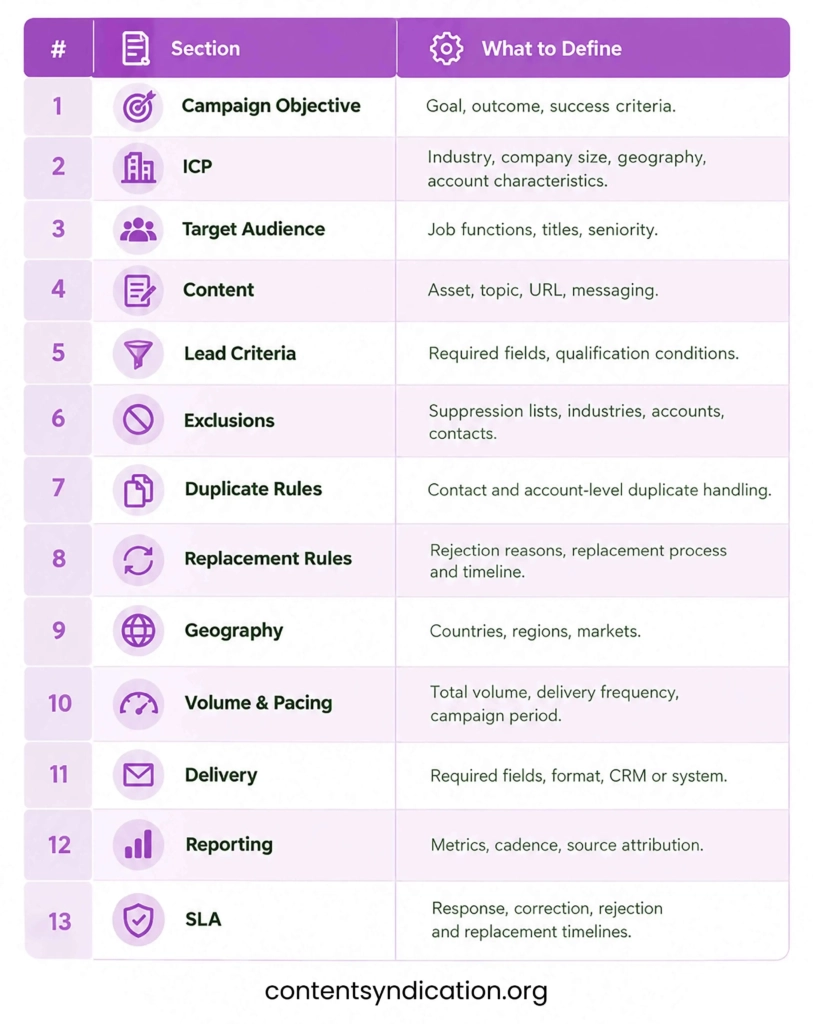
B2B Content Syndication Brief Template
Use the following structure as a practical starting point.
1. Campaign Overview
Campaign Name:
[Enter campaign name]
Campaign Objective:
[Enter campaign objective]
Campaign Start Date:
[DD/MM/YYYY]
Campaign End Date:
[DD/MM/YYYY]
Total Lead Goal:
[Enter target volume]
Primary Success Metric:
[Qualified leads / sales-accepted leads / meetings / opportunities]
2. Ideal Customer Profile
Target Industries:
[Enter industries]
Company Size:
[Employee range]
Revenue Range:
[Enter revenue criteria]
Geography:
[Countries or regions]
Business Model:
[B2B SaaS / enterprise software / IT services / etc.]
Technology Environment:
[Relevant technologies or platforms]
Named Target Accounts:
[Attach target account list where applicable]
Excluded Accounts or Industries:
[List exclusions]
3. Target Audience and Buying Roles
Target Job Functions:
[Enter functions]
Target Job Titles:
[Enter preferred titles]
Seniority Levels:
[C-Level / VP / Director / Manager]
Decision-Makers:
[Enter roles]
Influencers:
[Enter roles]
Technical Evaluators:
[Enter roles]
Practitioners:
[Enter roles]
Excluded Roles:
[List exclusions]
4. Content Asset Details
Asset Name:
[Enter asset]
Content Format:
[Whitepaper / eBook / report / webinar / guide]
Landing Page or Registration URL:
[Enter URL]
Primary Topic:
[Enter topic]
Target Audience:
[Enter audience]
Core Value Proposition:
[Why should the buyer engage?]
Campaign Messaging:
[Enter approved messaging]
Brand or Disclosure Requirements:
[Enter requirements]
5. Lead Qualification Criteria
A valid lead should meet the agreed requirements for:
- Business email
- Company
- Industry
- Geography
- Job function
- Job title
- Seniority
- Company size
- Content engagement
- Qualification responses
- Consent status
Required Qualification Questions:
- [Question]
- [Question]
- [Question]
6. Lead Rejection Criteria
Reject records that contain:
- Personal email addresses
- Invalid contact details
- Incorrect geography
- Excluded industries
- Non-target job functions
- Duplicate records
- Suppressed accounts
- Incomplete required fields
7. Suppression and Duplicate Rules
Existing Customers:
[Include / Exclude]
Current Opportunities:
[Include / Exclude]
Existing CRM Contacts:
[Include / Exclude]
Previous Campaign Leads:
[Define lookback]
Competitors:
[Include / Exclude]
Duplicate Rule:
[Contact / account / both]
Duplicate Lookback Window:
[90 / 180 / 365 days]
8. Lead Replacement Rules
Replacement Required For:
[List rejection reasons]
Replacement Request Window:
[Enter period]
Vendor Replacement SLA:
[Enter period]
Replacement Approval Process:
[Describe process]
9. Geography, Volume and Pacing
Target Geography:
[Countries / regions]
Total Lead Volume:
[Enter volume]
Weekly or Monthly Pacing:
[Enter pacing]
Minimum Delivery:
[Enter requirement]
Maximum Delivery:
[Enter requirement]
Delivery Frequency:
[Daily / weekly / scheduled batches]
10. Lead Delivery and CRM Requirements
Delivery Method:
[CSV / CRM / API / marketing automation]
CRM or MAP:
[Salesforce / HubSpot / Marketo / etc.]
Required Fields:
- First name
- Last name
- Business email
- Job title
- Company
- Industry
- Company size
- Country
- Content asset
- Campaign source
- Qualification responses
- Consent information
Campaign Naming Convention:
[Enter naming convention]
Source Attribution Requirement:
[Enter requirements]
11. Reporting Requirements
Reporting Frequency:
[Weekly / biweekly / monthly]
Track:
- Leads delivered
- Accepted leads
- Rejected leads
- Replacement leads
- ICP match rate
- Duplicate rate
- Lead acceptance rate
- Cost per qualified lead
- Sales progression where available
12. SLA Requirements
Lead Delivery SLA:
[Enter timeline]
Rejected Lead Response SLA:
[Enter timeline]
Replacement SLA:
[Enter timeline]
Data Correction SLA:
[Enter timeline]
Reporting SLA:
[Enter timeline]
13. Campaign Approval
Marketing Owner:
[Name]
Sales Owner:
[Name]
Operations Owner:
[Name]
Vendor Contact:
[Name]
Final Approval Date:
[Date]
Download the B2B Content Syndication Brief Template
Want a ready-to-use version instead of building the document yourself?
Use our editable campaign brief to document your ICP, buying roles, qualification criteria, exclusions, lead-delivery requirements, CRM fields, reporting expectations, and SLAs before campaign activation.
Download the Brief Template →Pre-Launch Review Checklist
Before activating the campaign, review the brief with marketing, sales, operations, and the vendor.
Confirm that:
- Campaign objective is clearly documented
- ICP is defined
- Account exclusions are defined
- Target roles are specified
- Seniority is specified
- Content asset is approved
- Campaign messaging is approved
- Lead qualification requirements are documented
- Consent requirements are defined
- Suppression lists are shared
- Duplicate rules are agreed
- Replacement conditions are clear
- Geography is confirmed
- Lead volume is confirmed
- Delivery pacing is agreed
- CRM fields are defined
- Delivery format is confirmed
- Reporting cadence is defined
- SLAs are documented
- Sales understands the lead acceptance criteria
A final review at this stage can prevent avoidable changes once the campaign is already live.
Planning a B2B Content Syndication Campaign?
A campaign brief defines what should happen before launch. Execution determines whether those requirements turn into qualified demand.
If you already know your ICP, target roles, qualification requirements, and campaign goals, the next step is building the campaign around them.
Get My Campaign Plan →Frequently Asked Questions
1. What should a B2B content syndication brief include?
A B2B content syndication brief should cover the campaign objective, ICP, target audience, content assets, lead qualification criteria, exclusions, consent requirements, duplicate rules, replacement conditions, geography, pacing, delivery, reporting, CRM requirements, and SLAs.
2. Why is a campaign brief important for content syndication?
It creates a shared definition of the campaign before execution begins. This helps align marketing, sales, operations, and the vendor around targeting, lead quality, delivery, and measurement.
3. How detailed should a content syndication brief be?
The brief should be detailed enough to remove operational ambiguity without becoming difficult to use. The required level of detail depends on campaign complexity, targeting requirements, qualification rules, and the number of teams involved.
4. Should lead rejection rules be included?
Yes. Defining unacceptable leads, duplicate handling, suppression rules, and replacement conditions before launch creates a clearer process for managing delivery issues.
5. Should consent requirements be included in the campaign brief?
Yes. If consent or opt-in is required, the brief should specify what evidence or fields must be delivered with the lead and what standard the vendor is expected to follow.
6. Who should approve the brief?
Marketing will typically own the campaign brief, with input from sales and operations. The vendor should also confirm that the requirements are understood and executable before campaign activation.
7. Can the same brief template be used with multiple vendors?
The overall structure can remain consistent, but delivery rules, pricing, lead models, integrations, qualification requirements, and SLAs may need to be adjusted for individual vendors.
Turn a Clear Campaign Brief Into Qualified Demand
The quality of a content syndication campaign is influenced by more than content distribution.
Audience definition, buying roles, lead qualification, exclusions, delivery requirements, consent, reporting, and sales follow-up all affect whether campaign activity becomes usable demand.
A B2B content syndication brief template gives every stakeholder the same operating reference before the campaign begins.
It reduces ambiguity, improves vendor alignment, and makes campaign performance easier to evaluate.
Before activating your next campaign, treat the brief as part of campaign strategy rather than administrative paperwork.
Define what success should look like before the first lead is delivered.