

A strong B2B asset can reach thousands of people and still have little influence on demand.
The problem is often not the content itself. It is what happens before, around and after distribution.
This is where content activation vs content syndication becomes an important distinction. Syndication can put an asset in front of new, relevant audiences through third-party channels. Activation goes further by connecting that content to specific audiences, channels, buyer stages and follow-up experiences.
What Is Content Syndication?
Content syndication is the distribution of existing content through third-party platforms to reach audiences beyond a company’s owned channels. These can include industry publishers, professional networks, specialist media and B2B audience networks.
The basic model is straightforward:
Create content → Distribute → Reach new audiences → Capture engagement or leads
The value comes from access. Your website may have a strong content library, but its reach is naturally limited by your existing audience, search visibility and promotional channels.
Syndication gives that content another route to relevant buyers.
This makes content syndication strategy particularly useful when the challenge is reaching more of the right market rather than creating more content. However, distribution alone does not determine whether an asset influences demand. What happens after someone encounters it matters just as much.
What Is Content Activation?
B2B content activation is the broader process of turning content into an active part of the buyer experience.
Instead of treating an ebook, webinar or report as a standalone asset, activation connects it to the surrounding journey.
That can include:
- Promoting the asset to defined audiences
- Matching content to buyer interests
- Retargeting engaged visitors
- Sharing related content based on the first interaction
- Equipping sales teams with relevant assets
- Personalising follow-up by role or account
- Using engagement signals to determine the next interaction
The distinction is important because a content asset does not create value simply because someone has accessed it.
A technology buyer might download a report, return to a product page two weeks later, attend a webinar, share the report internally and eventually speak with sales. Activation connects those interactions.
In that sense, content activation strategy is less about getting content seen and more about giving each piece of content a role within a larger demand journey.
Key Differences Between Content Activation vs Content Syndication
The easiest way to understand content activation vs content syndication is to look at the job each one performs.
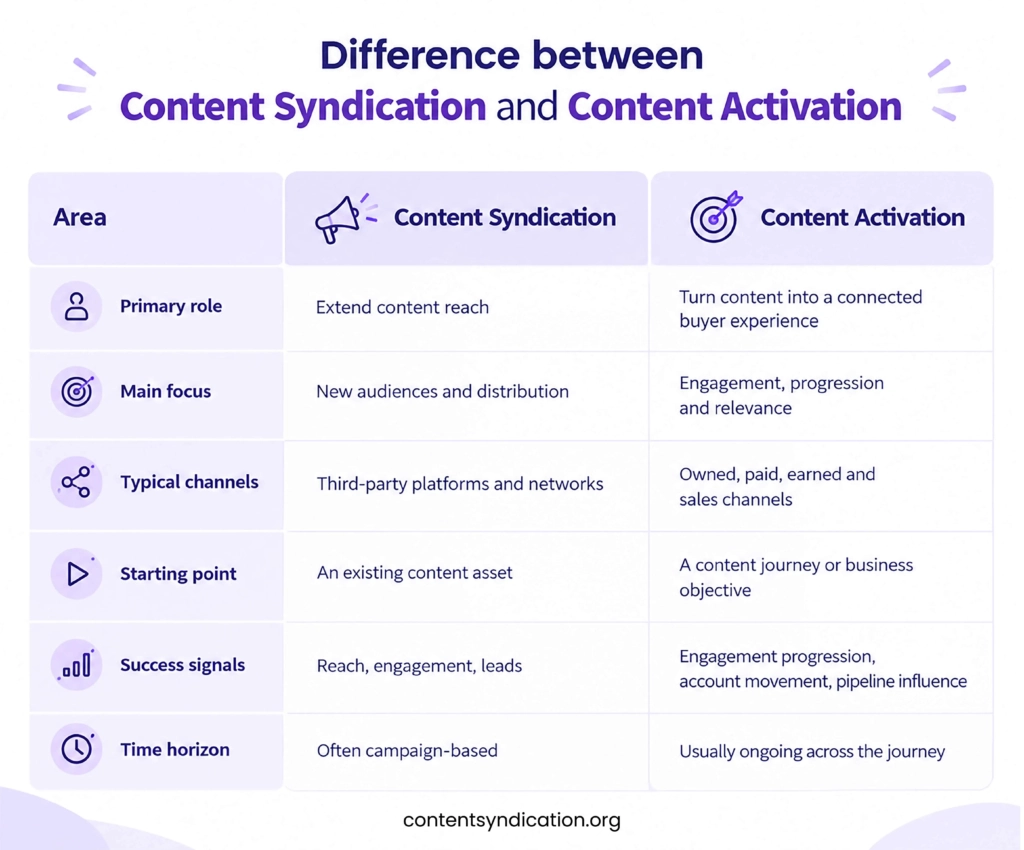
Syndication is therefore one mechanism within a broader activation model.
That distinction also explains why content activation vs content syndication for B2B should not be treated as a simple either-or decision.
Syndication can create the first interaction. Activation determines what the organisation does with that interaction.
Where Content Syndication Fits in the B2B Buyer Journey
B2B buyers rarely move from first exposure to purchase in one step.
They research problems, compare approaches, involve colleagues, evaluate vendors and revisit information as their requirements become clearer.
Syndication can play a role particularly when buyers are still discovering a problem or exploring possible solutions.
For example:
- Awareness: Industry research or benchmark report
- Consideration: Practical guide or solution comparison
- Evaluation: Case study, technical guide or product-focused content
The asset and audience should change as the buyer progresses.
This is why content syndication strategy should not be built around distributing the same asset to everyone. The content needs to make sense for the audience and stage being targeted.
Syndication can also generate useful engagement signals. When combined with account, role or intent information, those signals can help marketing understand which audiences are responding and where deeper engagement may be warranted.
What Content Activation Adds Beyond Distribution
Distribution answers:
Who can see this content?
Activation asks:
What should happen because they saw it?
That second question changes how content is planned.
Suppose a target account engages with an industry report. A basic distribution approach may record the download and move on.
An activation model can use that interaction as context.
The account could receive related educational content. A sales team could see the topic that attracted attention. A retargeting campaign could reinforce the same problem from a different angle. A later interaction could introduce a case study or evaluation asset.
The content is no longer operating as an isolated campaign.
Use Cases for Each Approach
There are situations where syndication is particularly useful.
Use syndication when you need to:
- Reach audiences beyond your owned database
- Enter a new market
- Generate awareness around a new topic
- Extend the reach of research or thought leadership
- Support account or persona targeting
- Generate new contacts around a gated asset’
Activation becomes more important when you need to:
- Build engagement across multiple interactions
- Support a longer buying journey
- Coordinate marketing and sales content
- Personalise experiences by audience
- Move engaged accounts toward deeper consideration
- Connect content engagement to pipeline progression
The two approaches become more powerful when they operate together.
How to Combine Syndication With Multi-Channel Activation
A practical model looks like this:
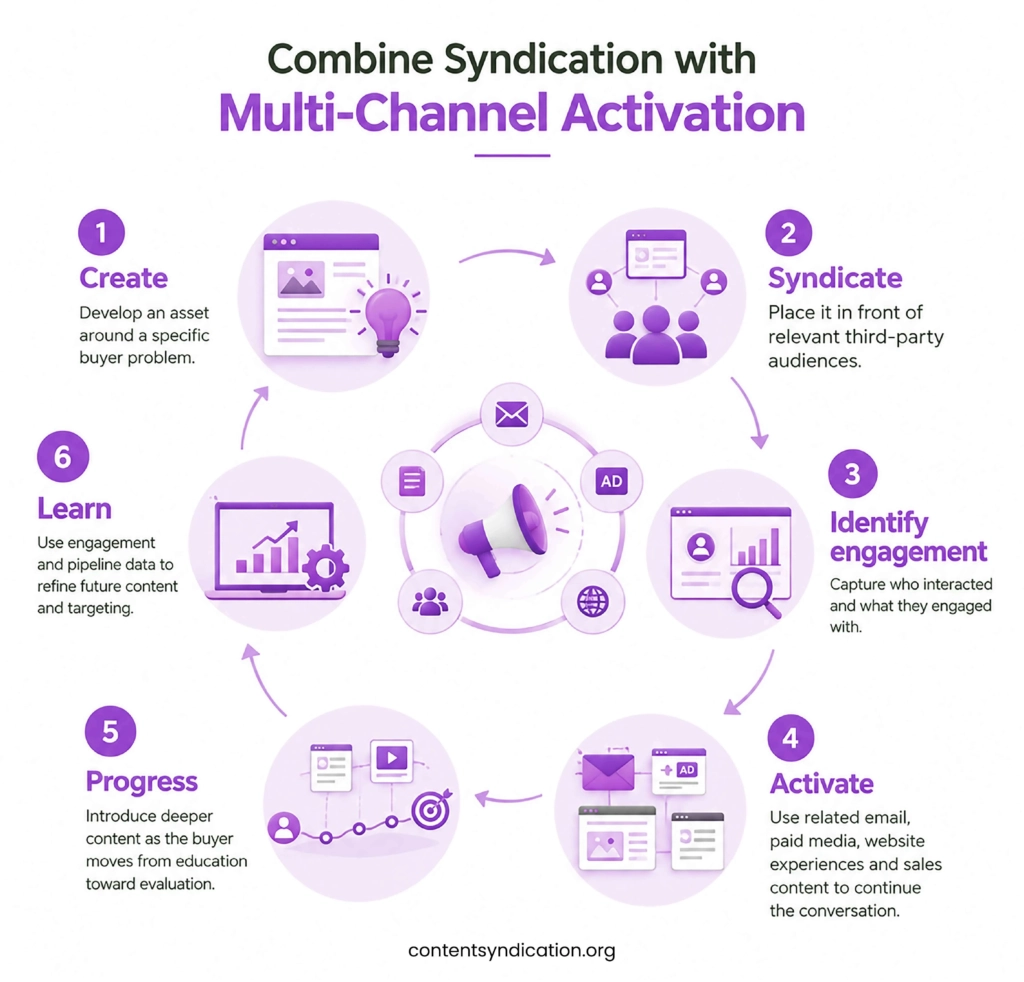
This creates multi-channel content activation without requiring every channel to repeat the same message.
The same research report might introduce the problem, while an email explains the implications, a webinar explores the issue in more depth and a case study demonstrates how another company addressed it.
The content changes. The strategic narrative remains connected.
Metrics to Measure Content Activation and Syndication
Measurement should reflect the job each activity performs.
For syndication, useful metrics include:
- Qualified reach
- Target-account engagement
- Content downloads
- Lead quality
- Cost per qualified lead
- Engagement by persona
For activation, look further into what happens after the initial interaction:
- Repeat engagement
- Content progression
- Account engagement
- Stakeholder engagement
- Meeting creation
- Opportunity progression
- Pipeline influence
If syndication is judged only by pipeline immediately after the first interaction, its role in early-stage discovery can be underestimated.
If activation is judged only by clicks, its contribution to pipeline acceleration remains invisible. The measurement model should therefore match the stage and purpose of the activity.
Common Mistakes
- Generating contacts without considering account or persona relevance.
- Not having a defined clear audience for activation.
- Activation not creating progression, but simply duplicating distribution.
- Measuring every interaction the same way
- An asset not having a role beyond the download.
Frequently Asked Questions
1. What is the difference between content activation and content syndication?
Syndication focuses on extending content to relevant audiences through third-party channels. Activation is broader and connects content to ongoing engagement across the buyer journey.
2. When to use content activation vs content syndication?
Use syndication when expanding reach is the immediate requirement. Use activation when the goal is to turn that reach into a connected sequence of engagement and progression.
3. Can content syndication and activation work together?
Yes. Syndication can create new audience exposure while activation provides the follow-up experiences that deepen engagement.
4. Is content activation the same as content distribution?
Not necessarily. Distribution is about getting content to an audience. Activation considers how content is used, connected and followed up across the buyer experience.
Turn Content Distribution Into Qualified Demand
Content syndication can help you reach new audiences. Content activation helps turn that engagement into a connected path toward pipeline.
If your team is generating downloads but struggling to create qualified opportunities, the next step is not simply distributing more content. It is connecting targeting, qualification, nurture, and follow-up around the accounts that matter.
Get My Campaign Plan →Move From Content Distribution to Content Progression
The distinction between content activation vs content syndication becomes clearer when the buyer journey is considered as a connected system.
Syndication helps content travel further.
Activation determines how that content continues to work once the buyer encounters it.
Neither needs to replace the other. The stronger approach is to give each a clear role.
Use syndication to reach relevant audiences beyond your existing channels. Use activation to connect those interactions to the next useful experience.