
B2B revenue teams often launch content syndication campaigns with strong expectations for pipeline growth, only to end up with a spreadsheet full of leads that do not convert.
The problem is not always the quality of the whitepapers, e-books, or webinars being distributed.
Often, the bigger issue is how success is being measured.
Traditional demand generation tends to focus on lead volume, treating each lead as an isolated contact. But enterprise buying decisions usually involve multiple stakeholders across the same target account.
That is why modern B2B teams should also measure account coverage.
Instead of asking only, “How many leads did we generate?”, marketers should ask:
“How effectively are we reaching the people and roles that matter inside our target accounts?”
A strong account coverage strategy can help content syndication teams understand whether they are building meaningful visibility across the buying group or simply collecting isolated contacts.
What B2B Account Coverage Means
B2B account coverage measures how effectively your marketing efforts reach relevant people across target accounts.
Rather than looking only at total lead volume, it evaluates whether your content is reaching decision-makers, influencers, technical evaluators, end users, and other stakeholders who may participate in the buying process.
Strong account coverage does not necessarily mean reaching every person inside an organization.
It means building enough visibility across the right roles to support evaluation, internal discussion, and eventual sales engagement.
In content syndication, this matters because a single content download may show interest from one individual, but it does not necessarily indicate that the broader account is engaged.
Why Lead Count Alone Is Not Enough
Evaluating a content syndication campaign only by total lead count or cost per lead can create an incomplete picture of performance.
A campaign may generate hundreds of downloads while still missing the accounts your sales team actually wants to reach.
Relying on raw lead volume can create several problems.
The Single-Contact Trap
Capturing one junior researcher or low-influence contact from a target account may create awareness, but it usually provides limited insight into whether the broader buying group is engaged.
Wasted Budget
Budget may be spent reaching individuals who fall outside your target roles, departments, or buying influence.
Sales and Marketing Friction
Sales teams may reject syndication leads when contacts lack context, authority, or relevance.
This can create tension between marketing and sales even when the campaign appears successful based on lead volume alone.
Account coverage gives both teams a more useful way to evaluate whether the campaign is reaching the right organizations and stakeholders.
Define Target Account Roles
Enterprise technology and software purchases are rarely made by one person.
They often involve multiple stakeholders with different responsibilities across evaluation, approval, technical review, procurement, and adoption.
Before launching a content syndication campaign, define the roles you want to reach.
Typical buying-group roles may include:
Economic Buyers and Decision-Makers
These are senior leaders who control budget or final approval.
They are usually interested in:
- Business impact
- ROI
- Risk
- Strategic value
- Financial justification
Technical Evaluators
These stakeholders assess whether a solution can work within the organization.
They may focus on:
- Integrations
- Security
- Performance
- Architecture
- Implementation requirements
End Users and Champions
These are the people who may use the solution directly or advocate for it internally.
They often care about:
- Usability
- Productivity
- Workflow improvements
- Day-to-day impact
Procurement, Legal, and Risk Stakeholders
These teams may become involved later in the evaluation process.
Their priorities can include:
- Pricing
- Contract terms
- Compliance
- Risk management
- Vendor approval
Mapping these roles before campaign launch makes it easier to measure whether your syndication activity is reaching the right mix of people.
Measure Contact Coverage
Once target roles are defined, the next step is measuring contact coverage.
Contact coverage looks at how many relevant individuals you are engaging within a target account.
For example, imagine a target account where your data shows 15 relevant stakeholders across the departments you want to reach.
If your content syndication campaign engages 6 of those contacts, your contact coverage for that account is 40%.
This does not automatically mean the account is sales-ready.
But it does show that your campaign is reaching deeper into the organization than a single-contact interaction.
Tracking contact coverage across priority accounts can help you understand whether your syndication partner is reaching meaningful portions of the buying group or only generating isolated contacts.
Measure Role Coverage
Contact volume alone is not enough.
You should also measure role coverage.
Role coverage looks at whether your content is reaching the right functional mix within an account.
For example, a campaign may engage three developers from a target company.
That may look like strong contact coverage.
But if the campaign has not reached any security leaders, business stakeholders, or budget owners, the buying group is still incomplete.
That is why content should be aligned to different roles.
Executives may respond to:
- Business cases
- ROI content
- Strategic guides
Technical stakeholders may prefer:
- Architecture guides
- Implementation content
- Product comparisons
Practitioners may engage with:
- How-to content
- Use cases
- Workflow examples
Balanced role coverage helps create a stronger account-level view of engagement.
Track Engagement Depth
Reaching an account is only the first step.
You also need to understand how deeply the account is engaging.
Account-level engagement goes beyond asking whether a single download happened.
Instead, look at the quality, frequency, and variety of interactions across the account.
Useful indicators include:
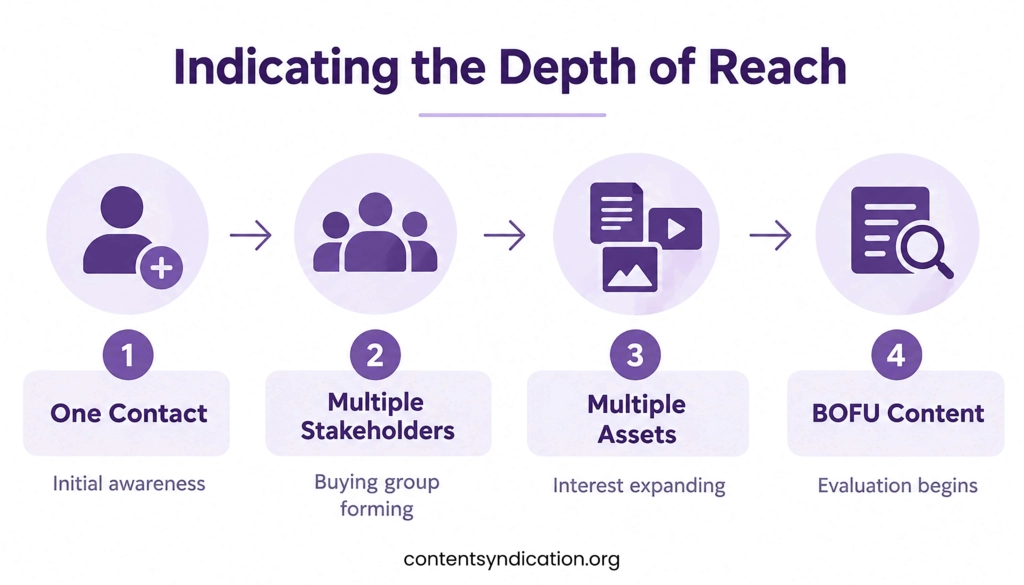
- Multiple stakeholders engaging with content
- Several content assets consumed within a short period
- Engagement with both top-of-funnel and bottom-of-funnel content
- Repeat activity from the same account
- Visits to solution-focused or decision-stage resources
For example, one person downloading an introductory guide may indicate early awareness.
But multiple stakeholders consuming a benchmark report, an implementation guide, and an ROI calculator can indicate a much deeper level of account interest.
This is where account coverage becomes more useful than raw lead volume.
Identify Coverage Gaps
As you review campaign data, you will often find gaps.
Those gaps can help you decide where to adjust targeting, content, or budget.
Common coverage gaps include:
Industry Gaps
Certain industries or sub-segments within your ICP may not be responding to your current content.
This may signal a mismatch between the content and the audience.
Geographic Gaps
You may see strong engagement in one region but limited activity in another.
That can help guide localization or targeting adjustments.
Missing Decision-Makers
You may have strong engagement among junior or technical users but little visibility among senior decision-makers.
That means the campaign may need different content, targeting filters, or distribution channels.
Role Imbalance
A campaign may be over-indexed toward one function and underrepresented in others.
For example, strong technical engagement but no business or procurement engagement.
Identifying these gaps during the campaign allows you to adjust before the campaign ends.
Account Coverage vs Account Penetration
Account coverage and account penetration are related, but they measure different things.
| Metric | Focus | Primary Goal | Typical Funnel Role |
|---|---|---|---|
| Account Coverage | Breadth of reach across target accounts and buying roles | Build awareness and buying-group visibility | Top to mid funnel |
| Account Penetration | Depth of engagement and progression inside an account | Move the account toward evaluation, opportunity, and revenue | Mid to bottom funnel |
Content syndication is often especially useful for building account coverage.
It helps brands reach more people across relevant target accounts and creates signals that can support later-stage marketing and sales activity.
Account penetration usually becomes more important as the account progresses deeper into evaluation and sales engagement.
Both metrics matter, but they should not be treated as the same thing.
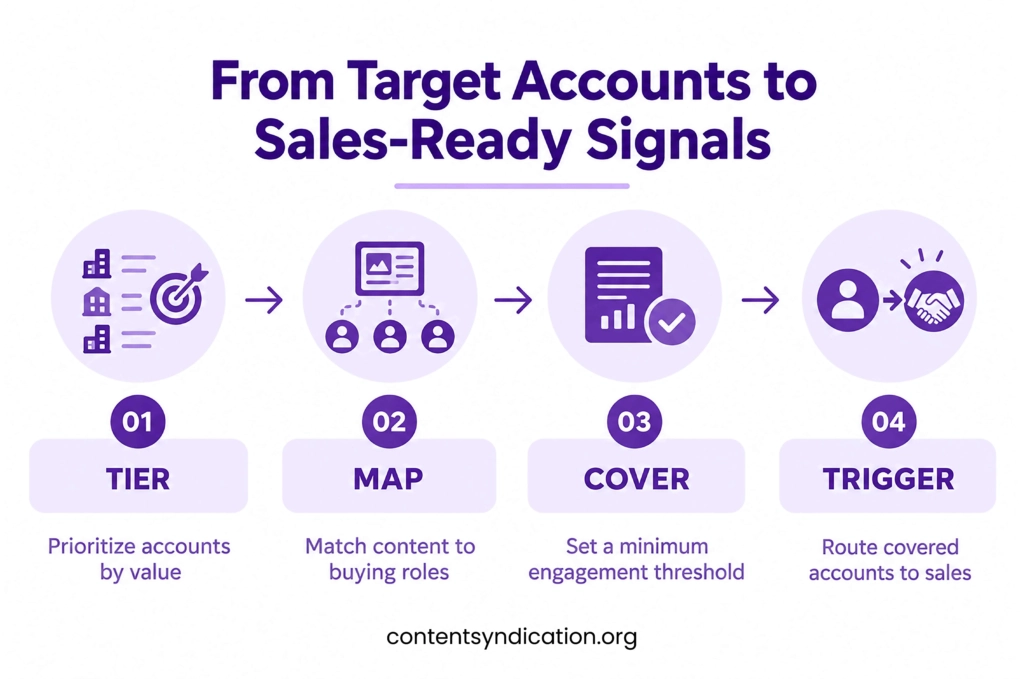
Example Account-Level Framework
A simple framework can help teams measure account coverage more consistently.
1. Tier Accounts
Segment accounts based on value and strategic importance.
For example:
- Tier 1: Strategic accounts
- Tier 2: High-priority accounts
- Tier 3: Broader ICP accounts
2. Map Content to Roles
Assign content based on the buying roles you want to reach.
For example:
- Executive content for economic buyers
- Technical content for evaluators
- Practical guides for users
- ROI and proof content for decision-stage stakeholders
3. Define Coverage Thresholds
Create internal rules for what counts as meaningful coverage.
For example, a Tier 1 account might need engagement from multiple relevant contacts across more than one buying role before it is considered well covered.
The exact threshold should come from your own sales cycle, account size, and historical conversion data.
4. Trigger the Next Action
Once an account reaches your internal coverage threshold, decide what happens next.
That may include:
- Sales outreach
- Retargeting
- ABM advertising
- Executive nurture
- Deeper intent monitoring
- Higher-priority SDR follow-up
This turns account coverage from a reporting metric into an operational signal.
Metrics to Track
To evaluate account coverage effectively, track metrics that go beyond raw lead count.
Target Account Reach
What percentage of your target account list engaged with at least one syndicated asset?
Stakeholder Coverage
How many different buying roles are engaged inside each account?
Multi-Contact Engagement
How many accounts have multiple active contacts within a defined time period?
Engagement Depth
How many accounts are interacting with multiple content assets or higher-intent resources?
Account-Level Intent
Are multiple contacts from the same account showing related research activity?
Sales Acceptance
Are covered accounts more likely to be accepted by sales?
Pipeline Progression
Do accounts with stronger coverage progress more often into opportunities?
The goal is to connect account coverage with business outcomes.
Common Mistakes
Treating Syndication Leads in Isolation
Do not evaluate each lead without matching it to the parent account.
Account-level context is critical.
Ignoring Asset-to-Persona Alignment
Different roles need different content.
Sending the same asset to every stakeholder reduces relevance.
Expecting Immediate Deep Penetration
A cold syndication campaign may build awareness before it builds deep engagement.
Coverage usually develops over time.
Measuring Only CPL
CPL can be useful, but it should not be the only success metric.
A low CPL is not valuable if the campaign fails to reach the accounts and buying roles that matter.
Frequently Asked Questions
How many contacts per target account should a syndication campaign aim for?
There is no universal benchmark. The right number depends on account size, deal complexity, and the number of stakeholders involved in the buying process. Focus on reaching the roles that influence evaluation and purchase decisions rather than chasing an arbitrary contact count.
Can content syndication support account-based marketing?
Yes. Content syndication can support ABM by helping marketers reach relevant stakeholders across target accounts, build awareness, and surface engagement signals that can be used for further account-based activation.
How do I improve low stakeholder coverage?
Review your targeting criteria, content mix, and role distribution. If engagement is concentrated among one type of contact, adjust job-title, seniority, department, and content targeting to improve the functional mix within the account.
What is the difference between account coverage and buying-group coverage?
Account coverage measures how broadly you are reaching people within a target account. Buying-group coverage focuses specifically on whether the key roles involved in a purchase decision are being reached and engaged.
Why is account coverage important in content syndication?
It helps marketers understand whether syndication is building visibility across the right accounts and stakeholders instead of producing disconnected leads with limited buying influence.
Improve Account Coverage Across Your Content Syndication Campaigns
ContentSyndication.org helps B2B marketers reach more relevant stakeholders across target accounts, improve buying-group engagement, and create a stronger path from content engagement to qualified pipeline.
If your campaigns are generating isolated leads but limited account-level traction, request a content syndication campaign plan built around the accounts and buying roles that matter most.