
Content syndication remains one of the most effective ways for B2B brands to expand reach, generate leads, and build pipeline visibility. Yet many marketers still struggle to connect syndication campaigns to measurable business impact.
That is why the comparison between publisher networks and intent data has become increasingly important.
Some marketers believe broader content distribution creates stronger results. Others focus on buyer intent and behavioral targeting. In reality, both influence campaign performance in different ways. Publisher networks improve reach and visibility, while intent signals improve targeting precision and conversion potential.
The real question is not which one matters more in isolation. It is understanding how each impacts ROI and how marketers can combine both to improve campaign performance.
Why Do Marketers Miss ROI?
Many syndication campaigns generate high lead volumes but weak pipeline outcomes. A campaign may appear successful because downloads increase and forms are completed, yet sales teams often struggle to convert those leads into opportunities.
One major reason is that marketers optimize for the wrong metrics.
Lower CPL might look efficient, but cheap leads do not automatically translate into stronger revenue impact. In many cases, campaigns fail because:
- Audience targeting is too broad
- Buyers are not actively researching solutions
- Lead validation is weak
- Content distribution lacks relevance
- Follow-up timing is inconsistent
This is especially common in long B2B buying cycles where multiple stakeholders influence decisions.
Without strong distribution, campaigns struggle to gain visibility. Without intent alignment, campaigns often attract low-conversion leads. Modern syndication performance depends on balancing both.
What Is a Publisher Network in Content Syndication?
A publisher network is a collection of third-party media sites, professional communities, newsletters, and industry publications used to distribute marketing content.
In publisher network content syndication, brands place gated assets such as whitepapers, reports, webinars, and case studies across platforms that already attract relevant professional audiences.
The goal is to expand reach among decision-makers already consuming industry-specific content.
For example, a cybersecurity company may distribute research reports through technology publications read by IT leaders, while a SaaS brand targeting finance teams may syndicate content through CFO-focused business media.
Publisher networks help marketers:
- Expand audience reach
- Generate opt-in leads
- Increase brand visibility
- Improve top-of-funnel engagement
- Access niche industry audiences
However, publisher reach alone does not guarantee conversion quality.
A prospect may download a report simply because the topic is interesting, not because they are actively evaluating vendors. That is why distribution needs to be paired with stronger buyer intelligence.
What Is Intent Data in Content Syndication?
Intent data refers to behavioral signals showing that a buyer or account may be actively researching a solution category.
In intent data content syndication, marketers use these insights to prioritize prospects more likely to convert.
Intent signals are often based on:
- Keyword searches
- Content consumption patterns
- Competitor research activity
- Engagement with industry topics
- Visits to relevant websites
Intent platforms aggregate this behavior to identify in-market buyers.
This has become increasingly valuable because B2B buyers now complete large portions of research independently before speaking with vendors.
Intent-driven targeting helps marketers:
- Improve audience prioritization
- Increase conversion potential
- Reduce wasted spend
- Improve sales alignment
- Accelerate follow-up timing
Instead of only asking whether a prospect matches the ICP, marketers now ask whether that account is actively researching solutions right now.
That distinction has a direct impact on engagement quality and pipeline efficiency.
Key Differences between Publisher Network and Intent Data
Understanding the differences between distribution scale and buyer intelligence is essential when evaluating publisher network vs. intent data strategies.
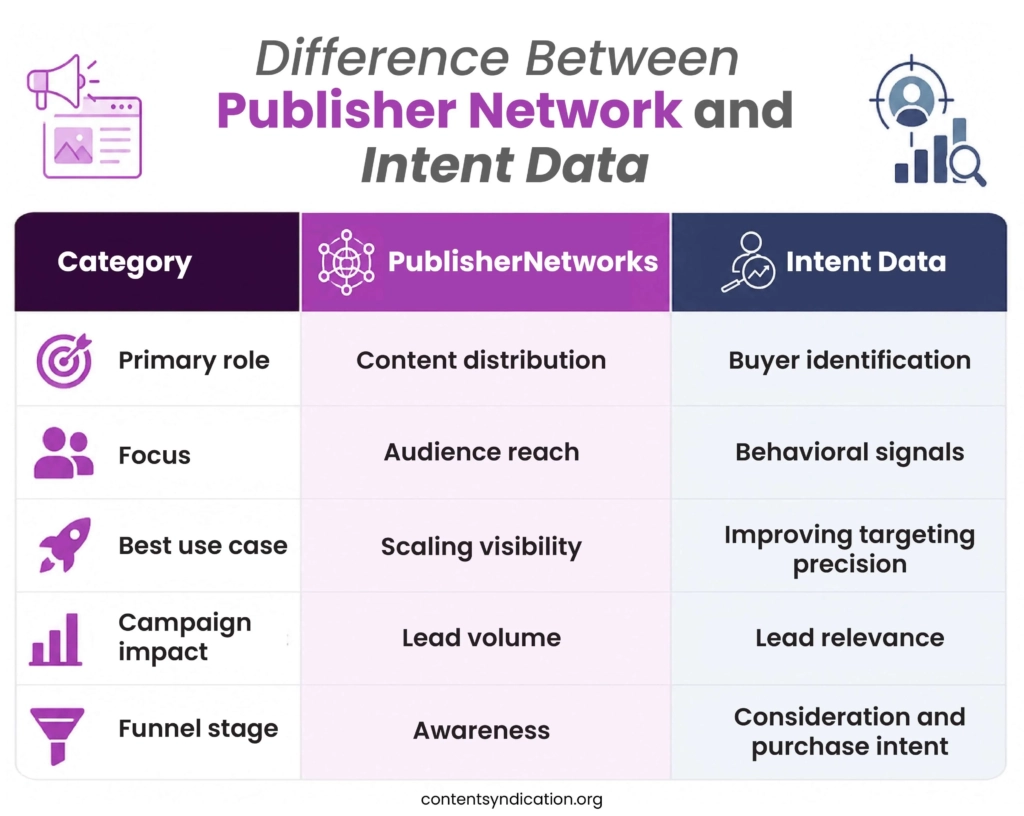
Publisher networks help marketers place content in front of larger audiences. Intent data helps marketers identify which audiences are more likely to convert.
Which One Impacts ROI?
If the goal is brand awareness and visibility, publisher networks often create stronger short-term impact.
If the goal is conversion efficiency and pipeline growth, intent data usually contributes more directly to long-term ROI.
When marketers compare publisher network vs intent data, intent signals often influence:
- Sales acceptance rates
- Opportunity creation
- Meeting conversions
- Deal velocity
- Revenue contribution
This is because intent-driven targeting improves audience relevance.
However, intent data alone is not enough. Even highly targeted campaigns need quality distribution to generate engagement opportunities at scale.
That is why the best-performing strategies combine:
- Relevant publisher reach
- Behavioral targeting
- Strong content alignment
- Timely follow-up
- Sales and marketing coordination
Organizations that integrate these elements effectively often achieve stronger demand generation ROI because campaigns become both scalable and conversion-focused.
What is the Best Approach?
The most effective syndication strategies combine publisher ecosystems with intent intelligence.
A practical framework includes:
Define Ideal Buyer Profiles
Identify industry, company size, job role, region, and technology fit to improve campaign targeting.
Activate Relevant Publisher Channels
Distribute content through trusted publications and communities aligned with audience interests.
Layer Intent Insights
Use behavioral signals to prioritize accounts actively researching related solutions.
Match Content to Funnel Stage
Make sure that content aligns with the funnel stage:
- TOFU: Blogs, reports, infographics
- MOFU: Case studies, webinars
- BOFU: Demos, ROI assets, comparison guides
Optimize Using Revenue Metrics
Track engagement quality, conversion rates, and pipeline contribution instead of relying only on lead volume.
This is often the best way to improve content syndication campaign performance because optimization decisions become tied to business outcomes.
How to Measure ROI Beyond CPL
One of the biggest mistakes in B2B content syndication is evaluating campaigns only through acquisition costs. While CPL matters, it does not provide a complete picture of performance.
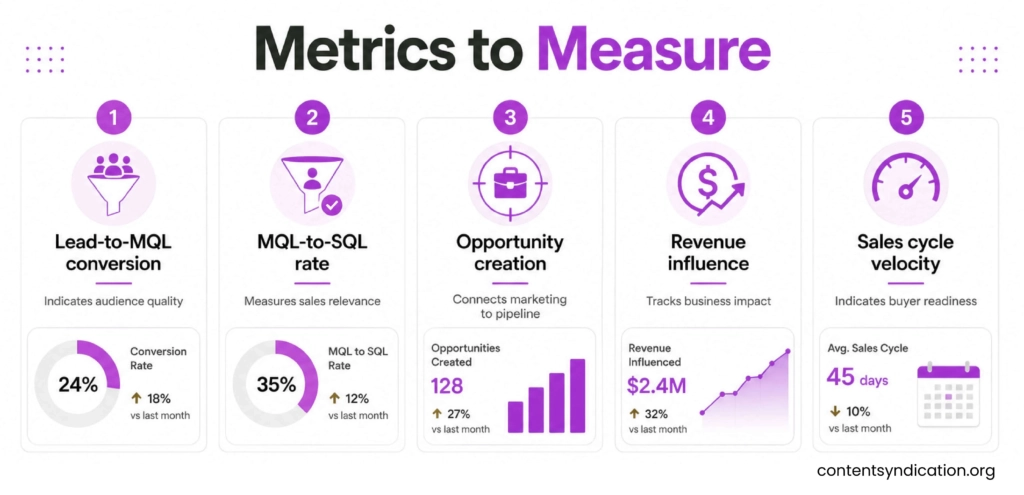
High-performing syndication programs focus on long-term efficiency rather than isolated lead costs. In publisher networks vs. intent data investments, this becomes important.
Intent-enriched campaigns may initially cost more, but stronger conversion rates often improve total ROI. Understanding how intent data improves content syndication ROI requires evaluating downstream business impact, not just front-end lead metrics.
Frequently Asked Questions (FAQs)
What is the difference between publisher networks and intent data?
Publisher networks distribute content across media channels, while intent data identifies buyers showing active research behavior.
Which approach improves lead quality more?
Intent-driven targeting generally improves lead quality because it prioritizes accounts already researching solutions.
Can publisher networks work without intent data?
Yes, but campaigns may generate broader audiences with lower conversion efficiency.
Why is intent data important for syndication campaigns?
Intent insights help marketers prioritize accounts more likely to convert and improve sales alignment.
Do publisher networks improve lead volume?
Yes. Publisher networks are useful for scaling content distribution, increasing brand visibility, and generating more opt-in leads from relevant professional audiences.
Improve Content Syndication ROI with Verified, Intent-Aligned Leads
Modern syndication success is no longer about generating the highest number of leads. It is about generating leads that actually convert.
The discussion around publisher network vs intent data should not be framed as an either-or decision. Publisher networks create visibility and audience access, while intent data improves precision and conversion quality.
Together, they help marketers build more efficient and measurable syndication strategies.
Improve content syndication ROI with verified, intent-aligned leads that connect your content with the audiences most likely to engage and convert.