
Reaching B2B technology buyers in the US is rarely about simply getting more people to see your content. Technology purchases involve multiple stakeholders, long research cycles, and significant evaluation before a buyer is ready to speak with a vendor.
This makes content syndication for B2B technology buyers a valuable way to extend content beyond owned channels and reach relevant audiences earlier in the buying journey.
When supported by precise ICP targeting, firmographic and technographic data, intent signals, and lead qualification, syndication can become an effective part of B2B technology lead generation.
Who Are US B2B Technology Buyers?
US B2B technology buyers include the professionals who identify technology needs, evaluate solutions, influence internal decisions, approve investments, and oversee implementation.
Depending on the product and organisation, the buying group can include:
- CIOs and CTOs evaluating strategic technology investments
- IT leaders assessing infrastructure, security, software, and integration
- Business and functional leaders responsible for transformation initiatives
- Procurement teams evaluating vendors and commercial terms
- Technical specialists assessing architecture and implementation
- Operations leaders responsible for adoption and business outcomes
These B2B technology buyers rarely operate as a single decision-maker. A software, infrastructure, cybersecurity, or data purchase can involve stakeholders from IT, finance, operations, security, procurement, and executive leadership.
Why Technology Buyers Are Difficult to Reach
Technology buyers have access to more information than ever. They can compare vendors, research solutions, read analyst reports, consult peers, watch demonstrations, and evaluate technical information before engaging directly with a company.
Several factors make them particularly difficult to reach:
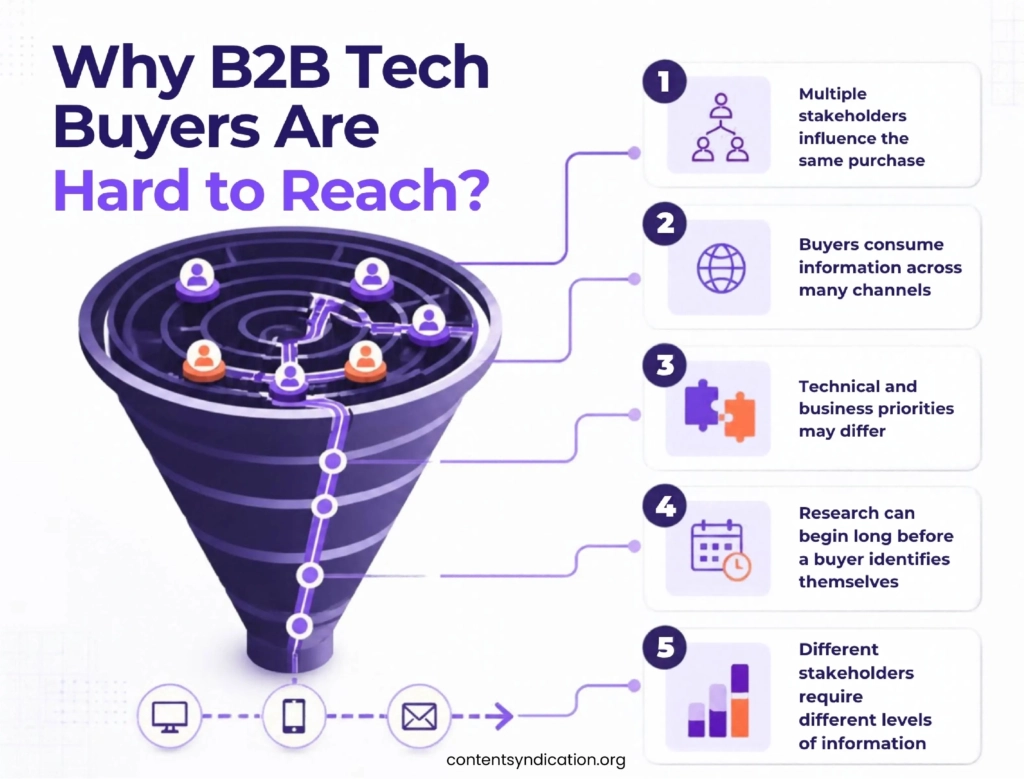
A broad audience strategy can therefore generate engagement without generating meaningful demand.
For content syndication for B2B technology buyers, distribution needs to be connected to a clearly defined audience, relevant content, and a measurable qualification framework.
Build the Right ICP
An ICP defines the organisations most likely to have a relevant problem, the ability to adopt your solution, and the potential to become valuable customers.
Instead of defining the audience simply as “US technology companies,” consider:
- Industry and sub-industry
- Employee count
- Revenue range
- Geographic location
- Business model
- Growth stage
- Existing technology environment
- Relevant operational challenges
The more precisely the ICP is defined, the easier it becomes to identify relevant accounts and build a content syndication strategy for technology buyers around their priorities.
Identify Buying Committee Roles
Reaching the right company is only the first step. The next is identifying who inside that company may influence the purchase.
The buying committee may include:
- Economic buyers
- Technical evaluators
- Functional leaders
- End users
- Procurement
- Security and compliance stakeholders
Each role evaluates the solution differently.
This means content syndication for B2B technology buyers should account for stakeholder roles rather than treating everyone within an account as the same audience.
Choose High-Performing Content Assets
The content being syndicated needs to provide enough value to attract serious researchers.
High-value formats can include:
- Research reports
- Benchmark studies
- Industry reports
- Whitepapers
- Practical guides
- Technology comparison guides
- Playbooks
- Original research
The strongest assets generally address a problem or question that exists before the buyer evaluates a specific vendor.
Target by Firmographics
Firmographic targeting helps ensure content reaches organisations that match the ICP.
Common criteria include:
- Industry
- Company size
- Revenue
- Location
- Department
- Growth stage
- Business model
This is particularly useful forenterprise technology buyers, where organisational size, structure, and complexity can influence the technology purchasing process.
Firmographic filters also reduce irrelevant lead generation. If a campaign targets large financial services organisations, for example, distributing content broadly across unrelated industries creates activity but weakens the commercial value of the campaign.
Use Technographics and Intent
Technographics provide visibility into the technology environment it operates within.
Technographic data can identify organisations using specific cloud platforms, CRM systems, databases, security solutions, infrastructure, or other technologies relevant to your offering.
Intent signals provide another layer by showing when companies are researching topics associated with a potential need.
Used together, these signals can strengthen IT buyer targeting by helping marketers identify accounts that fit the ICP and show relevant research behaviour.
For example, a company using technologies that integrate with your platform and actively researching related topics may warrant greater attention than an account that only matches your industry criteria.
This creates a more focused approach to B2B tech demand generation.
Trying to Reach US Technology Buyers?
Build a targeted content syndication campaign around your ICP, target accounts, buying roles, intent signals, and qualification criteria.
Get My Campaign Plan →Syndicate Across Relevant Channels
Content should be distributed through channels that have a strong connection to the target audience.
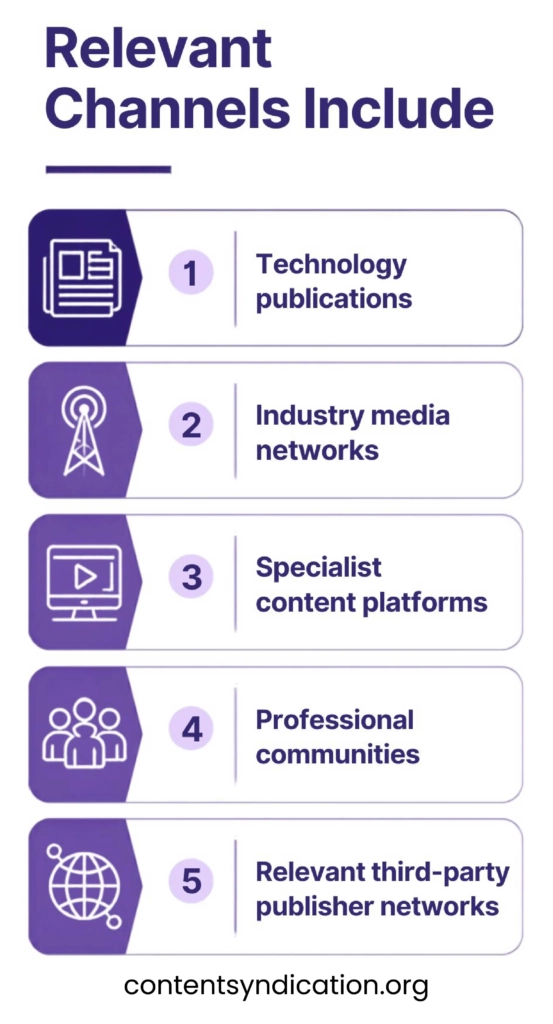
The channel should support audience relevance, not simply audience scale.
A strong content syndication for B2B technology buyers program combines audience targeting with appropriate distribution environments.
Validate and Qualify Every Lead
A content download is not automatically a qualified lead.
Technology content can attract researchers, students, consultants, service providers, and professionals who have no current buying requirement.
Lead validation should therefore assess:
- Company and industry fit
- Job title and function
- Company size and location
- Contact accuracy
- Content relevance
- Stated business needs
- Potential buying stage
Qualification criteria should be defined before the campaign begins.
This allows marketing teams to distinguish between someone who simply consumed an asset and someone who fits the intended audience and may represent a genuine buying opportunity.
Strong B2B technology lead generation depends as much on qualification as it does on acquisition.
Getting Downloads but Not Qualified Opportunities?
Improve lead quality with a content syndication campaign built around your ICP, buying roles, qualification criteria, and target accounts.
Discuss My Target Audience →Nurture Technology Buyers After Engagement
Many buyers will not be ready for a sales conversation after their first content interaction.
The next step should be a relevant nurture journey that builds knowledge and confidence over time.
A simple progression could look like:
Research report → Educational guide → Case study → Product evaluation → Sales conversation
This helps turn content syndication for B2B technology buyers from a lead acquisition tactic into a broader demand-generation process.
Metrics to Measure
Syndication should be measured against audience quality and commercial progression rather than downloads alone.
| Metric | What It Shows |
|---|---|
| Target-account reach | Whether priority accounts were reached |
| ICP fit rate | How closely leads match the intended audience |
| Role relevance | Whether relevant stakeholders are engaging |
| Content engagement | Whether the asset is attracting meaningful interest |
| Lead acceptance rate | How many leads meet qualification criteria |
| MQL-to-SQL rate | How effectively leads progress |
| Opportunity creation | Whether engagement develops into opportunities |
| Cost per qualified lead | Efficiency of qualified lead generation |
These metrics provide a clearer view of campaign quality.
A campaign generating fewer leads with stronger ICP fit and higher opportunity progression may create more value than one producing thousands of poorly matched downloads.
That is why content syndication for B2B technology buyers should be evaluated across the complete journey from audience reach to commercial progression.
Frequently Asked Questions
1. How does content syndication help reach B2B technology buyers?
It extends valuable content beyond owned channels and places it in front of relevant third-party audiences. With precise targeting and qualification, it can help technology companies reach potential buyers earlier in the research process.
2. What content works best for technology buyers?
Research reports, benchmark studies, practical guides, industry analysis, and educational whitepapers can work well because they address buyer questions without requiring an immediate product conversation.
3. How to reach B2B technology buyers in the US effectively?
Start with a defined ICP, create content around real buyer challenges, use firmographic and technology-based targeting, distribute through relevant third-party channels, and qualify every engagement against agreed criteria.
Turn Content Reach Into Qualified Technology Demand
Reaching US technology buyers requires more than putting content in front of a large audience. It requires a connected approach to targeting, distribution, qualification, and nurture.
Content syndication for B2B technology buyers can help technology companies extend their reach while maintaining control over who they want to engage and why.
The strongest programs connect the right content with the right accounts, stakeholders, technology environments, and buying signals.
When these elements work together, syndication becomes more than a way to generate downloads. It becomes a structured way to introduce relevant ideas to the right buyers and create a measurable path toward qualified demand.