

For years, B2B marketers have highly relied on lead volume to define their success. More leads meant better performance. But that mindset doesn’t work anymore.
Today, B2B marketers are shifting toward pipeline-driven strategies, where the focus is not just on generating leads but on converting them into revenue opportunities. Content syndication plays a critical role in this shift by helping brands build a predictable pipeline from high-intent audiences.
Since not all leads translate into revenue, focusing purely on volume often creates a false sense of success.
This is where building a pipeline from content syndication becomes an important strategy. Instead of simply generating contacts, the focus shifts to driving qualified prospects who have a higher likelihood of converting into opportunities and revenue.
Content syndication, when done right, does more than fill the top of the funnel; it directly contributes to pipeline creation and acceleration.
Content syndication pipeline strategy allows marketers to consistently generate high-quality opportunities by combining targeted distribution with intent-driven engagement.
In this blog, we’ll break down how content syndication drives pipeline, how leads move through the funnel, and how to optimize campaigns for revenue impact.
According to Demand Gen Report, over 60% of B2B buyers engage with multiple pieces of content before speaking with sales.
What is Pipeline in B2B Marketing
In B2B marketing, pipeline refers to the total value of potential revenue opportunities that are actively being pursued by the sales team.
Unlike leads, which represent initial interest, pipeline reflects buying intent and engagement. It typically includes:
- Sales-qualified leads (SQLs)
- Opportunities created
- Deals in various stages of the sales cycle
Pipeline is a more accurate indicator of future revenue because it captures progress beyond initial engagement.
Understanding pipeline impact helps organizations move from vanity metrics to performance metrics that align marketing with revenue outcomes.
This is why pipeline from content syndication is considered a more reliable performance metric than lead volume alone.
Role of Content Syndication in Pipeline Building
Content syndication is increasingly becoming a core component of B2B pipeline generation strategies due to its ability to combine reach, targeting, and intent data.
Content syndication enables brands to distribute their content through third-party platforms to reach highly targeted, in-market audiences.
The real value of content syndication shows up in pipeline generation as it has the ability to bring in leads who are already consuming relevant content and showcasing high intent.
Unlike the traditional inbound approach, it doesn’t rely on organic discovery or wait for the prospect to find your content in their buyer journey. It accelerates the reach and places your content on the platforms your audience is already actively searching on.
That is why a pipeline from content syndication tends to be more predictable and easier to scale than many other channels.
Key ways in which syndication supports pipeline building include:
- Targeting accounts based on ICP and intent signals
- Capturing opt-in leads with verified data
- Aligning content offers with buying stage
- Feeding sales-ready prospects into nurture and SDR workflows
What makes content syndication unique is its ability to reach in-market buyers without waiting for organic discovery. Unlike inbound strategies that depend on SEO or brand awareness, syndication actively places your content in front of decision-makers who are already researching solutions. This significantly reduces time to pipeline and improves conversion efficiency.
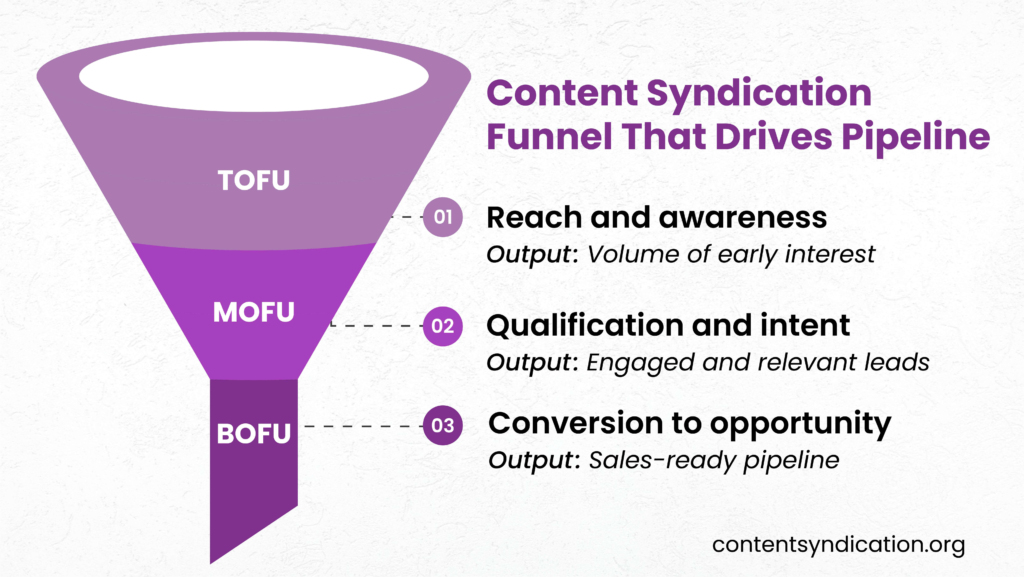
Content Syndication Funnel Breakdown
To understand how syndication contributes to pipeline, it’s important to map it across the funnel.
Top of Funnel (TOFU)
Content syndication at the top of the funnel helps generate early-stage pipeline by attracting problem-aware audiences.
At the awareness stage, syndication helps distribute thought leadership content such as:
- Industry reports
- Educational ebooks
- Trend analysis guides
The goal here is reach and initial engagement.
Middle of Funnel (MOFU)
This is where content syndication pipeline generation becomes more focused, improving lead qualification and engagement.
At this stage, content becomes more solution-oriented:
- Case studies
- Webinars
- Product comparisons
This is where lead qualification begins and engagement deepens.
Bottom of Funnel (BOFU)
At the bottom of the funnel, content syndication directly contributes to pipeline conversion by engaging high-intent buyers ready for sales discussions.
Here, content is designed to drive decisions:
- Product demos
- ROI calculators
- Buyer guides
Syndication at this stage directly supports opportunity creation by engaging prospects who are close to purchase decisions.
This is where content syndication pipeline generation directly translates into revenue opportunities.
How Leads Turn into Pipeline from Content Syndication
Generating leads through content syndication is only the first step. The real value lies in converting those leads into a qualified pipeline.
The journey typically looks like this:
- Lead capture through gated content
Captures initial interest and intent through value-driven assets. - Qualification based on ICP and engagement
Filters leads based on fit and behavior to identify potential buyers. - Nurture through email and retargeting
Builds trust and keeps your brand top of mind as buyers evaluate options. - SDR outreach and validation
Adds a human layer to qualify intent and move leads forward. - Conversion into SQLs and opportunities
Transitions qualified leads into active pipeline.
This is where MQL to SQL content syndication becomes important. Not all syndicated leads are ready for sales immediately, but with proper qualification and nurturing, they can be effectively progressed into pipeline.
Strong alignment between marketing and sales ensures that lead conversion is optimized and high-quality leads are prioritized.
Key Metrics to Measure Pipeline from Content Syndication
Tracking the right metrics is essential to understand how effectively your content syndication campaigns are contributing to pipeline growth.
Key metrics include:
- Volume of SQLs generated
- Opportunity creation rate
- Pipeline contribution from campaigns
- Conversion rates across funnel stages
- Cost per opportunity
Measuring pipeline contribution helps teams understand not just how many leads are generated but also how many actually turn into revenue-driving opportunities.
Challenges in Pipeline Attribution
While content syndication can drive strong pipeline results, measuring its exact contribution can be challenging.
Syndication works well, but attributing pipeline accurately can get tricky.
Common challenges include:
- Multi-touch buyer journeys make it difficult to identify which interaction actually influenced pipeline.
Fix: Implement multi-touch attribution models to capture the full buyer journey.
- Multiple channels influence decisions, making single-channel attribution unreliable.
Fix: Track campaign-level performance consistently across all active channels.
- Delayed conversions create gaps between lead generation and visible pipeline impact.
Fix: Use longer attribution windows and cohort-based tracking to measure true impact.
- Data silos between marketing and sales tools result in incomplete visibility across the funnel.
Fix: Align CRM and marketing automation data and standardize definitions for MQLs, SQLs, and opportunities.
Because buyers interact with multiple touchpoints before converting, it can be difficult to assign clear credit to a single channel.
This makes it important to adopt multi-touch attribution models and ensure data consistency across systems.
How to Increase Pipeline from Syndication
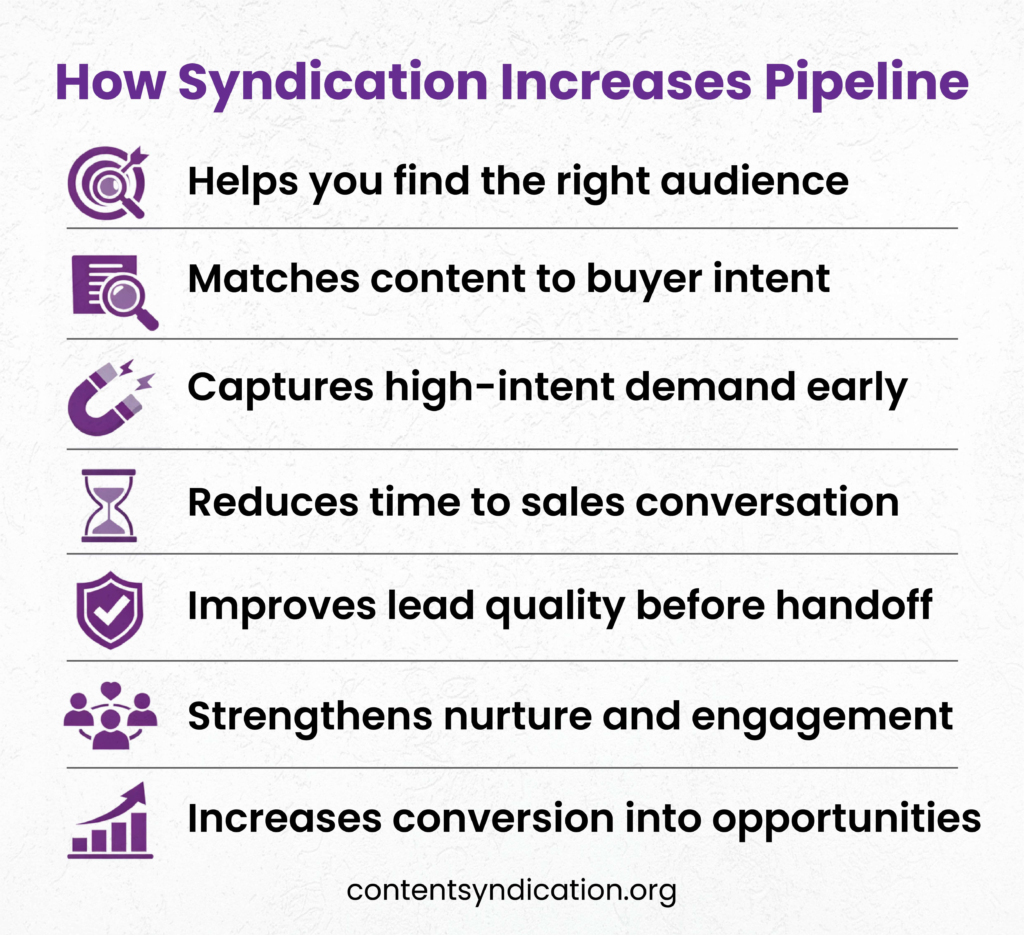
To maximize pipeline from content syndication, marketers need a structured and data-driven approach.
A well-defined content syndication pipeline strategy ensures that each stage of the funnel is optimized for conversion.
1. Align Content with Buyer Intent
Ensure your content matches each stage of the buyer journey to improve engagement and pipeline progression. In manufacturing, pipeline progression often requires different content for operations, technical evaluators, procurement teams, and financial decision-makers. See the complete manufacturing lead generation guide.
2. Prioritize Targeting
Use firmographic, technographic, and intent data to reach the right audience segments.
3. Improve Lead Qualification
Implement strong filtering criteria to ensure only relevant leads enter your system.
4. Strengthen Nurture Programs
Leads often require multiple touchpoints before converting. Structured nurture flows help accelerate movement through the funnel.
5. Enable Sales Follow-Up
Timely and contextual follow-up from SDRs significantly improves conversion rates.
6. Optimize Campaign Performance
Continuously analyze campaign performance and refine targeting, content, and messaging.
These strategies directly improve pipeline performance by enhancing both lead quality and conversion rates.
7. Align Sales and Marketing Teams
Pipeline growth depends heavily on how well marketing and sales teams are aligned. Clear definitions of MQLs, SQLs, and follow-up processes ensure that high-quality leads are not lost during handoff.
Real Example of Content Syndication Driving Pipeline
A B2B SaaS company running content syndication campaigns targeted mid-size enterprises using intent-based targeting. By aligning TOFU and MOFU content with buyer needs, they generated high-quality leads that were nurtured through email workflows.
Within 60 days:
- 35% of leads converted into SQLs
- 20% moved into opportunities
- Pipeline value increased significantly
This demonstrates how content syndication, when aligned with intent and follow-up, can directly impact revenue outcomes.
Frequently Asked Questions
1. What is a pipeline from content syndication?
Pipeline from content syndication refers to the revenue opportunities generated as a result of leads acquired through syndicated content campaigns.
2. How does content syndication contribute to a pipeline?
Understanding how content syndication contributes to pipeline involves looking beyond lead volume to how those leads are nurtured, qualified, and converted into opportunities.
3. Is content syndication effective for B2B lead generation?
Yes, especially when targeting specific audiences and aligning content with buying stages. It helps reach in-market buyers more efficiently.
4. How long does it take to see pipeline results?
Timelines vary, but typically results can be seen over a few weeks to a few months depending on campaign scale and sales cycle length.
5. What types of content work best?
High-value assets such as reports, case studies, and webinars tend to perform best in syndication campaigns.
6. What is content syndication pipeline generation?
Content syndication pipeline generation refers to the process of converting leads acquired through syndicated content into qualified sales opportunities and revenue. It focuses on moving prospects beyond initial engagement into the active sales pipeline through targeting, nurturing, and sales alignment.
7. How do you generate pipeline from content syndication?
You can generate pipeline from content syndication by targeting the right audience, aligning content with buyer intent, capturing high-quality leads, and nurturing them through email and SDR outreach. Strong follow-up and qualification processes help convert leads into SQLs and opportunities.
8. What is the difference between leads and pipeline in B2B?
Leads represent initial interest from potential buyers, while pipeline refers to qualified opportunities that are actively being pursued by the sales team. Pipeline is a more accurate measure of revenue potential because it reflects intent, engagement, and progression through the sales cycle.
9. How does content syndication improve lead-to-revenue conversion?
Content syndication improves lead-to-revenue conversion by delivering targeted content to high-intent audiences, capturing qualified leads, and enabling structured nurturing and sales follow-up. This ensures that more leads progress into pipeline and ultimately convert into revenue.
Why Content Syndication Outperforms Traditional Lead Generation
Unlike traditional inbound strategies, content syndication provides immediate access to in-market audiences. It eliminates the dependency on organic discovery and accelerates pipeline generation.
This makes content syndication pipeline strategy one of the most scalable approaches for consistent B2B growth.
Key advantages include:
• Faster reach to targeted audiences
• Better targeting using intent data
• Higher quality, high-intent leads
• More predictable and scalable pipeline generation
Conclusion
B2B marketing is clearly shifting to pipeline-focused performance.
By focusing on pipeline from content syndication, organizations can ensure that their efforts translate into measurable business impact.
Content syndication is no longer just a lead generation tactic. It is a powerful strategy for building a predictable B2B pipeline and driving revenue. By aligning content with buyer intent, improving lead qualification, and enabling strong sales follow-up, organizations can turn content syndication into a scalable pipeline engine.
Organizations that invest in pipeline from content syndication will be better positioned to drive consistent revenue growth.