
Are your content syndication campaigns generating leads but not building a clear path to the pipeline? Many teams invest in distribution and gated assets, yet struggle to connect those leads to a structured journey.
Without a defined funnel, syndication becomes a lead source rather than a growth engine. The real opportunity lies in turning every syndicated interaction into a step toward qualification, intent, and conversion.
A well-built lead funnel using content syndication changes that. Instead of relying on isolated campaigns, it creates a continuous system that attracts the right audience, nurtures intent, and guides prospects toward conversion.
Why Content Syndication Works for Funnel Building
The reason having a lead funnel using content syndication works is simple: it meets buyers where they already consume content. Instead of waiting for prospects to find you organically, syndication expands your reach through publishers, media partners, and specialized platforms that already have your target audience.
This matters for the following reasons.
- It improves top-of-funnel visibility.
- It helps generate leads from gated content campaigns without depending only on paid search or social.
- It creates a repeatable system for moving contacts into the funnel with trackable engagement.
For teams focused on MQL generation, syndication can be a reliable entry point into the pipeline.
Understanding the B2B Funnel Structure
A strong funnel is not just a list of leads. It is a progression from awareness to consideration to decision. That is why a B2B lead funnel strategy must define what happens at each stage before campaigns go live.
At the top, TOFU attracts new buyers with educational assets. In the middle, MOFU nurtures interest and builds trust. At the bottom, BOFU turns attention into action through high-intent offers and sales alignment. If the funnel stages are not clearly defined, content syndication may bring in volume, but it will not reliably produce a qualified pipeline.
In other words, the lead funnel using content syndication works best when every lead enters a journey, not a database.
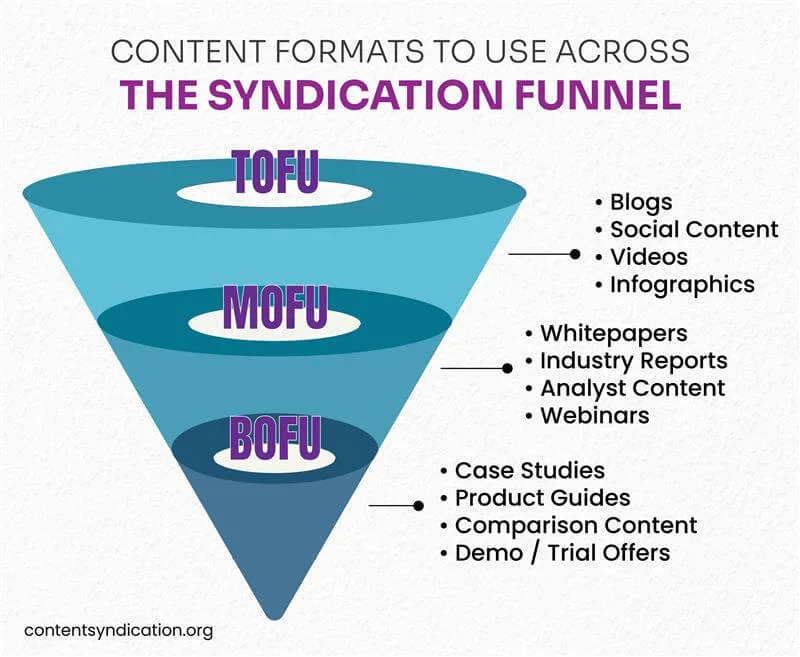
To better understand how content works across each stage of the funnel, refer to the visual below:
Step 1: TOFU Syndication Strategy
The first stage of TOFU MOFU BOFU in syndication starts with awareness. TOFU is where your goal is not immediate conversion, but qualified reach. At this stage, the right content should educate, introduce a problem, or frame a market trend.
Good TOFU assets in syndication include thought leadership reports, trend guides, industry benchmarks, and educational articles. These formats work well because they build trust before asking for commitment. They also support using content syndication for TOFU leads by expanding exposure among buyers who are still early in their research process.
To make TOFU effective, the offer must match the audience. If the asset is too product-heavy, the response quality usually drops. If it is too generic, the lead pool may grow, but the relevance weakens. The best TOFU syndication strategy balances reach with fit.
Step 2: MOFU Lead Nurturing
Once leads enter the funnel, the next task is not to push hard for a demo. It is to build context. This is where the content syndication funnel becomes more strategic.
MOFU leads usually need more information before they are ready to speak with sales. That is why a nurture email sequence is essential. The sequence should add value step by step, not repeat the same message. For example, one email can expand on the business problem, another can share a comparison framework, and a third can introduce a practical solution path.
This middle stage is also where webinar syndication becomes valuable. Webinars allow you to deepen education while capturing stronger signals of interest. A prospect who registers, attends, and engages with follow-up content is showing more intent than a contact who only downloaded a TOFU asset.
For the best results, MOFU content should be aligned to buyer role, industry, and prior behavior. That is what turns syndication from lead capture into meaningful progression.
Step 3: BOFU Conversion Strategy
BOFU is where the funnel shifts to decision support. At this stage, the lead funnel using content syndication should be designed to help sales identify the strongest opportunities and move them forward with clarity.
BOFU content usually includes case studies, product comparisons, ROI summaries, implementation guides, and buyer enablement assets. The objective is to remove friction and answer the questions that typically block conversion.
This is also where how to convert syndicated leads into SQLs becomes a practical question rather than a theory. The answer depends on timing, relevance, and sales readiness. If a lead has engaged multiple times, visited key pages, or requested a high-intent asset, the follow-up should be immediate and contextual.
At this stage, the role of syndication is no longer just lead creation. It is pipeline acceleration.
Integrating Syndicated Leads with CRM & Lead Scoring
A funnel only works when connected to your core systems. Syndicated leads should flow directly into your CRM and marketing automation, where they can be tracked, scored, and nurtured.
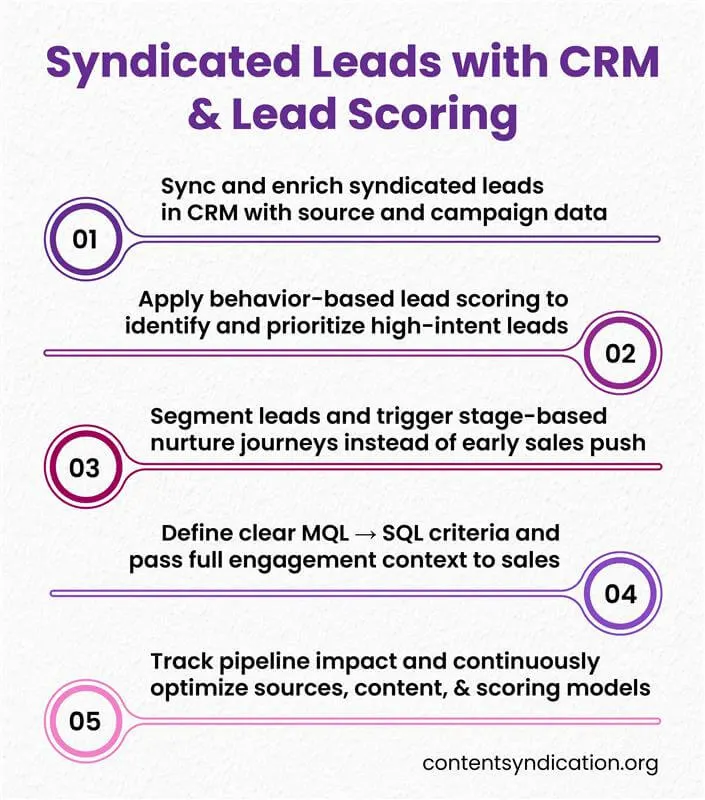
While a single download shows curiosity, repeated engagement and high-value actions signal readiness. When scoring aligns with sales criteria, handoffs become faster and more consistent.
This is especially critical in SaaS, where quick qualification and tight marketing-sales alignment directly impact pipeline outcomes.
Metrics to Track in a Syndication Funnel
A syndication funnel should be measured by movement. The metrics must show whether your lead funnel using content syndication is producing quality and progression.
Track lead volume, but do not stop there. Also monitor MQL conversion rate, sales acceptance rate, SQL rate, engagement depth, opportunity creation, and pipeline contribution. These metrics reveal where the funnel is working and where it is leaking.
It is also worth watching cost per qualified lead rather than only cost per lead. A lower CPL is not valuable if the leads do not progress. The real test of content syndication is whether it improves revenue outcomes, not just reportable activity.
Common Funnel Mistakes
Even a strong lead funnel using content syndication can underperform when teams make basic mistakes.
- Mistake: Same content for every audience.
Fix: Segment your audience and tailor content to match their industry, role, and intent.
- Mistake: Treating TOFU leads like BOFU too early.
Fix: Nurture with relevant content before pushing for sales conversations.
- Mistake: No lead scoring or CRM integration.
Fix: Implement lead scoring and sync with CRM for timely, consistent follow-ups.
- Mistake: Measuring only lead quantity.
Fix: Track quality metrics like qualification rate, opportunities created, and pipeline impact.
- Mistake: Treating syndication as a standalone channel.
Fix: Integrate it into a broader B2B lead funnel strategy for better results.
Final Framework
Here is the simplest way to structure the lead funnel using content syndication:
- TOFU: Syndicate educational content to attract the right audience
- MOFU: Nurture interest through layered content and webinars
- BOFU: Use high-intent assets to support conversion and sales follow-up
System layer: Connect leads to CRM, scoring, and account intelligence
Outcome: Improve qualified pipeline and drive measurable growth
When all of these layers work together, content syndication becomes more than lead generation. It becomes a repeatable demand engine.
Frequently Asked Questions
What is the best content format for a lead funnel using content syndication?
Educational reports, benchmark guides, and webinars usually perform well because they create value before asking for a direct sales step.
How do you know if content syndication is working?
Look beyond lead volume. Track MQL quality, SQL conversion, opportunity creation, and pipeline contribution to measure real impact.
Can content syndication support account-based marketing?
Yes. When paired with targeting and scoring, it can strengthen ABM funnel integration by helping you reach the right contacts inside priority accounts.
Is content syndication suitable for all B2B businesses?
Yes, content syndication works well for most B2B companies, especially those targeting niche audiences or looking to scale lead generation quickly.
Conclusion
A successful lead funnel using content syndication is built on relevance, progression, and measurement. It starts with reach, moves through education, and ends with conversion support that aligns marketing and sales. When the funnel is designed with clear stages, strong content, and connected systems, it becomes a dependable path to pipeline acceleration.
For B2B teams that want scale without losing quality, the opportunity is not simply to syndicate more content. It is to build a lead funnel using content syndication with intent, structure, and measurable outcomes.