In content syndication, not all leads are created equal. Some campaigns generate large volumes of contacts after a single content download, while others require multiple engagement steps before a lead is delivered to the advertiser.
So which approach actually produces better lead quality?
Many B2B marketers today are comparing single-touch vs double-touch content syndication to understand which approach generates higher-quality leads and stronger pipeline impact.
This question sits at the center of an ongoing debate around single-touch vs. double-touch content syndication. Should marketers rely on a single interaction to capture leads or introduce an additional engagement step to validate real interest?
Understanding the difference between single-touch and double-touch models helps demand generation teams design more effective syndication campaigns and improve overall funnel performance.
What is Single-Touch Content Syndication?
Single-touch content syndication is the traditional model used in many lead generation campaigns. In this structure, a prospect engages with a single piece of gated content and submits their information once to access it.
Typically, this process involves a straightforward gated content distribution workflow where the publisher promotes a whitepaper, report, or eBook to their audience. When a reader downloads the asset, their contact information is passed to the brand running the campaign.
Key characteristics of single-touch syndication include:
- One content interaction before lead delivery
- Basic lead capture through a form submission
- High lead volume potential
- Limited behavioral validation
This model works well for early awareness campaigns. However, many organizations find that the leads generated through a single interaction may still be very early in their buying journey.
As a result, the gap between marketing-qualified leads (MQLs) and sales opportunities can often be significant.
What is Double-Touch Content Syndication?
To address lead quality challenges, many B2B marketers are adopting double-touch content syndication.
In this model, prospects interact with two pieces of content or complete two engagement steps before their information is delivered to the brand. This second interaction acts as an additional validation step that confirms genuine interest.
The concept is simple: a lead must engage twice before being passed to the advertiser.
The typical double-touch syndication process includes:
- Initial content engagement or registration
- Follow-up‑interaction such as another asset download or confirmation
- Lead delivery after engagement verification
This approach introduces a form of lead validation, helping filter out casual downloads and surface contacts with higher intent.
For demand generation teams, this additional engagement step often produces a more reliable pool of marketing-qualified prospects.
Lead Quality Comparison: Single-Touch vs Double-Touch Content Syndication
When evaluating double-touch vs. single-touch content syndication, the primary difference comes down to engagement depth and buyer intent.
| Factor | Single-Touch Syndication | Double-Touch Syndication |
|---|---|---|
| Engagement | One interaction | Two interactions |
| Lead Volume | High | Moderate |
| Lead Intent | Lower | Higher |
| Buyer Validation | Limited | Stronger |
| Best For | Awareness campaigns | Qualified lead generation |
| Sales Readiness | Lower | Higher |
Single-touch campaigns prioritize reach. They aim to place content in front of a wide audience and capture as many leads as possible.
Double-touch campaigns prioritize qualification. They introduce an extra interaction to ensure that the prospect is genuinely interested in the topic or solution.
For marketing teams measured on pipeline impact rather than raw lead volume, deeper engagement often proves more valuable.
Why Single-Touch Often Fails to Deliver Sales-Ready Leads
Single-touch syndication can generate impressive numbers on paper, but those numbers do not always translate into meaningful pipeline.
There are several reasons this happens.
First, the barrier to entry is low. A single download does not necessarily indicate active buying intent. Many prospects download content simply for research or general education.
Second, there is often limited visibility into the buyer’s stage in the purchasing journey. Without multiple interactions, it is difficult to determine where the lead sits in the buying journey.
This creates a challenge for sales teams trying to prioritize follow-up based on MQL vs SQL qualification thresholds.
Third, single-interaction campaigns rarely capture strong behavioral intent signals. Without deeper engagement tracking, the marketing team has fewer insights to guide nurturing strategies.
The result is a large pool of contacts that still require significant qualification and nurturing.
How Double-Touch Improves Lead Quality
The strength of double-touch content syndication lies in its ability to introduce a qualification layer within the acquisition process.
Instead of relying on a single interaction, the campaign requires prospects to demonstrate continued interest before being passed to the brand.
This is where a structured content syndication workflow becomes important. By sequencing engagement steps, marketers can capture stronger buying signals.
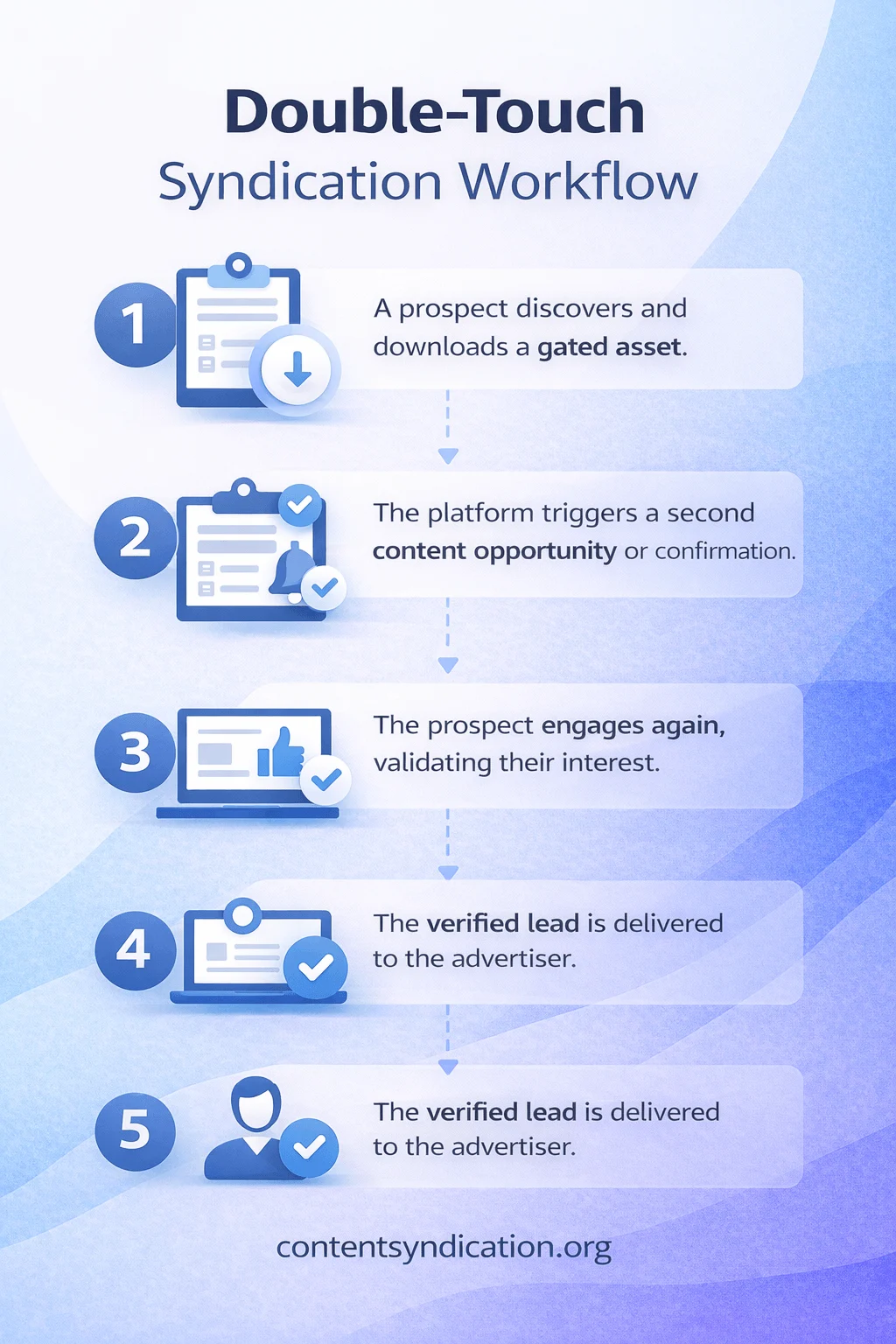
This approach effectively introduces a multi-touch nurture stage before the lead enters the brand’s CRM system.
In many cases, it also allows marketers to combine intent data and syndication signals to better identify prospects who are actively researching a solution category.
The result is a smaller but significantly more engaged lead pool.
To maximize results, many companies combine content syndication campaigns with lead nurturing strategies that help move prospects from early interest to sales-ready opportunities
When Should You Use Single-Touch?
Despite its limitations, single-touch syndication still plays an important role in B2B marketing strategies.
It is particularly effective in scenarios where the goal is broad awareness and audience expansion.
Common use cases include:
- Launching new thought leadership reports
- Entering new markets or industries
- Building early-stage prospect databases
In these scenarios, the campaign primarily serves the top of the content syndication funnel, helping brands introduce their expertise to new audiences.
When Double-Touch is the Smarter Choice
For organizations focused on pipeline quality, double-touch content syndication often delivers stronger results.
This approach works particularly well in campaigns where sales teams expect leads with higher purchase intent.
A well-planned double-touch syndication strategy in B2B campaigns is especially effective for:
- Enterprise demand generation programs
- High-value‑ technology solutions
- Complex buying environments with multiple stakeholders
In these scenarios, the additional interaction helps confirm genuine interest before leads enter the sales process.
The Real Debate of Cost vs. Quality
On the surface, single-touch campaigns often appear more cost-efficient because they deliver larger lead volumes at a lower CPL.
However, this comparison can be misleading.
When evaluating syndication ROI, the true metric is not cost per lead but cost per qualified opportunity.
If a campaign generates hundreds of leads that never progress beyond initial contact, the effective acquisition cost becomes far higher than expected.
Double-touch campaigns may produce fewer contacts, but those contacts often move through the pipeline more efficiently.
Common Mistakes in Double-Touch Syndication
Several common mistakes can limit campaign effectiveness:
1. Using identical content for both touches
Fix: Use complementary assets such as a guide followed by a case study.
2. Ignoring audience targeting
Fix: Align campaign targeting with your ICP, industry, job role, and buying stage.
3. Weak follow-up‑ strategy
Fix: Activate immediate nurture emails and sales alerts once validated leads are delivered.
Following proven syndication best practices helps ensure the additional engagement step translates into measurable performance improvements.
How to Measure Lead Quality in Syndication Campaigns
Evaluating the effectiveness of double-touch content syndication requires more than just tracking lead volume.
Marketing teams should focus on metrics that reflect engagement depth and pipeline impact.
Key indicators include:
- Lead-to-opportunity conversion rates
- Sales acceptance rate
- Pipeline contribution
- Average deal velocity
Some organizations also use lead nurture syndication models that integrate additional engagement campaigns after the initial interaction to further qualify prospects before sales outreach.
These programs help bridge the gap between early interest and active buying intent.
How to Choose the Right Syndication Model
Choosing between single-touch and double-touch syndication depends on your campaign goals.
If your goal is brand awareness and audience reach, single-touch campaigns can work well.
However, if your focus is pipeline growth and higher-intent leads, double-touch syndication often delivers stronger results.
Conclusion: Which Delivers Better Lead Quality?
Both single-touch and double-touch content syndication have a role in modern demand generation strategies.
Single-touch campaigns remain valuable for awareness and audience growth.
However, when the goal is higher-quality leads and stronger pipeline contribution, double-touch content syndication typically delivers better results.
By requiring multiple engagement points, the model filters out low intent contacts and surfaces prospects who are more likely to continue the buying journey.
For B2B organizations focused on pipeline efficiency rather than raw lead volume, this additional validation step can significantly improve overall campaign performance.
Looking to Improve Your Content Syndication Lead Quality?
If your goal is to focus on pipeline-ready leads instead of raw lead volume, implementing a more structured content syndication strategy can make a big difference. Understanding how single-touch and double-touch campaigns fit into your demand generation strategy is the first step toward better results.