

In modern B2B marketing, content must accomplish two goals simultaneously: first, to build organic visibility, and second, to generate qualified demand. Many companies rely on content syndication services to achieve both. This often raises an important strategic question for marketing teams: should they prioritize original content or content syndication?
Original content strengthens brand authority and search rankings, while syndication expands reach through external audiences. When executed correctly, both approaches complement each other. When executed poorly, they can compete for search visibility.
This guide explains how each approach works, whether syndication affects search rankings, and the SEO strategies marketers should apply in 2026 to protect performance while expanding distribution.
Syndicated Content vs Original Content: Quick Comparison
| Factor | Original Content | Syndicated Content |
|---|---|---|
| Ownership | Fully owned and controlled by your brand | Published across third-party platforms |
| SEO Impact | Builds long-term rankings and authority | Requires proper canonical and indexing signals |
| Reach | Limited to your existing audience | Expands reach to new qualified audiences |
| Lead Generation | Full control over CTAs and conversions | Drives referral traffic and awareness |
| Best Use Case | Ranking for keywords & building authority | Scaling distribution of high-performing content |
Turn Your Content Into Qualified Leads
Expand your reach, generate demand, and convert high-intent audiences through strategic content syndication campaigns.
Start Your Content Syndication CampaignWhat is Original Content?
Original content refers to material created and published first on your own website or owned media channels. This includes blog posts, research reports, case studies, whitepapers, and guides produced specifically for your audience.
Original content is the foundation of any sustainable organic strategy.
Search engines prioritize original material because it provides unique value and signals authority. When content is published first on your domain, search engines recognize your website as the primary source.
Typical characteristics of original content include:
- Unique insights or research
- Original analysis or frameworks
- Brand-specific perspectives
- Proprietary data or expertise
Original content supports multiple strategic outcomes:
- Long-term organic visibility
- Brand authority and expertise
- Audience trust and credibility
- Lead generation through owned assets
For B2B organizations, original content often acts as the core asset that powers broader marketing campaigns.
What is Syndicated Content?
Syndicated content refers to republishing previously created material on third-party platforms. If you are new to this concept, this guide on content syndication explained will help you understand how it works in detail. Instead of creating entirely new material, marketers distribute existing assets to reach additional audiences.
When evaluating syndicated content vs original content, syndication focuses primarily on reach rather than ownership.
Common syndication channels include:
- Industry publications
- Content syndication networks
- Partner websites
- Media platforms
From a content syndication SEO perspective, the key challenge is ensuring search engines understand which version of the content is the original source.
The goal of syndication is not to replace original publishing. Instead, it extends the value of existing assets while enabling broader audience discovery.
Does Content Syndication Hurt SEO?
A common concern among marketers is whether syndication damages search rankings. In discussions around syndicated content vs original content, this question frequently appears: is syndicated content bad for SEO?
The short answer is no. Syndication itself does not harm rankings when implemented correctly.
Search engines are designed to recognize content that appears across multiple websites. Problems typically occur only when search engines cannot determine the original source.
Understanding the SEO impact of content syndication is important because it helps teams design distribution strategies that support both reach and search performance.
When technical signals are properly implemented, syndication can expand audience exposure without sacrificing organic performance.
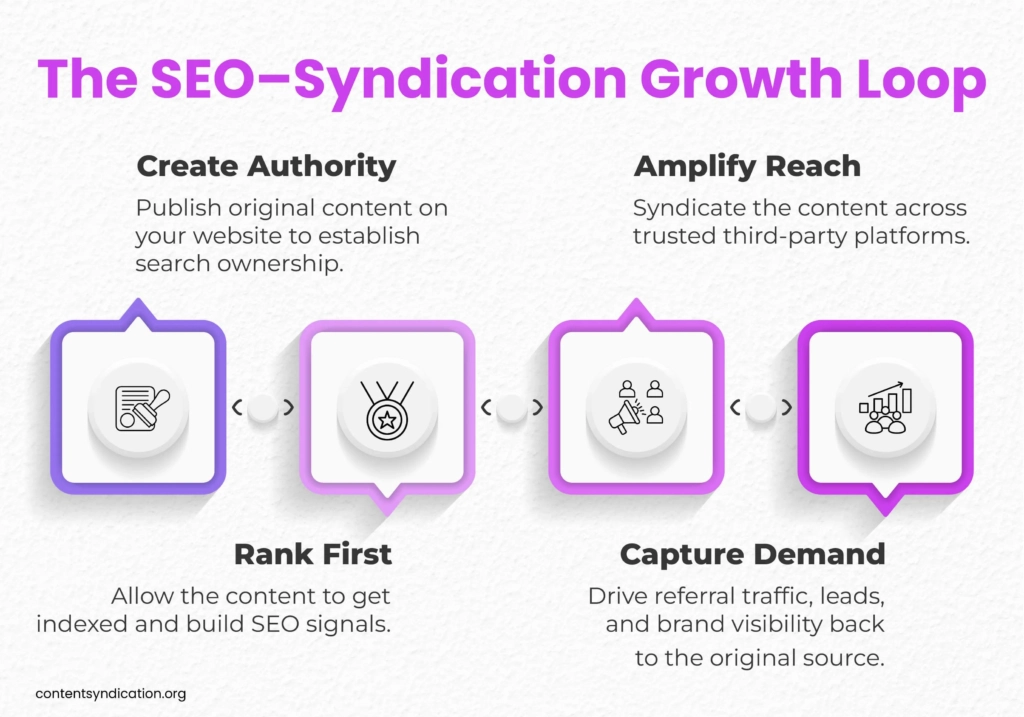
SEO Risks of Syndicated Content
Although syndication can be beneficial, there are potential risks marketers should manage carefully.
The primary concern involves duplicate content in syndication. When identical material appears across multiple websites, search engines must decide which version should rank.
Potential SEO risks include:
- Ranking dilution: Multiple versions of the same article may compete for visibility.
- Source confusion: Search engines may incorrectly identify the syndicated version as the original.
- Traffic diversion: External platforms might capture search traffic intended for your domain.
Managing these signals is central to protecting search visibility while distributing content widely.
SEO Best Practices for Syndicated Content
To maintain visibility while expanding distribution, marketers should follow proven SEO for syndicated content guidelines. These technical and strategic practices help ensure that search engines recognize the original source and attribute ranking authority correctly.
Use a Canonical Tag Strategy
A strong canonical tag strategy tells search engines which version of the article should be treated as the original source.
When a partner republishes your article, the page should include a canonical tag pointing back to the original URL on your website.
This signal consolidates ranking authority and prevents search engines from splitting visibility between versions.
Implement Clear Indexing Rules
Another common approach involves deciding between noindex and canonical depending on the syndication agreement.
- Canonical tags allow indexing but consolidate authority
- Noindex prevents the syndicated page from appearing in search results
Both options help prevent ranking conflicts.
Delay Republishing
Allow the original version to be indexed before distribution begins. Waiting several days gives search engines enough time to identify your website as the source.
Follow Republishing Content Best Practices
Effective republishing content best practices include small edits, updated introductions, and links pointing back to the original resource.
These adjustments reinforce attribution while improving referral traffic.
Protect Organic Visibility
Syndication should always support organic traffic protection by linking readers back to the primary article or gated asset on your website.
When implemented properly, these steps answer a common question: how to avoid duplicate content in syndication?
When to Choose Original Content Over Syndication
Despite the advantages of distribution, there are scenarios where original publishing should take priority.
Organizations should prioritize original content when:
- Building topical authority in search
- Targeting high‑value organic keywords
- Launching new thought leadership initiatives
- Publishing proprietary research or insights
In these cases, original publishing strengthens domain authority and improves ranking potential.
From an SEO perspective, marketers often debate syndicated vs original content for rankings. For competitive keywords, original content usually provides stronger long‑term visibility.
Original publishing also ensures full control over user experience, internal linking, and conversion paths.
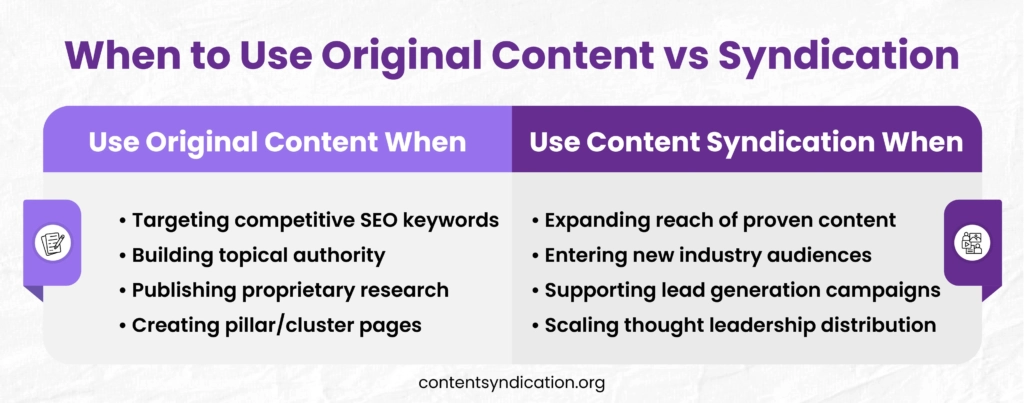
When Syndication Makes Strategic Sense
Choosing the right content syndication vendors is essential to maximize reach and lead quality.
Syndication becomes particularly valuable when organizations want to scale reach beyond their existing audience.
In a broader content strategy, syndication works best as a distribution amplifier rather than a replacement for original content.
Situations where syndication is effective include:
- Expanding thought leadership distribution.
- Quickly extending the visibility of high-performing assets.
- Supporting multi-channel promotion, including social media, newsletters, and partner publications.
Syndication is particularly effective when marketing teams already have strong original assets but want to maximize their exposure.
Balancing SEO Performance and Lead Generation
The decision between syndicated content and original content should not be framed as an either‑or choice. Instead, it should be viewed as a strategic balance between search authority and audience reach.
Original content builds the foundation for long-term organic growth, while a strong B2B lead generation strategy ensures that this content converts into qualified opportunities. Syndication extends the impact of those assets by exposing them to larger audiences.
When marketers apply proper technical safeguards and follow SEO best practices for content syndication, they can achieve both outcomes simultaneously.
For B2B marketing teams, the most effective strategy combines strong original publishing with carefully managed distribution. This approach protects search visibility while expanding lead generation opportunities.
In 2026 and beyond, organizations that integrate both approaches thoughtfully will be best positioned to grow authority, reach new audiences, and convert attention into measurable pipeline impact.
Frequently Asked Questions
1. What is the difference between syndicated content and original content?
Original content is created and published on your own website, giving you full control over SEO, branding, and conversions. Syndicated content, on the other hand, is republished on third-party platforms to expand reach and visibility.
2. Does content syndication hurt SEO?
No, content syndication does not hurt SEO when implemented correctly. Issues only arise when search engines cannot identify the original source. Using canonical tags or noindex directives helps prevent ranking conflicts.
3. What’s Included in Your Packages?
Our travel packages typically include accommodation, transportation, and some guided tours. Check the details to see what’s specifically covered for each package.
4. When should you use content syndication?
Content syndication is best used when you want to expand the reach of high-performing content, enter new markets, or support lead generation campaigns without creating new content from scratch.
5. Is original content better for SEO than syndicated content?
Original content is generally better for long-term SEO because it builds authority and rankings on your own domain. However, syndication complements it by increasing exposure and driving additional traffic.
6. How can you avoid duplicate content issues in syndication?
You can avoid duplicate content issues by:
- Using canonical tags
- Applying noindex where needed
- Adding backlinks to the original source
- Publishing content on your site first
7. Can syndicated content generate leads?
Yes, syndicated content can generate leads by driving traffic from third-party platforms back to your website, especially when combined with strong CTAs and gated assets.
8. What are the best practices for content syndication in 2026?
Key best practices include:
- Publish original content first
- Wait for indexing before syndication
- Use canonical or noindex tags
- Partner with relevant platforms
- Track performance and lead quality
Conclusion
In the debate around syndicated content vs original content, the strongest strategy is balance. Original content builds authority and search visibility, while syndication expands reach and demand generation.
When supported by proper SEO signals and distribution planning, both approaches work together to protect rankings, grow audience reach, and drive sustainable marketing results.