

What is the most appropriate, gated content or ungated content? Some say, “You must gate everything!” or “Forms kill conversions, so ungate it all!” But savvy demand-generation professionals know that context is what actually drives results.
The real question isn’t which one is better. It’s when, why, and for whom each model works, based on how buyers behave across the funnel, how content impacts intent, and how your team measures success.
The Difference Between Gated and Ungated Content
You already know the definitions: gated content lives behind a form and requires contact info, while ungated content is openly accessible without barriers. But where most teams trip up is failing to map why each type matters to the stages of the buyer journey.
Gated content is about lead capture and qualification. It signals to sales that a prospect is perhaps ready for deeper engagement.
Ungated content is about awareness, reach, and discovery. It meets prospects where they are, absorbing information, comparing options, and shaping problem definitions long before they’re ready to raise their hand.
That simple idea, gating for qualification versus opening for discovery, is core to creating a demand-generation engine that actually works.
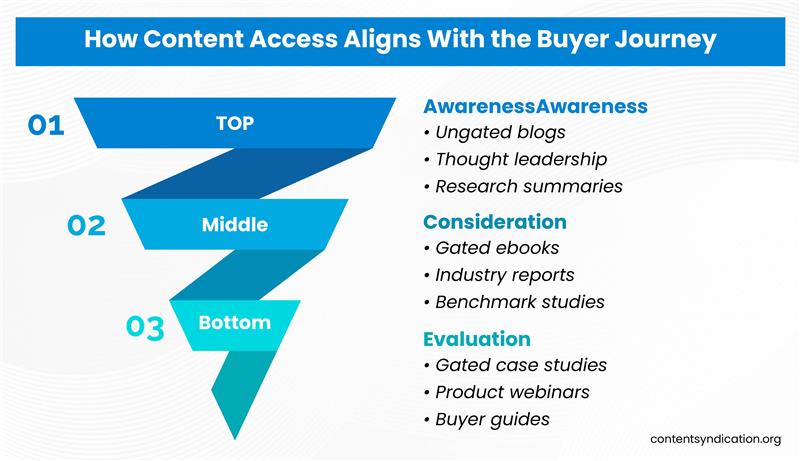
How Content Access Aligns With the Buyer Journey
Why Gated Content Still Matters (When Used Strategically)
Gated content gets a bad rap from teams who’ve tried to force forms too early. But the data shows that buyers are still willing to exchange contact information for valuable assets if those assets are worth the trade.
According to the NetLine 2024 B2B Content Consumption Report, demand for gated content increased 14.3% in 2023 compared to the previous year, and overall demand for gated assets has grown 77% since 2019.
This report is based on millions of first-party content registrations – real behavioral data, not self-reported survey responses.
Turns out people don’t hate forms. But they will surely reject forms when the value behind them isn’t compelling. On the other hand, when content offers real insight, professionals are happy to share contact details.
This also aligns with what marketers see operationally: typical gated formats like eBooks, detailed reports, and webinars often attract serious prospects because they provide information buyers can use in real evaluation scenarios.
So what’s the takeaway? Gate content that reflects deeper curiosity or purchasing readiness, not top-of-funnel education.
The Trade-Offs of Gated Content
Gating creates a commitment signal along with some friction. That friction is bound to reduce volume, but that’s intentional. Form fills are inherently a filter.
If your goal is purely top-of-funnel traffic, gating will always underperform ungated approaches in volume because it prioritizes quality over reach. That’s not bad, it’s a feature. Again, this requires alignment between marketing and sales because that’s when MQLs actually translate into opportunities.
Use gated content where:
- Buyers require data or insight for evaluation
- Sales alignment matters (e.g., ABM context)
- You want to qualify interest before routing to sales
For example, a mid-funnel report comparing vendors or detailing in-market benchmarks is worth gating because it signals a transition from learning to evaluating.
Why Ungated Content Is Not “Just Awareness”
Ungated content gets a reputation for being high-level or only useful for thought leadership, but the modern buyer journey disproves that limitation.
Buyers now research independently more often than ever before. They read blogs, watch videos, and explore resources long before ever filling out a form.
Here’s what we do know from recent data:
- Ungated content builds brand visibility and trust, which makes it easier for buyers to seek out gated assets later. Such content is great to support organic traffic growth and brand visibility, while gated assets focus more narrowly on lead generation.
- Content that is freely accessible tends to build SEO value and audience engagement because it can be indexed, shared, and discovered without barriers. This is why most blogs, thought leadership pieces, and case study summaries are ungated while deeper reports are behind forms – a strategy designed to bring people in before asking for commitment.
So, what to take from these reports? Ungated content earns attention first, while gated content capitalizes on that attention later. They’re not opposites; they’re sequential stages in a healthy funnel.
When Ungated Content Is the Best Choice
Ungated content should dominate when your primary goals are awareness, rapid learning, and intent signal observation. It’s particularly effective if:
- You’re educating new audiences about a category or problem space
- You want broad visibility to fuel downstream campaigns
- You’re targeting long sales cycles where early touchpoints matter
Because ungated content doesn’t require a form, it removes friction that would kill early curiosity. It allows you to observe behavior first – which topics attract repeat visitors, which content triggers deeper reading, and which signals correlate with eventual conversion.
Ungated also plays well with intent data and third-party syndication platforms that map anonymous engagement into account-level insights. You may not capture email addresses immediately, but you do capture engagement patterns that signal readiness to engage.
This is where sophisticated demand teams get creative – they use ungated engagement to segment audiences and predict who’s warming up to a solution long before they convert.
A Hybrid Content Strategy: The Best of Both Worlds
The most successful B2B marketers don’t force a choice between gated and ungated. Instead, they build a hybrid content ecosystem where:
- Ungated content introduces a topic, defines terms, and builds credibility.
- Engagement with that content triggers segmentation, nurturing, and retargeting.
- Gated content steps in when the buyer demonstrates deeper interest or readiness.
A hybrid strategy lets you get the most reach and the most relevant leads.
It also helps avoid the common pitfall where teams either:
- Gate everything and miss the broader opportunity to attract new audiences, or
- Ungate everything and struggle to capture meaningful lead signals.
In short, gated content without ungated context is shallow, and ungated content without gated depth is incomplete.
Practical Framework for When to Gate Content
Here’s a simple way to decide:
- Top of Funnel (TOFU): Use primarily ungated content
This is where buyers are learning and exploring. Keep things open so audiences can discover your expertise without barriers. - Middle of Funnel (MOFU): Introduce targeted gates
When a topic shows deeper intent – such as detailed comparisons, industry insights, or solution frameworks. that’s where gating makes sense. - Bottom of Funnel (BOFU) : Gate content that directly supports evaluation
Gartner and other analyst guidance suggest putting most forms later in the journey where buyers expect commitment and are closer to sales involvement.
This structured approach aligns content gating with real buyer behavior, not arbitrary rules.
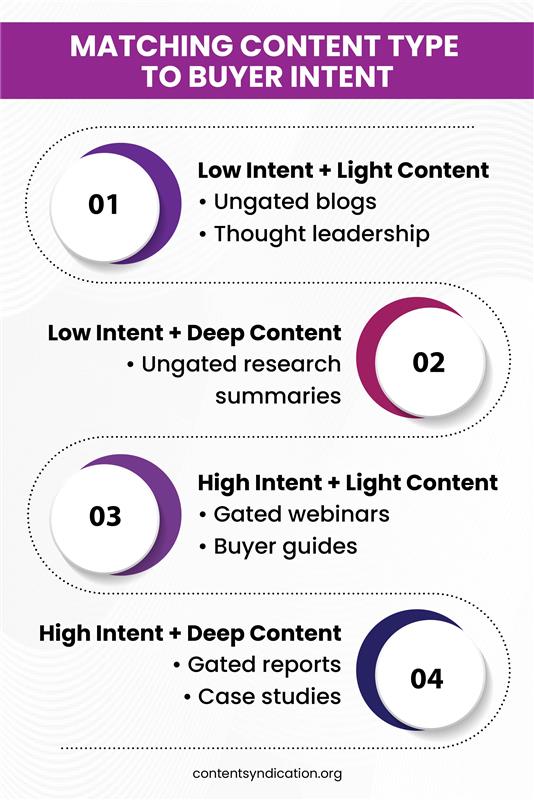
Matching Content Type to Buyer Intent
Final Recommendation: Context Over Convention
The old “gated everything” vs “ungated everything” debate misses the point.
Gated and ungated content are not opposing strategies. They’re complementary tools that must be orchestrated with a clear understanding of:
- Buyer intent
- Funnel stage
- Distribution and engagement goals
Gated content is best when buyers want deeper insight.
Ungated content is best when buyers are still discovering what they need.
When you align your content access strategy to buyer psychology and journey stage, you increase both reach and lead quality, and you stop sacrificing one for the other.
That’s how high-performing B2B demand teams build pipelines that don’t just generate leads, but drive real opportunities.
Frequently Asked Questions (FAQs)
What is gated content syndication?
Gated content syndication is distributing assets (eBooks, reports, webinars) behind a form so you capture lead details like name, email, company, and job title.
What is ungated content syndication?
Ungated content syndication distributes content without a form, so anyone can access it instantly—helpful for reach, awareness, and SEO-style discovery.
Which is better for B2B: gated or ungated content?
Neither is universally better. Ungated works best for awareness and discovery, while gated works best when the buyer wants deeper insight and you need lead capture.
When should you use gated content?
Use gated content when the asset supports evaluation (benchmarks, vendor comparisons, deep guides) and the audience is likely to exchange details for high value.
When should you keep content ungated?
Keep content ungated when the goal is visibility, organic discovery, education, and early-stage research – like blogs, thought leadership, and overview resources.
What content formats perform best as gated assets?
High-performing gated formats typically include industry reports, original research, webinars, detailed templates, checklists, and comparison guides.
Do forms reduce conversions in content syndication?
Forms reduce volume, but they can increase lead quality. The drop happens mainly when gating is used too early or the asset isn’t valuable enough.
What content formats should usually be ungated?
Blogs, pillar pages, glossary pages, short case study summaries, opinion pieces, and quick “how-to” articles usually perform better ungated.
What is the best funnel strategy for gated vs ungated?
Use ungated content for TOFU, introduce selective gating in MOFU, and gate BOFU assets that support product evaluation and sales conversations.
What is a hybrid gated + ungated strategy?
A hybrid strategy uses ungated content to earn attention first, then offers gated assets when readers show intent, through retargeting, nurture, or content upgrades.
How do you decide whether to gate an asset?
Gate it if it’s high-value, specific, and used for evaluation. Keep it ungated if it’s introductory, broad, or designed for reach and discovery.
How do you measure success for gated vs ungated syndication?
Gated: CPL, lead quality, MQL-to-SQL rate, pipeline influenced.
Ungated: traffic, engagement, account-level intent, retargeting performance, assisted conversions.
Can ungated content generate leads without forms?
Yes. Ungated content can generate leads through retargeting, CTA upgrades, newsletter signups, chatbot prompts, and intent/account-level engagement signals.
What are common mistakes with gating in B2B?
Gating TOFU content, asking too many fields, offering low-value assets, routing leads too fast to sales, and not nurturing before qualification.
How many form fields should gated content have?
Keep it minimal: typically 3-6 fields (name, email, company, role). Add more only when the asset is highly valuable and the audience expects it.