
Is your content syndication program actually driving revenue, or just filling your CRM with names? Many B2B teams struggle with this question.
Reports show lead volume. CPL looks acceptable. Dashboards appear healthy. Yet sales feedback feels inconsistent, and pipeline impact remains unclear. In a market where every marketing dollar is scrutinized, uncertainty is costly.
The truth is that content syndication can be measured. What most teams lack is a structured way to evaluate it. A disciplined content syndication lead audit helps you move from guesswork to evidence by assessing data accuracy, ICP alignment, engagement quality, and real sales outcomes.
When You Should Audit Content Syndication Leads
A content syndication lead audit should be a proactive governance process, not a reaction to frustration. High-performing demand generation teams typically review syndicated lead quality quarterly, alongside pipeline performance.
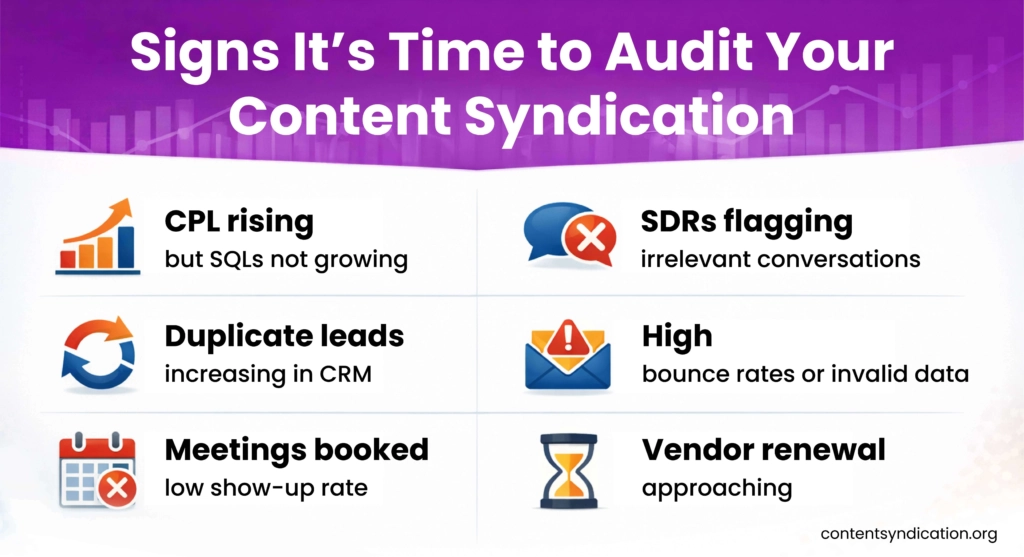
A structured content syndication lead audit replaces unreliable feedback with measurable evaluation criteria. It allows marketing, sales, and revenue operations to align on facts rather than assumptions.
The 30-Point Audit Framework Overview
This framework functions as a comprehensive lead quality checklist for content syndication campaigns.
The scorecard contains six categories, each worth five points, creating a total possible score of 30. Every category addresses a different risk layer: data integrity, company accuracy, persona alignment, engagement strength, revenue validation, and vendor compliance.
The goal of a content syndication lead audit is not simply to reject leads; it is to identify exactly where quality gaps occur so you can optimize targeting, validation rules, follow-up processes, or vendor management.
Data Accuracy & Validation Checks
The foundation of any content syndication lead audit is data integrity. If contact information is inaccurate, incomplete, or duplicated, downstream metrics become unreliable.
This 5-point section evaluates whether the lead record itself meets baseline operational standards.
A high-quality syndicated lead should be judged on the following basis, carrying a point each:
- Contain a verified business email tied to a legitimate company domain (not free providers like Gmail or Yahoo)
- Pass format validation checks and show no prior bounce history
- Include a dialable, correctly formatted phone number
- Not already exist in your CRM as an active record
- Contain all mandatory campaign fields completed accurately
This category ensures you are not inflating volume with technically unusable data. If this section consistently scores below 3/5, your content syndication lead audit should trigger improved business email verification processes and stronger data validation checklist protocols before leads are routed to sales.
Firmographic Accuracy
Once contact data is validated, the next step in a content syndication lead audit is confirming that the company itself matches campaign filters.
A lead may be real but strategically irrelevant. Firmographic review confirms alignment with targeting criteria.
Next on our checklist are the following pointers that ensure that a strong record is demonstrated (Evaluate on a 1 or 0 basis.):
- Company size within defined employee range
- Industry classification aligned with campaign segmentation
- Geography matching approved regions
- A legitimate, active company presence
- Domain consistency between email and company identity
If a large percentage of leads fail this category, targeting parameters likely need refinement. This is not necessarily vendor malpractice; it may indicate overly broad filters. A structured content syndication lead audit separates targeting drift from quality concerns.
ICP & Role Fit
Beyond company-level filters, persona alignment determines conversion probability.
This section evaluates whether the contact meaningfully participates in the buying process.
During a content syndication lead audit, assess whether (Evaluate on a 1 or 0 basis.):
- The job title maps to your defined buying committee
- Seniority aligns with decision-making authority
- Their department matches the campaign’s strategic intent
- The contact is a decision-maker or strong influencer
- The account-level ICP score meets your internal threshold
This category strengthens your content syndication lead scoring model by ensuring routing prioritizes realistic revenue opportunities rather than surface-level matches.
Intent & Engagement Quality
Intent is where many quality debates emerge. A form submission alone does not guarantee buying interest.
A complete content syndication lead audit evaluates behavioral signals alongside declared interest.
High-quality intent indicators include (Evaluate on a 1 or 0 basis.):
- Asset relevance aligned with persona and funnel stage
- No suspicious behavior patterns, such as instant form completion with no interaction
- Follow-up email open activity
- Acceptable SDR connect rate
- Engagement occurring within seven days of download
This layer supports intent signals validation and helps reduce fake leads from content syndication by identifying atypical behavior. When engagement metrics are consistently weak, campaign asset positioning or targeting depth may require optimization.
Sales Outcome Indicators
Revenue impact ultimately determines whether a lead is valuable.
In this phase of the content syndication lead audit, we measure tangible sales validation.
Key indicators to see are (Evaluate on a 1 or 0 basis.):
- Sales accepted lead (SAL) status
- Good meeting booked rate
- Good meeting show-up rate
- Opportunity creation
- SDRs mark the lead as legitimate rather than junk or spam
If this category consistently scores low, isolate patterns before making vendor decisions. Knowing what to do when content syndication lead quality is low requires identifying whether failure occurs at targeting, engagement, or follow-up stages.
Vendor & Compliance Factors
The final dimension of a content syndication lead audit evaluates vendor accountability.
This section ensures operational standards are met.
Review whether (Evaluate on a 1 or 0 basis.):
- Leads are delivered within agreed SLA timelines
- Required data fields are consistently complete
- Replacement policies are honored promptly
- GDPR consent/compliance checks are properly documented
- Lead source transparency is clearly provided
Evaluating the content syndication vendor lead verification process strengthens governance and creates measurable accountability during renewals.
Scoring, Benchmarking & Decisions
After scoring all six categories, calculate the total out of 30. Here is what scores mean:
Score Interpretation
- 26–30: High-quality, Scale investment
- 20–25: Moderate, Optimize targeting or validation
- 15–19: Risk Zone, Conduct structured vendor review
- Below 15: Pause and reassess program
This structured evaluation acts as a content syndication lead scoring model example grounded in operational metrics rather than opinion.
For benchmarking, monitor trends across:
- CPL vs SQL conversion
- ICP match percentage
- Validation failure rates
- Duplicate ratios
- Opportunity creation rates
A quarterly content syndication lead audit ensures continuous optimization rather than reactive correction.
Downloadable Scorecard + How to Use It
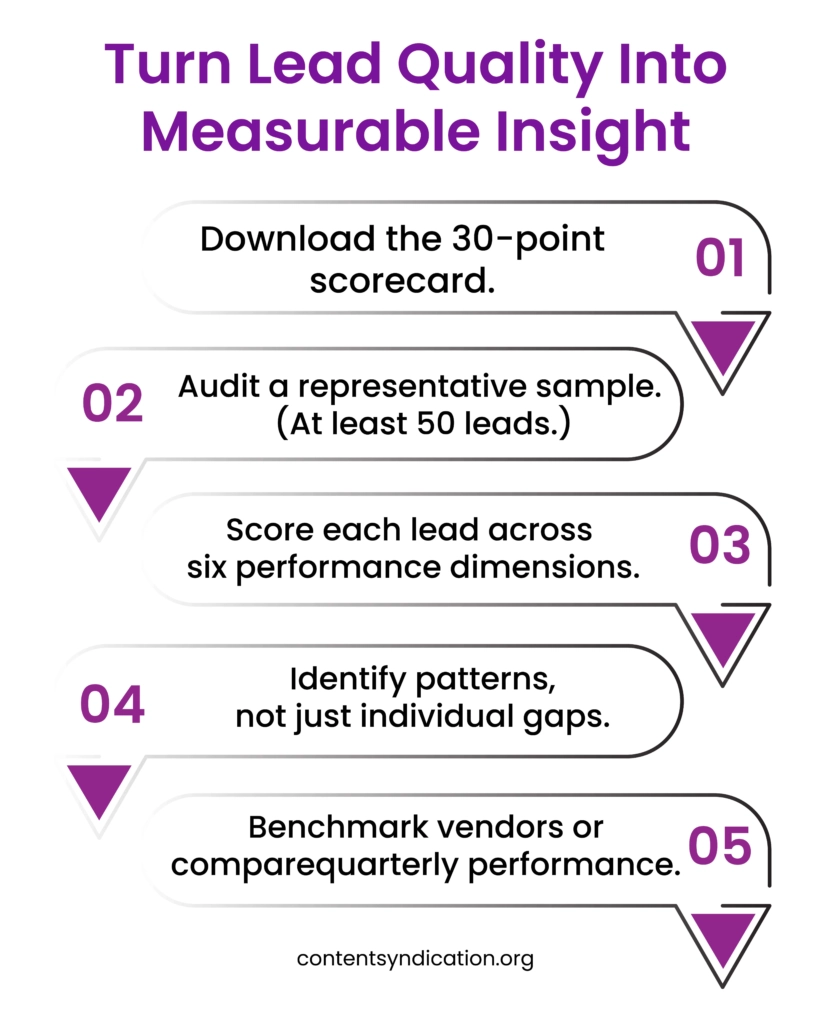
To operationalize this framework, we have created a structured 30-point Excel scorecard aligned with the six-category model described above.
Download the sheet and apply it to a representative sample (minimum 50 leads). Score each category from 0–5, document qualitative observations, and review the total score. Compare vendors side-by-side or track quarterly changes.
When applied consistently, your content syndication lead audit becomes a governance tool that protects pipeline quality, strengthens sales confidence, and improves long-term ROI.
Downloadable Scorecard
To operationalize this framework, we created a structured 30-point Excel scorecard aligned with the six-category model described above. Download the sheet and apply it to a representative sample of leads.
Download the 30-Point Lead Audit ScorecardConclusion
Content syndication is not about posting and wishing your content to work, it is measurable.
A structured content syndication lead audit enables marketing and revenue teams to validate data integrity, confirm ICP alignment, verify intent depth, assess sales outcomes, and hold vendors accountable.
By applying this 30-point scorecard consistently, organizations can transform lead quality from a subjective debate into a disciplined revenue safeguard.
How do you measure content syndication lead quality?
You measure content syndication lead quality by auditing data accuracy, ICP alignment, engagement signals, sales validation, and vendor compliance using a structured scoring framework.
What is a good conversion rate for content syndication leads?
Conversion rates vary by industry, but SQL conversion typically ranges between 5–15% depending on targeting and follow-up speed.
How often should you audit content syndication campaigns?
High-performing B2B teams conduct a content syndication lead audit quarterly alongside pipeline reviews.
Why do sales teams reject syndicated leads?
Common reasons include poor ICP alignment, incorrect contact data, weak intent signals, and delayed follow-up.
How can you improve content syndication ROI?
Improve ROI by tightening targeting filters, enforcing validation checks, aligning persona criteria, and benchmarking sales outcomes.