
B2B demand generation is evolving faster than ever. Buyers are more independent, research anonymously, and rely on third-party platforms before speaking to sales. According to Gartner, 83% of the B2B buying journey now happens online-and most of that research occurs outside your website.
This is exactly why content syndication has become a powerful channel. It helps you:
- Reach buyers before they land on your website
- Build trust via authoritative third-party platforms
- Expand reach beyond your owned audience
- Generate predictable, scalable pipeline
If you’re a demand marketer looking to make your brand visible throughout the research journey, this guide is for you.
What Is Content Syndication in B2B Demand Generation?
Content syndication means distributing your content across trusted third-party platforms-industry websites, analyst portals, media houses, and B2B networks-to reach new, relevant audiences.
Many marketers confuse content syndication with content distribution. The intent is different.
Content Distribution
- Shared on your own channels (social, email, blog)
- Goal: Traffic, engagement, visibility
Content Syndication
- Shared on third-party platforms
- Goal: Demand generation, MQLs, intent signals, pipeline influence
In B2B demand gen, syndication helps you:
- Reach anonymous early-stage buyers
- Build credibility through education
- Capture MQLs and MQAs
- Gather intent signals
- Influence pipeline and revenue
Done well, it becomes a predictable and scalable demand engine.
Content Syndication vs Content Distribution
Distribution grows awareness.
Syndication grows pipeline.
Use this simple comparison:
Content Distribution
- Pushes content to your existing audience
- Focuses on clicks and engagement
- Drives early-stage awareness
Content Syndication
- Places content in front of new, qualified audiences
- Focuses on MQLs, CPQL, ABM integration
- Drives revenue-impacting demand
Why Content Syndication Fuels Modern B2B Demand Generation
Traditional demand-gen struggles because:
- Buyers stay anonymous longer
- Organic reach is shrinking
- Attention competition is intense
- First-party data decays
- Ad costs keep rising
- Algorithms restrict visibility
Content syndication solves these gaps by showing your content where buyers already research.
Case Study: How Intent-Based Syndication Increased SQLs by 38%
A cybersecurity SaaS company struggled with low-quality MQLs and poor sales engagement. Paid ads were expensive and pipeline velocity slowed.
They implemented intent-based content syndication using Bombora signals and targeted 15,000 accounts researching security automation.
What They Did
- Syndicated a MOFU asset: Security Automation Checklist
- Added double-touch validation
- Targeted accounts with active intent signals
Results in 90 Days
- 38% increase in SQL-ready leads
- 27% higher email reply rate
- 19% lower CPL compared to LinkedIn
- 22% faster pipeline movement
Intent-driven syndication brought better account fit and faster conversions.
Key Benefits of Content Syndication in B2B Demand Gen
1. Reach Hidden & Anonymous Buyers
Most buyers never visit your website. Syndication reaches them early.
2. Expand TOFU Awareness
Position your brand as a trusted educator.
3. Increase Lead Volume & Quality
Advanced filters—industry, region, role, company size—improve MQL quality.
4. Accelerate MOFU Engagement
Warm, educated buyers engage better with nurture and sales.
5. Fuel ABM & Intent-Based Targeting
Combine syndication with intent data to target in-market accounts.
6. Support Multi-Touch Attribution
Syndication creates early touchpoints that push buyers toward SQL.
7. Reduce CPL & CPQL vs Paid Ads
Guaranteed lead volumes without bidding wars.
Challenges of Content Syndication (And How to Solve Them)
1. Poor Lead Quality
Sometimes vendors deliver irrelevant leads.
Solution: Use double-touch + intent-based syndication.
2. Wrong Assets for the Wrong Stage
Sending TOFU content to BOFU accounts reduces conversions.
Solution: Map assets to funnel stages.
3. Lack of Vendor Transparency
Some vendors hide where leads originate.
Solution: Prefer partners that provide source tracking and IP validation.
4. Slow Sales Follow-Up
Syndication leads decay fast.
Solution: Add a 7–10 day nurture sequence.
5. Tracking Weak KPIs
CPL alone is misleading.
Solution: Track CPQL, SQL conversion, pipeline influence, intent lift.
Where Content Syndication Fits in the Demand Generation Funnel
Content syndication plays a role across TOFU, MOFU and BOFU stages. Here is a visual breakdown:
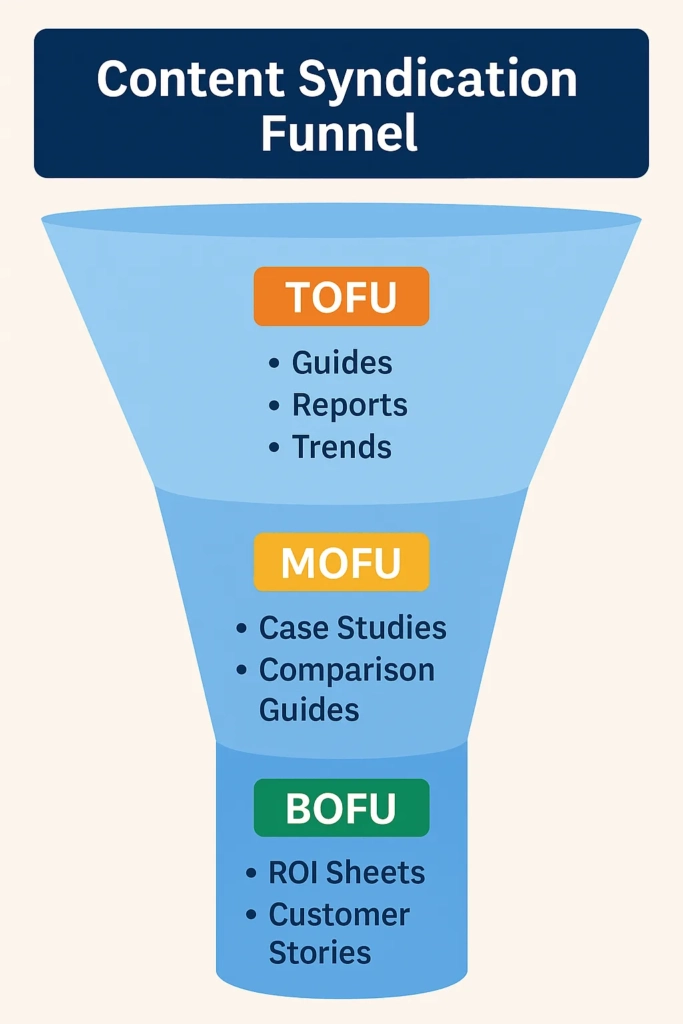
Content syndication powers all three funnel stages.
TOFU (Top of Funnel) – Awareness
Effective content:
- Industry reports
- Guides
- Ebooks
- Introductory webinars
Goal: Capture anonymous researchers early.
MOFU (Middle of Funnel) – Engagement
Effective content:
- Case studies
- Comparison guides
- Evaluation checklists
- Problem-solution content
Goal: Qualification + trust.
BOFU (Bottom of Funnel) – Decision
Effective content:
- ROI calculators
- Product sheets
- Customer stories
- Deep-dive demos
- “How we work” breakdowns
Goal: Build confidence and speed up closing.
Types of Content Syndication Models in B2B Demand Gen
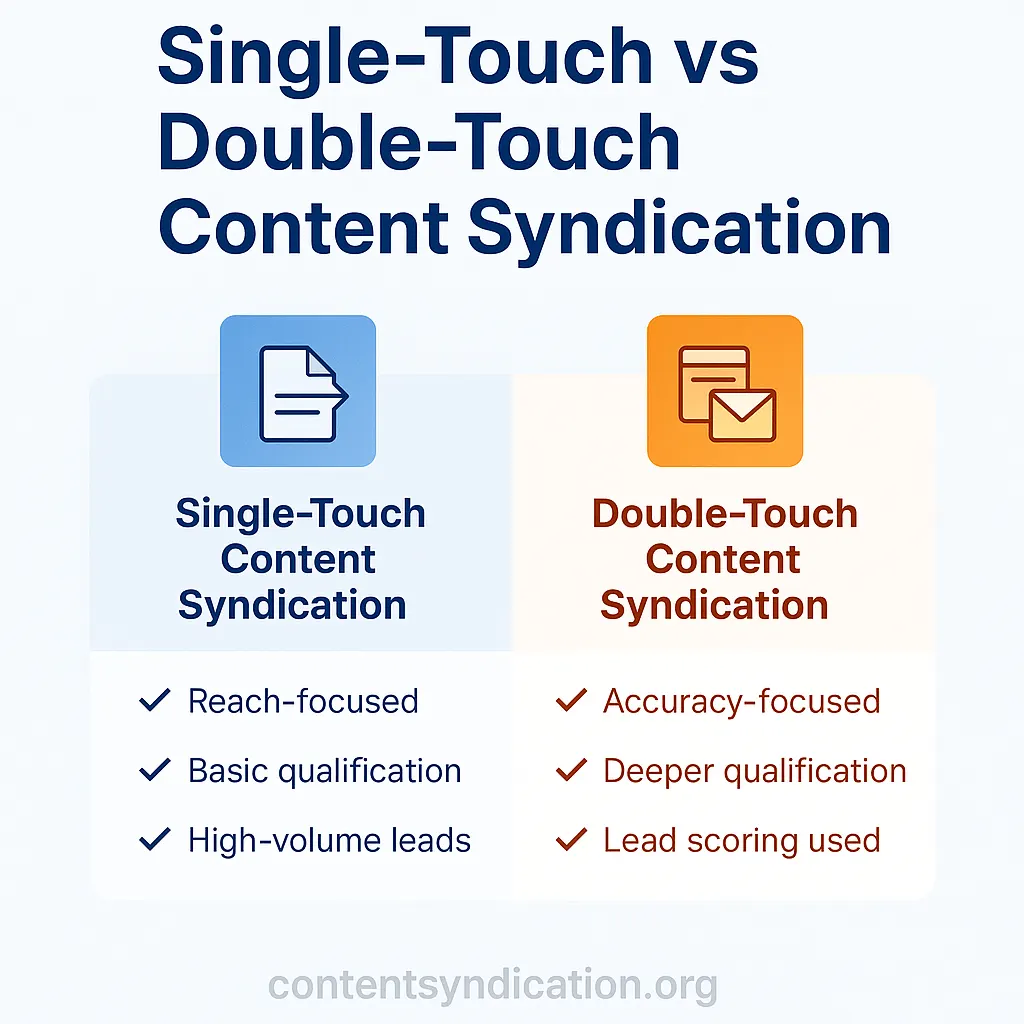
1. Single-Touch Syndication
Best for TOFU reach and fast lead volume.
2. Double-Touch Syndication
Includes verification steps.
Best for higher accuracy and lead quality.
3. Intent-Based Syndication
Uses Bombora, G2, ZoomInfo.
Best for in-market accounts.
4. Account-Based Syndication (ABS)
Targets a curated ABM list.
Best for enterprise deals and multi-stakeholder journeys.
How to Build a Demand Generation Strategy with Content Syndication
Below is the 6-step framework that explains how to build an effective content syndication program.
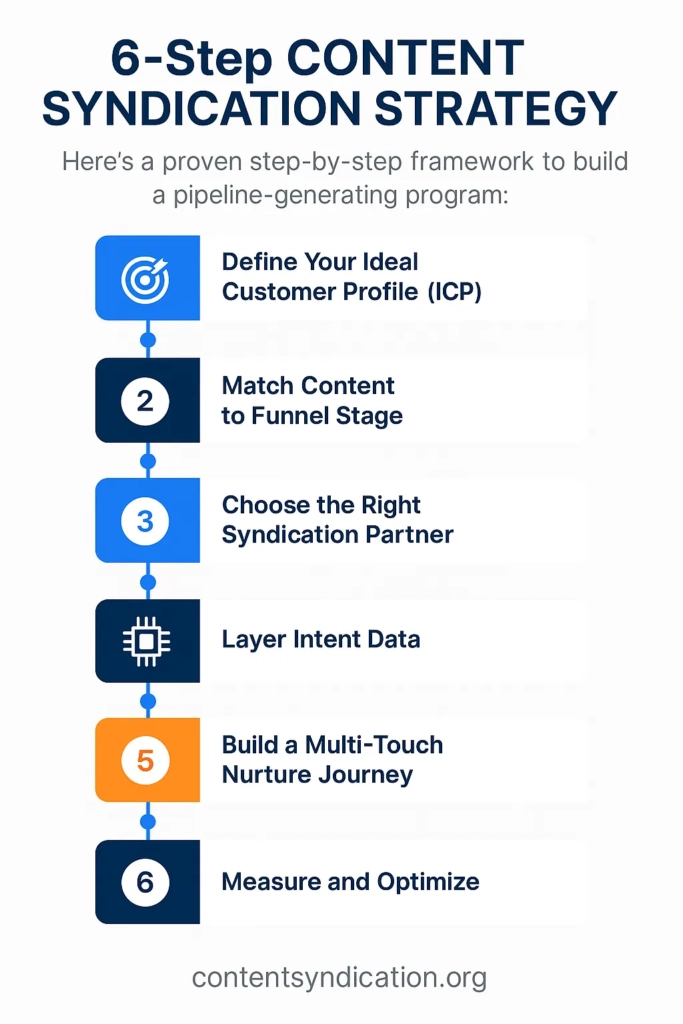
Step 1: Define Your Ideal Customer Profile (ICP)
Include industry, size, region, roles, tech stack, and buying committee.
Step 2: Match Content to Funnel Stage
Choose assets aligned with TOFU, MOFU, BOFU.
Step 3: Choose the Right Syndication Partner
Evaluate based on audience match, delivery method, data accuracy, verification, region.
Step 4: Layer Intent Data
Use topic intent, contact intent, and mesh intent to increase accuracy.
Step 5: Build a Multi-Touch Nurture Journey
Include email sequences, retargeting, explainer videos, sales outreach aligned with content consumed.
Step 6: Measure and Optimize
Track CPQL, SQL conversion, pipeline influence, intent lift, and ROI.
How Content Syndication Supports ABM Programs
Content syndication strengthens ABM by:
- Warming up target accounts
- Engaging multiple stakeholders
- Supporting early-stage education
- Improving account progression signals
- Giving SDRs more context for outreach
Syndication + ABM = higher pipeline velocity.
Content Syndication Use Cases
Content syndication works extremely well for:
- SaaS companies targeting niche personas
- Cybersecurity firms targeting enterprise buyers
- IT services entering new regions
- FinTech solutions needing CFO engagement
- Enterprise SaaS with multi-stakeholder buying cycles
Future of B2B Demand Generation with Content Syndication
The next evolution of syndication will be driven by:
- AI-powered audience targeting
- Predictive intent scoring
- Hyper-personalized content delivery
- Multi-source intent orchestration
- Real-time validation
- Automated nurture journeys
Content + Intent + AI = the future of B2B demand generation.
Conclusion
Content syndication is one of the most reliable and scalable pillars of modern B2B demand generation. It helps you:
- Reach research-phase buyers early
- Deliver meaningful content at scale
- Generate high-intent leads
- Support ABM programs
- Improve conversions across the funnel
Whether you’re a SaaS company, IT services provider, or enterprise tech brand-content syndication should be a core component of your 2026 demand-gen strategy.