
Hitting B2B lead targets is getting harder every year-especially when demand gen channels get crowded and buyers ignore cold outreach.
That’s why content syndication still works: it puts your best assets in front of in-market buyers through trusted third-party networks and captures leads who are actively researching the topic.
In this step-by-step guide, you’ll learn how to launch a B2B content syndication campaign that drives qualified leads (not just downloads), including:
- ICP + exclusion filters (to reduce junk leads)
- Which assets perform best for syndication
- Vendor selection checklist + SLAs
- Budget & CPL planning
- Tracking + a weekly optimization routine
You can also benchmark buyer behavior and content engagement using recent industry research-like Gartner’s B2B buying journey insights and NetLine’s B2B content consumption report.
What Is a Content Syndication Campaign?
Content syndication is a process to distribute content assets across third-party platforms. This requires you to partner with publishers, industry platforms, or specialized syndication networks to promote your gated content assets, like ebooks, whitepapers, webinars, or research reports, to their audiences.
How does it work?
You provide the content to the syndication partner, and they then promote it across their audience network. When someone downloads or engages with the asset, they capture the person’s contact information and deliver it to you as a qualified lead.
Unlike traditional advertising, where you pay for impressions or clicks, with content syndication you only pay for performance. You pay for real people who have shown interest in topics related to your business by downloading your content.
The typical content syndication flow:
Your content → Syndication partner’s platform → Target audience discovers it → Prospect downloads content → Partner validates data → Lead information delivered to you → You nurture the lead through your marketing funnel
Why Launch a Content Syndication Campaign?
Content syndication helps you reach in-market buyers through trusted third-party audiences and generate opt-in leads at predictable volume. It works best for mid-funnel demand generation, ABM contact expansion, and entering new geographies faster.
Content Syndication vs Paid Ads (What’s Different?)
Paid ads usually mean you pay for impressions or clicks-and then hope the right people convert.
Content syndication is different: you distribute a gated asset through third-party networks and pay for validated leads who engaged with that content.
When syndication works best:
- Capturing mid-funnel demand (buyers already researching)
- Supporting ABM campaigns with additional contacts in target accounts
- Entering new verticals/regions faster than organic
When ads work better:
- Broad awareness and top-of-funnel reach
- Promoting time-sensitive events or launches
Lead generation at scale
Syndication bypasses the slow climb of organic growth. You trade impressions for direct lead submissions, giving you predictable volume and pipeline velocity.
Reach hard-to-access audiences
Many buyers prefer researching independently before talking to sales, which makes mid-funnel content distribution and strong follow-up critical. (Gartner)
Maybe your ideal buyers are busy, skeptical of cold emails, or do not follow your channels yet. Syndication reaches them through trusted third-party networks.
Faster sales cycles with warmer leads
Because prospects self-select (interest → form fill), syndicated leads can convert better than cold lists-especially when targeting and nurture are set up correctly.
Maximise the value of existing content
Got a whitepaper sitting idle after one promotion? Syndication helps you repurpose it, stretching ROI without creating new assets.
Types of Content Syndication Campaigns (Choose the Right Model)
1) CPL (Cost Per Lead) Campaign
You pay per validated lead delivered (best for predictable lead volume).
2) Fixed Package Campaign
You pay a fixed budget for a fixed lead commitment (best for pilots and budgeting).
3) Network Vendors
Best for scale + advanced ICP targeting across multiple sources.
4) Direct Publisher Campaign
Best when you want niche authority audiences and category trust.
5) Guaranteed Leads vs Best-Effort
Always confirm replacement terms, lead validation rules, and delivery SLAs before launch.
Pre-Launch Preparation
Before you upload a single asset or sign a contract with a syndication partner, you need to lay strong groundwork. This content syndication campaign planning phase determines whether your campaign delivers ROI or drains budget.
1. Define Clear Goals
Every successful campaign starts with specific, measurable objectives. Vague goals like “generate more leads” set you up for misalignment with sales and make it impossible to measure success.
Instead, define goals across three categories:
Volume Goals:
- Generate 500 net-new contacts
- Deliver 1,000 content downloads
- Target cost per lead of $75
Quality Goals:
- Achieve 25% lead-to-MQL conversion rate
- Generate 75 marketing-qualified leads
- Create 15 sales-qualified opportunities
Strategic Goals:
- Penetrate 100 target accounts
- Reach decision-makers in a new industry vertical
- Support ABM program with multi-threading
A critical insight about pricing: Do not automatically chase the lowest cost per lead. HubSpot’s research shows that in B2B tech and software, you can expect to pay anywhere from $50–150 per lead depending on targeting specificity and lead quality standards.
Also consider measuring lead quality beyond CPL-like sales acceptance rate and opportunity creation-because cheaper leads don’t always translate into pipeline.
You should focus on cost per opportunity and ROI, not just cost per lead. A $120 lead that converts to pipeline at 20% is far more valuable than a $40 lead that never goes anywhere.
Your goal-setting checklist:
- Primary success metric identified
- Quantitative targets set for each metric
- Budget allocated and approved
- Timeline established (most campaigns run 60–90 days)
- Sales team aligned on lead volume, quality, and handoff process
2. Budgeting & CPL Planning (Simple Formula)
Start with a pilot before committing big budgets. A 2–4 week pilot gives you enough data to judge lead quality, not just volume.
Simple planning formula:
Budget = Target Leads × Expected CPL
Example:
If you want 200 leads and expect $90 CPL,
Budget = 200 × 90 = $18,000 (pilot)
What to track beyond CPL:
- Sales acceptance rate
- MQL-to-SQL conversion
- Cost per opportunity (more meaningful than cheap CPL)
3. Identify Target Audience
Precise targeting is the deciding factor between generating pipeline and generating frustration. Your content syndication campaign setup must include detailed audience parameters.
Build your ideal customer profile (ICP) with these filters:
Company Characteristics:
- Industry (be specific. “Healthcare” is too broad; “Hospital Systems 500+ beds” is better)
- Company size by employees or revenue
- Geographic location
- Growth indicators (funding, expansion, hiring)
- Technology stack (when relevant)
Individual Attributes:
- Job titles and functions
- Seniority level
- Department
- Decision-making authority
Exclusions (equally important):
- Current customers
- Active opportunities in your pipeline
- Competitors
- Industries or company sizes you do not serve
- Geographic regions outside your sales coverage
Here is your targeting reality check: broader targeting equals lower cost per lead but also lower conversion rates.
Narrowing target costs more upfront but delivers better-qualified prospects who progress through your funnel more efficiently.
Pro tip: Create buyer personas for your syndication campaign. Understanding not just who you are targeting but why they care about your content topic helps you choose the right assets and craft more effective nurture sequences.
4. Select the Right Content Assets
Not every piece of content works well for syndication. The best-performing assets share specific characteristics:
- Educational and valuable: Your content should help prospects solve problems or make better decisions, not pitch your product. Save the sales message for your nurture emails.
- Substantive: Aim for 8–15 pages of original insights, research, frameworks, or expert analysis. Thin content reflects poorly on your brand and will not generate engagement.
- Relevant to your audience: Align your content topic with what your target audience is actively researching. Use keyword research, sales conversations, and customer feedback to identify high-interest topics.
- Professionally designed: First impressions matter. Poor design signals low quality and reduces download intent.
Top-performing content types for syndication:
- Industry benchmark reports and original research
- Comprehensive buyer’s guides
- Technical whitepapers (for technical audiences)
- Ultimate guides on complex topics
- Trend reports and future predictions
Content preparation checklist:
- Content is current (published or updated within 12 months)
- All branding and contact information is accurate
- Ungated PDF version created for syndication partners
- Landing page and thank-you page copy prepared
- Follow-up nurture sequence drafted
- Lead scoring rules configured in your marketing automation platform
- CRM campaign created for tracking
Choosing the Right Syndication Partners
Your campaign is only as strong as the partner delivering it. Vet syndication vendors as carefully as you would a media-buy or agency.
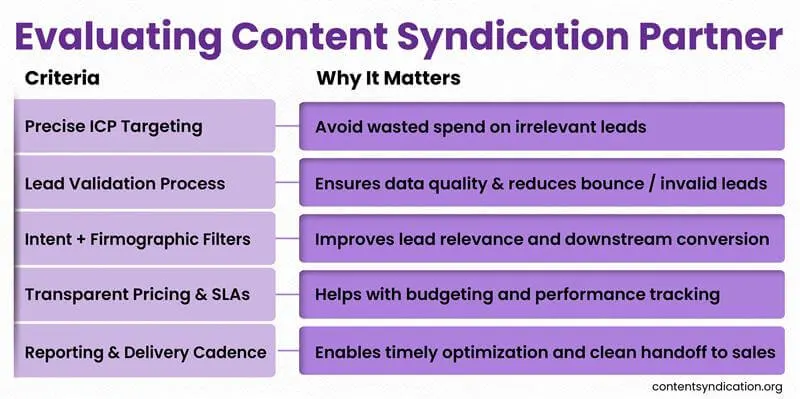
What to Evaluate:
- Audience match – can they target your ICP precisely?
- Lead validation – do they verify email, phone, and role?
- Geography and firmographic reach – especially crucial for global campaigns
- Intent or behavioral data layers – do they support topic-based, intent-driven targeting?
- Transparency on pricing (CPL, volume guarantees) and delivery SLAs
- Reporting frequency and granularity
Criteria
- Precise ICP Targeting
- Lead Validation Process
- Intent + Firmographic Filters
- Transparent Pricing & SLAs
- Reporting & Delivery Cadence
Why It Matters
- Avoid wasted spend on irrelevant leads
- Ensures data quality and reduces bounce or invalid leads
- Improves lead relevance and downstream conversion
- Helps with budgeting and performance tracking
- Enables timely optimization and clean handoff to sales
Lead Quality Controls (Validation, Dedupe & Replacement SLA)
Most campaigns fail not because syndication doesn’t work—but because lead quality rules weren’t defined before launch.
Set these rules upfront:
- Work email only (reject personal emails)
- Role + seniority match (confirm job function aligns with your ICP)
- Suppression list (exclude existing customers, open opportunities, competitors)
- Dedupe rules (avoid duplicates from parallel campaigns)
- Replacement window (invalid leads replaced within 7–14 days)
- Delivery SLA (daily/weekly delivery + format via API/CSV/CRM)
Pro tip: Ask for a sample lead report format before scaling.
Why Content Syndication Campaigns Fail (and How to Avoid It)
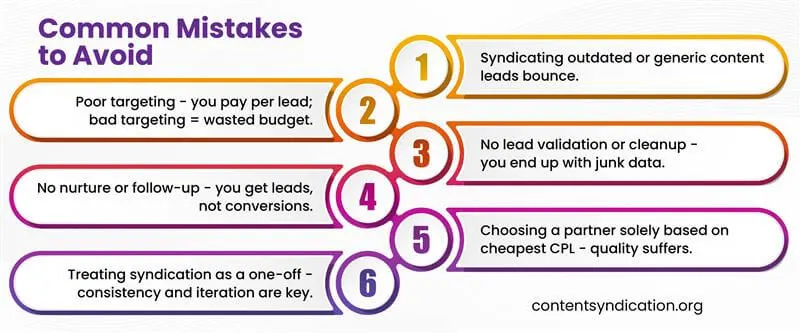
Failure #1: ICP too broad
Fix: Narrow by industry + seniority + company size + exclusions.
Failure #2: Asset feels promotional
Fix: Use educational guides, benchmarks, frameworks-save product for nurture.
Failure #3: Too many form fields
Fix: Keep 5–7 required fields + 1-2 qualifier questions.
Failure #4: Slow follow-up
Fix: SDR fast follow (same day). Hot leads cool off fast.
Failure #5: No nurture sequence
Fix: 7–14 day nurture flow with value-first emails + soft CTA.
Compliance & Consent (GDPR/CCPA)
Before launch, confirm how your partner captures consent and shares data. Ask for:
- The consent language used on the form (and where it appears)
- How opt-outs are handled and how quickly suppression lists are applied
- Data storage duration and access controls
- A clear process for honoring unsubscribe / deletion requests across regions
If you operate across multiple geos, document these requirements in the agreement before leads start flowing.
Campaign Launch: Step-by-Step Process
Here is what your campaign launch strategy should look like, from prep to live execution.
Launch Workflow Checklist:
Kickoff Brief
- Share ICP and exclusions with partner
- Provide content asset + abstract + promo copy
- Agree on report format (daily/weekly) and SLAs
Tracking Setup
- Create unique UTMs or tracking URLs
- Prepare CRM to segment leads by source/campaign
- Configure lead scoring or MQL criteria
Activation
- Partner publishes/promotes the asset (email blast, ads, newsletter, etc.)
- Leads start coming in via forms
- Vendor validates and delivers leads (via API, SFTP, or email)
Immediate Follow-up
- Auto-trigger thank-you/welcome email
- Start nurture path (value-add content, next-step CTA)
- Alert SDRs for high-intent or high-fit leads
Vendor Brief Template
- Target industry:
- Company size:
- Regions:
- Job titles/functions:
- Seniority level:
- Exclusions (customers, competitors, open opps):
- Work email only: Yes/No
- Dedupe rules:
- Replacement SLA (invalid leads): ___ days
- Delivery frequency: Daily / Weekly
- Delivery method: CSV / API / CRM
- Required fields: (list)
Weekly Optimization Checklist (30 Minutes)
- Leads delivered vs target pacing
- CPL by source/placement
- Sales accepted vs rejected (reasons)
- MQL rate by job title / industry / company size
- Best segments: scale
- Worst segments: pause/exclude
- Next week actions (Top 3)
Tracking and Optimization
Here is a truth that separates successful programs from failed experiments: optimization is not a one-time activity, it is a continuous discipline.
Critical Optimization Levers
- Targeting Refinement
Dive into which specific segments convert best:
- Which job titles progress to MQL and SQL most frequently?
- Are certain company sizes or industries outperforming others?
- Does seniority level impact conversion rates?
- Are there geographic patterns in conversion?
Use these insights to double down on high-performing segments and eliminate or reduce spend on poor performers.
Source Performance Analysis
Not all syndication sources deliver equal quality. Track performance by:
- Specific partner
- Publication or platform (if partner operates multiple properties)
- Placement type (email, display, content recommendations)
Pause sources consistently delivering low-quality leads and scale winners.
Content Performance
Monitor how your content itself is performing:
- Download or completion rates
- Time spent engaging with content
- Bounce rates on thank-you pages
- Nurture email engagement by cohort
Low engagement might signal audience misalignment or content quality issues.
Nurture Optimization
Your nurture sequence determines whether leads go cold or convert. Test:
- Email frequency (daily vs every 3 days vs weekly)
- Content mix (educational vs product-focused)
- CTA placement and copy
- Personalization elements
- Sending time and day
Segment nurture by persona, engagement level, or content topic for better relevance.
Lead Scoring Adjustments
Refine your scoring model based on which attributes actually correlate with opportunity creation. You might discover that certain job functions convert better than others, or that company size is a stronger indicator than you thought.
Creating Your Weekly Optimization Routine
Set aside 30–60 minutes every week to review:
- Lead delivery vs target (pacing)
- Cost per lead by source
- MQL conversion by source and segment
- Sales acceptance/rejection feedback
- Nurture engagement trends
- Top 3 optimization actions for next week
Create feedback loops with sales. Their qualitative insights, such as “these leads do not have budget authority” or “wrong department”, reveal targeting problems your data might miss.
Best Practices for Long-Term Success
- Think “campaign series”, not one-off events. A single push gets a bump, and repeated, refined campaigns build pipeline over time.
- Refresh content periodically. Quarterly or biannual updates keep assets relevant and performance up.
- Leverage intent signals and firmographics together. Intent data lets you reach active researchers, and firmographics keep targeting sharp.
- Keep an exclusion and suppression list. Avoid duplicate leads or overlapping campaigns and protect budget.
- Integrate syndication into nurture and ABM workflows. Syndication works best when it is part of a broader lead-gen and nurture ecosystem.
- Track partner performance quarterly. Drop or renegotiate with underperformers, and invest in the top 20% that deliver 80% of value.
Frequently Asked Questions (FAQs)
1. What is a good CPL for B2B content syndication?
A “good” CPL depends on your targeting and lead-quality rules. Broad targeting can lower CPL, but often reduces sales acceptance. For tighter ICP (seniority, specific industries, Tier-1 geos), CPL is typically higher-but quality and pipeline impact are usually better. The best benchmark is cost per opportunity and sales acceptance rate, not CPL alone.
2. How long does it take to see results from syndication?
Most campaigns start delivering leads within days of launch, but meaningful performance insights typically need 2-4 weeks (pilot). Use that window to evaluate lead quality, sales acceptance, and early-stage conversion before scaling.
3. How can I reduce invalid or low-quality leads?
Set clear lead-quality controls upfront:
- Work email only (no personal emails)
- Role + seniority match
- ICP exclusions + suppression list (customers, competitors, open opps)
- Dedupe rules across campaigns
- Replacement SLA (invalid leads replaced within 7–14 days)
4. Is content syndication GDPR/CCPA compliant?
It can be, if done correctly. Confirm the partner’s consent language, opt-out handling, data processing terms, and how they store/share lead data. For multi-geo campaigns, document compliance requirements in the agreement before launch.
5. Which assets perform best for content syndication?
Mid-funnel, high-value assets perform best-like:
- Benchmark/research reports
- Buyer’s guides
- Playbooks/frameworks
- Technical whitepapers (for tech audiences)
- Checklists/templates
Avoid overly promotional or thin content.
6. How many form fields should I use?
Keep it simple: typically 5-7 required fields + 1-3 qualifier questions (use case, timeline, priority). Too many fields reduces conversions; too few can hurt quality. Balance based on pipeline goals.
7. Vendor vs publisher-which is better?
Vendors/networks are great for scale and flexible targeting.
Specific publishers can work better when you want niche authority and a known audience.
Best approach: start with a pilot, compare performance by source, then scale what delivers sales-accepted leads
8. Should SDRs call syndicated leads immediately?
Yes-especially for high-fit leads. A fast-follow motion (within 5-30 minutes, or at least same day) improves connect rates and conversion. For lower-fit leads, route them into nurture first and trigger SDR outreach based on engagement.
Conclusion
Poorly executed content syndication is marred with challenges. When executed correctly, it is the true demand generation gem. It is a scalable, efficient, and data-driven tactic for building pipeline, reaching new markets, and driving maximum ROI from your content.
Leveraged strategically with precise targeting, strong assets, the right partners, and relentless optimization, syndication becomes a core pillar of your demand generation engine, not just a random lead generation experiment.