

No marketer wants to invest in leads that never had the potential to convert.
Yet in content syndication, that risk is more common than most teams admit. While the strategy helps B2B brands scale visibility and generate demand through third-party publishing networks, lead volume alone does not guarantee pipeline impact.
What matters is lead quality and accountability. That is why lead replacement policies have become an important part of modern content syndication programs. They help marketers protect budgets, reduce budget waste, and ensure campaigns are measured by meaningful outcomes instead of inflated numbers.
In this blog, we explore what lead replacement policy in content syndication really means, how content syndication lead replacement works, and why lead validation matters in B2B content syndication.
What Is a Lead Replacement Policy?
A content syndication campaign is only as valuable as the leads it delivers. No matter how large the lead volume is, marketers still question one thing at the end of every campaign:
“Are these leads actually worth the budget?”
This is where a content syndication lead replacement policy comes into the picture. It is an agreement between the content syndication vendor and the client that allows leads to be replaced if predefined quality standards are not met.
In simpler terms, if a lead is invalid, duplicated, inaccurate, or outside the agreed targeting criteria, the vendor replaces it with a qualified lead at no additional cost.
Which Leads Should Be Replaced?
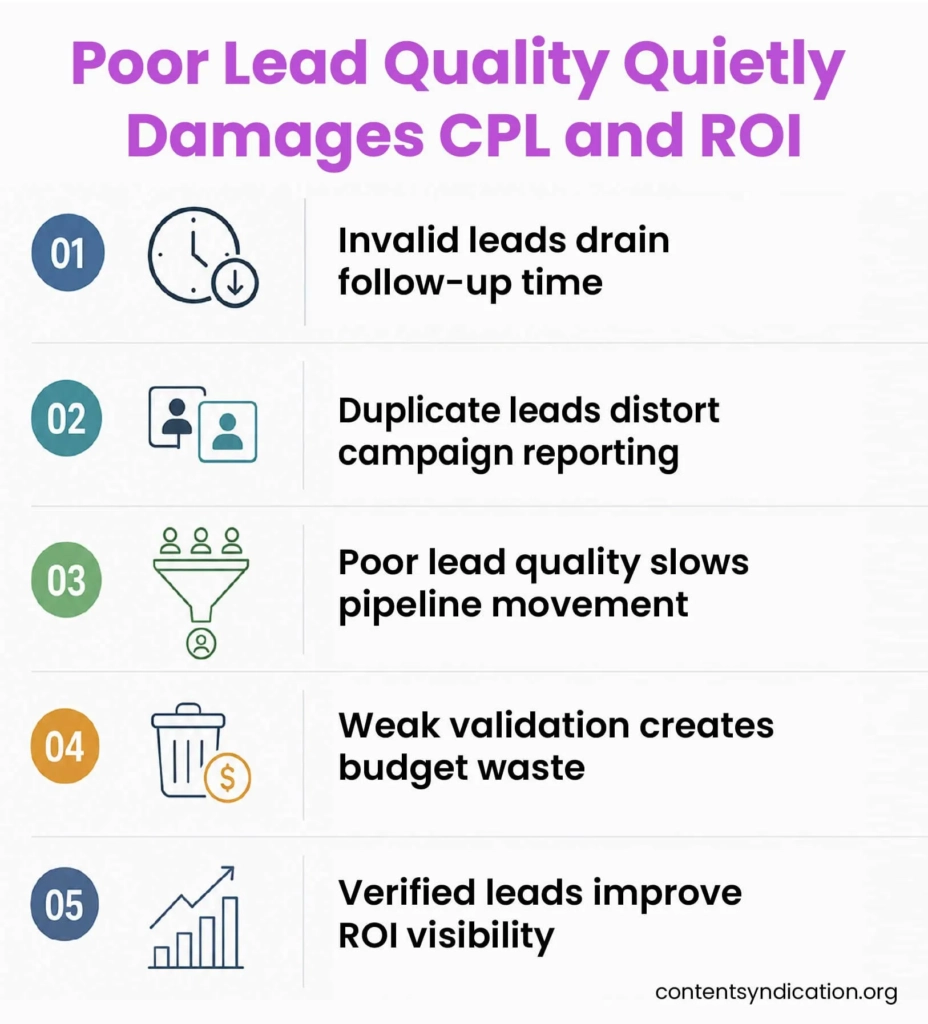
Not every lead generated through content syndication delivers equal value. Strong content syndication lead replacement policies clearly define which leads qualify for replacement to maintain campaign QA standards and protect ROI.
While criteria may vary between vendors, some lead categories are widely accepted for replacement requests.
Duplicate Leads
Duplicate leads are contacts already present in your CRM or previously delivered during the campaign.
These duplicate leads add little value because sales teams are often already engaging with them or they have already been counted toward earlier campaign goals.
Most vendors define duplication through factors such as:
- Existing in the CRM within the last 3–6 months
- Previously delivered during the same campaign
- Previously sourced through the same vendor
Invalid Contact Information
Leads with inaccurate or unusable information are usually eligible for replacement.
Examples include:
- Fake email addresses
- Invalid phone numbers
- Incomplete contact details
- Non-working company domains
Without proper lead verification, these invalid leads create unnecessary follow-up effort and reduce campaign efficiency.
Leads Outside Targeting Criteria
Content syndication campaigns are typically built around specific audience parameters such as:
- Industries
- Job titles
- Company sizes
- Regions
- Seniority levels
If delivered leads fall outside these agreed criteria, they generally qualify for replacement.
For example, a campaign targeting directors and C-level healthcare executives should not deliver entry-level retail employees.
Competitor or Internal Leads
Sometimes campaigns unintentionally generate contacts from:
- Competitor companies
- Vendor employees
- Internal staff
- Agencies unrelated to the target audience
These leads rarely contribute to revenue generation and are often included under content syndication lead replacement terms.
Fraudulent or Incentivized Leads
Some low-quality lead generation tactics rely on misleading incentives or fraudulent submissions.
Warning signs may include:
- Suspicious engagement patterns
- Fake company names
- Automated form submissions
- Unrealistic conversion spikes
Reliable vendors use lead validation and campaign QA processes to identify fraudulent activity before leads are delivered.
Why It Matters for Your CPL and ROI
A content syndication lead replacement policy is not just an operational safeguard. It directly impacts CPL protection, campaign efficiency, and long-term ROI.
Prevents Budget Waste
Without a replacement policy, marketers may end up paying for invalid leads, duplicate leads, or contacts that never matched the campaign criteria in the first place.
A structured replacement process ensures marketing budgets are spent on verified, target-aligned prospects instead of unusable records.
This is one of the clearest examples of how lead replacement protects marketing budget in modern demand generation campaigns.
Improves Sales Productivity
Sales teams lose valuable time chasing poor-quality leads.
When invalid leads are identified and replaced quickly, sales representatives can focus on real opportunities instead of manually filtering bad data.
Better B2B lead quality improves efficiency across the entire funnel.
Creates More Accurate Reporting
Campaign performance becomes unreliable when inflated lead numbers hide quality issues.
Strong lead validation processes improve:
- CPL analysis
- Conversion tracking
- Pipeline attribution
- ROI reporting
- Forecasting accuracy
This gives marketing teams a clearer understanding of actual campaign performance.
Encourages Vendor Accountability
Content syndication vendors with clear replacement policies are more likely to invest in:
- Lead verification
- Audience targeting
- Intent monitoring
- Fraud prevention
- Campaign QA
This improves trust and creates stronger long-term partnerships.
Questions to Ask Before Starting a Campaign
Before launching a content syndication program, marketers should carefully evaluate the vendor’s lead replacement process.
Here are a few important questions to ask:
- What qualifies for lead replacement?
- How are duplicate leads identified?
- What lead verification methods are used?
- How long is the replacement request window?
- Are fraudulent or incentivized leads filtered before delivery?
- How does the vendor handle disputes?
- Is CRM integration supported for faster lead validation?
- What campaign QA processes are in place?
The answers to these questions reveal how seriously a vendor approaches lead quality and accountability.
How Lead Validation Improves Sales Trust
One of the biggest challenges in B2B demand generation is the disconnect between marketing-generated leads and sales expectations.
When sales teams repeatedly receive irrelevant or inaccurate contacts, trust in marketing performance begins to decline.
Strong lead validation processes help solve this issue by ensuring leads are:
- Relevant to the ICP
- Properly verified
- Accurate and complete
- Aligned with campaign targeting
This creates stronger alignment between sales and marketing teams.
When this happens, follow-up improves, conversion rates improve, and campaigns generate stronger pipeline impact.
This is exactly why lead validation matters in B2B content syndication. It strengthens confidence in campaign outcomes instead of forcing teams to rely on inflated lead volume metrics.
Red Flags in Vendor Replacement Policies
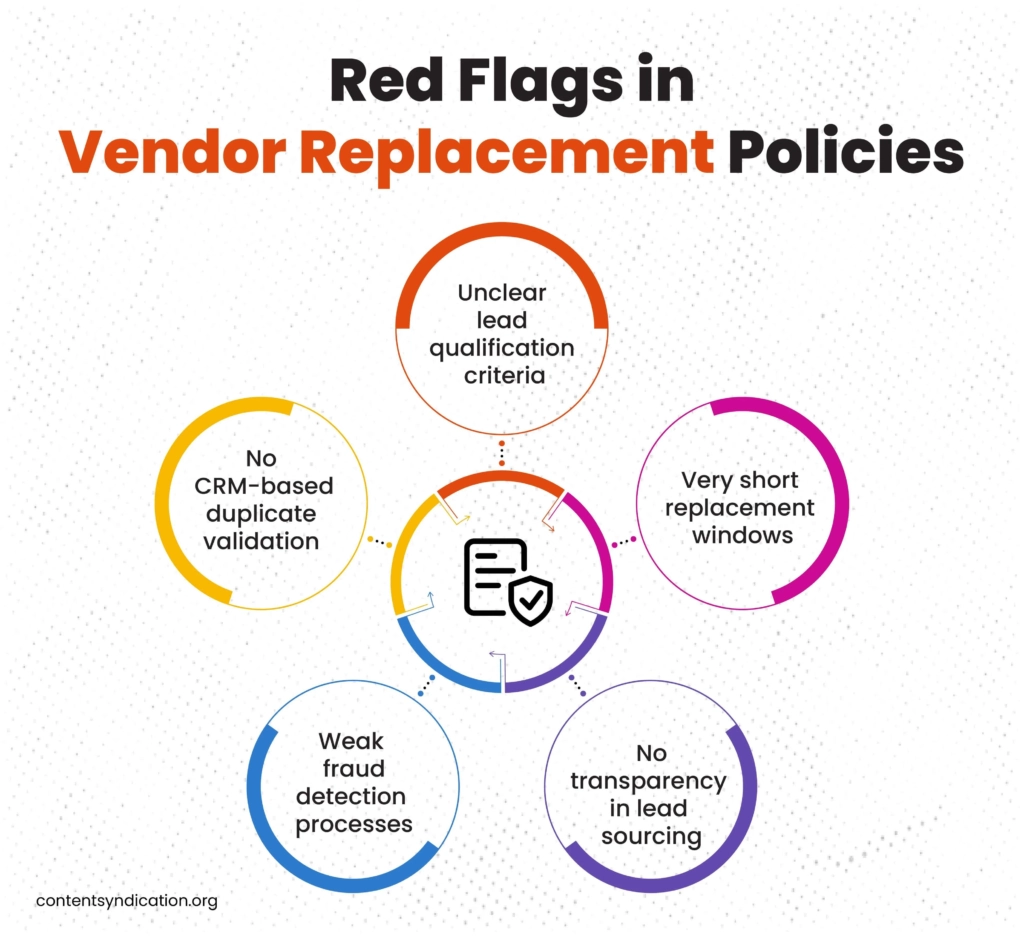
Not every content syndication lead replacement policy offers meaningful protection.
Some vendors position replacement policies as a marketing promise while limiting actual accountability through restrictive conditions.
Here are a few red flags to watch for:
Unclear Qualification Criteria
If targeting definitions are vague or undocumented, disputes become difficult to resolve later.
Extremely Short Validation Windows
Some vendors allow only a few days to review leads. This creates pressure on internal teams and increases the risk of missing invalid leads.
Limited Transparency
Reliable vendors should clearly explain:
- Lead sourcing methods
- Verification processes
- Replacement workflows
- Reporting practices
Lack of transparency often signals weak campaign QA standards.
No Fraud Prevention Measures
If vendors cannot explain how they detect suspicious activity or fake submissions, lead quality risks increase significantly.
Resistance to CRM Integration
Vendors unwilling to support CRM syncing may make duplicate lead detection and lead validation harder.
Frequently Asked Questions
1. What is lead replacement policy in content syndication?
A content syndication lead replacement policy is an agreement where vendors replace invalid, duplicate, fraudulent, or non-targeted leads with qualified leads at no additional cost.
2. Why is content syndication lead replacement important?
It helps marketers reduce budget waste, improve B2B lead quality, protect CPL, and ensure campaign performance is measured accurately.
3. Which leads are usually eligible for replacement?
Common replacement categories include duplicate leads, invalid leads, inaccurate contact data, fraudulent submissions, and leads outside the agreed targeting criteria.
4. How does lead validation improve campaign performance?
Lead validation improves data accuracy, strengthens sales trust, reduces wasted follow-up effort, and increases the likelihood of conversions.
5. How long do marketers typically have to request replacements?
Most vendors offer replacement windows ranging between 7 and 30 days after lead delivery.
The Real Value of Content Syndication Comes from Lead Quality
Lead generation only delivers value when the leads are accurate, relevant, and capable of progressing through the funnel.
A strong content syndication lead replacement policy ensures your campaigns are backed by accountability, lead verification, and measurable quality standards instead of inflated numbers.
Run content syndication campaigns with verified lead quality and stronger conversion potential.