

Most B2B teams lose months trying to decide whether to build an in-house content syndication engine or outsource it – and in the process, delay pipeline growth.
The reality is simple: the wrong decision doesn’t just waste budget, it slows down revenue.
In-house content syndication offers control and long-term efficiency. Outsourcing delivers speed, scale, and immediate access to distribution.
But which one actually works better for your business?
This guide breaks down the real trade-offs between in-house vs outsourced content syndication – based on execution, cost, scalability, and pipeline impact – so you can make the right decision for your growth stage.
What is In-House Content Syndication?
In-house content syndication means your internal team owns the entire distribution process – from identifying publishers to executing campaigns and optimizing performance.
Instead of relying on external vendors, your marketing team manages outreach, placements, targeting, and reporting end-to-end.
This typically includes:
· Identifying and building relationships with publishers
· Managing outreach, negotiations, and placements
· Setting up and executing campaigns internally
· Tracking performance and continuously optimizing results
In an in-house vs outsourced content syndication comparison, the in-house model gives teams full control over messaging, targeting, and execution.
However, this control comes with operational responsibility and resource demands.
Pros of In-House Syndication
Complete Control Over Targeting, Messaging, and Execution
Internal teams can align campaigns tightly with ICP targeting, brand voice, and sales objectives — without relying on external interpretation.
Better Alignment With Internal Teams
Marketing, sales, and RevOps teams can collaborate seamlessly, improving targeting precision and follow-up workflows.
Greater Transparency in Execution
You have direct visibility into every part of the process from publisher selection to performance tracking.
Long-Term Cost Efficiency (At Scale)
When executed effectively, in-house programs can reduce dependency on vendors and improve margins over time.
In an in-house vs outsourced content syndication scenario, this model is often preferred by mature organizations with established demand gen teams.
Limitations of In-House Syndication
Limited Access to High-Quality Publisher Networks
Building a reliable publisher network takes months – and without it, campaign reach and lead quality can suffer. Without existing connections, teams may struggle to secure high-quality placements.
Resource-Intensive Operations
Managing campaigns internally requires dedicated bandwidth across strategy, execution, and reporting.
Slower Campaign Scalability
Scaling campaigns quickly can be challenging without pre-existing infrastructure or partnerships, impacting campaign scalability.
Complex Publisher Relationships
Establishing and maintaining publisher relationships requires consistent effort and negotiation expertise.
In the broader discussion, these limitations often slow down growth for smaller or mid-sized teams.
What is Outsourced Content Syndication?
Outsourced content syndication involves partnering with specialized vendors who manage the entire distribution process on your behalf.
Instead of building infrastructure internally, you leverage existing networks, systems, and expertise to launch campaigns faster.
These providers typically offer:
- Access to established publisher networks
- Campaign setup and execution
- Lead generation and delivery
- Reporting and performance insights
Outsourcing allows companies to tap into existing expertise and infrastructure without building it internally.
Benefits of Outsourced Syndication
Instant Access to Established Publisher Networks
Vendors give you immediate access to large, pre-built publisher ecosystems — eliminating the need to build relationships from scratch.
Faster Campaign Launch and Execution
Campaigns can go live quickly due to established workflows and processes.
Built-In Lead Validation Process
Most providers include a lead validation process to ensure data quality and compliance.
Easier Campaign Optimization
Experienced vendors continuously refine targeting and performance through ongoing campaign optimization.
Improved ROI Comparison Insights
Outsourcing often includes detailed reporting, enabling clearer ROI comparison across campaigns.
For organizations asking, is outsourcing syndication worth it? The answer often depends on speed, scale, and internal capabilities.
Limitations of Outsourced Syndication
Reduced Control Over Targeting and Execution
You rely on external teams for targeting, messaging, and delivery, which can limit flexibility and customization.
Variability in Lead Quality
Lead quality can vary significantly across vendors, making ongoing monitoring and strict qualification criteria essential.
Dependency on External Partners
Over-reliance on vendors can make it difficult to build internal expertise over time.
Cost at Scale
While outsourcing enables faster execution, costs can increase significantly as campaign volume grows.
Limited Transparency
Some providers may not offer full visibility into sources, placements, or campaign mechanics, which can impact optimization decisions.
These limitations highlight the importance of choosing the right partner and maintaining internal oversight.
Comparing In-House vs Outsourced Costing
Cost is one of the most misunderstood aspects of content syndication.
At a surface level, outsourcing appears more expensive due to CPL-based pricing. However, in-house execution carries hidden costs – including hiring, tools, time-to-launch, and operational overhead.
In-House Costs
- Salaries (marketing, ops, analysts)
- Technology and tools
- Time investment in building processes
Outsourced Costs
- Cost-per-lead (CPL) pricing models
- Platform or vendor fees
A realistic CPL comparison should factor in hidden costs such as internal bandwidth, time-to-launch, and opportunity cost.
When making an in-house vs outsourced syndication cost comparison, companies often find that outsourcing appears more expensive upfront but delivers faster results.
Which Model is Best for Your Business?
There is no universal answer – but there is a clear pattern.
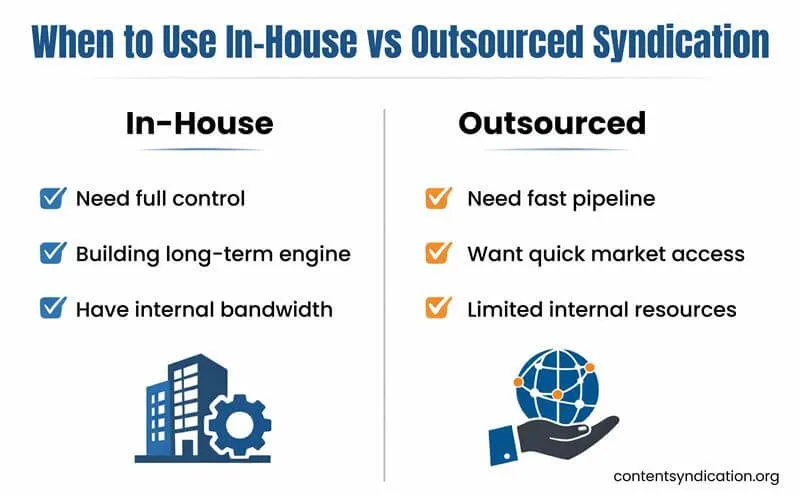
Most B2B teams choose outsourcing when speed and pipeline are the priority, and shift towards in-house models as they scale and optimize for efficiency.
Instead of treating this as a binary choice, evaluate it across four decision layers:
1. How Fast Do You Need Pipeline Impact?
If you need immediate contribution to pipeline, outsourcing is typically more effective due to existing infrastructure and execution speed.
If your focus is on building a long-term engine, in-house investment becomes more relevant.
2. Where Is Your Operational Bottleneck?
- If your constraint is execution bandwidth, outsourcing removes that friction.
- If your constraint is strategic control or experimentation, in-house gives you more flexibility.
The right choice depends on where your current system is breaking.
3. Are You Optimizing for Learning or Output?
- In-house models help build internal knowledge, insights, and repeatable processes over time.
- Outsourced models prioritize output and efficiency, often with less internal learning.
If building internal capability is a priority, in-house has long-term value beyond immediate results.
4. How Predictable Do You Need Outcomes to Be?
Outsourced models are typically more standardized, which can make performance more predictable in the short term.
In-house models may take longer to stabilize but can be tailored more precisely once optimized.
Practical Decision Scenarios
To simplify the decision, here is how most B2B teams align:
- Early-stage or growth-focused teams tend to outsource for speed, reach, and lower operational burden.
- Mid-sized teams often combine both models to balance efficiency and control.
- Mature teams with strong internal capabilities shift more towards in-house execution for better margin control.
The answer typically comes down to how quickly you need results and how much control you are willing to trade for that speed.
Hybrid Approach (Often the Smartest Strategy)
Many high-performing B2B teams adopt a hybrid model – combining the speed of outsourcing with the control of in-house strategy.
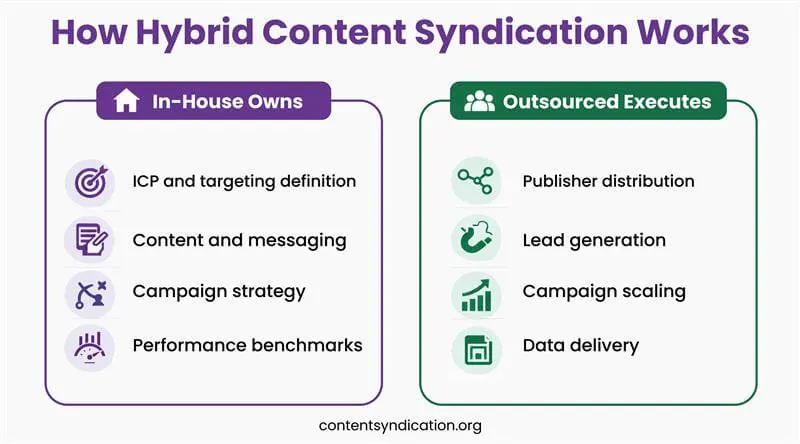
This approach allows teams to scale faster while still maintaining ownership over targeting, messaging, and performance optimization.
This involves:
- Using vendors for scale and reach
- Managing strategy and optimization internally
It also enables teams to test channels externally before bringing successful campaigns in-house.
Final Recommendation Framework
To make the right decision in the in-house vs. outsourced content syndication debate, evaluate the following:
1. Business Goals
Are you optimizing for speed, scale, or cost efficiency?
2. Internal Capabilities
Do you have the resources to manage campaigns effectively?
3. Growth Stage
Early-stage companies often benefit more from outsourcing, while mature teams may shift in-house.
4. Performance Metrics
Track pipeline contribution, lead quality, and conversion rates, not just CPL.
5. Flexibility Needs
A hybrid model often provides the best balance between control and scalability.
Ultimately, in-house vs. outsourced content syndication is not about choosing one over the other; it’s about aligning your approach with your growth strategy.
Frequently Asked Questions
1. What is the difference between in-house and outsourced content syndication?
In-house content syndication is managed entirely by your internal team, including publisher outreach, campaign setup, lead tracking, and optimization. Outsourced content syndication involves working with a third-party provider that handles distribution, lead generation, and reporting on your behalf.
2. Is outsourced content syndication better for B2B companies?
Outsourced content syndication is often better for B2B companies that need faster campaign execution, wider reach, and immediate pipeline impact. It is especially useful for teams with limited internal resources or those looking to scale quickly.
3. When should a company choose in-house content syndication?
A company should choose in-house content syndication when it has the internal bandwidth, publisher relationships, and operational maturity to manage campaigns effectively. It is usually a better fit for businesses focused on long-term control and efficiency.
4. Is in-house content syndication more cost-effective?
In-house content syndication can become more cost-effective over time, but it usually requires upfront investment in talent, tools, processes, and publisher relationships. Outsourcing may seem more expensive initially, but it often delivers faster results.
5. What are the main benefits of outsourced content syndication?
The main benefits of outsourced content syndication include faster campaign launch, access to established publisher networks, easier scaling, built-in lead delivery processes, and reduced operational burden on internal teams.
Conclusion
Choosing between in-house and outsourced content syndication is not about preference – it’s about alignment with your growth stage and priorities.
If speed and pipeline are critical, outsourcing is often the fastest path to results.
If long-term efficiency and control matter more, building an in-house engine becomes valuable over time.
For most B2B teams, the smartest approach is not choosing one over the other – but combining both to balance scale, cost, and control.
The companies that win are not the ones that pick a model – but the ones that evolve it as they grow.
Looking to scale your pipeline without building everything from scratch? Explore how a structured content syndication strategy can accelerate your demand generation efforts.