

Content syndication has become a consistent pipeline driver for B2B organizations, but attribution often lags behind performance. Many teams still evaluate results using single-touch models that fail to reflect how modern buyers actually engage.
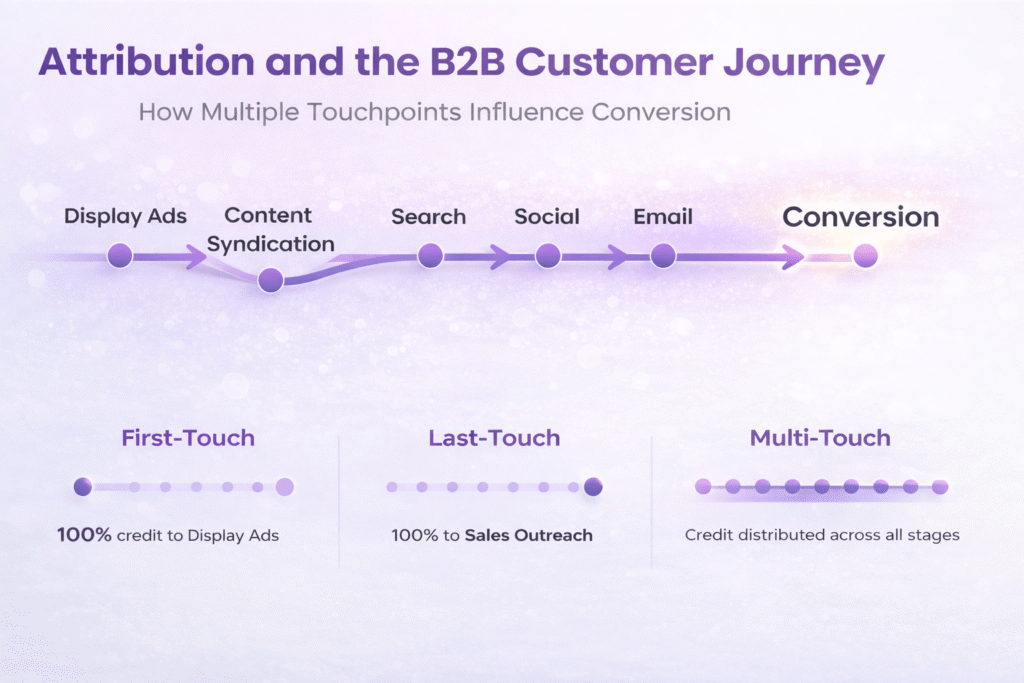
A prospect might discover a brand through syndicated content, revisit through search, attend a webinar, and only later convert through sales outreach. Without clarity on contribution across these interactions, its value is underestimated.
This is where multi-touch attribution for content syndication becomes essential. Instead of asking which channel generated the lead, it asks how each interaction influenced progression.
How Content Syndication Fits Into the B2B Buyer Journey
B2B buying journeys are rarely linear. Research happens across multiple platforms, stakeholders consume information independently, and engagement builds gradually before sales conversations begin.
Content syndication typically operates in early and mid-stage engagement, where awareness and consideration are formed.
In practical terms, syndicated assets such as white papers, reports, and webinars introduce your message to audiences already researching related challenges. T
hese interactions may not immediately generate opportunities, but they influence future actions. This is where multi-touch attribution for content syndication helps clarify contribution across stages rather than forcing a single source of credit.
Syndication plays three roles in the journey:
- Creating first meaningful engagement with new accounts
- Reinforcing credibility through educational content
- Supporting progression toward sales readiness
Understanding this role prevents mislabeling syndication as underperforming.
Attribution Models Explained (With Syndication Context)
Attribution models assign value to marketing interactions across the buyer journey.
Multi-touch attribution models distribute credit across multiple interactions, making them more suitable for content syndication environments.
Linear attribution:
It distributes equal credit across all touchpoints, ensuring early engagement is recognized alongside later interactions.
U-shaped attribution (position-based):
It assigns higher weight to the first and lead-conversion touchpoints while still recognizing the middle interactions that nurture interest.
W-shaped attribution:
It assigns significant credit to first touch, lead creation, and opportunity creation, reflecting how marketing and sales interactions collectively influence pipeline progression.
Time-decay attribution:
It gives increasing credit to interactions closer to conversion while still acknowledging earlier influence, useful in longer sales cycles.
Data-driven attribution:
This uses historical performance and algorithmic analysis to assign credit based on actual contribution patterns.
For most B2B organizations, multi-touch attribution provides the clearest understanding of content syndication performance because it recognizes influence across stages rather than forcing ownership into a single interaction.
Syndication often creates entry or momentum within accounts, and multi-touch models ensure that contribution remains visible.
Lead-Level vs Account-Level Attribution
Lead-level and account-level attribution represent two distinct methodologies for measuring marketing effectiveness.
Lead-level attribution:
Itmeasures engagement at the individual contact level. Each person’s journey is tracked separately, and credit is assigned based on that individual’s interactions with marketing touchpoints.
This approach works well for understanding which channels or assets generated conversions at a contact level and is commonly used in high-volume demand generation environments.
Account-level attribution:
It isoften associated with account-based marketing (ABM), which shifts the unit of measurement from the individual to the organization.
Instead of analyzing one person’s journey, it aggregates engagement across multiple stakeholders within the same company and evaluates how collective engagement contributes to pipeline creation.
In modern B2B buying environments, this shift is critical. Buying decisions involve multiple stakeholders.
Attribution Comparison
Lead-Level vs Account-Level (ABM) attribution explained.
| Feature | Lead-Level Attribution | Account-Level Attribution (ABM) |
|---|---|---|
| Focus | Individual contact | Account or buying committee |
| Primary Metric | MQLs (Marketing Qualified Leads) | MQAs (Marketing Qualified Accounts) |
| Data Scope | Single person’s journey | Unified engagement across contacts |
| Best Fit | High-volume or shorter sales cycles | Enterprise or complex B2B sales |
| Primary Goal | Lead conversion | Pipeline and revenue acceleration |
Syndicated content often reaches multiple stakeholders before sales engagement begins. One contact may download a whitepaper, another may attend a webinar, and a third may engage with sales later in the process.
Lead-level reporting treats these as separate events, while account-level attribution reveals their combined impact on opportunity creation.
Importance of Tracking Setup
Attribution accuracy depends less on the model and more on a clean tracking setup. If data is inconsistent or disconnected, even advanced attribution models produce misleading conclusions.
A reliable setup for multi-touch attribution for content syndication requires four essentials:
1. Clear Conversion Definitions
Define measurable actions across the journey—content downloads, MQL qualification, SQL progression, and opportunity creation—before assigning credit.
2. Standardized UTM Governance
Apply consistent UTM parameters across syndication vendors to preserve source, medium, campaign, and asset integrity.
3. Centralized Tracking Infrastructure
Use unified tracking (via tag management and analytics platforms) so sessions, devices, and interactions connect to a single contact record.
4. Lead-to-Account Mapping
Ensure contacts are correctly associated with accounts, so engagement from multiple stakeholders is unified.
5. Opportunity & Campaign Association
Opportunities must connect back to campaigns and contact roles, so contribution is visible beyond lead creation.
Measuring What Actually Matters
One of the most common attribution mistakes is measuring only lead volume. Syndication performance should be evaluated based on progression and influence.
Key metrics include:
- Conversion from MQL → SQL → opportunity attribution
- Pipeline influenced by syndicated engagement
- Account engagement depth over time
- Opportunity creation rate from syndicated audiences
Instead of asking how many leads were generated, teams begin asking how many opportunities moved forward because syndication introduced or reinforced engagement.
Reporting Framework for CMOs & RevOps
Attribution reporting must serve decision-making, not just dashboards. Effective reporting connects marketing activity directly to pipeline outcomes.
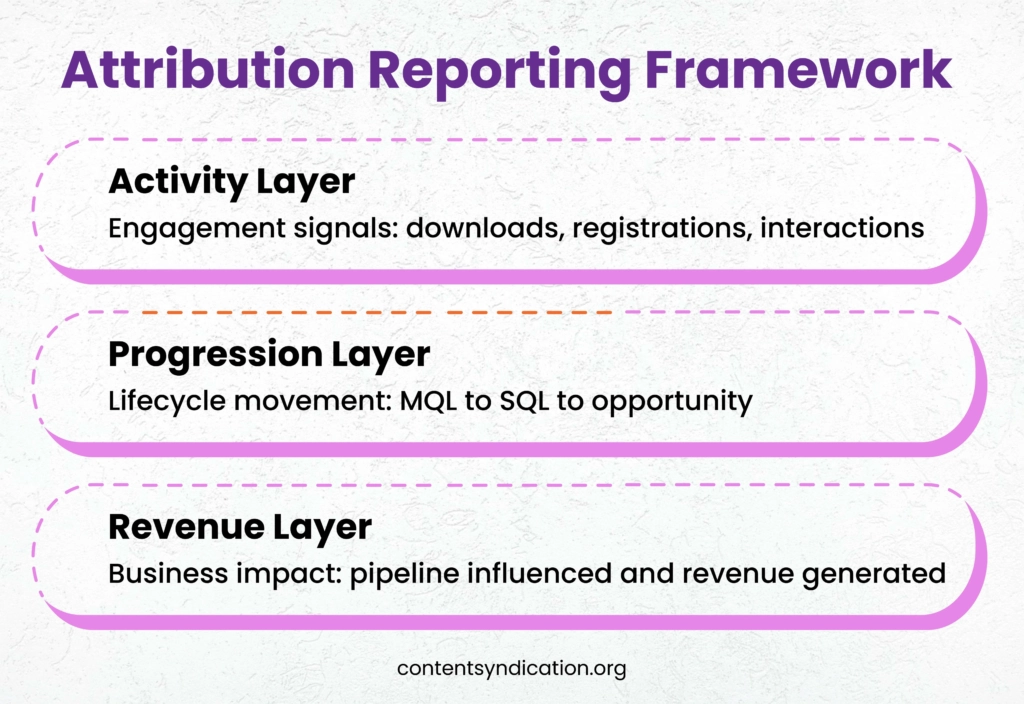
A practical framework includes three layers:
Activity Layer: Talks about downloads, registrations, and engagement volume.
Progression Layer: Focuses on movement between lifecycle stages and account engagement growth.
Revenue Layer: Covers opportunities influenced, pipeline value, and closed revenue contribution.
Multi-touch attribution for content syndication allows CMOs and RevOps leaders to see where syndication supports pipeline acceleration rather than forcing it into a single ownership category. This distinction helps separate marketing-sourced pipeline vs influenced pipeline, creating more realistic expectations across teams.
Common Attribution Mistakes
Attribution challenges rarely come from technology limitations. They usually come from incorrect assumptions.
Common issues include:
- Expecting syndication to generate last-touch conversions
- Ignoring account-level engagement signals
- Misaligned lifecycle definitions between teams
- Over-optimizing for CPL instead of pipeline contribution
Multi-touch attribution for content syndication corrects these issues by reframing performance around contribution rather than ownership.
When attribution reflects how buyers actually behave, decision-making improves across marketing and sales.
Proving ROI (Even When Syndication Isn’t First Touch)
One of the biggest challenges for marketers is proving value when syndication is not the first interaction recorded. In reality, influence often appears later in the journey.
To demonstrate impact, teams should analyze:
- Opportunities where syndicated engagement occurred before conversion
- Pipeline velocity changes after content interaction
- Engagement expansion within target accounts
This approach answers how to measure content syndication ROI with multi-touch attribution by focusing on progression and acceleration rather than origin alone.
It also supports scenarios such as content syndication influenced pipeline tracking in Salesforce, where multiple campaigns contribute to opportunity creation.
Understanding first touch vs multi-touch for content syndication leads helps teams communicate performance more accurately to leadership and finance stakeholders.
Conclusion
Content syndication works best when measured in the way buyers actually engage. Multi-touch attribution for content syndication provides the structure needed to recognize that influence.
By aligning attribution models, tracking setup, and reporting frameworks with real buyer behavior, organizations gain a clearer understanding of how content contributes to pipeline growth.
The outcome is not just better reporting. It is better decision-making.