

Content syndication remains one of the most dependable demand generation channels for B2B companies that need predictable pipeline at scale.
It delivers broad reach, reliable lead volume, and consistent content distribution especially for teams that already have strong assets like whitepapers, research reports, and industry guides.
Yet there is one persistent challenge that separates “good” syndication programs from the ones that deliver revenue: SQL rate.
Marketing teams generate thousands of leads, but sales often rejects most of them. The pipeline looks full, but deals don’t move. The result is a familiar complaint: “Content syndication gives us leads, not pipeline.”
The solution is not to stop syndication or chase a different channel, it’s to fix the process. SQL rate is a reflection of qualification, scoring, sales alignment, and follow-up.
This playbook will show you exactly how to improve SQL rate from content syndication using a practical, step-by-step approach that B2B teams can implement.
What Is a “Good” SQL Rate in Content Syndication?
Before discussing ways to improve SQL conversion from syndicated leads, it’s important to set realistic benchmarks.
In most B2B environments, a healthy SQL rate from content syndication typically falls between 8–15%, depending on:
- Target account precision
- Content relevance and intent
- Sales follow-up speed and quality
- Lead validation rigor and routing accuracy
High-intent campaigns with strong ICP alignment can push beyond 15%, while broad awareness programs may land lower.
The goal isn’t to chase vanity percentages, but to consistently improve SQL quality and sales confidence.
If your SQL rate is below 5%, the issue is rarely the channel. It’s usually a weak qualification process, inconsistent scoring, or sales not being enabled to convert syndicated leads.
Why SQL Rates Are Low in Content Syndication Campaigns
To improve SQL conversion from syndicated leads, you must first diagnose why conversion drops after MQL.
Content syndication is often treated like inbound marketing: a lead downloads an asset, marketing hands it to sales, and sales expects a conversation-ready prospect.
But syndicated leads are different. They are typically earlier in the buyer journey and may not be ready for a sales conversation.
Without proper orchestration, this difference becomes the reason why content syndication SQL rates are low.
Common reasons include:
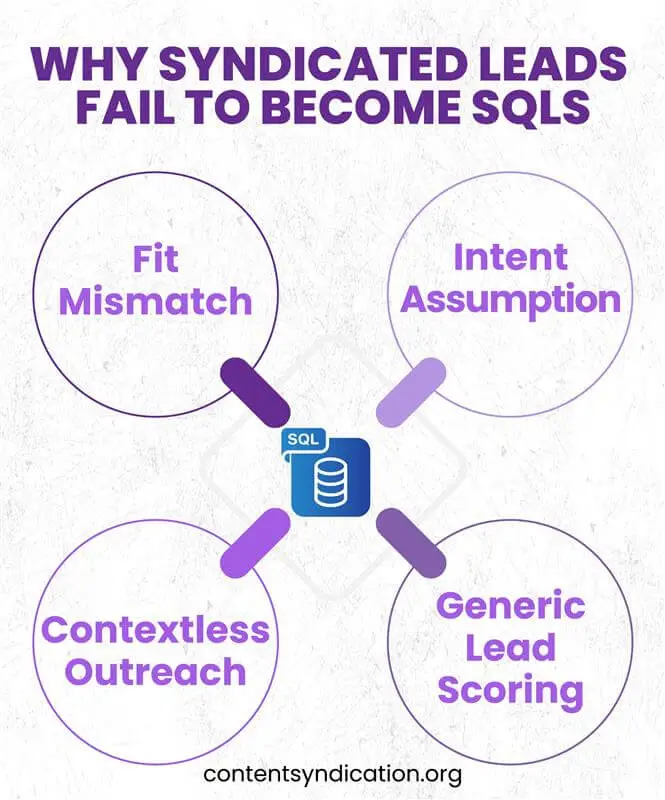
- Leads gated on content but not validated against ICP
- Sales teams treating syndicated leads like inbound demo requests
- Inconsistent lead scoring logic
- Minimal context provided to sales
- Delayed or generic follow-up
- Too much emphasis on volume instead of fit
Step 1: Improve Lead Qualification Before Sales Touch
The foundation of improving SQL conversion starts before sales ever sees the lead.
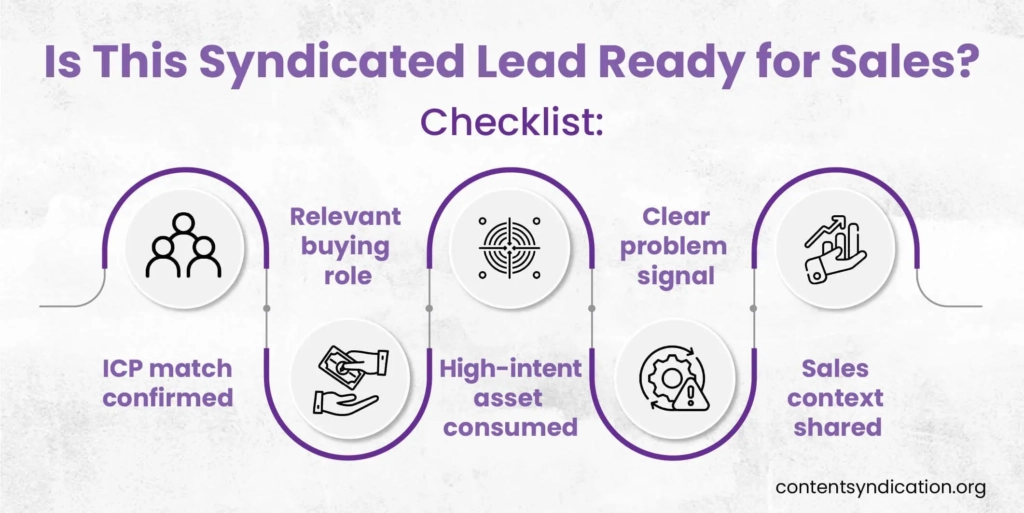
A strong content syndication lead qualification process should include:
ICP and Firmographic Validation
Use filters that align with your ICP, such as:
- Industry
- Company size (employee count or revenue)
- Geography
- Company type (private, enterprise, public)
Role and Seniority Verification
Many syndicated leads come from irrelevant roles. Include validation for:
- Job function
- Seniority level
- Buying authority or influence
Buying Committee Relevance
The best SQLs often come from the buying committee, not just the person who downloaded the content. Add checks for:
- Decision makers
- Influencers
- Budget owners
Data Hygiene and Exclusion Rules
Exclude leads that don’t match your business goals:
- Competitors
- Students or researchers
- Non-target job functions
This step ensures that leads entering the funnel already meet baseline sales criteria.
Early lead validation to improve SQL rates prevents sales rejection later and builds trust in the channel.
Step 2: Implement Smarter Lead Scoring
If all syndicated leads are scored the same, SQL rates will remain inconsistent. One of the most effective ways to improve results is through refined content syndication lead scoring methods.
Separate Fit and Intent Scores
Instead of a single score, use two layers:
- Fit score (ICP alignment)
- Intent score (content engagement)
Weight Content Depth
Not all content downloads signal equal intent. Give higher scores to:
- Research reports
- Whitepapers
- Product comparison guides
Adjust Thresholds for Syndicated Leads
Syndicated leads should not use the same scoring thresholds as inbound. They might need higher fit thresholds or longer nurturing before sales involvement.
Add Behavioral Signals
Include signals such as:
- Multiple asset downloads
- Repeat visits
- Content consumed from the same campaign
This approach supports content syndication SQL optimization by ensuring only sales-ready leads are pushed forward.
Step 3: Align Sales Follow-Up to Increase SQL Acceptance
Even the best-qualified lead will fall through without proper follow-up. A key lever in improving SQL acceptance from syndicated leads is aligning sales follow-up of syndicated leads.
Clear SLAs on Response Time
If sales waits more than 24 hours, interest drops. Establish SLAs such as:
- First contact within 4 hours for high-fit leads.
- First contact within 24 hours for mid-fit leads.
Provide Context and Intent Signals
Sales should know:
- Which asset was downloaded
- What the lead’s intent likely is
- What the campaign promise was
Use Contextual Outreach Messaging
Instead of generic outreach, use messaging like:
- “I saw you downloaded our [asset]. What challenge were you researching?”
- “The report mentions [pain point]. Is this something your team is facing?”
This increases the chances of meaningful conversations.
Step 4: Nurture Leads Before Pushing to Sales
Not every syndicated lead is sales-ready on day one. Pushing too early hurts SQL rates. This is why content syndication nurturing for SQL conversion is essential.
Create a Multi-Touch Nurture Track
Design nurture sequences that:
- Reinforce the problem statement
- Build credibility through proof points
- Introduce your solution gradually
Use Intent-Based Content Paths
Segment nurture based on the asset topic:
- Security operations content → follow-up with incident response materials
- Data privacy content → follow-up with compliance guides
- Cost optimization content → follow-up with ROI calculators
Step 5: Create a Sales Feedback Loop
Improving SQL conversion from syndicated leads requires continuous feedback between marketing and sales.
Create a Structured Rejection Log
Track:
- Rejection reason
- Lead fit issues
- Timing issues
- Missing context
Run Weekly Alignment Meetings
Marketing and sales should review:
- Which campaigns are performing
- Which content drives better SQL rates
- What objections are common
Use Feedback to Refine Campaigns
Marketing can then adjust:
- Targeting criteria
- Lead scoring thresholds
- Asset selection
- Nurture flows
This collaboration directly supports increasing sales qualified leads from content syndication over time.
Measuring SQL Improvement the Right Way
Tracking the right metrics is essential when evaluating SQL rate from content syndication. Focus on:
- MQL-to-SQL conversion rate
- SQL acceptance rate by sales
- Time-to-first-contact
- SQL-to-opportunity progression
- Campaign-level performance (asset, audience, publisher)
Avoid measuring success only by volume or CPL. A high volume of low-fit leads can hide the real problem. Instead, measure SQL conversion at each stage to identify where the leak is.
This lens enables improving SQL conversion from content syndication campaigns with data-backed decisions instead of assumptions.
Common Mistakes That Keep SQL Rates Low
Despite best intentions, teams often undermine SQL performance in content syndication by:
- Optimizing only for CPL and not for fit
- Treating syndicated leads like inbound demos
- Ignoring sales feedback and rejection reasons
- Using generic scoring models across channels
- Skipping nurture altogether
- Routing leads without context or prioritization
Avoiding these pitfalls is foundational to sustained content syndication SQL optimization.