
B2B buyers receive hundreds of marketing messages every week-but email remains the only channel where they intentionally consume professional content. And that’s exactly why email content syndication continues to outperform every other demand-generation method in 2026.
Despite the rise of paid social, influencer marketing, and algorithm-driven content, email syndication delivers higher-quality leads, stronger intent signals, and faster pipeline movement-making it one of the most reliable and scalable channels for B2B marketers.
This guide breaks down everything you need to know: how email syndication works, why it dominates, where it fits in your funnel, and how to use it for measurable ROI.
What Is Email Content Syndication?
Email content syndication is the process of distributing your high-value content (eBooks, guides, reports, webinars) to a targeted B2B audience via email through a third-party syndication partner.
Unlike other syndication formats (display ads, partner blogs, organic SEO), email syndication ensures:
- Direct inbox delivery
- Higher relevance
- Permission-based access
- More accurate targeting
- Stronger engagement
This is why top brands rely heavily on email-driven syndication for lead gen, ABM programs, and mid-funnel acceleration.
Why Email Syndication Still Performs Better Than Any Other B2B Channel
Here’s what recent numbers show:
- 77% of B2B buyers prefer receiving content by email (B2B Email Marketing: Insights & Stats for 2024)
- Marketers using email-based syndication achieve 60% higher sales alignment
- Email-based syndication leads produce shorter warming cycles
- Syndicated emails have stronger open & engagement rates than general newsletters
- CPL is 24% lower than most paid social campaigns
Email continues to win because:
It is consent-based
Buyers have opted in – they expect professional content in their inbox.
It bypasses platform algorithm limitations
No dependency on social reach, ad fatigue, or feed ranking.
It supports multi-stakeholder buying committees
You can reach different roles with different content versions.
It produces clean, accurate first-party data
Email → form → CRM → nurture = a perfect measurable loop.
Simply put, email syndication is the highest-intent, highest-control, and most predictable content distribution model in B2B.
How Email-Based Content Syndication Works (Step-by-Step)
Here is the exact process:
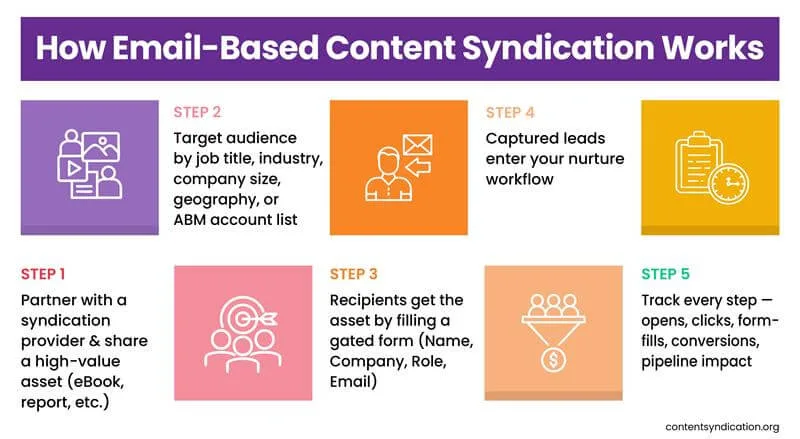
Step 1: Partner with a trusted syndication provider
You share your high-value asset (eBook, whitepaper, case study, research report).
Step 2: Define the exact audience
Target by:
- job title
- seniority
- industry
- company size
- geography
- ABM account list
This ensures content lands in the inbox of qualified professionals.
Step 3: Deliver the asset through a gated form
Recipients fill details like:
- Name
- Company
- Role
This generates high-quality, opt-in leads.
Step 4: Push captured leads into your nurture workflows
Because the lead engaged via email, email-first nurturing performs 2-3x better.
This entire flow is predictable, measurable, and highly scalable – making email syndication a top choice for demand gen teams.
Where Email Syndication Delivers the Highest Impact
1. Account-Based Marketing (ABM)
Email syndication helps you:
- penetrate target accounts
- reach multiple stakeholders
- deliver personalized assets to each persona
- warm accounts before SDR outreach
Email → ABM retargeting → sales → pipeline
A perfect ABM motion.
2. Amplifying High-Value Assets
Long-format assets like:
- research reports
- industry studies
- detailed guides
- benchmark reports
deserve wider exposure.
Email syndication spreads these assets far beyond your own list – ensuring maximum consumption and ROI.
3. Improving Lead Quality
Email-sourced leads show:
- stronger intent
- higher MQL → SQL conversion
- faster movement to evaluation
Because the lead chose to download your content, not just view an ad.
4. Cost Efficiency & Large-Scale Reach
Compared to paid social:
| Channel | Avg CPL | Lead Intent | Scalability |
|---|---|---|---|
| Paid Social | High | Weak | Unpredictable |
| Display | Highest | Very Weak | Low |
| Influencers | Medium | Mixed | Limited |
| Email Syndication | Low | Strong | Highly Scalable |
In tight budget conditions, email syndication gives the best ROI per dollar spent.
Email Syndication + Email Nurturing = Fast Pipeline Acceleration
Email syndication = top-of-funnel demand
Email nurturing = mid-funnel engagement
Together they create a frictionless journey:
- Lead downloads your syndicated asset
- Automatically enters nurture flow
- Receives deeper content + case studies
- Builds trust with your brand
- Soft CTA → demo/consultation
- Sales-ready conversation
This is why email-first nurture has the highest close rate among all digital channels.
AI’s Role in Email Content Syndication (2026 Edition)
AI enhances email-based syndication by:
- predicting best send times
- segmenting audiences by intent
- generating dynamic email copy
- personalizing subject lines
- recommending the best content format
- scoring syndicated leads more accurately
AI + email syndication =
More reach, more relevance, more revenue.
Measuring ROI of Email Syndication
Don’t just track opens and clicks – measure pipeline impact.
Key metrics:
- Cost per lead (CPL)
- MQL → SQL conversion
- Account engagement
- Pipeline velocity
- Influence on closed-won deals
- Contribution to revenue
Marketers who use CRM + MAP + syndication analytics get the clearest picture of ROI.
Challenges (and How to Solve Them)
1. Deliverability
Solution:
Warm sender domain + SPF/DKIM/DMARC + clean lists.
2. Low Personalization
Solution:
Use intent-based segmentation and role-based content.
3. Proving ROI
Solution:
Connect syndication lead data → CRM → opportunity stage → revenue.
Best Practices for Successful Email Content Syndication
- Choose one strong high-value asset
- Target precisely (role, industry, seniority)
- Align syndication with ABM
- Build a dedicated nurture path for syndicated leads
- Use AI-assisted personalization
- Track deeper metrics, not vanity KPIs
- Optimize your content for mobile (60% opens are mobile)
Your Action Plan (Simple & Effective)
- Select a syndication-friendly asset
- Choose a reliable email syndication partner
- Define ICP + role + industry targeting
- Set up gated capture + CRM integration
- Build a 3–5 step nurture flow
- Add retargeting + SDR follow-up
- Measure pipeline and refine quarterly
This is the fastest path to predictable, high-quality B2B lead generation.
Conclusion: Email Content Syndication Still Wins in 2026
Email content syndication remains powerful because it aligns with how B2B buyers actually behave:
- They still prefer email for receiving content
- They engage more deeply with syndicated assets
- They convert better with email-first nurture journeys
- They trust direct, professional communication over noisy feeds
If your goal is to reach the right people, deliver value, and build a predictable pipeline, email syndication is still one of the most reliable and ROI-rich strategies available today.
Frequently Asked Questions (FAQs)
1. What is email content syndication?
Email content syndication is the process of distributing your high-value content-such as eBooks, reports, and guides-to a targeted B2B audience through email. Leads receive the asset through a gated form, creating high-intent, opt-in leads that can be nurtured through email workflows.
2. How does email syndication work?
Email syndication works through four steps:
- A syndication provider distributes your content to a filtered email audience;
- Prospects receive the asset link;
- They fill out a gated form (Name, Company, Role, Email);
- The captured leads automatically enter your nurture flow.
3. Why is email syndication effective for B2B marketing?
Because B2B buyers prefer consuming content via email. Email syndication reaches decision-makers directly in their inbox, bypassing algorithm limits and ensuring highly targeted, opt-in engagement-leading to stronger intent signals and faster pipeline progression.
4. Is email syndication different from regular email marketing?
Yes. Regular email marketing sends content to your existing list, while email syndication distributes content to new, targeted audiences through third-party networks. It’s a scalable way to grow reach and generate qualified leads.
5. Are syndicated leads good for nurturing?
Absolutely. Syndicated leads have already shown intent by requesting your asset. When added to personalized, email-based nurture sequences, they convert into MQLs and SQLs faster than cold outbound lists.
6. What types of content work best for email-based syndication?
High-value, educational assets such as:
- eBooks
- Industry reports
- Research studies
- Whitepapers
- Webinars
- Comparison guides
These formats drive strong engagement and form-fill conversions.
7. How do I measure the success of email syndication campaigns?
Track metrics like:
- Cost per lead (CPL)
- Lead-to-MQL conversion
- MQL-to-SQL conversion
- Pipeline influence
- Content engagement
- Revenue contribution
These show real ROI beyond open and click rates.
8. Does email syndication support ABM?
Yes. Email syndication allows you to target specific accounts, industries, and buying committee roles. This makes it a powerful top-funnel engine for ABM, warming accounts before sales outreach.
9. How do I avoid spam issues when using email syndication?
Use reputable syndication partners, ensure SPF/DKIM/DMARC authentication, segment relevant audiences, avoid aggressive frequency, and deliver valuable assets that users actually request.
10. Is email content syndication still relevant in 2026?
Yes – more than ever. With rising advertising costs and algorithm limitations, email syndication offers direct reach, predictable scaling, and stronger lead quality, making it one of the most effective B2B demand-generation methods today.