

Content syndication is often chosen for one clear reason: it delivers reach and lead volume at scale. For many B2B teams, campaigns launch successfully, dashboards fill up, and cost-per-lead looks efficient. The real challenge appears after that initial success.
As volume increases, sales acceptance declines. Follow-ups slow as reps struggle to distinguish priority leads from noise. Marketing teams are pushed to defend quality, while sales questions relevance, accuracy, and intent. This disconnect wastes sales capacity and makes pipeline impact harder to predict.
These issues are not caused by content syndication itself, but by the absence of a clear quality control layer between lead capture and sales handoff. A well-defined content syndication lead validation checklist introduces structure and accountability, shifting focus from raw lead counts to sales-qualified leads that convert into pipeline.
What Is Lead Validation in Content Syndication?
Lead validation in content syndication refers to the systematic process of verifying whether collected leads are accurate, relevant, complete, and aligned with your ideal customer profile before they are routed to sales or entered into lead scoring workflows.
Unlike simple form-fill checks, validation ensures that the data captured through syndicated content meets predefined quality standards.
A structured content syndication lead validation checklist examines identity, role relevance, company attributes, consent compliance, and engagement context to determine whether a lead is actionable.
Lead validation functions as a structured decision layer that differentiates between leads with real buying potential and records that lack relevance, accuracy, or intent.
Why Lead Validation Is Necessary in Content Syndication
Content syndication operates across third-party platforms, publishers, and distribution networks. While this reach is powerful, it also introduces variability in audience intent, data accuracy, and compliance standards.
Implementing a content syndication lead validation checklist is essential as it:
- Protects sales teams from chasing unqualified prospects
- Improves trust between marketing and sales
- Reduces wasted follow-up efforts
- Improves downstream conversion metrics
More importantly, it directly impacts SQL rates by ensuring that only leads meeting minimum readiness and relevance thresholds progress through the funnel.
While content syndication delivers lead volume, quality breaks down at multiple stages before leads ever reach sales.
The infographic below highlights where content syndication leads most commonly fail.

Content Syndication Lead Validation Process (High-Level Flow)
A content syndication lead validation process typically follows a structured flow:
- Lead capture through syndication partners
This step involves collecting lead information from third-party publishers and platforms where your content is distributed.
The quality of this step depends on partner standards, audience targeting, and form design, which is why downstream validation is critical.
- Automated data normalization
Once leads are captured, raw data is standardized to ensure consistency across fields such as job titles, company names, locations, and industries.
Normalization prepares lead data for accurate comparison, validation, and CRM integration.
- Validation against predefined criteria
At this stage, leads are evaluated against established qualification rules, including role relevance, firmographic fit, and completeness. Only leads aligned with your ideal customer profile move forward.
- Compliance and consent review
This step verifies that each lead meets data privacy and consent requirements based on region and source. It ensures that follow-up activities are legally compliant and aligned with brand trust standards.
- Qualification and scoring
After validation is complete, leads enter scoring models that assess intent and readiness based on behavior and attributes. This final step determines whether a validated lead is ready for sales engagement or further nurturing.
This flow ensures consistency across campaigns while allowing flexibility based on region, product line, or target account segment.
The Content Syndication Lead Validation Checklist
The checklist below outlines the step-by-step validation process high-performing B2B teams use to improve SQL quality from content syndication leads.
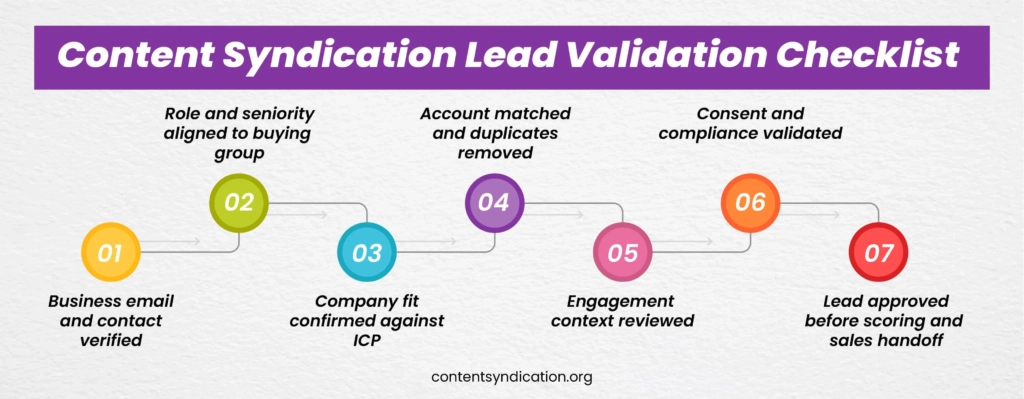
Below is the step-by-step content syndication lead validation checklist that high-performing B2B teams rely on. This checklist is created to be execution ready across multiple syndication partners and campaigns.
Step 1: Identity and Contact Verification
Every validation workflow begins with confirming whether the individual behind the submission is real and reachable.
- Validate business email domains, removing personal or disposable email addresses, and check for obvious syntax or formatting errors.
- Phone numbers, when collected, should be reviewed for country alignment and completeness.
This step prevents fake submissions and reduces wasted follow-up attempts.
Step 2: Role and Seniority Alignment
Once identity is confirmed, the next step evaluates whether the lead belongs to the intended buying group.
- Job title normalization helps map roles to standardized functions such as IT, security, finance, or operations.
- Seniority assessment determines whether the lead is an influencer, decision-maker, or practitioner.
This role and firmographic validation in content syndication ensures that leads align with how buying decisions are actually made.
Step 3: Company-Level Validation
Company-level validation verifies that the organization itself fits your ideal customer profile.
- Check employee count, revenue range, industry classification, and geographic location.
A mature content syndication lead validation checklist treats company fit as non-negotiable, ensuring that leads reflect target account strategy rather than broad market reach.
Step 4: Account Matching and Duplication Review
Leads should be matched against existing accounts within CRM and marketing automation platforms.
- Identify whether the lead belongs to an active opportunity, a previously disqualified account, or an already engaged buying group.
Effective duplication control within the content syndication lead validation checklist protects account-level context and avoids conflicting outreach.
Step 5: Engagement Context Review
Engagement context provides insight into why the lead engaged and what problem they may be exploring.
- Review the content asset consumed, the depth of interaction, and the timing of engagement.
This information strengthens interpretation and informs appropriate next steps.
Step 6: Data Accuracy and Hygiene Checks
Clean data enables reliable downstream execution.
- Apply content syndication data hygiene practices such as field normalization, country and state standardization, and removal of placeholder values.
As part of broader content syndication data validation, this ensures that lead records integrate cleanly into reporting, scoring, and routing systems.
Step 7: Compliance and Consent Verification
Validation must confirm that every lead meets regional privacy and consent requirements.
- Review opt-in language, timestamp records, and source attribution.
Content syndication compliance checks protect brand reputation while ensuring lawful follow-up across regions.
Step 8: Readiness Assessment Before Scoring
Before leads move into scoring models, validation is necessary.
- Confirm that minimum readiness criteria are met.
This step ensures that only leads passing the full content syndication lead validation checklist are evaluated for intent strength, improving scoring accuracy and predictability.
Lead Scoring After Validation
Validation and scoring serve different purposes validation ensures accuracy, while scoring determines readiness.
By validating first, scoring models become more predictive and reliable. This approach strengthens the overall content syndication lead validation for higher SQL rates by aligning behavioral signals with verified attributes.
Common Validation Mistakes to Avoid
Teams often make mistakes to speed up the process which should be avoid:
- Relying solely on volume-based KPIs
- Skipping firmographic checks
- Ignoring engagement context
- Passing unverified leads directly to sales
Avoiding these mistakes ensures that your content syndication lead validation checklist remains as a quality gate, not a formality.
Best Practices for Validating Content Syndication Leads
To maximize results, follow these best practices for validating content syndication leads:
- Treat validation as an operational system, not a one-time review
- Align validation criteria closely with sales qualification standards
- Standardize your content syndication lead validation checklist across all syndication partners
- Review validation outcomes alongside SQL conversion data
- Refine rules based on feedback from sales and revenue teams
A disciplined content syndication lead validation checklist strengthens trust between teams, improves efficiency, and creates consistency across campaigns.
FAQs
How to validate content syndication leads effectively?
Validation requires a structured checklist covering identity, role, company fit, engagement, and compliance.
How to improve lead quality in content syndication campaigns?
Improvement comes from applying consistent validation criteria before scoring or sales handoff.
How to reduce invalid leads from content syndication?
Clear validation rules, partner accountability, and data hygiene significantly reduce low-quality submissions.
What is the step-by-step content syndication lead validation checklist?
It is a sequential framework that verifies accuracy, relevance, compliance, and readiness before qualification.
Conclusion
Content syndication continues to play a central role in B2B demand generation strategies, but performance depends heavily on what happens after leads are captured.
Without a structured content syndication lead validation checklist, volume becomes noise and opportunity is lost in follow-up inefficiencies.
Organizations that invest in validation create a measurable advantage.
Clean, verified, and relevant leads move faster through scoring models, convert into higher-quality conversations, and generate stronger SQL outcomes. A well-executed content syndication lead validation checklist transforms content syndication from a volume-driven tactic into a predictable revenue contributor.