

If you’ve ever launched a syndication campaign that delivered volume but disappointed sales, this piece is for you.
A content syndication landing page sits at a critical intersection: it’s where borrowed attention from third ‑party platforms either becomes qualified demand or turns into low ‑intent noise.
Unlike inbound traffic, syndication audiences haven’t built trust with your brand yet. They’re exploring a topic, not shopping for a vendor. That gap between curiosity and commercial intent is where most programs fail.
The objective isn’t to maximize form fills, it’s to create a system that reliably produces sales ‑ready conversations.
What Makes Content Syndication Landing Pages Different
A landing page for a syndication campaign serves a fundamentally different role than an inbound page. Visitors did not search for your solution or navigate through your website. They clicked through from a trusted third-party‑ environment because the topic resonated.
A high performing‑ landing page must therefore accomplish three jobs very quickly:
- Re‑establish the context the visitor engaged with
- Reinforce relevance to a specific business problem
- Qualify intent before the lead enters your funnel
This distinction is central to content syndication landing page vs website landing page performance. Website pages invite exploration. Syndication pages validate fit and set expectations. When teams blur this line, lead quality suffers.
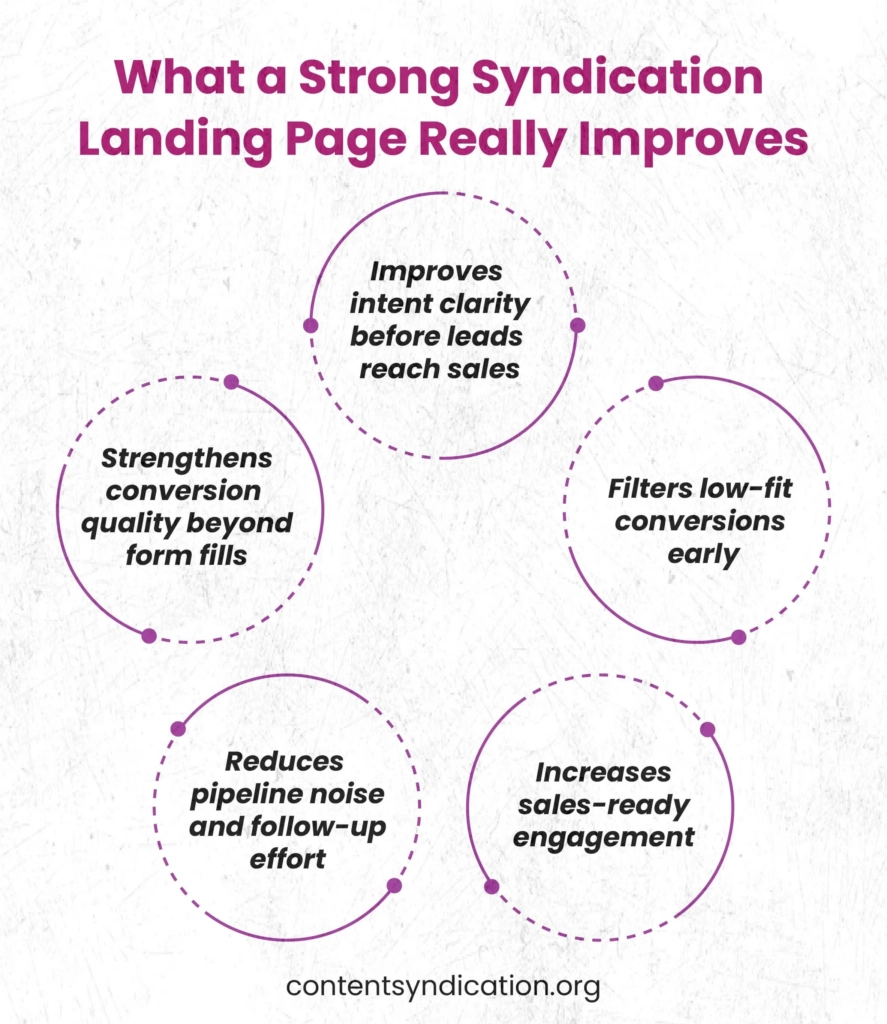
Landing Page Structure That Converts
Effective landing page for content syndication optimization starts with restraint. The page should feel intentional, focused, and free of distractions.
Core structural elements include:
- A headline that mirrors the publisher’s topic framing
- A sub headline‑ that clearly defines the target audience
- Three to five outcome oriented‑ bullets that set expectations
- Minimal or no navigation
- A single, unmistakable call to action
These elements align closely with B2B landing page best practices (syndication), where clarity consistently outperforms creativity. Every additional link, image, or message increases cognitive load and attracts unqualified clicks.
A well-structured‑ landing page does not try to impress. It tries to qualify.
Form Design: The Real Gatekeeper of Lead Quality
Forms are where syndication programs succeed or fail. Many teams default to short forms in the name of conversion, only to flood their CRM with low intent‑ leads.
When designing form fields for B2B lead gen landing pages, the goal is to capture signals that indicate readiness, not just identity. Fields should align directly with your ICP and buying committee criteria.
Best practices include:
- Prioritizing role, function, and company context
- Avoiding vanity fields that don’t inform qualification
- Using conditional logic where supported
If you are wondering about how many form fields you should put for B2B content syndication, a starting range of six to eight fields typically balances volume and quality. From there, optimization should be guided by downstream metrics, not raw conversion rate.
More mature programs adopt progressive profiling landing pages to distribute friction across multiple interactions while steadily improving lead depth.
Lead Quality Safeguards You Should Never Skip
Strong form design alone is not enough. Protecting lead quality in content syndication requires back-end safeguards that prevent obvious mismatches from entering the funnel.
Non‑negotiable safeguards include:
- Corporate email verification
- Geographic and company size filtering
- Job title and seniority alignment
- Suppression lists for students, agencies, and competitors
These measures have a direct impact on MQL quality from content syndication, reducing SDR rejection rates and restoring confidence in the channel.
A disciplined syndication landing page strategy prioritizes exclusion as much as inclusion.
Copy That Qualifies While It Converts
Syndication copy has a dual responsibility: it must persuade the right audience while discouraging the wrong one. Generic benefit driven‑ language attracts clicks but weakens intent.
High performing‑ copy:
- Clearly names the business problem being addressed
- Signals the maturity level required to benefit
- Specifies who the content is and is not for
This approach helps improve content syndication conversion rate while ensuring those conversions align with pipeline goals.
Every sentence on a landing page should act as a quiet filter, reinforcing relevance rather than chasing volume.
Trust Signals That Actually Work in Syndication
Because syndication audiences are encountering your brand for the first time, trust signals play a huge role in conversion decisions.
The most effective signals include:
- Credibility transfer from the publisher
- Recognizable customer or partner logos
- Specific, data backed‑ outcomes
- Analyst recognition or industry validation
Resist the urge to overload the page. One or two strong trust indicators outperform cluttered logo walls.
Strategic trust placement increases confidence without inflating unqualified conversions on your landing page.
Thank You‑ Page Optimization
The thank‑you page is often treated as an afterthought, but it represents a critical continuation of the experience.
An effective thank‑you page:
- Confirms access to the asset immediately
- Sets expectations for follow-up‑ communication
- Introduces a logical next step aligned with buyer stage
A strong syndication landing page template accounts for this moment, using it to guide nurture rather than introduce another hard gate.
Testing & Optimization Framework
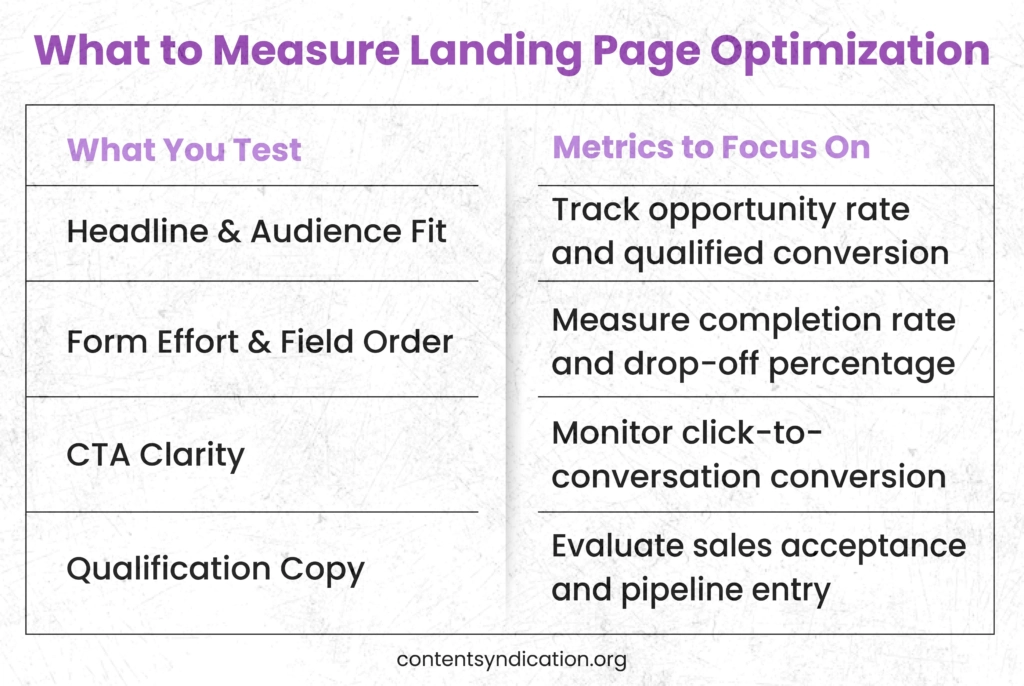
Optimization efforts should extend beyond surface level‑ metrics. Testing should focus on elements that influence intent quality and pipeline contribution.
Key variables to test include:
- Headline specificity and audience framing
- Field order and perceived effort
- CTA language clarity
- Qualification oriented ‑ copy
Success should be measured using sales acceptance, pipeline influence, and conversion velocity, the true indicators of syndication landing page optimization.
Reviewing credible syndication landing page examples in B2B can inform hypotheses, but direct copying rarely produces results.
Final Checklist
Before launching any content syndication landing page, confirm the following:
- ICP alignment is explicit
- Messaging mirrors publisher context
- Page structure is distraction free‑
- Forms capture intent, not just contact data
- Lead quality safeguards are active
- Copy qualifies as much as it persuades
- Trust signals are relevant and restrained
- Thank‑you experience supports the journey
This checklist ensures campaigns are designed for revenue contribution, not just lead volume.
Conclusion
Syndication success is rarely determined by the publisher alone. More often, it’s the result of how well your landing page bridges third-party‑ attention and internal revenue goals.
A thoughtfully designed content syndication landing page respects the buyer’s context, qualifies intent early, and protects sales trust downstream.
When teams apply the right structure, form strategy, safeguards, and copy, syndication stops being a volume play and becomes a predictable demand channel. The difference lies in discipline, not complexity. Build landing pages with intent in mind, and conversion and quality no longer compete they reinforce each other.