

Most B2B companies invest heavily in content – blogs, whitepapers, reports – but struggle to generate consistent, high-quality leads.
The problem isn’t content quality.
It’s distribution.
Even the best content fails if it never reaches the right audience.
That’s where B2B content syndication becomes a game-changer.
Instead of waiting for traffic, content syndication places your content directly in front of high-intent buyers across trusted platforms – helping you generate leads faster, more predictably, and at scale.
Why B2B Content Syndication Matters
In today’s B2B buying journey, decision-makers don’t rely on a single source.
They consume content across multiple platforms before engaging with a vendor.
If your content exists only on your website, you’re invisible in most of that journey.
Content syndication ensures your brand appears where your buyers are already researching – making your content work harder and reach further.
Key Benefits of B2B Content Syndication
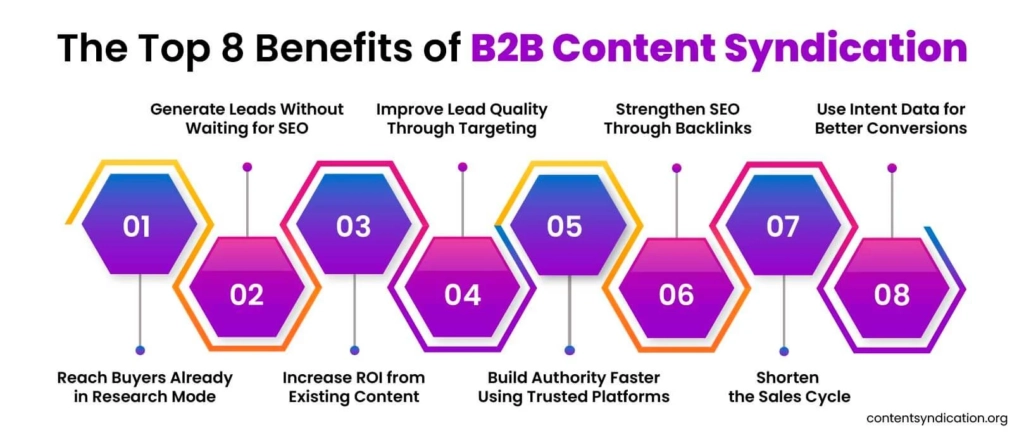
1. Reach Buyers Already in Research Mode
Most B2B buyers discover content on third-party platforms, not brand websites.
Syndication places your content in front of decision-makers actively evaluating solutions.
Example: A SaaS company syndicating a report on TechTarget reaches IT leaders already comparing vendors.
Result: Higher-intent traffic and better lead quality.
2. Generate Leads Without Waiting for SEO
SEO takes time. Paid ads require continuous spend.
Content syndication delivers immediate access to targeted audiences through publisher networks.
Result: Faster pipeline generation and predictable lead flow.
3. Increase ROI from Existing Content
Most content is underutilized after publishing.
Syndication turns one asset into multiple lead-generation opportunities across platforms.
Result: More output without increasing content production costs.
4. Improve Lead Quality Through Targeting
Unlike broad channels, syndication allows precise targeting:
- Job role
- Industry
- Company size
- Geography
- Buying intent
Result: Higher MQL-to-SQL conversion rates.
5. Build Authority Faster Using Trusted Platforms
Publishing on established platforms builds instant credibility.
Instead of building trust from scratch, you leverage the authority of trusted publishers.
Result: Stronger brand perception and faster trust building.
6. Strengthen SEO Through Backlinks
Content syndication can generate high-quality backlinks when implemented correctly.
Result: Improved domain authority and better organic rankings.
7. Shorten the Sales Cycle
When prospects consume your content before speaking with sales, they’re already informed.
Result: Faster decisions and reduced sales friction.
8. Use Intent Data for Better Conversions
Modern syndication platforms use intent signals to identify buyers researching specific solutions.
Result: Higher conversion rates and lower cost per lead.
9. Scale Lead Generation Efficiently
Syndication campaigns can scale across regions and audiences without creating new content.
Result: Consistent pipeline growth without proportional effort.
How B2B Content Syndication Drives Pipeline
Content syndication is not just a top-of-funnel activity — it directly impacts revenue when executed correctly.
Here’s the real flow:
- Content is distributed through publisher networks
- Targeted audiences receive the content
- Users access gated assets and submit details
- Leads are qualified based on ICP criteria
- Sales teams nurture and convert them
Result: A predictable, scalable lead generation engine.
B2B Content Syndication Benchmarks (2026)
Based on campaign data and industry benchmarks:
- Cost per Lead (CPL): $45–$90
- Lead Acceptance Rate: 80–95%
- MQL → SQL Conversion: 20–35%
- Pipeline Contribution: 10–25%
These metrics show why content syndication is widely used for predictable lead generation.
When Should You Use Content Syndication?
Content syndication works best when:
- You already have high-quality assets (whitepapers, case studies, reports)
- Your audience is niche and hard to reach organically
- You need faster pipeline compared to SEO timelines
- Your sales team requires a consistent flow of leads
Simple rule:
- SEO → long-term growth
- Content Syndication → immediate pipeline
Performance Metrics to Track
- Cost per Lead (CPL)
- Lead Quality (ICP match)
- MQL to SQL Conversion Rate
- Pipeline Contribution
Tracking these ensures your campaigns stay profitable and scalable.
Frequently Asked Questions
1. What are the benefits of B2B content syndication?
B2B content syndication helps increase brand visibility, generate high-quality leads, improve SEO through backlinks, and maximize the ROI of existing content. It also enables targeted outreach to decision-makers and supports scalable lead generation.
2. How does content syndication generate leads?
Content syndication distributes gated content such as whitepapers or reports through publisher networks. Users submit their details to access the content, which converts them into qualified leads that can be nurtured by sales teams.
3. Is B2B content syndication better than SEO?
Content syndication and SEO serve different purposes. SEO is ideal for long-term organic growth, while content syndication is better for generating immediate and scalable leads. The best strategy combines both.
4. What types of content work best for syndication?
High-value, educational content performs best, including:
– Whitepapers
– eBooks
– Case studies
– Research reports
– Webinars
Content that solves specific problems or provides insights tends to generate more engagement and leads.
5. Can content syndication improve lead quality?
Yes. Content syndication platforms allow precise targeting based on job role, industry, company size, and intent signals. This ensures your content reaches relevant decision-makers instead of a broad audience.
6.What is the average cost per lead in content syndication?
The average cost per lead (CPL) typically ranges between $45 and $90, depending on targeting criteria, industry, and campaign quality.
7. How do you measure the success of content syndication?
Success is measured using key metrics such as:
– Cost per Lead (CPL)
– Lead acceptance rate
– MQL to SQL conversion rate
– Pipeline contribution
These metrics help evaluate both lead quality and ROI.
8. What are common mistakes in content syndication?
Common mistakes include:
– Using overly promotional content
– Targeting the wrong audience
– Choosing low-quality syndication partners
– Not tracking campaign performance
– Failing to follow up on leads
Avoiding these improves overall campaign effectiveness.
Final Thoughts
Content syndication is not just about visibility – it’s about generating measurable business results.
When done right, it transforms your content from a passive asset into an active pipeline engine.
Read the complete B2B Content Syndication Guide to generate high-quality B2B leads