
Content syndication has matured. Most B2B teams no longer question whether it works, but many still struggle with what happens next. The real performance gap today is not lead volume, CPL, or distribution reach. It’s how sales teams follow up after content syndication.
Unlike inbound leads, syndicated leads don’t raise their hand asking for a demo. They opt into content across trusted third‑party platforms. That single difference changes everything about how sales should respond. When syndicated leads are treated like inbound or cold outbound, momentum is lost before a real conversation ever begins.
This guide lays out a practical, repeatable approach to following up on syndicated leads, helping revenue teams move from downloads to discussions and from discussions to SQLs.
Why Content Syndication Leads Need a Different Follow-Up Approach
Content syndication lives between inbound and outbound, which is why it’s so often mishandled.
Leads from syndicated usually:
- Show topic-level intent, not purchase intent
- Recognize the publisher before they recognize your brand
- Sit earlier in the buying journey, but with higher awareness than cold prospects
What this means in practice is simple: these buyers are learning, not shopping. They are forming opinions, not vendor lists. Treating them like demo-ready inbound leads creates pressure. Treating them like cold outbound ignores the context they’ve already given you.
This is why a dedicated syndicated lead follow-up process is essential. The goal is to continue the learning journey, not interrupt it. Sales must show relevance before requesting commitment.
The Ideal Sales Follow-Up Process After Content Syndication
From a sales perspective, syndicated leads move through a very different conversion funnel. Understanding this journey is critical before outreach begins.
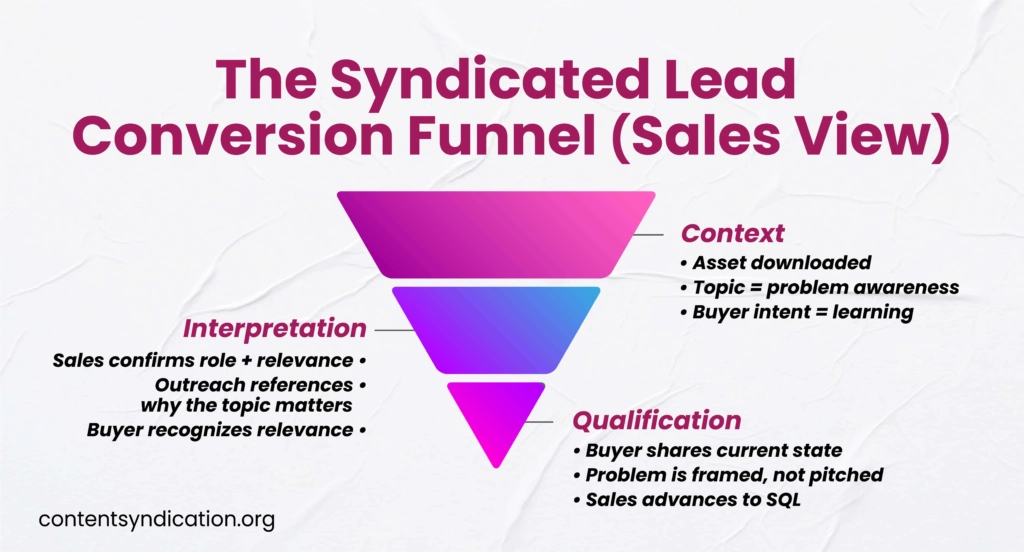
High-performing teams treat follow-up after content syndication as a system, not a one-time activity. The most effective approach follows three deliberate phases.
1. Validation
Before outreach begins, sales should validate fit and context. This includes role alignment, company size, industry relevance, and how closely the consumed content maps to your solution area. This step prevents wasted outreach and improves conversation quality.
2. Contextual Outreach
Every first touch should anchor itself in the content interaction. Referencing the topic, challenge, or theme demonstrates relevance and signals that the outreach is intentional.
3. Progressive Conversion
The objective is not immediate qualification. It is momentum. Effective syndicated lead follow-up gradually advances prospects from awareness to conversation to SQL readiness.
Together, these phases create a predictable sales handoff after content syndcation where marketing delivers educated interest and sales develops buying clarity.
When Should Sales Follow Up?
Speed matters, but precision matters more.
Most successful teams initiate follow-up on syndicated leads within 24–48 hours. This window keeps the content interaction fresh while allowing time for light personalization.
Follow up too late, and the context fades. Follow up too fast, and the outreach feels automated.
Understanding how fast should sales follow up on syndicated leads is less about racing competitors and more about respecting buyer psychology.
Sales Follow-Up Plan (Day 0–Day 14)
A structured plan ensures consistency without pressure. Below is a proven framework for following up on syndicated leads:
- Day 0–1: Personalized email referencing the asset and core challenge.
- Day 3: Light call or voicemail reinforcing relevance.
- Day 5: Value‑driven follow-up email offering a new perspective.
- Day 7: LinkedIn engagement (profile view or connection).
- Day 10: Call with role‑specific insight.
- Day 14: Respectful close‑the‑loop message.
This framework supports consistent sales outreach for syndicated leads while avoiding over‑communication or pressure on the lead.
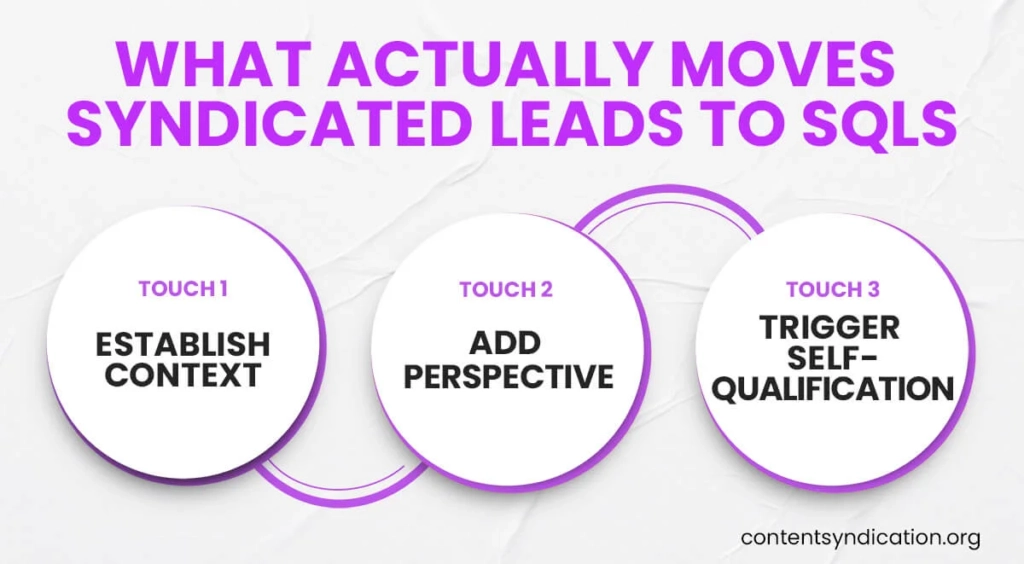
Messaging That Converts Syndicated Leads
Messaging should never assume urgency. It should assume curiosity.
Effective sales messaging for content syndication leads does three things well:
- Acknowledges the specific content interaction
- Builds on the topic with an additional insight
- Invites a conversation, not a commitment
Strong syndicated lead follow-up feels helpful, relevant, and informed-not promotional.
Sales Email & Call Framework
Rigid sales scripts fail in complex content syndication B2B environments. Instead, top teams rely on a flexible framework:
- Context: Why you’re reaching out now
- Relevance: Why the topic matters to their role or industry
- Insight: One pattern, observation, or lesson
- Next Step: A low‑pressure invitation to talk
For example,
“Hi (Name),
You recently downloaded our white paper, “Name of White Paper,” from one of our media partner platforms. We hope you found it insightful.
We’re reaching out to see:
- If you have any questions regarding the (white paper topic) that we can help answer.
- If there’s anything we can do to assist you with your (topic-related) challenges.
Please don’t hesitate to reach out, we’re happy to help.”
This approach scales far better than static sales email templates used for syndicated leads and enables personalization without reinventing the wheel.
Common Sales Follow-Up Mistakes to Avoid
Most breakdowns in syndicated lead follow-up come from repeatable mistakes:
- Treating syndicated leads like inbound demo requests
- Ignoring the asset or topic that triggered the lead
- Leading with product features instead of insight
- Over‑contacting in the first week
These content syndication lead follow-up mistakes reduce trust and stall engagement before qualification begins.
Aligning Sales & Marketing for Better Follow-Up
Strong sales and marketing alignment for syndicated leads starts before the campaign launches.
This alignment requires:
- Shared definitions of MQL and SQL
- Clear documentation of content themes and targeting logic
- Agreed SLAs and messaging expectations
When alignment exists, syndicated lead follow-up becomes predictable, measurable, and scalable.
Measuring Follow-Up Success Beyond Opens & Replies
Surface-level metrics rarely tell the full story. Real performance shows up in:
- Lead‑to‑conversation rate
- Conversation‑to‑meeting rate
- Time‑to‑first‑conversation
- SQL conversion rate
These indicators reveal how to convert content syndication leads into SQLs far more accurately than opens or replies alone.
FAQs
1. How sales teams should follow up on content syndication leads?
Sales teams should continue the education journey using relevant, insight-led outreach that builds on the original content interaction.
2. What is the best follow-up timing for syndicated leads?
The best time to follow up for syndication leads is within 24–48 hours, while context and recall are still high.
3. Is there a step-by-step content syndication lead validation checklist?
Following is the step-by-step content syndication lead validation checklist:
- Confirm role fit
- Account fit
- Content relevance
- Engagement context
4. What is the best sales follow-up strategy for B2B content syndication?
The best sales follow-up strategy is one that prioritizes value and insight with qualification.
5. How should SDRs approach early conversations with content syndication leads?
SDRs should lead with context and education, using the content interaction as an entry point.
Follow-Up Is Where Content Syndication Wins or Fails
Content syndication creates opportunity but follow-up determines impact.
When sales follow-up for content syndication leads is intentional, timely, and rooted in context, it transforms early interest into real sales conversations.
Teams that treat follow-up as a discipline, will see stronger engagement, higher SQL conversion, and more predictable pipeline. In content syndication, distribution gets attention but follow-up is where revenue is actually won.