
The modern B2B buyer is everywhere – and nowhere predictable.
They skim LinkedIn in the morning, browse industry blogs during lunch, compare tools on G2 at night, and follow communities on Slack, Reddit. They watch YouTube explainers, join webinars, read analyst reports, and review newsletters.
This fragmented and non-linear journey has redefined how brands must distribute content.
In 2026, your success doesn’t depend on producing more content; it depends on delivering it across multiple channels in formats that match buyer behavior.
This is where multi-channel content syndication – and the growing importance of multi channel content delivery – become essential.
This guide breaks down what it is, why it’s crucial, and how to implement a winning multi-channel content syndication strategy that consistently drives MQLs, SQLs, and pipeline.
What Is Multi-Channel Content Syndication?
Multi-channel content syndication is the strategic distribution of your content across multiple trusted B2B platforms to increase reach, intent, and conversions.
Unlike generic multi-channel marketing, this approach prioritizes:
- Lead generation
- Intent activation
- Account reach & expansion
- Sales pipeline creation
- Multi-touch influence
- Precise ICP targeting
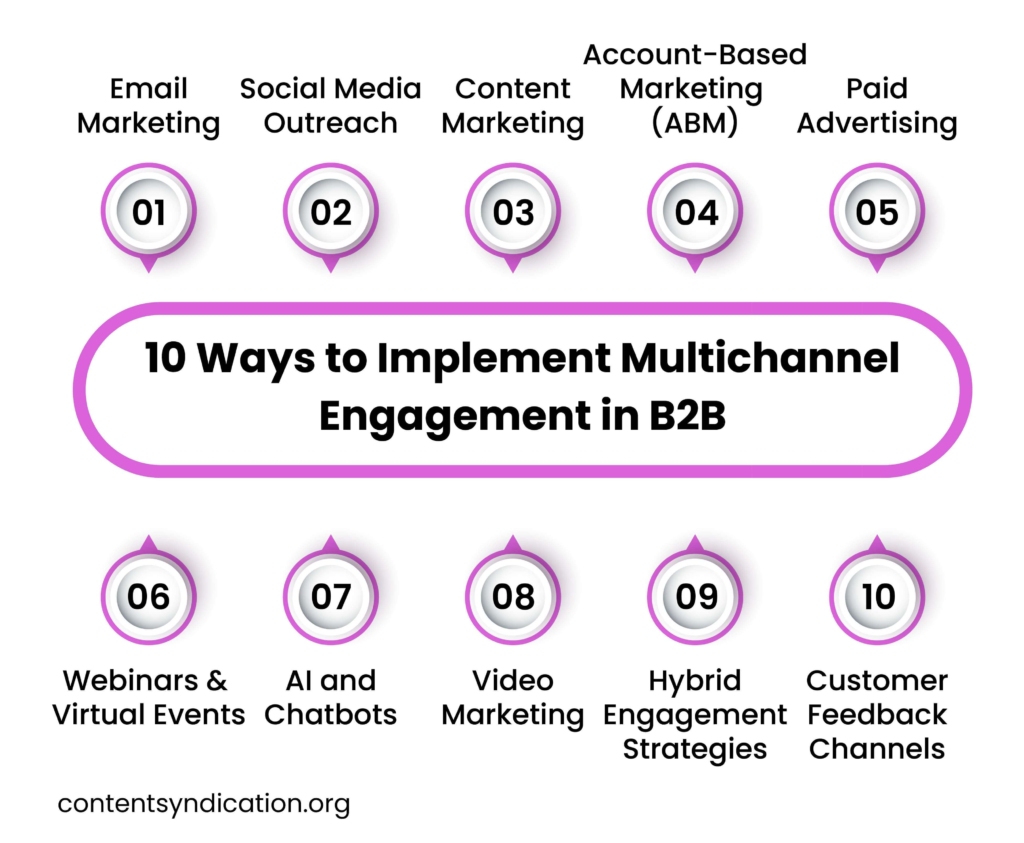
It includes channels like:
Top Multi-Channel Syndication Platforms
- B2B publisher networks: TechTarget, NetLine, DemandScience
- Email syndication: Opt-in databases, gated asset newsletters
- Programmatic & native ads: Taboola, Outbrain
- LinkedIn amplification: Lead Gen Forms, carousels, sponsored posts
- ABM networks: Vertical-specific partner platforms
- Review portals: G2, TrustRadius
- Communities: Reddit, Slack groups, Quora
- Industry newsletters
- Media partner sites
Primary Goal:
Deliver the right content to the right ICP, across every channel they trust.
Why Multi-Channel Syndication Is Non-Negotiable in 2026
1. B2B buyers require 27–35 touchpoints
A single channel cannot build trust or momentum.
Multi-channel syndication adds frequency + relevance across the entire journey.
2. Audience fragmentation is at an all-time high
Buyers move between:
- Publisher sites
- Review platforms
- Communities
- YouTube
- Webinars
- Analyst reports
You must show up everywhere they make decisions.
3. Lead quality improves dramatically
Multi-channel buyers deliver:
- 30–45% higher MQL → SQL conversion
- 25% better lead scoring accuracy
- Lower CPL over time
- Higher account match-rates
Because repeated exposure produces stronger intent signals.
4. Multi-channel = higher revenue
Brands using 3+ channels see:
- 14.6% sales uplift
- 23% better deal closure
- 34% stronger trust perception
5. Reduces dependence on a single platform
Relying on only LinkedIn, only email, or only publishers is risky.
Multi-channel distribution creates a stable, predictable, scalable pipeline.
The Multi-Channel Syndication Framework
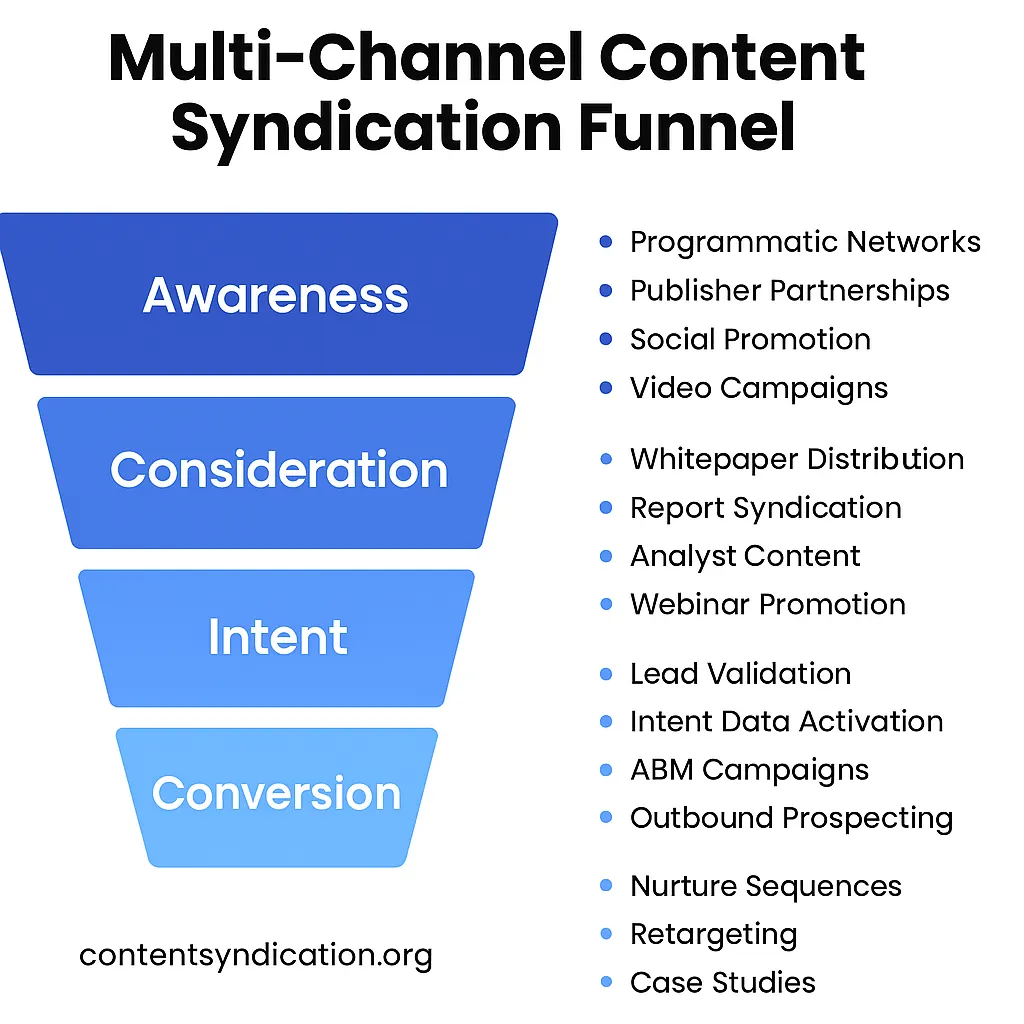
A modern 4-stage architecture for distributing content across the buyer’s journey.
Stage 1 – Awareness
Purpose: Introduce the problem
Channels:
- Programmatic
- Native ads
- YouTube
- Social amplification
Stage 2 – Consideration
Purpose: Educate & influence
Channels:
- Whitepapers
- Industry newsletters
- Analyst reports
- Publisher placements
Stage 3 – Intent Activation
Purpose: Capture demand
Channels:
- Lead-gen partner networks
- Intent data platforms
- ABM outreach
- Retargeting
Stage 4 – Conversion
Purpose: Drive opportunities
Channels:
- Nurture sequences
- Case studies
- Demo sequences
- Sales engagement
- Retargeting
Multi-Channel Content Delivery (A Critical Factor)
This is the execution layer of syndication.
Multi channel content delivery means tailoring how content is served on each platform so buyers actually engage.
For example:
- Email: Short CTA + landing page
- LinkedIn: Carousel + clip + thought leadership post
- Publisher networks: Sponsored content format
- Native ads: Article-style teaser
- Communities: Value-first summaries
- ABM platforms: Personalized content per account
This is where most B2B companies fail
They push the SAME PDF everywhere.
Multi channel content delivery fixes this by aligning:
✔ Format
✔ Context
✔ Consumption style
✔ Buyer behavior
This leads to:
- Higher engagement
- Lower drop-off
- Better intent signals
- More conversions
How Multi-Channel Syndication Works (Step-by-Step Blueprint)
Step 1: Identify ICP + Intent Signals
Define:
- Job roles
- Industry
- Company size
- Tech stack
- Pain points
- Buying stage
- Signal behavior (page visits, comparisons, intent topics)
Step 2: Choose the Right Channel Mix
| Channel | Purpose |
|---|---|
| Email Syndication | Fast lead generation |
| Native Ads | Awareness + high-volume traffic |
| Branding, authority & thought leadership | |
| B2B Publishers | High-quality, validated leads |
| Communities | Trust-building & dark-funnel influence |
| ABM | Hyper-targeted, 1:1 account outreach |
Step 3: Repurpose Content for Each Channel
One asset → multiple delivery formats:
- Whitepaper → infographic
- Webinar → LinkedIn clips
- Blog → carousel
- Report → email teaser
- Guide → Reddit summary
- Case study → testimonial snippets
This is multi channel content delivery in action.
Step 4: Launch Across 3-6 Channels Simultaneously
This drives:
- Omnipresence
- Frequent touchpoints
- Faster funnel movement
Step 5: Lead Delivery + Validation
Validate:
- Email accuracy
- Domain validity
- Job title match
- Firmographics
- ICP match
- Duplicates
- Bot/spam filtering
Step 6: Nurture + Score + Accelerate
Track:
- Engagement signals
- Scroll depth
- LinkedIn interactions
- Repeat visits
- Multi-touch patterns
This boosts SQL conversion.
Channel-by-Channel Performance Breakdown (2026)
1. Email Syndication
Best for: Fast lead-gen
Metrics: OR 22–35%, CTR 1.2–2.8%
2. Publisher Networks
(TechTarget, NetLine, DemandScience)
Best for: High-intent MQLs
SQL conversion: 18–30%
3. Native & Programmatic Ads
Best for: Awareness at scale
CPC: Low
Reach: High
4. LinkedIn (Paid + Organic)
Best for: C-suite impact & authority
Formats: Carousels, Lead Gen Forms, video
5. ABM Networks
Best for: Enterprise targeting & 1:1 personalization
6. Communities
Best for: Dark funnel influence
Examples: Reddit, Slack, WhatsApp
How to Measure Multi-Channel Syndication Success
1. AI-Driven Personalization
Predictive channel mapping + automated repurposing.
2. First-Party Data Dominance
Your CRM becomes the new targeting engine.
3. Video-Led Syndication
Short-form + webinar clips dominate reach.
4. Interactive Content Growth
Quizzes, calculators, configurators.
5. Retention-Focused Syndication
Not just for acquiring leads – for nurturing customers.
Conclusion: Multi-Channel Syndication Isn’t Optional Anymore
In 2026, only one strategy stands strong:
Be everywhere your ideal buyers are – consistently and contextually.
Multi-channel content syndication helps you:
- Reach fragmented audiences
- Build trust faster
- Generate high-quality leads
- Accelerate pipeline
- Grow revenue predictably
With multi channel content delivery, you transform every asset into a multi-format engine that drives influence from discovery → decision → conversion.
This is the future of B2B marketing – full-funnel, multi-channel, always-on syndication.
Frequently Asked Questions (FAQs)
1. What is multi-channel content syndication?
Multi-channel content syndication is the practice of distributing your marketing content-such as eBooks, blogs, videos, whitepapers, and reports-across multiple trusted B2B platforms to increase visibility, engagement, and conversions.
Instead of relying on one channel (e.g., LinkedIn only), you deliver content across:
- Email databases
- B2B publisher networks
- Native ads
- Review platforms
- Communities
- Social platforms
- ABM partner networks
This ensures your ICP (Ideal Customer Profile) discovers your content wherever they spend time.
2. How is multi-channel syndication different from single-channel syndication?
Single-channel syndication means you rely on just ONE channel-for example, only LinkedIn, only email, or only Outbrain.
Multi-channel syndication uses 3-10+ platforms simultaneously, ensuring:
- Wider reach
- Repeated touchpoints
- Better brand recall
- Higher-quality leads
- Reduced dependency on any one channel
In 2025, multi-channel syndication significantly outperforms single-channel efforts because buyers are highly fragmented.
3. Why is multi-channel syndication important in 2026?
Because:
- B2B buyers are scattered across platforms (LinkedIn, G2, email, newsletters, communities).
- It now takes 27–35 touchpoints before a buyer converts.
- Single-channel strategies fail to build consistent awareness.
- Competition is higher and buyers trust multiple sources before deciding.
- AI-driven personalization requires multi-channel data signals.
Simply put → brands that appear across multiple channels win visibility, intent, and pipeline.
4. Which platforms are best for multi-channel syndication?
The best-performing channels in B2B are:
- LinkedIn – decision-maker reach
- Email syndication – fast lead-generation
- B2B publisher networks (TechTarget, NetLine, DemandScience)
- Native ads (Taboola, Outbrain)
- Communities (Slack, Discord, Reddit, WhatsApp groups)
- Review platforms (G2, TrustRadius)
- Industry newsletters
- ABM platforms for 1:1 enterprise targeting
Choose channels based on where your ICP consumes content.
5. What types of content should I syndicate across multiple channels?
High-performing syndicated content includes:
- Whitepapers and eBooks
- Industry reports
- Case studies
- Webinars and on-demand videos
- How-to guides
- Solution briefs
- Infographics
- Blog posts
- Checklists and templates
Each channel needs the same content in different formats-this is called multi channel content delivery, which improves performance.
6. How do I measure the effectiveness of multi-channel syndication?
Track these KPIs:
- MQLs generated
- SQL conversion rate
- Cost per lead (CPL)
- Cost per acquisition (CPA)
- Engagement rate (CTR, time on page, downloads)
- Pipeline generated
- Multi-touch attribution influence
- Account match-rate
- Lead validation quality
Success = not just leads → leads that convert into revenue.
7. What role does AI play in multi-channel syndication?
AI accelerates syndication by:
- Predicting which channels your ICP will engage on
- Personalizing content formats for each platform
- Automating repurposing (text → video → carousel)
- Optimizing delivery times
- Scoring leads using behavioral signals
- Identifying high-intent prospects earlier
- Improving validation and routing
AI is now the backbone of content delivery automation.
8. Can small B2B businesses benefit from multi-channel syndication?
Absolutely.
Even with low budgets, small B2B companies can start with:
- LinkedIn organic + paid
- Email newsletters
- Native ads with small spends
- Community engagement
- Posting on Medium, Reddit, Quora
- Niche industry directories
You don’t need huge budgets-you need the right channel mix and consistent delivery.
9. Is content syndication only for lead generation?
Not anymore.
Modern syndication supports the entire B2B funnel:
- Top of Funnel: Awareness + reach
- Mid-Funnel: Education + trust building
- Bottom of Funnel: Intent activation + conversion
- Post-Purchase: Onboarding, retention, upsell
Syndication is becoming a full-funnel growth engine, not just a lead-gen tactic.