
Most marketers invest heavily in content syndication — but what many forget is to measure its effectiveness.
Then comes the frustration: “Why isn’t it delivering ROI?”
The smarter approach is to track what truly moves the needle. Without metrics, you’ll never know which campaigns are working, where your audience is engaging, or which channels are driving high-value results.
The intent is simple – distribute your strongest assets to the right audience, fuel engagement, and drive meaningful traffic that converts.
In this guide, we’ll walk through the most important content syndication metrics every marketer should track and how each one connects directly to ROI.
Why Tracking Content Syndication Metrics Matters
Tracking content syndication metrics isn’t just about measuring ROI – it’s about maximizing every touchpoint of your campaign’s impact.
When you monitor performance data, you unlock insights that show what’s working, what’s wasting budget, and where to optimize next.
For instance, analyzing how leads engage with your syndicated assets across multiple channels reveals which topics and formats actually drive meaningful conversations – not just clicks. It tells you which campaigns attract high-intent prospects and which ones fall flat.
The same analysis helps you identify the platforms and content formats that resonate most with your target decision-makers – so you can double down on high-performing distribution partners and phase out low-return ones.
In short, tracking metrics turns content syndication from a guesswork exercise into a data-driven growth engine for your marketing pipeline.
Why Content Syndication Metrics Are Crucial:
Metrics aren’t just vanity numbers – they’re your campaign’s compass.
Validate success: Track whether your syndicated content genuinely influences awareness and pipeline growth.
Optimize performance: Use engagement data and partner analytics to re-allocate spend toward channels delivering higher ROI.
Drive alignment: Syndication metrics connect marketing activity directly with business outcomes like lead velocity, brand recall, and revenue impact.
For instance, if your gated whitepaper sees high CTR but a weak conversion rate, that’s a sign to refine your landing page or offer. Similarly, monitoring metrics such as viewer retention and average session duration reveals how well your content resonates with your ideal audience.
Key Content Syndication Metrics to Track
To make your campaigns more effective, focus on the following key content syndication metrics that reveal both visibility and conversion potential.
1. Impressions
Why It Matters:
Impressions show how often your syndicated content is displayed across partner websites, newsletters, or platforms. It helps gauge your brand visibility and the overall reach of your campaign.
A high impression count signals that your content distribution network is working – but remember, visibility alone doesn’t guarantee engagement.
Stat Insight:
According to the Demand Metric Report, marketers witness up to a 55% increase in brand awareness through content syndication.
How to Track:
- Review analytics from syndication platforms (like NetLine, Outbrain, Taboola, or partner dashboards).
- Track impressions at the campaign level to identify which partner or content type delivers the widest reach.
- Combine this with CTR data to distinguish between visibility and interest.
Pro Tip:
Pair impressions with click-through and engagement metrics to avoid falling into the “vanity metric trap.” The goal isn’t just to be seen – it’s to be remembered.
2. Click-Through Rates (CTR)
Why It Matters:
CTR measures how many users clicked on your syndicated content after seeing it – a direct reflection of audience interest and content relevance.
A high CTR means your titles, visuals, and placement are resonating with the right audience, while a low CTR can indicate weak messaging or poor targeting.
Stat Insight:
The average CTR for B2B syndicated content is 2.46%. (Source: Only-B2B Blog)
Top-performing campaigns often cross the 3% mark when backed by personalized messaging and precise targeting.
How to Track:
If your CTR is low despite high impressions, tweak your headline hooks, thumbnails, or audience targeting. Small creative changes can boost CTR dramatically.
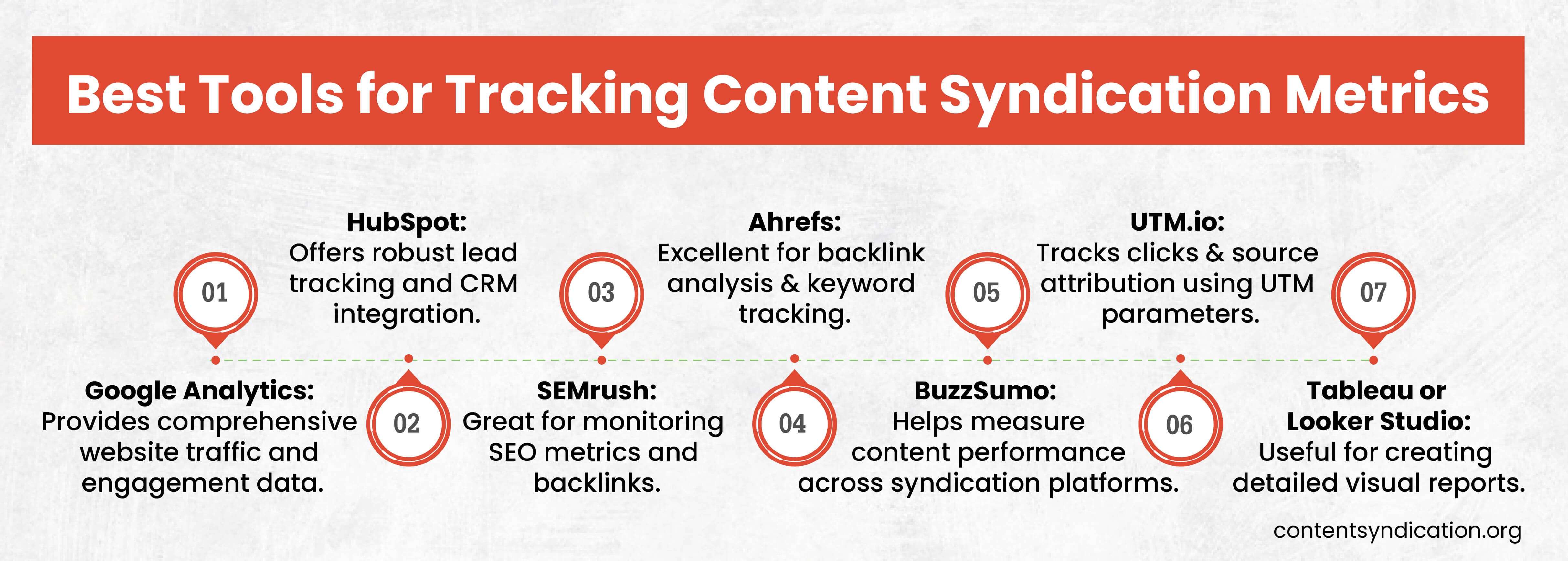
- Use syndication platform analytics or tools like UTM parameters, Google Analytics, and HubSpot to monitor link performance.
- Segment CTRs by content type (eBook, blog, infographic) and distribution partner to identify which assets and platforms yield the best engagement.
- Compare CTR trends over time to evaluate if new creative or messaging strategies are improving audience responsiveness.
Pro Tip:
If your CTR is low despite high impressions, tweak your headline hooks, thumbnails, or audience targeting. Small creative changes can boost CTR dramatically.
3. Traffic Metrics
Why It Matters:
Traffic metrics help you understand whether your syndicated content is successfully driving qualified visitors to your website or landing pages.
They show not just volume, but also the quality of that traffic – i.e., are users spending time, exploring multiple pages, and taking desired actions?
A steady rise in referral traffic from syndication partners signals that your distribution strategy is working. Conversely, if traffic increases but engagement or conversions don’t, you may need to revisit content relevance or audience targeting.
Stat Insight:
According to Forrester Research, businesses experience up to a 50% increase in quality traffic through effective content syndication programs.
How to Track:
- Use Google Analytics (or GA4) to track Referral Traffic and UTM-tagged URLs from your syndication partners.
- Analyze key engagement metrics like Average Session Duration, Bounce Rate, and Pages per Session to evaluate visitor quality.
- Use filters or custom segments to isolate traffic from syndication channels and compare it with organic and paid traffic sources.
Pro Tip:
If your syndicated traffic volume is high but session duration is low, revisit your landing page messaging or CTA alignment. The problem often lies not in traffic quantity – but in message mismatch.
4. Engagement Metrics
Why It Matters:
Engagement metrics measure how deeply your audience interacts with your syndicated content after clicking through. These include time on page, bounce rate, and pages per session — all of which reveal how relevant, valuable, and compelling your content truly is.
High engagement signals that your syndicated assets are connecting with the right audience, while low engagement often points to weak content alignment or poor landing-page experience.
Stat Insight:
According to Gartner, tracking and optimizing engagement metrics can double the overall effectiveness of your content syndication efforts.
How to Track:
- Use analytics tools such as Google Analytics (GA4) or HubSpot to monitor user behavior after visitors arrive from syndicated channels.
- Track average session duration to evaluate content depth, and bounce rate to detect early exits.
- Compare engagement rates across syndication partners and content formats to determine which ones keep users exploring longer.
- Use heatmaps or scroll-depth tracking (Hotjar, Microsoft Clarity) to understand which sections of your content truly hold attention.
Pro Tip:
If engagement drops despite high CTR, the issue isn’t visibility – it’s relevance. Try improving content flow, visual hierarchy, and CTA placement to keep readers hooked.
5. Conversion Metrics
Why It Matters:
Conversion metrics measure how effectively your syndicated content drives meaningful actions — like form fills, demo requests, eBook downloads, or newsletter sign-ups.
They directly reflect the business impact of your syndication efforts by showing how well awareness is turning into measurable pipeline opportunities.
High conversion rates signal that your message, audience targeting, and landing page experience are all in sync.
Stat Insight:
According to HubSpot’s 2025 Marketing Report, top-performing B2B syndication campaigns achieve conversion rates exceeding 10%.
This means that even modest improvements in conversion rate can yield exponential ROI when scaled across multiple distribution partners.
How to Track:
- Use Google Tag Manager and Google Analytics (GA4) to set up event tracking for conversions such as downloads, form submissions, or CTA clicks.
- Map your conversions within your CRM (HubSpot, Salesforce) to connect leads directly to the syndication source.
- Evaluate conversion-to-lead and lead-to-MQL ratios to measure post-click performance quality.
- Continuously A/B test landing page headlines, CTAs, and form length to improve your conversion rate over time.
Pro Tip:
If your conversion rate is low despite strong engagement, optimize your form experience and CTA clarity. Often, small tweaks like reducing form fields or offering clearer value propositions can boost conversions by 20–30%.
6. Syndicated Content ROI
Why It Matters:
Measuring ROI is the single most reliable way to understand the financial performance of your content syndication strategy.
It shows whether the time, budget, and distribution efforts invested in syndication are actually generating measurable returns – in the form of leads, pipeline, or revenue.
Without ROI tracking, you might continue spending on channels that don’t convert, while missing opportunities to scale the ones that do.
Stat Insight:
According to Forbes Advisor, 74% of companies say that content marketing (including syndication) significantly improves ROI when measured and optimized correctly.
How to Measure:
- Combine ROI analysis with lead quality and conversion metrics to identify your most profitable syndication sources.
- Calculate ROI using this simple formula:
ROI = (Revenue from Syndicated Content – Total Syndication Cost) ÷ Total Syndication Cost × 100 - Include all syndication costs such as platform fees, creative costs, and partner commissions.
- Track revenue attribution inside your CRM (HubSpot, Salesforce, or Zoho) to see which campaigns contribute directly to closed deals.
Pro Tip:
Don’t just stop at campaign-level ROI – map it to pipeline stages. When you can prove which syndicated assets move leads from MQL → SQL → Opportunity, that’s where true ROI visibility emerges.
7. Audience Insights and Demographics
Why It Matters:
Understanding your audience’s demographics and behavioral patterns helps you refine targeting, personalize messaging, and improve campaign performance.
When you know who is engaging with your syndicated content – their industry, job title, company size, and region – you can tailor future campaigns to reach the right buyers more effectively.
Accurate audience insights ensure that every piece of syndicated content resonates with decision-makers instead of being wasted on irrelevant audiences
Stat Insight:
Forrester reports that marketers leveraging demographic and behavioral insights see a 70% improvement in targeting accuracy and a higher conversion rate across all paid and earned channels.
How to Track:
- Use analytics tools such as Google Analytics, HubSpot, and LinkedIn Campaign Manager to track audience demographics (age, geography, company size, and interests).
- Analyze content engagement by persona or vertical to understand which segments interact most with your syndicated assets.
- Integrate these insights with your CRM or marketing automation platform to fine-tune lead-nurturing flows and messaging.
- Continuously compare demographic data from syndication partners to identify the most valuable audience pools.
Pro Tip:
If your content is reaching a large audience but generating few qualified leads, revisit your targeting filters and topic alignment. Focusing on buyer-intent keywords and persona-specific content usually delivers higher ROI.
Must Read:
Critical B2B Content Syndication Mistakes Marketers Should Avoid!
How to Use Syndication Metrics Effectively
Metrics are only as powerful as the decisions they inspire.
Here’s how to interpret and apply them strategically for maximum impact:
1. Set Clear Objectives
Before launching or measuring any campaign, define SMART goals — Specific, Measurable, Achievable, Relevant, and Time-bound.
Clarity in objectives ensures you know what success looks like and which metrics truly matter.
- For lead generation, focus on MQLs (Marketing-Qualified Leads), SQLs (Sales-Qualified Leads), and Cost per Lead (CPL).
- For engagement, emphasize CTR, bounce rate, and average time on page.
2. Align Metrics with Campaign Goals
Every metric tells a different story – but not every story supports your business goals.
Tie each metric directly to a desired outcome:
- Top-funnel: Impressions & CTR show awareness.
- Mid-funnel: Engagement & traffic metrics reveal content relevance.
- Bottom-funnel: Conversion & ROI confirm revenue impact.
3. Implement UTM Parameters
UTM tracking helps you trace exactly where your traffic and conversions originate.
Use consistent UTM tagging across platforms for precise attribution.
utm_source=LinkedIn&utm_medium=content_syndication&utm_campaign=ABM_Q1_2025
- ✅ utm_source → identifies the syndication partner or platform.
- ✅ utm_medium → indicates the content type (eBook, blog, webinar, etc.).
- ✅ utm_campaign → specifies the campaign or objective.