
However, many B2B marketers struggle with one critical challenge – choosing the right vendor.
The wrong content syndication partner can result in low-quality leads, wasted budget, and poor campaign performance, while the right one can significantly improve pipeline and ROI.
In this guide, we compare the top B2B content syndication vendors based on lead quality, pricing, and use cases – so you can choose the best partner for your business.
Looking for quick comparison? See the table below.
How to Use This B2B Content Syndication Vendor Comparison
Use this guide to compare content syndication vendors based on lead quality, targeting depth, pricing model, audience fit, reporting transparency, and compliance standards. The right vendor is not always the cheapest option. For B2B campaigns, the best fit depends on your ICP, target region, content asset, lead volume, and sales follow-up process.
Top B2B Content Syndication Vendors Comparison
Below is a quick comparison of the leading B2B content syndication vendors based on their core strengths, pricing models, and lead quality.
Each vendor offers different advantages – some focus on high-quality leads, while others are better for scaling campaigns or targeting specific industries.
Continue below for a detailed breakdown of each vendor.
| Vendor | Best For | Pricing | Lead Quality |
|---|---|---|---|
| Only B2B | Lead generation | CPL | High |
| DemandScience | Enterprise | CPL | High |
| INFUSE | Global | CPQL | High |
| NetLine | Scaling | CPL | Medium |
| TechTarget | IT | CPL | High |
| Datamatics Business Solutions | Full-funnel demand gen | CPL | High |
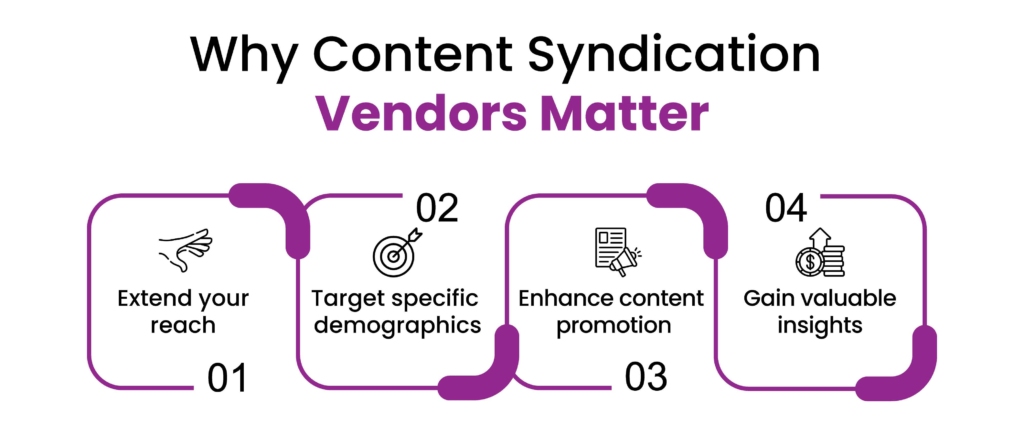
Why Content Syndication Vendors Matter
Here’s why vendors play an important role in B2B content syndication:
- Extend your reach
Content syndication vendors help distribute your content to a wider and more relevant audience.
- Target specific demographics
Advanced targeting allows you to reach decision-makers based on industry, job role, and company size.
- Enhance content promotion
Vendors use multiple channels such as email, platforms, and partner networks to increase visibility.
- Gain valuable insights
Campaign reporting and analytics help you understand performance and improve results.
Why B2B Content Syndication Vendors Matter in 2026? (Context + Research)
In B2B marketing, creating content is not enough – distribution is what drives real results.
If your content is not reaching the right decision-makers on the platforms they trust, you’re not just missing traffic – you’re missing pipeline.
B2B buyers now consume content across multiple channels before making decisions. Relying only on your website is rarely enough.
This is where content syndication vendors play a critical role. They help distribute your content across targeted platforms, ensuring it reaches the right audience at the right time.
Must Read: Different Types of B2B Content Syndication
What B2B Marketers Look for in Content Syndication Vendors
When choosing a content syndication vendor, most B2B marketers focus on a few key factors:
- Transparent pricing (CPL or CPQL)
- High-quality, intent-driven leads
- Reliable vendor performance
- Clear reporting and ROI visibility
Beyond just a list of vendors, the goal is to identify partners that can deliver qualified pipeline – not just form fills.
Evaluation Criteria for B2B Content Syndication Vendors
Not all content syndication vendors are the same. To compare them effectively, here are the key factors to consider:
1. Pricing & CPL Benchmarks
Check whether the vendor offers transparent pricing and if the cost per lead aligns with industry benchmarks.
2. Lead Quality & Validation
Ensure the vendor provides verified leads, removes duplicates, and offers replacement policies for invalid data.
3. Targeting Capabilities (Industry + Job + Geo)
Look for precise targeting options such as industry, job role, seniority, company size, and geographic location.
4. Compliance & Data Security
Confirm that the vendor follows GDPR/CCPA regulations and maintains proper consent records.
5. SLAs & Reporting
Choose vendors that provide clear delivery timelines, lead replacement terms, and detailed campaign reporting.
Top B2B Content Syndication Vendors (2026)
Below is a curated list of the top B2B content syndication vendors, evaluated based on lead quality, pricing, targeting capabilities, and overall campaign performance.
Each vendor offers different strengths – from high-quality lead generation to scalable campaign execution.
Explore the list below to find the right partner for your business.
How This 2026 Vendor Guide Compares to Other Lists
Most “top content syndication vendor” lists only provide basic information — often focusing on brand names rather than real performance factors like lead quality, pricing transparency, and ROI.
This guide takes a more practical approach by comparing vendors based on real decision-making criteria such as CPL benchmarks, targeting capabilities, intent data, and campaign performance.
| Competitor List | # of Vendors | Pricing / CPL | Pros & Cons | ABM / Intent | ROI Example | Depth | Why This Guide Is Better |
|---|---|---|---|---|---|---|---|
| CIENCE (Top 13) | 13 | No | No | No | No | Medium | Includes CPL benchmarks, ABM relevance & ROI model |
| Revnew (Top 10) | 10 | No | No | No | No | Shallow | Deeper vendor breakdowns with strengths, limits & use cases |
| Almohmedia (Top 20) | 20 | No | No | No | No | Very shallow | Focuses on quality, validation, targeting & compliance |
| Only-B2B Strategy Guide | No vendor list | Not vendor-specific | No | Yes (ABM-focused) | No | Strategy-focused | Combines strategy and vendor comparison in one place |
| Platform Lists (Outbrain / Taboola) | Platforms | No CPL clarity | No | Not B2B-specific | No | Weak for lead gen | Clearly explains platform vs vendor difference |
| This Guide (2026) | 10 vetted vendors | Yes | Yes | Yes | Yes (9x ROI) | Very deep | Most complete B2B-focused vendor guide for 2026 |
Quick Tip:
If you want high-quality leads → go with ABM-focused vendors
If you want volume → go with publisher networks
This comparison highlights why a deeper, evaluation-driven approach is essential when selecting a B2B content syndication partner in 2026.
What Is a B2B Content Syndication Vendor?
A B2B content syndication vendor helps distribute your content across targeted industry channels to reach decision-makers and generate qualified leads.
These vendors focus on lead generation using strategies like email outreach, publisher networks, intent data, and ABM targeting – typically on a cost-per-lead (CPL) model.
Types of B2B Content Syndication Vendors
There are four major types of B2B content syndication vendors:
Email-Based Vendors
Distribute your content to curated, opt-in email databases and capture leads from downloads or registrations.
Intent-Data Vendors
Use behavioral and intent signals to identify buyers actively researching topics related to your solution.
Publisher-Network Vendors
Own or partner with industry websites and publications where your content is promoted or gated.
ABM-Focused Vendors
Build campaigns around named account lists, buying committees, and account-based marketing strategies.
Each type works differently, but the goal is the same: deliver validated, compliant B2B leads that match your ICP.
Who Should Use B2B Content Syndication Vendors?
B2B content syndication vendors are ideal for:
- SaaS companies looking to generate consistent pipeline
- IT services and cybersecurity firms targeting decision-makers
- MarTech and AdTech companies scaling demand generation
- B2B businesses that want predictable, high-quality lead flow
They are especially useful if you:
- Need MQL generation at scale
- Want to expand into new markets or industries
- Don’t have the internal bandwidth to manage campaigns in-house
When Should You Choose a Vendor Instead of In-House Syndication?
Choose a content syndication vendor when:
- You need faster lead generation without long setup time
- You don’t have a large in-house marketing team
- You want predictable CPL and consistent MQL delivery
- You need advanced targeting (industry, accounts, or geography)
Working with the right vendor helps you scale campaigns faster, reach the right audience, and improve overall marketing performance.
Benefits of B2B Content Syndication Vendors
Working with the right content syndication vendor helps you generate qualified leads faster and scale campaigns efficiently.
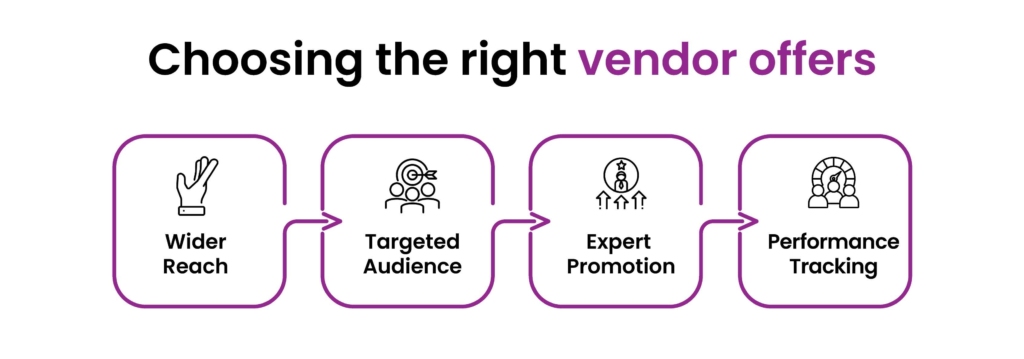
Key benefits include:
Wider reach and targeted audience access
Reach decision-makers across industries, job roles, and geographies through established distribution networks.
Improved content promotion
Leverage better positioning, premium placements, and publisher relationships for higher visibility.
Consistent lead generation
Generate a steady flow of qualified leads without relying only on inbound traffic.
Performance tracking and analytics
Access detailed reporting on campaign performance, lead quality, and ROI.
Scalability and efficiency
Run campaigns at scale without overloading your internal marketing team.
Challenges of Using B2B Content Syndication Vendors
While content syndication offers strong benefits, there are a few challenges to consider:
Cost
Advanced targeting, multi-channel distribution, and premium placements can increase CPL. It’s important to measure cost against pipeline impact and ROI.
Limited control
Outsourcing campaigns may reduce control over placements and messaging. Choosing vendors with transparent workflows helps manage this.
Vendor dependency
Switching vendors can be difficult if data, reporting, or campaign logic is locked into a platform. Look for flexible partners with clear data ownership.
How to Choose the Right Content Syndication Vendor in 2026
Choosing the right B2B content syndication vendor requires more than just selecting a well-known name.
While many vendors promise high-intent leads, only a few consistently deliver compliant, validated, and sales-ready opportunities.
Use the checklist below to evaluate vendors effectively and ensure your campaigns generate real ROI – not just lead volume.
Target Audience Reach (ICP Match)
The most important factor when choosing a content syndication vendor is whether they can reach your ideal customer profile (ICP).
Evaluate if the vendor’s network aligns with your target audience based on:
- Industry / vertical (SaaS, IT, cybersecurity, etc.)
- Job titles and seniority
- Company size
- Geography (US, EU, APAC)
A well-targeted audience ensures higher lead quality and better campaign performance.
Content Distribution Channels (Where Your Content Will Appear)
Not all content syndication vendors use the same distribution channels. Some rely on email databases, while others use publisher networks, paid placements, or intent-driven platforms.
When evaluating vendors, focus on:
- The channels they use for content distribution
- Whether those channels match your target audience and content type
- The credibility and authority of the platforms where your content will appear
The best vendors align their distribution strategy with your content format – whether it’s ebooks, reports, webinars, or case studies – to maximize reach and engagement.
Targeting Capabilities (Filters That Actually Matter)
Effective content syndication is not about mass distribution – it’s about precise targeting.
The best vendors use advanced filters to ensure your content reaches the right audience.
Key targeting capabilities to look for:
- Job title and seniority filters
- Industry and sub-industry targeting
- Company size and revenue segmentation
- ABM account list targeting
- Intent-based targeting (in-market behavior)
The more precise your targeting, the higher the lead quality — even if CPL is slightly higher, the ROI is significantly better.
Analytics and Reporting (Transparency)
A strong content syndication vendor should provide full visibility into campaign performance – not just a list of leads.
Key reporting capabilities to look for:
- Asset-level performance tracking
- Breakdown by region, industry, channel, or account segment
- Clear opt-in proof and lead validation data
- Tracking of lead replacements and delivery timelines
Transparent reporting allows you to optimize campaigns, improve lead quality, and scale results effectively.
Pricing and Features (CPL + What’s Included)
Pricing should be transparent, realistic, and aligned with your campaign goals.
When evaluating vendors, look beyond just cost per lead and focus on what’s actually included in the campaign.
Key factors to consider:
- CPL benchmarks by region (US/EU vs APAC)
- Lead replacement policy for invalid or non-compliant leads
- Lead validation process (duplicates, spam filtering, opt-in proof)
- CRM and marketing automation integrations
- Additional costs (setup, creative, targeting add-ons)
A lower CPL may look attractive, but true value comes from lead quality and conversion into pipeline.
Final Tip: Start With a Pilot Campaign
If you’re evaluating multiple vendors, avoid committing long-term right away. Start with a small pilot campaign to test performance before scaling.
Focus on key metrics such as:
- Lead quality (ICP fit)
- MQL to SQL conversion rate
- Sales team feedback
- Reporting transparency
- Lead replacement responsiveness
Once you identify a vendor that consistently delivers high-quality, sales-ready leads, you can scale your campaigns with confidence.
Top B2B Content Syndication Vendors (2026 Full Reviews)
Below is a curated list of the top B2B content syndication vendors, evaluated based on lead quality, pricing, targeting capabilities, and overall campaign performance.
Each vendor review highlights strengths, limitations, and ideal use cases to help you choose the right partner.
1. ContentSyndication.org
Best for: High-intent B2B lead generation
ContentSyndication.org distributes B2B content across high-authority platforms using a multi-channel strategy focused on reaching active buyers who are already researching solutions.
Key strengths:
- Multi-channel high-intent distribution
- Strong ICP targeting
- Conversion-focused placements
- Transparent reporting and analytics
Considerations:
- Premium service
- Requires strong content assets
2. Only B2B
Best for: B2B lead generation
Only B2B delivers targeted B2B leads through structured content syndication campaigns designed for consistent pipeline growth.
Key strengths:
- Strong targeting capabilities
- High-quality validated leads
- Flexible campaign execution
- Reliable delivery
Considerations:
- Custom pricing
- Works best with defined targeting
3. DemandScience
Best for: Enterprise demand generation
DemandScience provides data-driven content syndication with strong intent targeting and global reach.
Key strengths:
- Verified lead data
- Intent-based targeting
- Global campaigns
- Enterprise-grade solutions
Considerations:
- Higher pricing
- Complex onboarding
4. INFUSE
Best for: Global B2B campaigns
INFUSE specializes in delivering verified leads through multi-channel global syndication strategies.
Key strengths:
- High-quality leads
- Global reach
- Multi-channel execution
- Strong validation
Considerations:
- Premium pricing
- Requires structured campaigns
5. TechTarget
Best for: IT audience targeting
TechTarget connects vendors with IT decision-makers through highly targeted content platforms.
Key strengths:
- Strong IT audience
- High-intent leads
- Trusted platform
- Industry specialization
Considerations:
- Limited to tech niche
- Higher CPL
6. Madison Logic
Best for: ABM campaigns
Madison Logic focuses on account-based marketing with intent-driven syndication.
Key strengths:
- Strong ABM targeting
- Intent data integration
- High-quality leads
- Enterprise focus
Considerations:
- Expensive
- Complex execution
7. NetLine
Best for: Scalable campaigns
NetLine offers a large content distribution network designed for high-volume lead generation.
Key strengths:
- Wide distribution network
- Cost-effective scaling
- Easy campaign setup
- Good for volume
Considerations:
- Lead quality varies
- Requires filtering
8. 6sense
Best for: Predictive targeting
6sense uses AI and intent data to identify and target in-market buyers.
Key strengths:
- AI-powered insights
- Predictive analytics
- Advanced targeting
- High accuracy
Considerations:
- Requires expertise
- Premium pricing
9. Anteriad (True Influence)
Best for: Intent-driven campaigns
Anteriad combines intent data with multi-channel distribution strategies.
Key strengths:
- Intent-based targeting
- Multi-channel reach
- Flexible campaigns
- Data insights
Considerations:
- Needs optimization
- Moderate lead quality
10. Integrate
Best for: Lead validation
Integrate focuses on improving data quality and compliance.
Key strengths:
- Data accuracy
- Compliance-focused
- Lead validation
- Integration support
Considerations:
- Not a full syndication vendor
- Works best with partners
11. RollWorks
Best for: SMB ABM
RollWorks provides ABM-focused syndication solutions for small teams.
Key strengths:
- Easy to use
- Affordable
- ABM targeting
- Quick setup
Considerations:
- Limited features
- Medium lead quality
12. LeadSift
Best for: Intent-based lead discovery
LeadSift identifies buyers actively researching solutions.
Key strengths:
- Real-time intent data
- Strong targeting
- Buyer insights
- High relevance
Considerations:
- Smaller network
- Requires integration
13. Bombora
Best for: Intent data enrichment
Bombora provides intent data to enhance campaign targeting.
Key strengths:
- Strong data signals
- Market insights
- Improves targeting
- Widely used
Considerations:
- Not standalone
- Needs integration
14. Spiceworks
Best for: IT community
Spiceworks connects brands with an engaged IT audience.
Key strengths:
- Niche audience
- Community engagement
- Targeted campaigns
- Trusted platform
Considerations:
- Limited industries
- Medium scale
15. Foundry (IDG)
Best for: Premium tech audience
Foundry provides access to high-authority publishing networks.
Key strengths:
- Premium audience
- Strong credibility
- High-quality leads
- Industry authority
Considerations:
- Expensive
- Enterprise-focused
16. Datamatics Business Solution
Datamatics Business Solutions combines B2B content syndication with proprietary intent data and buying group acquisition, helping teams generate BANT-qualified leads instead of just form fills. With nearly five decades in data and businessoperations, DBSL blends AI-driven data accuracy with human-verified lead qualification across content syndication, appointment setting, and partner marketing programs.
Key strengths:
- BANT-qualified lead delivery
- Buying group and account-level targeting (AIBM)
- Strong data accuracy (95%+) feeding every campaign
- Global delivery across North America, EMEA, and APAC
Considerations:
- Best suited for mid-market to enterprise campaigns
- Full value comes through when paired with their data enrichment services
Looking for High-Quality B2B Leads?
Get a custom content syndication plan designed for your ICP, industry, and campaign goals.
Get Your Custom Plan →Other Notable B2B Content Syndication Vendors in 2026
In addition to the top vendors listed above, several other platforms offer specialized content syndication and demand generation capabilities:
- CIENCE – Combines outbound prospecting with AI-driven intent data to identify high-intent B2B buyers.
- Revcontent – Native advertising platform focused on content distribution across premium publisher networks.
- Zemanta – Programmatic content syndication platform with real-time bidding and advanced campaign optimization.
- Nativo – Native advertising solution that delivers personalized content experiences across multiple channels.
- ViB Syndication – B2B-focused pay-per-lead syndication provider targeting high-tech and enterprise audiences.
These vendors can be useful for specific use cases such as programmatic distribution, native advertising, or outbound-driven lead generation strategies.
B2B Content Syndication Pricing in 2026 (CPL Benchmarks)
Pricing in B2B content syndication varies based on geography, targeting depth, industry, and campaign complexity. Setting realistic CPL expectations is essential for planning high-performing campaigns.
Typical CPL Ranges (2026)
- US & EU: $35 – $60 per MQL
- APAC: $20 – $40 per MQL
- Global average: $25 – $50 per MQL
These benchmarks typically apply to validated, opt-in leads. Advanced targeting – such as C-level audiences, niche industries, or strict ABM filters – can increase CPL, but often results in significantly higher lead quality and conversion rates.
ROI Calculator Example (9x ROI Model)
Want to calculate your exact ROI?
Try our Content Syndication ROI Calculator to estimate your pipeline potential.
Here’s a simple example to understand how content syndication drives revenue:
Example Campaign ROI
If your budget is $10,000 and your CPL is $40, you can generate:
- Leads (MQLs):
$10,000 ÷ $40 = 250 MQLs
Now apply typical B2B conversion rates:
- MQL → SQL (25%)
250 × 0.25 = 62 SQLs
- SQL → Deal (10%)
62 × 0.10 = 6 Deals
Now calculate revenue:
- Average Contract Value (ACV): $15,000
6 × $15,000 = $90,000 Revenue
ROI Result
- $90,000 revenue from a $10,000 campaign
- That’s a 9x ROI from a single content syndication program.
How to Pick the Right Vendor for Your Business
Choosing the right B2B content syndication vendor isn’t about selecting the biggest name – it’s about finding a partner that consistently delivers ICP-matched, compliant, sales-ready leads aligned with your business goals.
Key Questions to Ask in Your RFP
Use these questions to evaluate vendors before signing any contract:
- What is your lead replacement policy?
(How many days? What qualifies? Is it documented?) - How do you validate leads?
(Duplicate removal, email verification, job-title validation, etc.) - Can you target specific job roles, industries, and company sizes?
(Ask for real campaign examples.) - What are your CPL benchmarks across regions (US, EU, APAC)?
(Understand what impacts pricing and quality.)
Additional Questions for Advanced Evaluation
- Do you provide opt-in proof and consent tracking?
- Can you execute ABM account-based targeting?
- What level of reporting is included (asset-level, channel-level, cadence)?
- How do you prevent irrelevant or competitor leads?
Red Flags to Watch Out For
Avoid vendors that show these warning signs:
- No clear CPL benchmarks or pricing transparency
- Leads delivered without verified opt-in proof
- No written SLA for replacements
- Generic targeting without ICP alignment
- Limited visibility into campaign performance
If a vendor cannot clearly explain how they generate, validate, and deliver leads – it’s a risk to your budget and pipeline.
Additional Resources and Considerations
Free Content Syndication Platforms
If you’re not ready to invest in paid vendors, you can start with free distribution channels:
- Medium
- LinkedIn (articles and newsletters)
- SlideShare
- Relevant industry communities
These platforms won’t guarantee MQL delivery, but they are useful for building visibility and testing what content resonates with your audience.
Content Quality Still Matters Most
No vendor can compensate for weak content. To drive real results, your content should be:
- Insightful and specific (avoid generic messaging)
- Aligned with your ICP’s pain points
- Designed for conversion (strong headline, clear CTA, optimized landing page)
Track and Analyze Performance
Measure success beyond just “leads delivered.” Focus on metrics such as:
- MQL → SQL conversion rate
- SQL → Deal conversion rate
- Pipeline influenced
- Cost per opportunity (CPO)
- Lead-to-meeting rate
- Sales feedback on lead quality
Use vendor analytics along with your CRM and tools like GA4 or HubSpot to evaluate true ROI.
Frequently Asked Questions (FAQs)
What is a B2B content syndication vendor?
A B2B content syndication vendor is a company or platform that helps distribute your marketing content across targeted channels, ensuring it reaches relevant decision-makers and generates high-quality leads for your business.
Why should I use a content syndication vendor instead of doing it myself?
Vendors have access to established networks, advanced targeting capabilities, and robust analytics tools. While DIY syndication on platforms like LinkedIn or Medium is useful, vendors can scale efforts, improve lead quality, and offer multi-channel amplification.
Who are the best B2B content syndication vendors in 2026?
The best vendors vary by region and industry, but our top picks include those with transparent CPL models, validated leads, and strong ABM capabilities.
How is content syndication different from paid advertising?
Paid ads often focus on clicks and impressions, while content syndication emphasizes engagement and lead generation through educational or informational content placed on relevant platforms. It’s a longer-term strategy focused on nurturing interest.
How do I measure the success of my syndicated content?
Key performance indicators (KPIs) include:
- Impressions and click-through rates (CTR)
- Engagement metrics (time on page, shares)
- Leads generated and conversion rates
- Cost per lead (CPL)
- ROI from sales attribution
Vendors usually offer dashboards or reports to help track this data.
Is content syndication suitable for all B2B industries?
Yes, but it’s especially effective in industries with long sales cycles, such as SaaS, tech, cybersecurity, and finance. The key is ensuring your content is tailored to your audience’s pain points and decision journey.
How much do content syndication vendors charge?
Average CPL ranges from $25 to $60 depending on geography, targeting, and content type.
Are content syndication vendors good for ABM campaigns?
Yes, many top vendors now offer account-based targeting, integrating intent data and buyer personas.
How do I choose the best vendor for my business needs?
Focus on:
- Audience match (industry, seniority, region)
- Targeting precision (intent data, ABM support)
- Analytics and transparency
- Cost and scalability
- Customer reviews and case studies
Your vendor should align with your growth goals and marketing maturity.
Are there any free content syndication sites I can use before choosing vendors?
Yes. You can start with free content syndication platforms such as LinkedIn Articles, Medium, SlideShare, Reddit communities, bookmarking sites, and RSS directories.
These help with SEO, awareness, and backlinks, but they do not provide guaranteed MQL volume or CPL-based leads.
If you want predictable, sales-ready leads, you’ll eventually need paid B2B syndication vendors.
Is content syndication software the same as a B2B content syndication vendor?
- Content syndication tools/software help your team republish content, manage workflows, or distribute articles (example: Kapost, NewsCred, repubHub).
- B2B content syndication vendors deliver qualified leads, validate data, run paid campaigns, and target specific accounts.
Most companies use both – tools for republishing, vendors for lead generation.
Are content syndication leads GDPR compliant?
Reputed vendors provide opt-in proof and follow GDPR/CCPA guidelines. Always verify compliance before running campaigns.
Final Thoughts on B2B Content Syndication Vendors (2026)
The right content syndication partner can be the difference between building a predictable pipeline of qualified MQLs – or wasting budget on leads that never convert.
This guide covered the top B2B content syndication vendors in 2026, along with their strengths, targeting capabilities, pricing benchmarks, and ROI potential – so you can make a confident, data-driven decision.
If you’re planning to invest in content syndication, start with a clear ICP, test vendors with pilot campaigns, and focus on lead quality over volume.
Want to estimate your potential ROI? Use our Content Syndication ROI Calculator to plan your campaign more effectively.