
In 2026, most B2B teams publish blogs, eBooks, reports, and webinars-but consistent reach to the right decision-makers is still hard. That’s where B2B content syndication platforms help: not by publishing more, but by distributing your assets through the right channels (social, search, video, native discovery, communities, and sponsorships).
This guide compares the top B2B content syndication distribution channels in 2026-what each is best for, where it fits in the funnel (TOFU/MOFU/BOFU), and how difficult tracking typically is.
Note: This page covers distribution channels (CPC/CPM/CPV). For CPL-based lead-delivery vendors, see our B2B content syndication vendors list.
If you’re new to the concept, read our complete B2B Content Syndication (2026 Guide) first.
Quick Comparison Table: B2B Content Syndication Platforms – 2026
Here’s a fast overview of common platform types. Use this as a shortlist before you deep-dive.
Tip: Use this table to pick 1 intent channel (Search/LinkedIn) + 1 scale channel (YouTube/Native), then add retargeting later.
| Platform | Channel Type | Best For | Best Funnel Stage | Targeting Depth | Tracking Effort | Pricing Model (Typical) |
|---|---|---|---|---|---|---|
| LinkedIn Ads (Lead Gen + Document Ads) | Social | ABM reach + decision-maker targeting | MOFU | ABM-grade | Medium | CPC/CPM |
| Google Search | Search | High-intent demand capture | MOFU/BOFU | Strong | Easy | CPC |
| YouTube | Video | Education + account warming | TOFU/MOFU | Strong | Medium | CPV/CPC |
| Outbrain / Taboola | Native Discovery | Scaled content distribution | TOFU | Medium–Strong | Medium–Hard | CPC |
| Reddit / Quora | Community & Q&A | Niche intent + category education | TOFU/MOFU | Medium | Medium | CPC (often low–mid) |
| Newsletter Sponsorships | Sponsorship | Trust transfer + qualified clicks | MOFU | Medium | Medium | Flat fee / sponsorship |
Top B2B Content Syndication Platforms in 2026 (Best Use Cases)
1) LinkedIn Ads (Lead Gen + Document Ads)
- Best for: High-quality B2B targeting + ABM account reach
- Targeting: Job title, seniority, skills, company, industry, retargeting, matched audiences
- Best assets: Reports, playbooks, benchmark PDFs, webinars
- Pros: Unmatched B2B targeting; strong mid-funnel performance
- Watch-outs: Costs can be high; requires strong creative + offer
- Syndication fit: Distribution channel (not a lead-delivery vendor)
- Attribution: Lead-form (if using Lead Gen Forms) + click-level (if landing page)
- Best gating: Lead Gen Form / Document Ad → thank-you page + nurture
2) YouTube (Video + Demand Capture)
- Best for: Building demand + warming accounts before conversion
- Targeting: Topics, custom intent, placements, remarketing
- Best assets: Short explainer videos, webinar trailers, case-study stories
- Pros: Scales awareness + retargeting pools fast
- Watch-outs: Needs video discipline; optimize the view-to-conversion path
- Syndication fit: Distribution channel
- Attribution: Click-level + view-through (less clean than search)
- Best gating: Video → landing page → download/webinar registration
- Best CTA: “Watch 60-sec explainer” / “Get the benchmark report” (video → offer alignment)
3) Google Search (High-intent distribution)
- Best for: Capturing active demand for pain-point queries
- Targeting: Keywords + audiences + remarketing lists
- Best assets: Landing pages, “download the guide” offers, comparison pages
- Pros: Highest intent traffic when aligned with query
- Watch-outs: Costs spike in competitive SaaS categories; landing page must be tight
- Syndication fit: Distribution channel
- Attribution: Click-level (cleanest)
- Best gating: High-intent landing page + short form
4) Outbrain (Native Content Discovery)
- Best for: Top-of-funnel distribution at scale
- Targeting: Contextual + audience targeting (varies by setup)
- Best assets: Thought-leadership articles, research reports
- Pros: Strong reach; good CPC efficiency
- Watch-outs: Lead quality varies; requires strict placement controls + filtering
- Syndication fit: Distribution channel
- Attribution: Click-level (lead-level depends on your funnel)
- Best gating: Native → content hub → retarget → gated offer
5) Taboola (Native Content Discovery)
- Best for: Efficient content amplification + retargeting pipeline
- Targeting: Contextual, audience, retargeting
- Best assets: Guides, reports, “learn more” content hubs
- Pros: Massive inventory; good for scale
- Watch-outs: Can drift into low-intent clicks without placement exclusions and ongoing optimization.
- Syndication fit: Distribution channel
- Attribution: Click-level
- Best gating: Native → pre-sell page → gated asset (or webinar)
6) Reddit Ads (Community Targeting)
- Best for: Niche tech audiences + category education
- Targeting: Subreddits, interests, keywords (capabilities vary)
- Best assets: Trend reports, technical explainers, AMA/webinar invites
- Pros: Hyper-relevant communities; great for early demand creation
- Watch-outs: Messaging must be non-salesy; comments can impact perception
- Syndication fit: Distribution channel
- Attribution: Click-level (brand/community impact is often indirect)
- Best gating: Post → lightweight landing page → optional gate
7) Quora Ads (Intent-by-question + Education)
- Best for: Capturing intent around “how to / best tool / vs” queries
- Targeting: Topics, questions, interests, retargeting
- Best assets: Checklists, comparison guides, short reports
- Pros: Great for mid-funnel education; sticky intent context
- Watch-outs: Needs crisp positioning; keep landing friction low
- Syndication fit: Distribution channel
- Attribution: Click-level
- Best gating: Answer-aligned landing page → short form → gated asset
8) Meta (Facebook/Instagram) for Retargeting Distribution
- Best for: Retargeting visitors into downloads + webinar sign-ups
- Targeting: Lookalikes, retargeting, interest stacks
- Best assets: Light lead magnets, webinar registrations, short checklists
- Pros: Cheap remarketing reach; strong for nurturing sequences
- Watch-outs: Cold B2B targeting weak vs LinkedIn; use mainly for retargeting
- Syndication fit: Distribution channel
- Attribution: Click-level + view-through (mixed)
- Best gating: Retarget → fast landing page → short form
9) Programmatic Display (ABM Retargeting)
- Best for: Account-based air cover + multi-touch influence
- Targeting: Account lists, intent audiences, retargeting
- Best assets: Case studies, category POV, analyst-style reports
- Pros: Supports sales cycles; consistent presence across accounts
- Watch-outs: Attribution is messy; requires disciplined measurement
- Syndication fit: Distribution channel
- Attribution: Account-level influence (not clean last-click)
- Best gating: Role-based landing pages + nurture (multi-touch)
10) Newsletter Sponsorships (B2B Creator + Media)
- Best for: Mid-funnel credibility + qualified clicks from a known audience
- Targeting: Audience fit selection (by publisher/creator)
- Best assets: Benchmark report, “download kit”, webinar invite
- Pros: Trust transfer; strong engagement when audience-match is right
- Watch-outs: Must vet audience + past sponsor performance
- Syndication fit: Distribution channel
- Attribution: Click-level (UTMs)
- Best gating: Sponsorship link → dedicated landing page
11) Webinar/Event Listing Platforms (Distribution via Registrations)
- Best for: Driving webinar registrations and warming leads
- Targeting: Category/industry/event audience targeting (varies)
- Best assets: Webinars, workshops, product education sessions
- Pros: High engagement format; strong lead depth
- Watch-outs: Attendance rates vary; need reminder + nurture flows
- Syndication fit: Distribution channel
- Attribution: Lead-level (registrations)
- Best gating: Registration-first → reminders → post-webinar nurture
12) Content Recommendation Widgets / On-site Personalization (Your own)
- Best for: Turning site traffic into downloads without extra ad spend
- Targeting: Behavioral segmentation, page intent, firmographics (if available)
- Best assets: Role-based guides, industry kits, case studies
- Pros: Compounds over time; improves conversion rates
- Watch-outs: Needs solid content library + simple UX
- Syndication fit: On-site distribution layer (owned)
- Attribution: Click + conversion tracking (clean)
- Best gating: Contextual recommendations → short form → nurture
How to Choose the Right Channel (5-point checklist)
Choose your distribution channel based on these 5 factors:
- Targeting fit: Do you need ABM/job-title precision (LinkedIn) or low-cost scale (native discovery)?
- Asset type: Reports & PDFs (LinkedIn/native) vs webinars (events/YouTube).
- Funnel stage: TOFU reach (native/YouTube) vs MOFU capture (Search/LinkedIn).
- Tracking requirements: If you need clean attribution, lean Search/LinkedIn + strict UTMs + dedicated landing pages.
- Quality control: Use placement exclusions, frequency caps, and post-click lead validation.
Use These Platforms When… (Quick Decision Guide)
- Use LinkedIn when: you need ABM / job-title precision and higher lead quality (especially for mid-funnel offers).
- Use Google Search when: you want high-intent downloads from buyers actively searching for solutions.
- Use YouTube when: you need education + account warming before conversion, and want to build retargeting pools fast.
- Use Outbrain/Taboola when: you want TOFU scale and can manage placements, exclusions, and creative testing carefully.
- Use Reddit/Quora when: your ICP lives in niche conversations and you can educate before you “sell.”
- Use Meta when: you already have site traffic and want cost-effective retargeting to push downloads/webinar sign-ups.
Tip: Start with 1 “intent” channel (Search/LinkedIn) + 1 “scale” channel (YouTube/Native), then add retargeting (Meta) after you have traffic.
Avoid (or be careful) when…
- Your ICP, offer, or landing page isn’t clear (unclear message = low-quality clicks + poor conversion).
- UTMs and conversion events aren’t set up (you won’t know what’s working).
- You expect instant SQLs without nurture or scoring (most channels create MQLs first).
- You can’t manage placement quality (especially native + community traffic-use exclusions, moderation, and QA).
Quick fix: Start small, test 1-2 channels, and scale only after you’ve validated conversion + lead quality
Platform Execution Tips (That Improve Lead Quality)
- Match the asset to the channel: Reports/playbooks → LinkedIn + native; webinars → YouTube + event listings; high-intent offers → Search.
- Use channel-specific creatives: 1 core idea, 3 angles, and a clear outcome promise (avoid generic “Download now”).
- Track properly: Strict UTMs, separate landing pages per channel, and conversion events (download, registration, demo click).
- Retarget smartly: Add a second touch (Meta/LinkedIn retargeting) to lift conversions and filter low-intent traffic.
- Validate leads: Require key fields (role, company size, region) and route by qualification (MQL rules + CRM mapping).
Why Use B2B Content Syndication Platforms for Your Marketing?
According to Demand Gen (2024), over 74% of B2B marketers rely on content syndication to generate consistent, high-quality leads.
Let’s face it-organic reach on your own website can be a slow climb. Content syndication helps you bridge the gap by distributing your best assets across high-traffic channels like industry publications, discovery platforms, communities, and paid distribution networks.
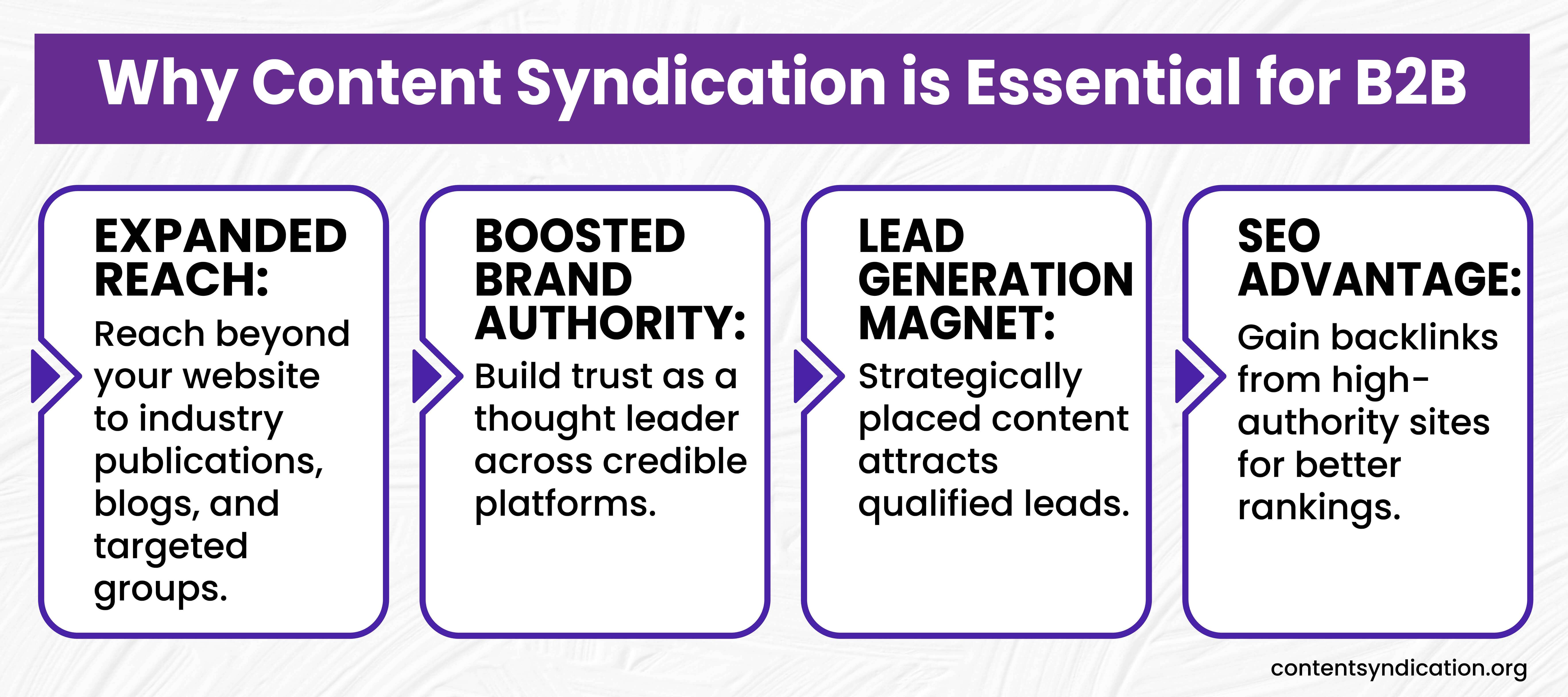
1) Expanded Reach (Beyond Your Website)
Instead of relying only on your site traffic, syndication helps your content appear where your buyers already spend time-industry publications, high-authority sites, newsletters, and relevant communities. This expands visibility and introduces your brand to new, highly relevant audiences.
2) Boosted Brand Authority
Consistent presence across credible, niche platforms builds trust. When buyers see your insights repeatedly in the right places, you’re positioned as a thought leader-not just another vendor.
3) Lead Generation (Qualified Demand)
Think of your content as a high-value offer placed directly in front of the right decision-makers. With the right targeting and offer alignment, syndication turns your reports, guides, and webinars into lead magnets that attract prospects who are ready to engage.
4) SEO Advantage (Backlinks + Visibility)
Syndication can also support SEO when done correctly-especially through mentions and backlinks from high-authority sites. Over time, that improves domain trust and can lift organic visibility.
Must Read: Types of B2B Content Syndication
Types of B2B Content Syndication Platforms (By Channel Category)
Pros & Cons by Platform Category
Use this quick breakdown to understand which channel category fits your goal-reach, intent, ABM precision, or community trust.
| Category | Pros | Cons |
|---|---|---|
| Industry-Specific Portals | High relevance; trusted niche audiences | Limited scale; can be costlier per lead |
| Native Discovery (Outbrain/Taboola) | Massive reach; fast top-of-funnel scale | Lower intent; needs retargeting + placement controls |
| Social (LinkedIn) | Precise B2B targeting; ABM-friendly | Higher costs; creative + offer quality matters |
| Communities/Q&A (Reddit/Quora) | Niche intent + trust building; strong education fit | Requires careful messaging and consistency |
Not all platforms are created equal. Here’s a breakdown of the diverse playing field:
1) Social Distribution Platforms
Best for: ABM + job-title targeting + high-quality leads
Examples: LinkedIn (primary), Meta (mainly for retargeting)
Use when: You need to reach specific roles/companies with precise targeting and want higher lead quality.
2) Native Content Discovery Platforms
Best for: TOFU scale + low CPC content reach
Examples: Outbrain, Taboola
Use when: You want to distribute content at scale for awareness/traffic and can optimize placements for quality.
3) Search + Video Promotion Platforms
Best for: Demand capture + audience warming
Examples: Google Search, YouTube
Use when: You want to capture high-intent queries or educate prospects via video before conversion.
4) Community And Q&A Platforms
Best for: Niche targeting + education-led conversions
Examples: Reddit, Quora
Use when: You want to capture “why/which/how” intent, build trust, and convert through helpful, non-salesy content.
5) Newsletter & Media Sponsorship Platforms
Best for: Trust transfer + qualified clicks
Examples: Industry newsletters, creator newsletters, niche publications
Use when: Your ICP is concentrated in specific newsletters/media and you want credibility-driven traffic.
How to Choose the Best Content Syndication Platform
What the Data Says
- 78% of B2B buyers used white papers to research purchasing decisions in the past year-higher than any other content format. (DemandGen, 2024)
- White paper downloads convert at ~7% to sales opportunities, compared to 4% for blog subscribers and 3% for webinar attendees. (MarketingSherpa)
- Average B2B CPL ranges from $65–$250 depending on channel and industry; content syndication often offers strong ROI vs. ads. (LeadSpot, 2026)
There’s no one-size-fits-all “best” platform. Consider these factors –
a) Cost-Effectiveness –
Are you a penny-pinching pioneer or a spendthrift seeker of reach? Understand your budget boundaries. Pricing models like per-placement, subscription fees, or revenue share each waltz to a different financial tune.
Do your research, compare deals, and find the platform that offers the most bang for your buck without breaking the bank.
b) Reach and Targeting –
Prioritize platforms that align with your target audience’s online behavior and offer precise targeting options.
c) Lead Generation Potential –
Is your aim to woo leads or just flirt with eyeballs? Pick a platform that’s not just a charmer, but a closer too. Look for platforms with built-in lead capture forms or seamless CRM integration.
Turn those fleeting glances into lasting relationships with qualified leads eager to commit. Choose platforms with built-in lead capture forms or strong integration with your CRM for seamless lead generation.
d) Specific Features –
Don’t just fall for a pretty face. Your platform should be feature-rich and compatible with your content type. Videos need smooth embedding, data-driven insights crave advanced analytics, and long-form articles require platforms that cater to their depth.
Find a platform that speaks the language of your content and complements its strengths.
Masterminding Your Syndication Strategy –
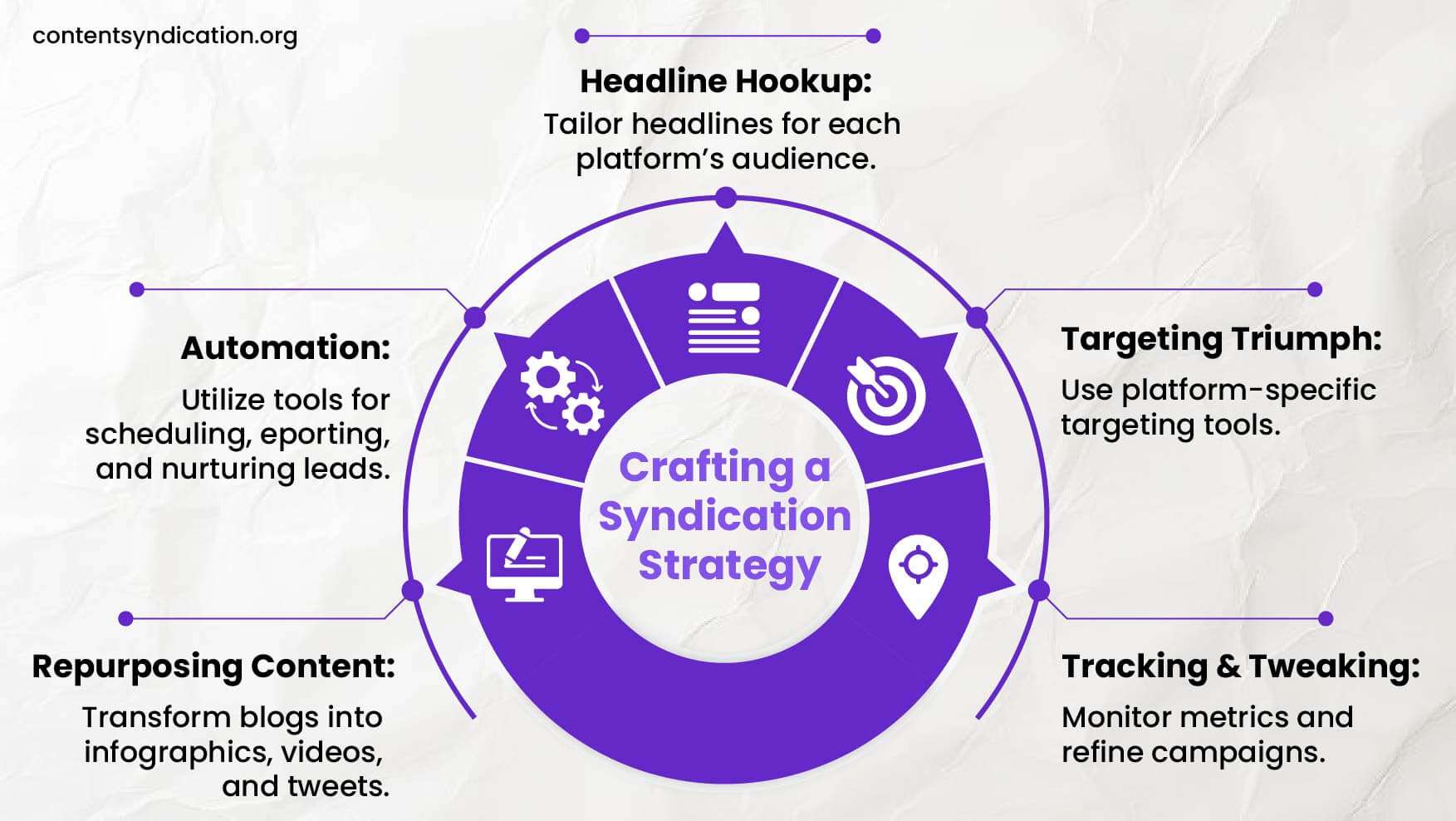
You’ve found your perfect platform match, congratulations! Now, let’s turn up the volume and make your content scream across the digital streets. Here’s your playbook for platform prowess:
a) Headline Hookup –
Craft platform-specific headlines like irresistible clickbait for thirsty readers. Twitter wants snappy wit, LinkedIn craves authority, and Reddit thirsts for intrigue. So, play the platform, and watch those clicks come a-knocking!
b) Targeting Triumph –
Don’t let your content wander aimlessly. Use laser-focused targeting options to reach your ideal audience like a heat-seeking missile.
LinkedIn demographics? Reddit communities? Forums by industry? Choose wisely, and watch your content hit its bullseye.
c) Tracking & Tweaking Tango –
Numbers don’t lie, my friend. Monitor clicks, shares, and leads like a hawk. Then, based on their whispers, refine your targeting, tweak your headlines, and optimize your campaigns for a victory dance!
d) Repurposing & Cross-Promotion Rhapsody –
Breathe new life into your content like a musical maestro! Turn blog posts into infographics for Reddit, videos for LinkedIn, and bite-sized tweets for Twitter. Then, cross-promote your masterpieces across platforms, creating a symphony of engagement.
e) Automation is Your Automated Ally –
Don’t drown in manual chores! Integrate your platform with your marketing automation tools like a tech-savvy wizard. Scheduling, reporting, and lead nurturing can all be automated, freeing your time to craft your next content masterpiece.
Remember, B2B content syndication is a powerful tool, but effective execution requires clear goals, platform-specific optimization, and continuous improvement. By embracing these strategies, you can transform your content into a magnet for qualified leads and amplify your brand voice across the B2B landscape.
Frequently Asked Questions (FAQ)
1. Which are the best B2B content syndication platforms in 2026 for lead generation?
The best B2B content syndication platforms in 2025 include LinkedIn Pulse, Outbrain, Taboola, NetLine, TechTarget, and MediaPost.
These platforms allow B2B marketers to distribute eBooks, whitepapers, and webinars to verified audiences of decision-makers, helping generate high-intent and sales-ready leads.
2. How do B2B content syndication platforms generate qualified leads?
B2B content syndication platforms promote your gated content across trusted industry sites and capture lead details through forms.
These leads are then filtered by job title, company size, and intent signals, ensuring only qualified prospects reach your CRM or marketing automation platform.
3. Are B2B content syndication platforms better than LinkedIn Ads?
LinkedIn Ads are great for visibility and brand awareness, while content syndication platforms offer higher intent leads at a lower average CPL (Cost-Per-Lead).
Ideally, both should complement each other — run awareness on LinkedIn, and use syndication for lead capture.
4. Is content syndication effective for SaaS and Tech companies?
Yes, 100%. SaaS and tech companies use content syndication to promote whitepapers, case studies, and product demos directly to IT and business decision-makers.
It helps fill the sales pipeline faster and supports Account-Based Marketing (ABM) campaigns effectively.
5. What’s the average cost per lead (CPL) for content syndication in 2026?
The average B2B CPL ranges from $65 to $250, depending on factors like industry, job seniority, region, and targeting depth.
Platforms like LinkedIn tend to be costlier but more precise, whereas Outbrain or Taboola offer lower CPL but broader audiences.
6. How do I choose the right B2B content syndication platform?
Choose a platform that aligns with your target audience, budget, and lead quality goals.
Look for verified databases, CRM integration, and detailed reporting. Always test campaigns for 2-3 weeks before scaling your spend.
7. Can content syndication be used for ABM (Account-Based Marketing) campaigns?
Absolutely. Modern B2B content syndication platforms allow account-level targeting based on firmographics and technographics.
You can align syndication lists with your ABM accounts to reach key decision-makers inside specific companies.
8. What type of content performs best on syndication platforms?
High-value gated assets like whitepapers, eBooks, industry reports, webinars, and case studies perform best.
Make sure your content solves a problem and provides actionable insights – this increases engagement and lead-to-pipeline conversion.
9. Are there free or low-cost B2B content syndication options?
Yes. Platforms like Reddit, Quora, and Medium can be used for free organic syndication.
You can also post on niche forums or LinkedIn groups to reach targeted professionals without spending on ads.
10. What KPIs should I track for B2B content syndication success?
Track metrics such as CPL, lead quality score, MQL-to-SQL conversion rate, engagement rate, and ROI.
These KPIs help you identify which platforms deliver the best performance and where to optimize future campaigns.
Conclusion –
Now that your content has a map to the promised land of amplified reach and booming leads, it’s time to set sail. Craft headlines that lure, target your audience like a laser, and track your success like a hawk.
Repurpose, cross-promote, and automate like a tech-savvy captain. By embracing these strategies in 2026, your B2B content won’t just survive, it will thrive, conquering new seas and leaving a trail of loyal customers in its wake. Bon voyage, B2B content captain!
Must Read: Top Content Syndication Metrics Every Marketer Should Track